Press | Symphonic Reviews

Music: Verein Revisited, With Jan DeGaetani
Monday, September 14, 1987
By Michael Kimmelman
In 1918, Schoenberg founded the Verein für Musikalisch Privataufführungen, a society devoted to the presentation of contemporary music from Mahler and Strauss onward. Admission to the society’s concerts was by subscription only; critics were not invited, and rehearsal time was ample. Berg, Webern and other composers active after the First World War belonged to the society, which became one of Austria’s most distinguished cultural institutions until its demise in 1923.
The society employed pianists and then chamber ensembles for its concerts, so among the central occupations of members became the transcription of orchestral scores for smaller forces. Dozens of works were rearranged, sometimes by the composers themselves.
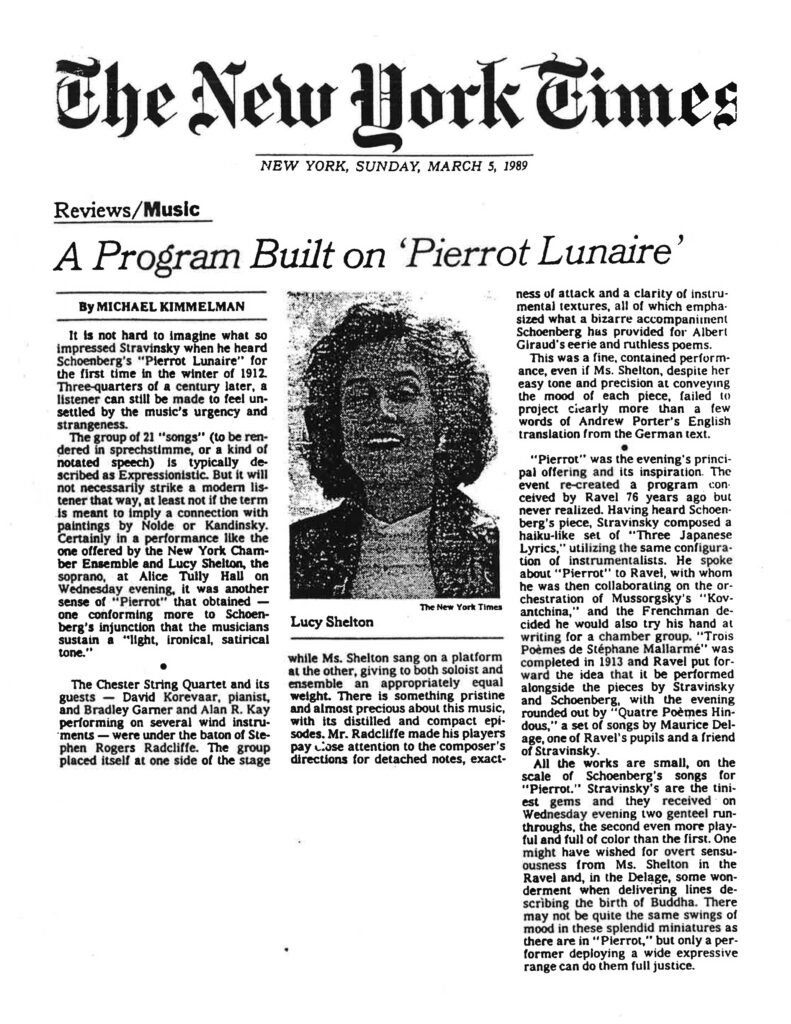
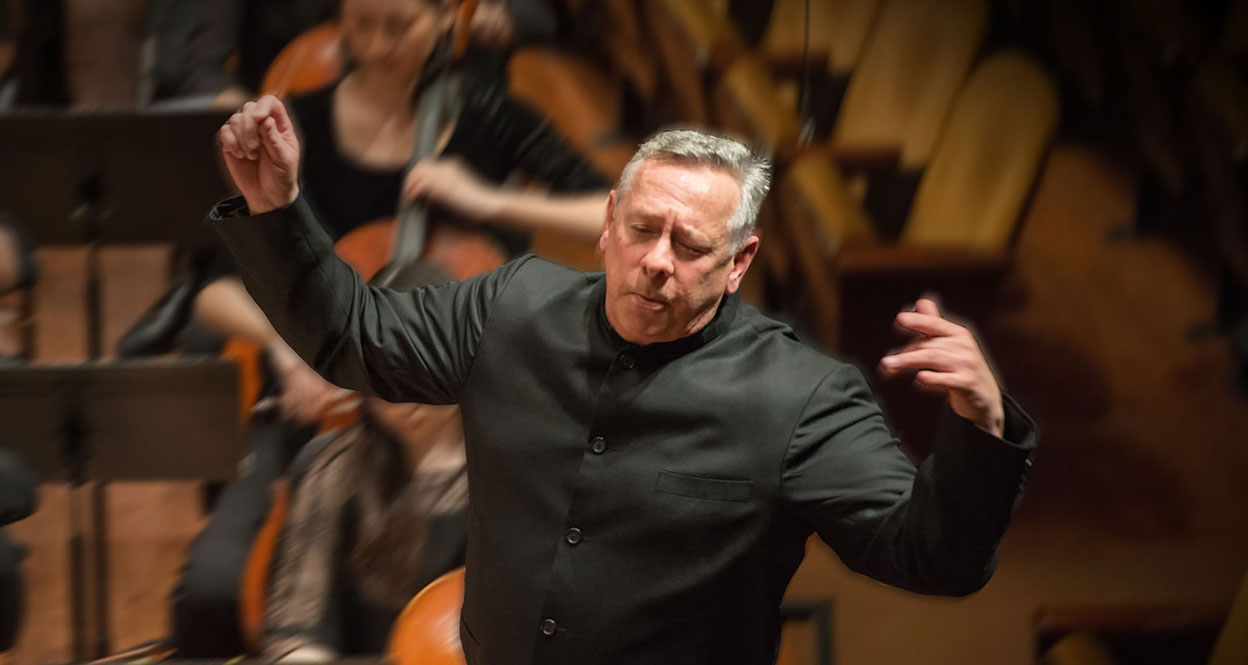
Saturday evening’s engaging program at Alice Tully Hall by the New York Chamber Ensemble was the first in a series of concerts entitled “Music of the Verein Revisited.” The performing ensemble, which incorporated the Fine Arts Quartet, the New York Woodwind Quintet and a handful of others, played works by Debussy, Schoenberg and Mahler. Stephen Rogers Radcliffe conducted, and the mezzo-soprano Jan DeGaetani was soloist.
Debussy’s “Prelude to the Afternoon of a Faun,” transcribed by Hanns Eisler, opened the program. Performed by 11 players, including the pianist Ursula Oppens, the work sounded less plush and colorful than usual, with the winds gaining even more prominence and the strings receding into the background. Still, the benefits of hearing a piece such as this stripped to the bone became apparent: textures were clear and there was no blanket of sound covering up the musical machinery.
Miss DeGaetani next rendered three sets of songs: Schoenberg’s “Vier Lieder” (Op. 22), arranged by Felix Greissle; Schoenberg’s “Gurre-Lieder,” arranged by the composer; and Mahler’s “Rückert Lieder,” transcribed by Philip West. Again, the music was on a scale that drew the listener to it and allowed small details to gain prominence. It also suited the temperament of the evening’s soloist, who did not have to battle large numbers of instrumentalists to make herself heard.
Throughout, Miss DeGaetani offered performances of exactitude, purity and elegance. Words meant something to Ms. DeGaetani; tones were struck clearly and precisely. She created an atmosphere of rapt concentration, and she sang in beautifully constructed, carefully measured phrases. In particular, the final lines of Mahler’s “Ich Bin der Welt Abhanden Gekommen” were spun out in silken tones.
Mr. Radcliffe served ably as partner without drawing from his players quite the same level of refinement. His best work of the evening came during an unusually spirited and thoughtful version of Schoenberg’s “Kammersymphonie” (Op. 9), which closed the program.
Future performances in the four-concert Verein series by the New York Chamber Ensemble are scheduled for Jan. 15, Feb. 6 and April 8 at Alice Tully Hall.