
Skip to content

Press | Symphonic Reviews

The New York Times Logo

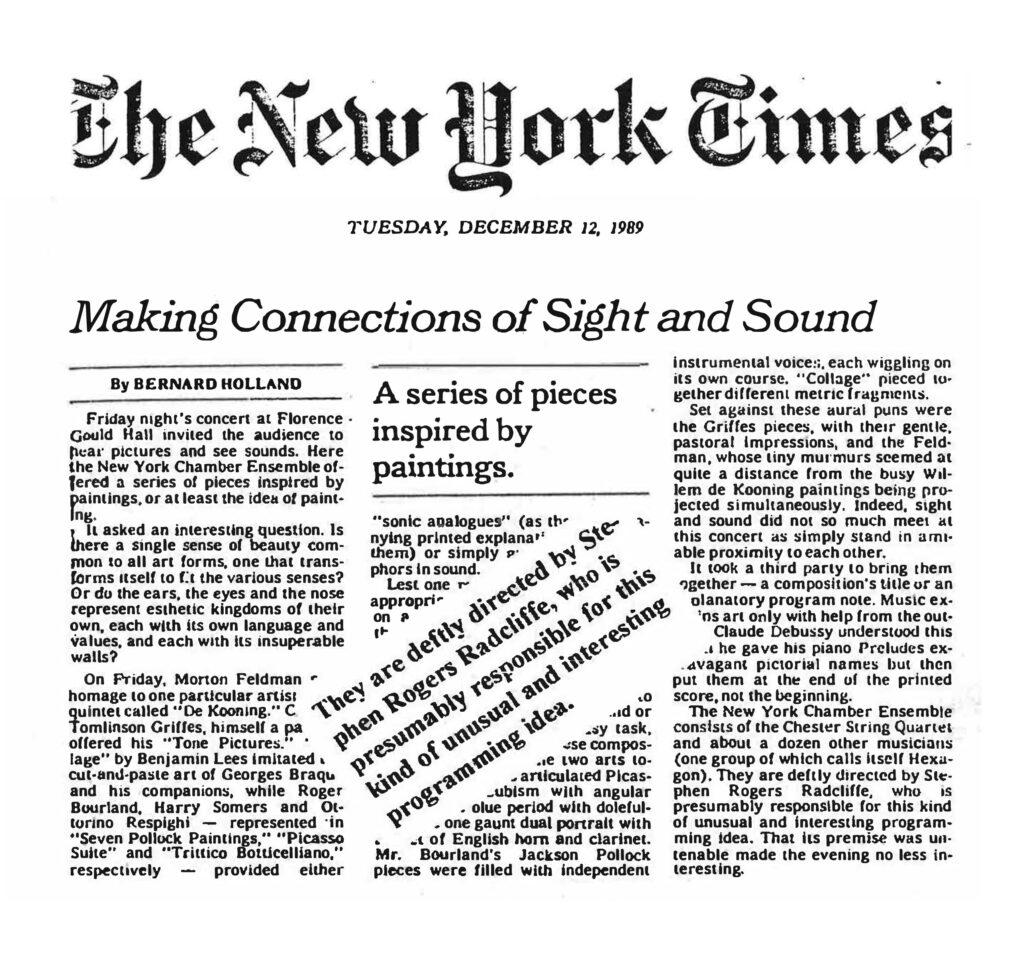
Making Connections of Sight and Sound

Tuesday, December 12, 1989

By Bernard Holland

Friday night’s concert at Florence Gould Hall invited the audience to hear pictures and see sounds. Here the New York Chamber Ensemble offered a series of pieces inspired by paintings, or at least the idea of painting.

It asked an interesting question. Is there a single sense of beauty common to all art forms, one that transforms itself to fit the various senses? Or do the ears, the eyes and the nose represent esthetic kingdoms of their own, each with its own language and values, and each with its insuperable walls?

On Friday, Morton Feldman’s quintet called “De Kooning” offered homage to one particular artist. Tomlinson Griffes, himself a painter, had “Tone Pictures,” and a cut-and-paste art of Georges Braque and his companions was mirrored by the music of Harry Somers and Ottorino Respighi in “Seven Pollock Paintings,” “Picasso Suite” and “Trittico Botticelliano,” respectively — provided either “sonic analogues” (as the program notes described them) or simply metaphors in sound.

Less one might argue that this was an appropriate approach, the composers’ task was to articulate Picasso’s cubism with angular blue period with doleful lyricism, one gaunt dual portrait with dissonant counterpoint. Mr. Bourland’s Jackson Pollock pieces were filled with independent instrumental voices, each wiggling on its own course. “Collage” pieced together different metric fragments.

Set against these aural puns were the Griffes pieces, with their gentle, pastoral impressions, and the Feldman, whose tiny murmurs seemed at quite a distance from the busy Willem de Kooning paintings being projected simultaneously. Indeed, sight and sound did not so much meet at this concert as simply stand in amicable proximity to each other.

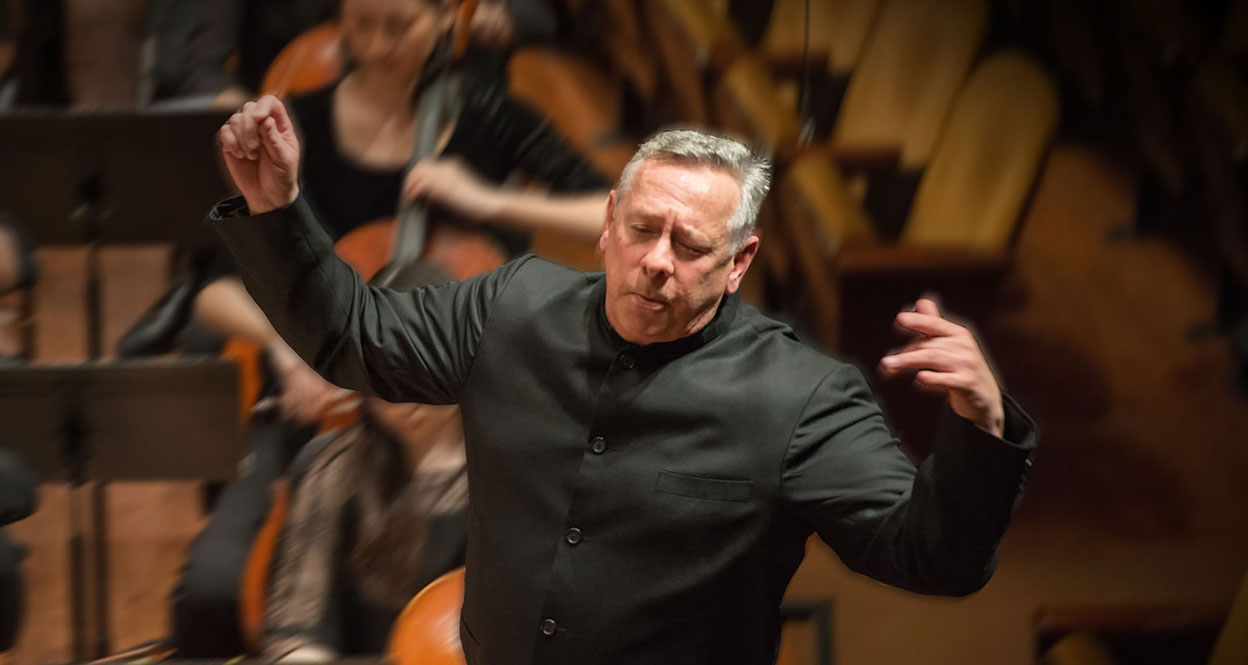
They are deftly directed by Stephen Rogers Radcliffe, who is presumably responsible for this kind of unusual and interesting programming idea.

It took a third party to bring them together — a composition’s title or an explanatory program note. Music exists only with help from the outside. Claude Debussy understood this when he gave his piano Preludes evocative pictorial names but then put them at the end of the printed score, not the beginning.

The New York Chamber Ensemble consists of the Chester String Quartet and about a dozen other musicians (one group of which calls itself Hexagon). They are deftly directed by Stephen Rogers Radcliffe, who is presumably responsible for this kind of unusual and interesting programming idea. That its premise was untenable made the evening no less interesting.
Here is the full text from the image: ⸻ The New York Times TUESDAY, DECEMBER 12, 1989 Making Connections of Sight and Sound By BERNARD HOLLAND Friday night’s concert at Florence Gould Hall invited the audience to hear pictures and see sounds. Here the New York Chamber Ensemble offered a series of pieces inspired by paintings, or at least the idea of painting. It asked an interesting question. Is there a single sense of beauty common to all art forms, one that transforms itself to fit the various senses? Or do the ears, the eyes and the nose represent esthetic kingdoms of their own, each with its own language and values, and each with its insuperable walls? On Friday, Morton Feldman’s quintet called “De Kooning” offered homage to one particular artist. Tomlinson Griffes, himself a painter, had “Tone Pictures,” and a cut-and-paste art of Georges Braque and his companions was mirrored by the music of Harry Somers and Ottorino Respighi in “Seven Pollock Paintings,” “Picasso Suite” and “Trittico Botticelliano,” respectively — provided either “sonic analogues” (as the program notes described them) or simply metaphors in sound. Less one might argue that this was an appropriate approach, the composers’ task was to articulate Picasso’s cubism with angular blue period with doleful lyricism, one gaunt dual portrait with dissonant counterpoint. Mr. Bourland’s Jackson Pollock pieces were filled with independent instrumental voices, each wiggling on its own course. “Collage” pieced together different metric fragments. Set against these aural puns were the Griffes pieces, with their gentle, pastoral impressions, and the Feldman, whose tiny murmurs seemed at quite a distance from the busy Willem de Kooning paintings being projected simultaneously. Indeed, sight and sound did not so much meet at this concert as simply stand in amicable proximity to each other. It took a third party to bring them together — a composition’s title or an explanatory program note. Music exists only with help from the outside. Claude Debussy understood this when he gave his piano Preludes evocative pictorial names but then put them at the end of the printed score, not the beginning. The New York Chamber Ensemble consists of the Chester String Quartet and about a dozen other musicians (one group of which calls itself Hexagon). They are deftly directed by Stephen Rogers Radcliffe, who is presumably responsible for this kind of unusual and interesting programming idea. That its premise was untenable made the evening no less interesting. ⸻ They are deftly directed by Stephen Rogers Radcliffe, who is presumably responsible for this kind of unusual and interesting programming idea.