
Skip to content

Press | Opera Reviews

The New York Times Logo

Sunday, January 17, 1988

Music: ‘Verein Revisited,’ By Chamber Ensemble

By John Rockwell

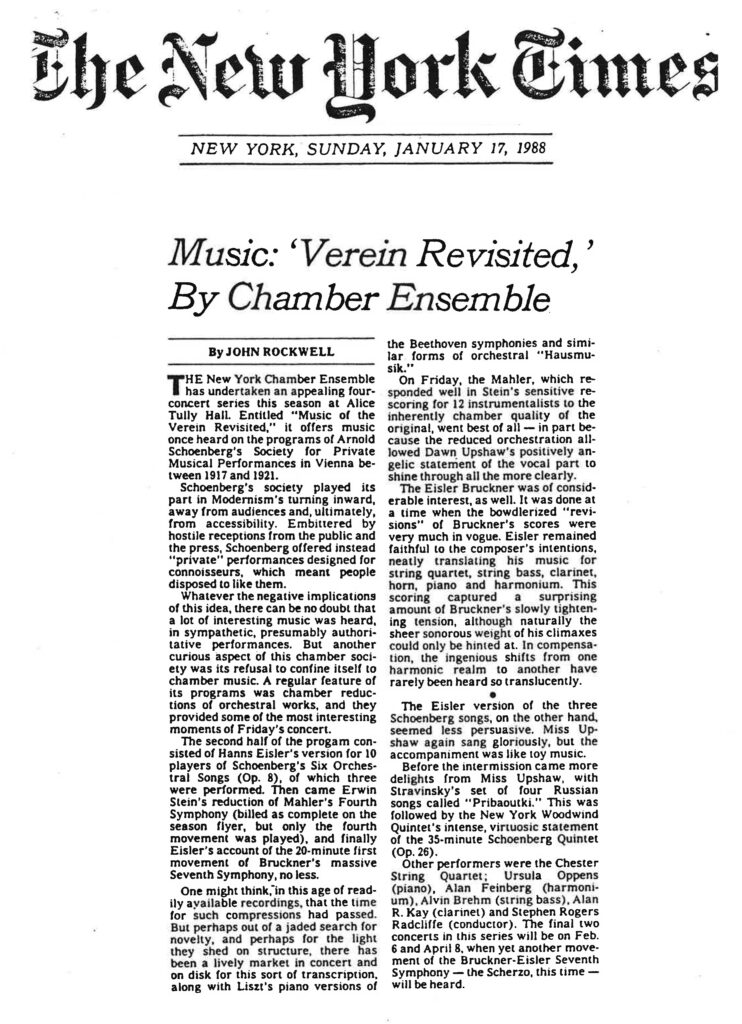
The New York Chamber Ensemble has undertaken an appealing four-concert series this season at Alice Tully Hall. Entitled “Music of the Verein Revisited,” it offers music once heard on the programs of Arnold Schoenberg’s Society for Private Musical Performances in Vienna between 1917 and 1921.

Schoenberg’s society played its part in Modernism’s turning inward, away from audiences and, ultimately, from accessibility. Embittered by hostile receptions from the public and the press, Schoenberg offered instead “private” performances designed for connoisseurs, which meant people disposed to like them.

Whatever the negative implications of this idea, there can be no doubt that a lot of interesting music was heard, in sympathetic, presumably authoritative performances. But another curious aspect of this chamber society was its refusal to confine itself to chamber music. A regular feature of its programs was chamber reductions of orchestral works, and they provided some of the most interesting moments of Friday’s concert.

The second half of the program consisted of Hanns Eisler’s version for 10 players of Schoenberg’s Six Orchestral Songs (Op. 8), of which three were performed. Then came Erwin Stein’s reduction of Mahler’s Fourth Symphony (billed as complete on the season flyer, but only the fourth movement was played), and finally Eisler’s account of the 20-minute first movement of Bruckner’s massive Seventh Symphony, no less.

One might think, in this age of readily available recordings, that the time for such compressions had passed. But perhaps out of a jaded search for novelty, and perhaps for the light they shed on structure, there has been a lively market in concert and on disk for this sort of transcription, along with Liszt’s piano versions of the Beethoven symphonies and similar forms of orchestral “Hausmusik.”

On Friday, the Mahler, which responded well in Stein’s sensitive re-scoring for 12 instrumentalists to the inherently chamber quality of the original, went best of all — in part because the reduced orchestration allowed Dawn Upshaw’s positively angelic statement of the vocal part to shine through all the more clearly.

The Eisler Bruckner was of considerable interest, as well. It was done at a time when the bowdlerized “revisions” of Bruckner’s scores were very much in vogue. Eisler remained faithful to the composer’s intentions, neatly translating his music for string quartet, string bass, clarinet, horn, piano and harmonium. This scoring captured a surprising amount of Bruckner’s slowly tightening tension, although naturally the sheer sonorous weight of his climaxes could only be hinted at. In compensation, the ingenious shifts from one harmonic realm to another have rarely been heard so translucently.

The Eisler version of the three Schoenberg songs, on the other hand, seemed less persuasive. Miss Upshaw again sang gloriously, but the accompaniment was like toy music.

Before the intermission came more delights from Miss Upshaw, with Stravinsky’s set of four Russian songs called “Pribaoutki.” This was followed by the New York Woodwind Quintet’s intense, virtuosic statement of the 35-minute Schoenberg Quintet (Op. 26).

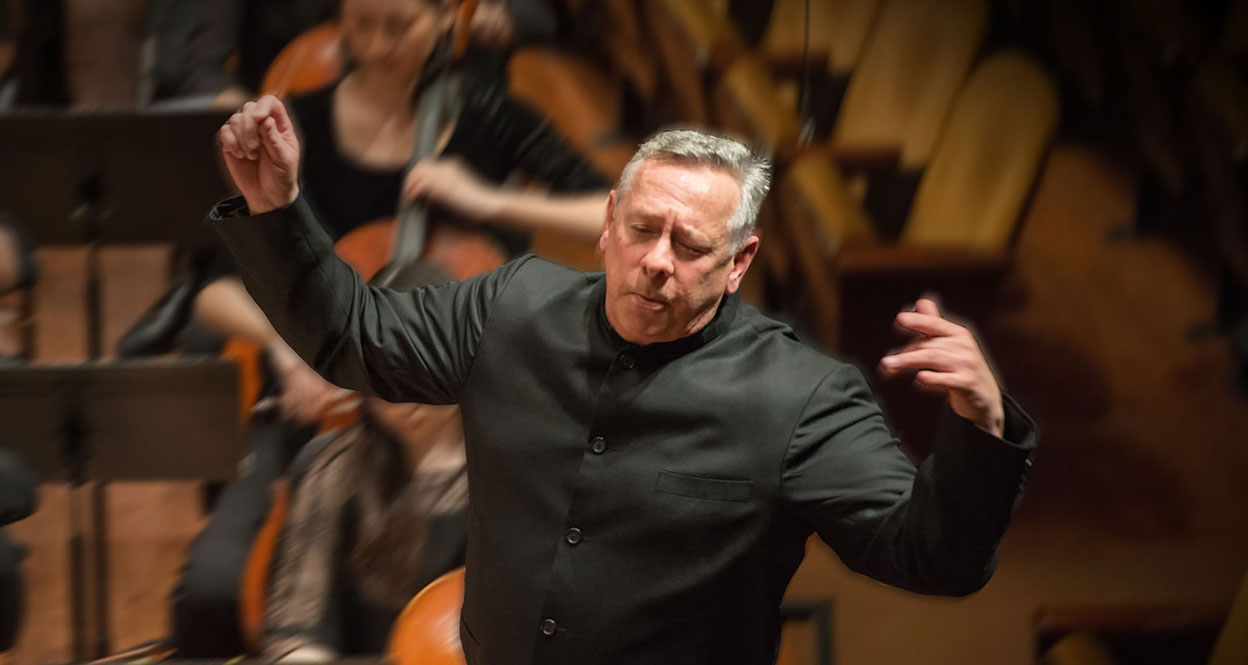
Other performers were the Chester String Quartet; Ursula Oppens (piano), Alan Feinberg (harmonium), Alvin Brehm (string bass), Alan R. Kay (clarinet) and Stephen Rogers Radcliffe (conductor). The final two concerts in this series will be on Feb. 6 and April 8, when yet another movement of the Bruckner-Eisler Seventh Symphony — the Scherzo, this time — will be heard.
Based on the second image provided, here is the retyped article: The New York Times NEW YORK, SUNDAY, JANUARY 17, 1988 Music: ‘Verein Revisited,’ By Chamber Ensemble By JOHN ROCKWELL The New York Chamber Ensemble has undertaken an appealing four-concert series this season at Alice Tully Hall. Entitled "Music of the Verein Revisited," it offers music once heard on the programs of Arnold Schoenberg's Society for Private Musical Performances in Vienna between 1917 and 1921. Schoenberg's society played its part in Modernism's turning inward, away from audiences and, ultimately, from accessibility. Embittered by hostile receptions from the public and the press, Schoenberg offered instead "private" performances designed for connoisseurs, which meant people disposed to like them. Whatever the negative implications of this idea, there can be no doubt that a lot of interesting music was heard, in sympathetic, presumably authoritative performances. But another curious aspect of this chamber society was its refusal to confine itself to chamber music. A regular feature of its programs was chamber reductions of orchestral works, and they provided some of the most interesting moments of Friday's concert. The second half of the program consisted of Hanns Eisler's version for 10 players of Schoenberg's Six Orchestral Songs (Op. 8), of which three were performed. Then came Erwin Stein's reduction of Mahler's Fourth Symphony (billed as complete on the season flyer, but only the fourth movement was played), and finally Eisler's account of the 20-minute first movement of Bruckner's massive Seventh Symphony, no less. One might think, in this age of readily available recordings, that the time for such compressions had passed. But perhaps out of a jaded search for novelty, and perhaps for the light they shed on structure, there has been a lively market in concert and on disk for this sort of transcription, along with Liszt's piano versions of the Beethoven symphonies and similar forms of orchestral "Hausmusik." On Friday, the Mahler, which responded well in Stein's sensitive re-scoring for 12 instrumentalists to the inherently chamber quality of the original, went best of all — in part because the reduced orchestration allowed Dawn Upshaw's positively angelic statement of the vocal part to shine through all the more clearly. The Eisler Bruckner was of considerable interest, as well. It was done at a time when the bowdlerized "revisions" of Bruckner's scores were very much in vogue. Eisler remained faithful to the composer's intentions, neatly translating his music for string quartet, string bass, clarinet, horn, piano and harmonium. This scoring captured a surprising amount of Bruckner's slowly tightening tension, although naturally the sheer sonorous weight of his climaxes could only be hinted at. In compensation, the ingenious shifts from one harmonic realm to another have rarely been heard so translucently. • The Eisler version of the three Schoenberg songs, on the other hand, seemed less persuasive. Miss Upshaw again sang gloriously, but the accompaniment was like toy music. Before the intermission came more delights from Miss Upshaw, with Stravinsky's set of four Russian songs called "Pribaoutki." This was followed by the New York Woodwind Quintet's intense, virtuosic statement of the 35-minute Schoenberg Quintet (Op. 26). Other performers were the Chester String Quartet; Ursula Oppens (piano), Alan Feinberg (harmonium), Alvin Brehm (string bass), Alan R. Kay (clarinet) and Stephen Rogers Radcliffe (conductor). The final two concerts in this series will be on Feb. 6 and April 8, when yet another movement of the Bruckner-Eisler Seventh Symphony — the Scherzo, this time — will be heard.