Press | Symphonic Reviews

Tuesday, September 15, 1987
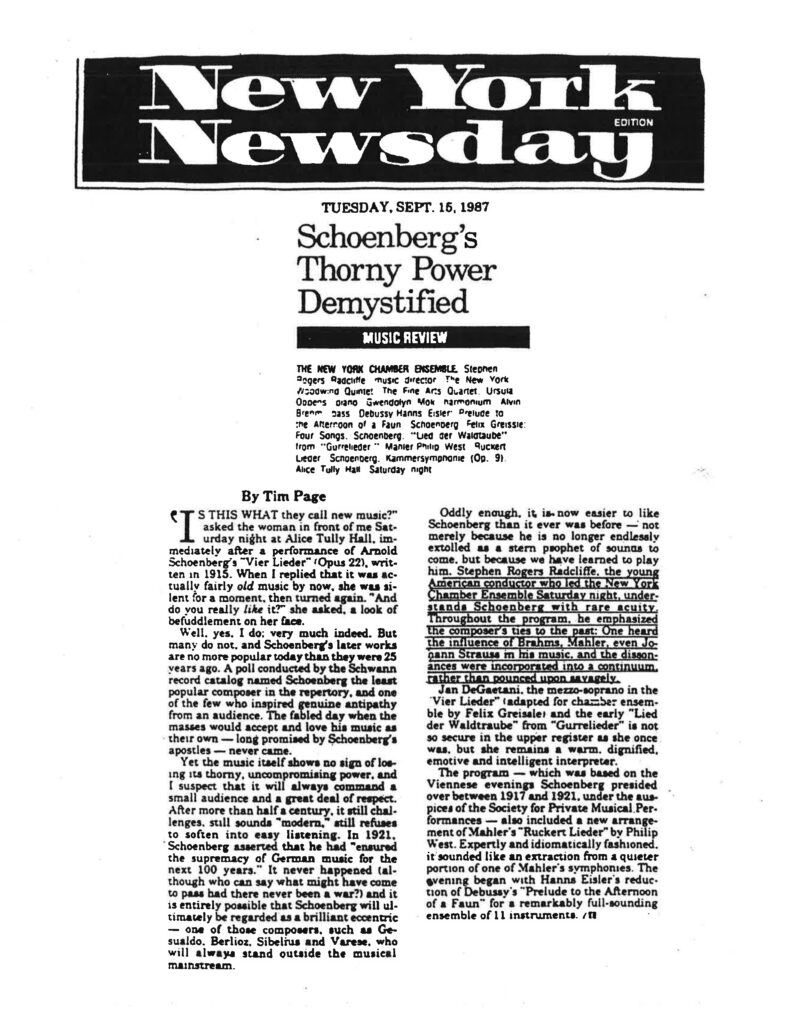
Schoenberg’s Thorny Power Demystified
By Tim Page
THE NEW YORK CHAMBER ENSEMBLE Stephen Rogers Radcliffe music director. The New York Woodwind Quintet. The Fine Arts Quartet. Ursula Oppens piano Gwendolyn Mok harmonium Alvin Brehm bass Debussy Hanns Eisler Prelude to the Afternoon of a Faun. Schoenberg Felix Greissle: Four Songs. Schoenberg. “Lied der Waldtaube” from “Gurrelieder.” Mahler Philip West Ruckert Lieder. Schoenberg. Kammersymphonie (Op. 9). Alice Tully Hall Saturday night.
“IS THIS WHAT they call new music?” asked the woman in front of me Saturday night at Alice Tully Hall, immediately after a performance of Arnold Schoenberg’s “Vier Lieder” (Opus 22), written in 1915. When I replied that it was actually fairly old music by now, she was silent for a moment, then turned again. “And do you really like it?” she asked, a look of befuddlement on her face.
Well, yes, I do; very much indeed. But many do not, and Schoenberg’s later works are no more popular today than they were 25 years ago. A poll conducted by the Schwann record catalog named Schoenberg the least popular composer in the repertory, and one of the few who inspired genuine antipathy from an audience. The fabled day when the masses would accept and love his music as their own — long promised by Schoenberg’s apostles — never came.
Yet the music itself shows no sign of losing its thorny, uncompromising power, and I suspect that it will always command a small audience and a great deal of respect. After more than half a century, it still challenges, still sounds “modern,” still refuses to soften into easy listening. In 1921, Schoenberg asserted that he had “ensured the supremacy of German music for the next 100 years.” It never happened (although who can say what might have come to pass had there never been a war?) and it is entirely possible that Schoenberg will ultimately be regarded as a brilliant eccentric — one of those composers, such as Gesualdo, Berlioz, Sibelius and Varese, who will always stand outside the musical mainstream.
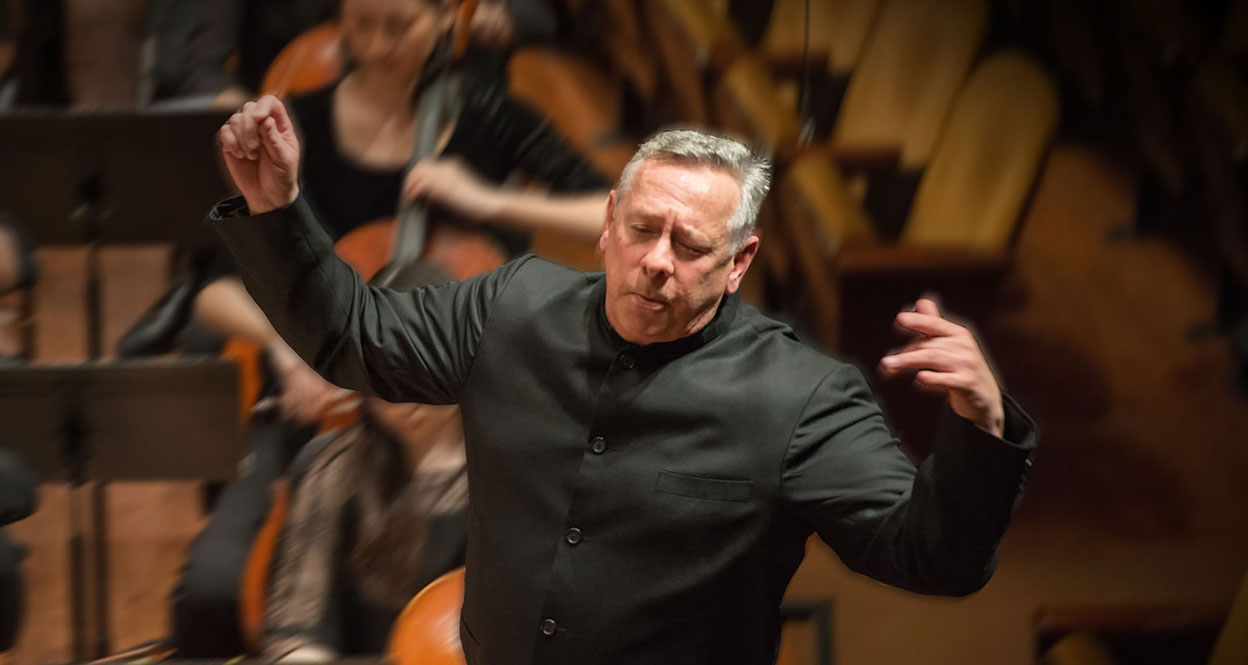
Oddly enough, it is now easier to like Schoenberg than it ever was before — not merely because he is no longer endlessly extolled as a stern prophet of sounds to come, but because we have learned to play him. Stephen Rogers Radcliffe, the young American conductor who led the New York Chamber Ensemble Saturday night, understands Schoenberg with rare acuity. Throughout the program, he emphasized the composer’s ties to the past: One heard the influence of Brahms, Mahler, even Johann Strauss in his music, and the dissonances were incorporated into a continuum, rather than pounced upon savagely.
Jan DeGaetani, the mezzo-soprano in the “Vier Lieder” (adapted for chamber ensemble by Felix Greissle) and the early “Lied der Waldtraube” from “Gurrelieder” is not so secure in the upper register as she once was, but she remains a warm, dignified, emotive and intelligent interpreter.
The program — which was based on the Viennese evenings Schoenberg presided over between 1917 and 1921, under the auspices of the Society for Private Musical Performances — also included a new arrangement of Mahler’s “Ruckert Lieder” by Philip West. Expertly and idiomatically fashioned, it sounded like an extraction from a quieter portion of one of Mahler’s symphonies. The evening began with Hanns Eisler’s reduction of Debussy’s “Prelude to the Afternoon of a Faun” for a remarkably full-sounding ensemble of 11 instruments.