
Skip to content

Press | Symphonic Reviews

Sunday, March 4, 1989

A Concert Is Heard — 77 Years Later

By Peter Goodman

THE PATH FROM PIERROT. Music by Ravel, Stravinsky, Delage, Schoenberg. New York Chamber Ensemble, Chester String Quartet, David Korevaar, piano; Bradley Garner, flute; Alan R. Kay, clarinet; Lucy Shelton, soprano; Stephen Rogers Radcliffe, conductor. Wednesday night. Alice Tully Hall, Lincoln Center, Manhattan.

THE FIRST two decades of this century were among the most fertile in all of western history in the number of important composers and masterpieces created. One can easily rank them with the 1720s, ’80s and ’90s or the mid-1800s. In terms of sheer invention and flying sparks, they may have been the most revolutionary.

The New York Chamber Ensemble, a bright and inventive group itself led by conductor Stephen Rogers Radcliffe, chose to explore one small but illuminating corner of that era for its second concert this season at Alice Tully Hall. The years were 1912 and 1913, and Igor Stravinsky and Maurice Ravel were responding to echoes from Arnold Schoenberg, whose “Pierrot Lunaire” Stravinsky had just heard in rehearsal.

“Pierrot Lunaire,” which Schoenberg had composed to 21 of the 50 poems in Albert Giraud’s cycle of that name, was the culmination of his expressionist period. It is a disturbing, quasi-psychotic song cycle that for the first time uses “Sprechstimme,” a form of notated and rhythmically confined speech that is neither talk nor song, and an ensemble of piano, flute, piccolo, clarinet, bass clarinet, violin, viola and cello.

Stravinsky (who was working on “The Rite of Spring” at the time) wasn’t wholly taken with the work, but he was fascinated by the instrumentation. He wrote “Three Japanese Lyrics,” using French texts translated from the Russian, for that combination of instruments. Ravel, having heard Stravinsky’s enthusiasm, used the same instruments for his “Trois Poèmes de Stephane Mallarmé” (Claude Debussy also set those poems that same year, for piano accompaniment). And then Ravel suggested a concert that would include his, Stravinsky’s and Schoenberg’s works, along with Charles Delage’s “Four Hindu Poems,” in which harp replaces piano.

The concert was never given — until Wednesday night, when it was offered by Radcliffe’s New York Chamber Ensemble and soprano Lucy Shelton. The event was a provocative evening, marked by exceptionally sensitive playing from the ensemble. Shelton sang “Pierrot Lunaire” in a taut, economical yet resonant new translation by Andrew Porter, music critic of The New Yorker.
The musical styles, of course, were quite different. Ravel’s “Poèmes” are the significant work of a mature artist, the instruments colorful yet transparent, changing moods sharply from ethereal to strong to subtly mysterious. Shelton’s voice was luminous and evocative, though her pronunciation left something to be desired.

Stravinsky’s “Lyrics” are short and haiku-like, their brevity belying their complex structure. They were so short the ensemble played them a second time.
The most Indian element of Delage’s “Hindu Poems” was a set of cello glissandos that mimicked the sitar, and some pizzicati that resembled the rhythms of a tabla. Otherwise, the music sounded more Mideastern than subcontinental, though it was pretty enough.

But “Pierrot Lunaire” was the masterpiece, with its discomforting, queasy, never-still vocal line and formally structured but tonally free instrumental accompaniment. Porter’s translation, its sounds hard and its language compressed, fit the music superbly. Shelton’s performance was full of expression, mostly unhappy and foreboding. Nevertheless, the ultimate effect was a little too complacent, not as devastating as “Pierrot Lunaire” can be.

Still, the program was a very effective demonstration of the spectacular creative ferment of the time.
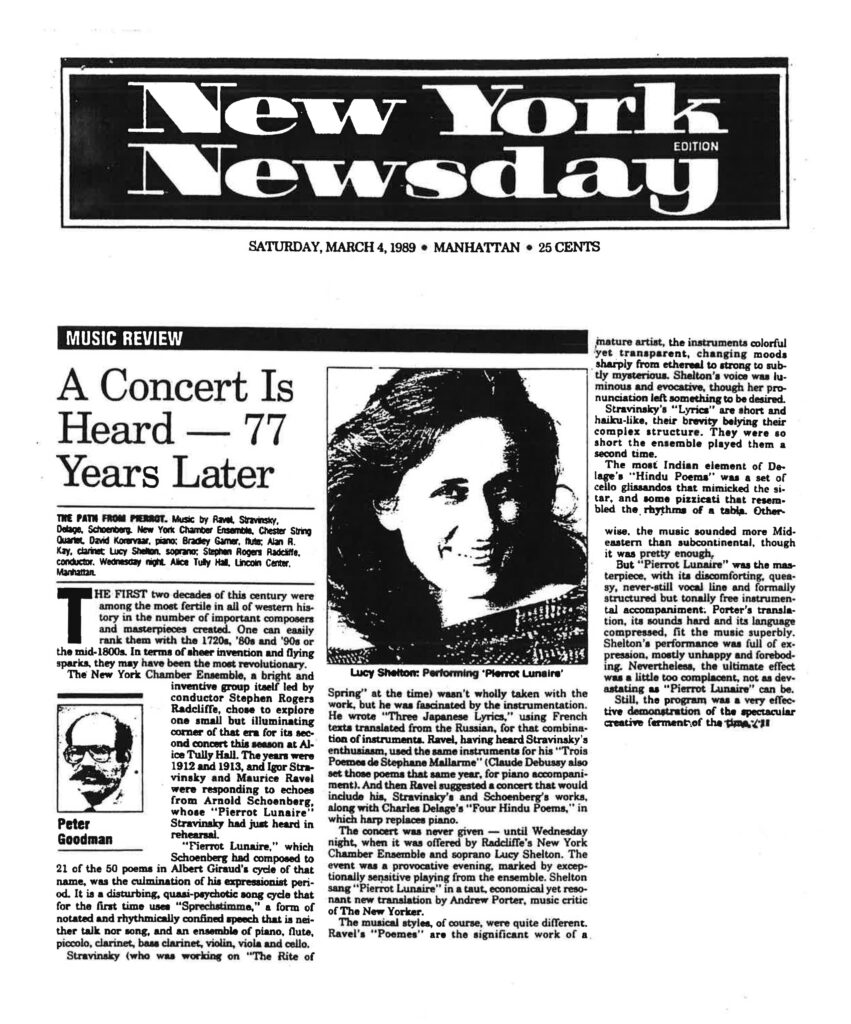
New York Newsday SATURDAY, MARCH 4, 1989 • MANHATTAN • 25 CENTS MUSIC REVIEW A Concert Is Heard — 77 Years Later THE PATH FROM PIERROT. Music by Ravel, Stravinsky, Delage, Schoenberg. New York Chamber Ensemble, Chester String Quartet, David Korevaar, piano; Bradley Garner, flute; Alan R. Kay, clarinet; Lucy Shelton, soprano; Stephen Rogers Radcliffe, conductor. Wednesday night. Alice Tully Hall, Lincoln Center, Manhattan. By Peter Goodman THE FIRST two decades of this century were among the most fertile in all of western history in the number of important composers and masterpieces created. One can easily rank them with the 1720s, '80s and '90s or the mid-1800s. In terms of sheer invention and flying sparks, they may have been the most revolutionary. The New York Chamber Ensemble, a bright and inventive group itself led by conductor Stephen Rogers Radcliffe, chose to explore one small but illuminating corner of that era for its second concert this season at Alice Tully Hall. The years were 1912 and 1913, and Igor Stravinsky and Maurice Ravel were responding to echoes from Arnold Schoenberg, whose "Pierrot Lunaire" Stravinsky had just heard in rehearsal. "Pierrot Lunaire," which Schoenberg had composed to 21 of the 50 poems in Albert Giraud's cycle of that name, was the culmination of his expressionist period. It is a disturbing, quasi-psychotic song cycle that for the first time uses "Sprechstimme," a form of notated and rhythmically confined speech that is neither talk nor song, and an ensemble of piano, flute, piccolo, clarinet, bass clarinet, violin, viola and cello. Stravinsky (who was working on "The Rite of Spring" at the time) wasn't wholly taken with the work, but he was fascinated by the instrumentation. He wrote "Three Japanese Lyrics," using French texts translated from the Russian, for that combination of instruments. Ravel, having heard Stravinsky's enthusiasm, used the same instruments for his "Trois Poèmes de Stephane Mallarmé" (Claude Debussy also set those poems that same year, for piano accompaniment). And then Ravel suggested a concert that would include his, Stravinsky's and Schoenberg's works, along with Charles Delage's "Four Hindu Poems," in which harp replaces piano. The concert was never given — until Wednesday night, when it was offered by Radcliffe's New York Chamber Ensemble and soprano Lucy Shelton. The event was a provocative evening, marked by exceptionally sensitive playing from the ensemble. Shelton sang "Pierrot Lunaire" in a taut, economical yet resonant new translation by Andrew Porter, music critic of The New Yorker. The musical styles, of course, were quite different. Ravel's "Poèmes" are the significant work of a mature artist, the instruments colorful yet transparent, changing moods sharply from ethereal to strong to subtly mysterious. Shelton's voice was luminous and evocative, though her pronunciation left something to be desired. Stravinsky's "Lyrics" are short and haiku-like, their brevity belying their complex structure. They were so short the ensemble played them a second time. The most Indian element of Delage's "Hindu Poems" was a set of cello glissandos that mimicked the sitar, and some pizzicati that resembled the rhythms of a tabla. Otherwise, the music sounded more Mideastern than subcontinental, though it was pretty enough. But "Pierrot Lunaire" was the masterpiece, with its discomforting, queasy, never-still vocal line and formally structured but tonally free instrumental accompaniment. Porter's translation, its sounds hard and its language compressed, fit the music superbly. Shelton's performance was full of expression, mostly unhappy and foreboding. Nevertheless, the ultimate effect was a little too complacent, not as devastating as "Pierrot Lunaire" can be. Still, the program was a very effective demonstration of the spectacular creative ferment of the time.