Press | Recording Review
January/February 1995 • Volume 18, Number 3
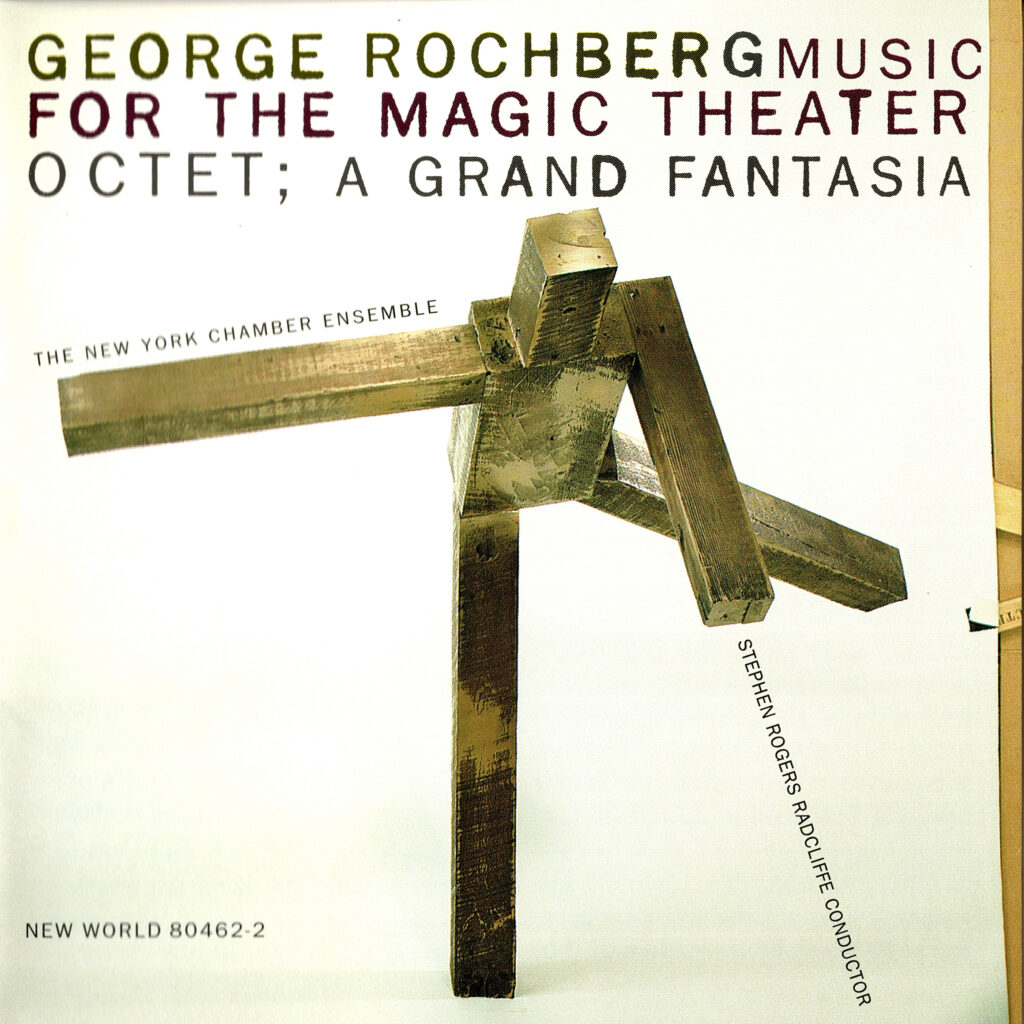
ROCHBERG: Music for the Magic Theater. Octet; A Grand Fantasia.
Stephen Rogers Radcliffe conducting the New York Chamber Ensemble.
NEW WORLD 80462-2 [DDD]; 48:39.
Produced by Daniel Kincaid.
By James H. North
Our esteemed editor continues to send me discs of George Rochberg’s music, even though I have expressed a general distaste for it. It makes sense that each of Fanfare’s reviewers gets mostly music that he or she appreciates; we are more likely to be knowledgeable about the music and informed about competing recordings that way, but it also accounts for the so-often-favorable reviews which have bothered some of our correspondents. An occasional counterview may be bracing, and I welcome another chance to understand any composer. Rochberg, of course, has been many things at many times; his compositional life was long an evolving struggle to find his own style, at a time (ca. 1945–75) when style was strictly dictated by a few academics (if you don’t write my way, you don’t pass my course, so you won’t get the degree, so you can’t succeed in the academic world of music, so you give up composing as a career).
Music for the Magic Theater (1965) found Rochberg at a turning point; he had previously followed the required atonal serialism, and had experimented with music of chance, only to find unexpected, depressing similarities between the two systems. Here Rochberg tries to merge music past with music present and future by using collage, which was not yet fashionable, although Ives’s music was beginning to be known. Collage brings much variety to these twenty-seven minutes, but it also exemplifies the problem I have with Rochberg’s music: it seems so internally disconnected, with one minute’s Mozart likely to be followed by another’s Mahler or Miles Davis. The three “Acts” of this magic theater go from confusion of past and present, to wallowing in the past, and finally trying and dissolving the present “into what?” This seems to me more like sophisticated navel-gazing than making music. The booklet points out that B. A. Zimmermann was exactly Rochberg’s age, forcing me to ask why I accept the German composer’s collages more than the American’s. It is because Zimmermann does so much more with his inherited material; he works it over thoroughly, transforming it into something all his own. For the record, the fifteen instrumentalists here (yes, yes: Schoenberg and Berg) make many beautiful and intriguing sounds, and they are expertly recorded.
Octet; A Grand Fantasia (1980) consists of twelve brief pieces scored for two to eight players (flute, clarinet, horn, violin, viola, cello, bass, and piano). References to the past are now more subtle, more a matter of style than of substance. The variety of tempos and moods (listing them all would take nearly as long as hearing them) is somehow more acceptable as a suite of short pieces than as chunks within larger movements. It also enables me to pinpoint a preference for Rochberg in slow tempos to Rochberg at speed. I give him much credit for leading the assault on an intolerable musical establishment, but I still don’t like Rochberg’s own solutions much.
I hope this review is useful to someone; if you disagree with each thought I have expressed, you better go out and buy this record.
By Mike Silverton
It’s easy to speak of a kinship of Rochberg to Ives. Ives was the first to play about with polystylistics, emulsions in the main of highbrow with low. In the listening, however, the Ives-Rochberg connection plays as tenuous. We make better use of space contemplating Rochberg’s entirely self-conscious move in the early 60s from serial atonality to (what has been called by the less than enthralled) pastiche. This bouncing about from musical style to style is today much in vogue, thanks in large measure to several of George Rochberg’s pivotal works. The more appropriate comparison is to Lucas Foss, a Rochberg contemporary whose esthetic flexibility measures as relatively opportunistic. His obvious qualities notwithstanding, is Rochberg’s a baleful influence on impressionable minds? In an environment where Steve Martland is packaged—in semi-beefcake, heaven help us!—as a hot property, the question is silly. Rather, let us see an unusually good and honest composer having hung an existential right on the road to what seemed to him, if not to everyone, a dead end. With regard to the discomfort Rochberg’s suspiciously entertaining alternatives inflict on those for whom Theodore Adorno wields papal authority (to name but one arbiter), I offer this useless opinion. Perhaps—just perhaps—it is Rochberg’s nature to entertain, his sojourn in Second Vienna’s long shadow an aspect of development toward what he has become—a fulfillment that has helped shape today’s postmodern terrain, moreover. (Escapes from serialism’s constraints have led in startlingly disparate directions: Stefan Wolpe’s for one, Giacinto Scelsi’s for another.) Schwann Opus show Rochberg’s cassettes, mostly CRI, outnumbering CDs. It’s gratifying to see a skimpy CDiscography graced by these well-played and -recorded additions.
Mike Silverton
![Fanfare The Magazine for Serious Record Collectors January/February 1995 • Volume 18, Number 3 ROCHBERG: Music for the Magic Theater. Octet; A Grand Fantasia. Stephen Rogers Radcliffe conducting the New York Chamber Ensemble. NEW WORLD 80462-2 [DDD]; 48:39. Produced by Daniel Kincaid. Our esteemed editor continues to send me discs of George Rochberg's music, even though I have expressed a general distaste for it. It makes sense that each of Fanfare's reviewers gets mostly music that he or she appreciates; we are more likely to be knowledgeable about the music and informed about competing recordings that way, but it also accounts for the so-often-favorable reviews which have bothered some of our correspondents. An occasional counterview may be bracing, and I welcome another chance to understand any composer. Rochberg, of course, has been many things at many times; his compositional life was long an evolving struggle to find his own style, at a time (ca. 1945–75) when style was strictly dictated by a few academics (if you don't write my way, you don't pass my course, so you won't get the degree, so you can't succeed in the academic world of music, so you give up composing as a career). Music for the Magic Theater (1965) found Rochberg at a turning point; he had previously followed the required atonal serialism, and had experimented with music of chance, only to find unexpected, depressing similarities between the two systems. Here Rochberg tries to merge music past with music present and future by using collage, which was not yet fashionable, although Ives's music was beginning to be known. Collage brings much variety to these twenty-seven minutes, but it also exemplifies the problem I have with Rochberg's music: it seems so internally disconnected, with one minute's Mozart likely to be followed by another's Mahler or Miles Davis. The three "Acts" of this magic theater go from confusion of past and present, to wallowing in the past, and finally trying and dissolving the present "into what?" This seems to me more like sophisticated navel-gazing than making music. The booklet points out that B. A. Zimmermann was exactly Rochberg's age, forcing me to ask why I accept the German composer's collages more than the American's. It is because Zimmermann does so much more with his inherited material; he works it over thoroughly, transforming it into something all his own. For the record, the fifteen instrumentalists here (yes, yes: Schoenberg and Berg) make many beautiful and intriguing sounds, and they are expertly recorded. Octet; A Grand Fantasia (1980) consists of twelve brief pieces scored for two to eight players (flute, clarinet, horn, violin, viola, cello, bass, and piano). References to the past are now more subtle, more a matter of style than of substance. The variety of tempos and moods (listing them all would take nearly as long as hearing them) is somehow more acceptable as a suite of short pieces than as chunks within larger movements. It also enables me to pinpoint a preference for Rochberg in slow tempos to Rochberg at speed. I give him much credit for leading the assault on an intolerable musical establishment, but I still don't like Rochberg's own solutions much. I hope this review is useful to someone; if you disagree with each thought I have expressed, you better go out and buy this record. James H. North • • • It's easy to speak of a kinship of Rochberg to Ives. Ives was the first to play about with polystylistics, emulsions in the main of highbrow with low. In the listening, however, the Ives-Rochberg connection plays as tenuous. We make better use of space contemplating Rochberg's entirely self-conscious move in the early 60s from serial atonality to (what has been called by the less than enthralled) pastiche. This bouncing about from musical style to style is today much in vogue, thanks in large measure to several of George Rochberg's pivotal works. The more appropriate comparison is to Lucas Foss, a Rochberg contemporary whose esthetic flexibility measures as relatively opportunistic. His obvious qualities notwithstanding, is Rochberg's a baleful influence on impressionable minds? In an environment where Steve Martland is packaged—in semi-beefcake, heaven help us!—as a hot property, the question is silly. Rather, let us see an unusually good and honest composer having hung an existential right on the road to what seemed to him, if not to everyone, a dead end. With regard to the discomfort Rochberg's suspiciously entertaining alternatives inflict on those for whom Theodore Adorno wields papal authority (to name but one arbiter), I offer this useless opinion. Perhaps—just perhaps—it is Rochberg's nature to entertain, his sojourn in Second Vienna's long shadow an aspect of development toward what he has become—a fulfillment that has helped shape today's postmodern terrain, moreover. (Escapes from serialism's constraints have led in startlingly disparate directions: Stefan Wolpe's for one, Giacinto Scelsi's for another.) Schwann Opus show Rochberg's cassettes, mostly CRI, outnumbering CDs. It's gratifying to see a skimpy CDiscography graced by these well-played and -recorded additions. Mike Silverton](https://stephenrogersradcliffe.com/wp-content/uploads/1995/01/Fanfare_January_1995-791x1024.jpg)