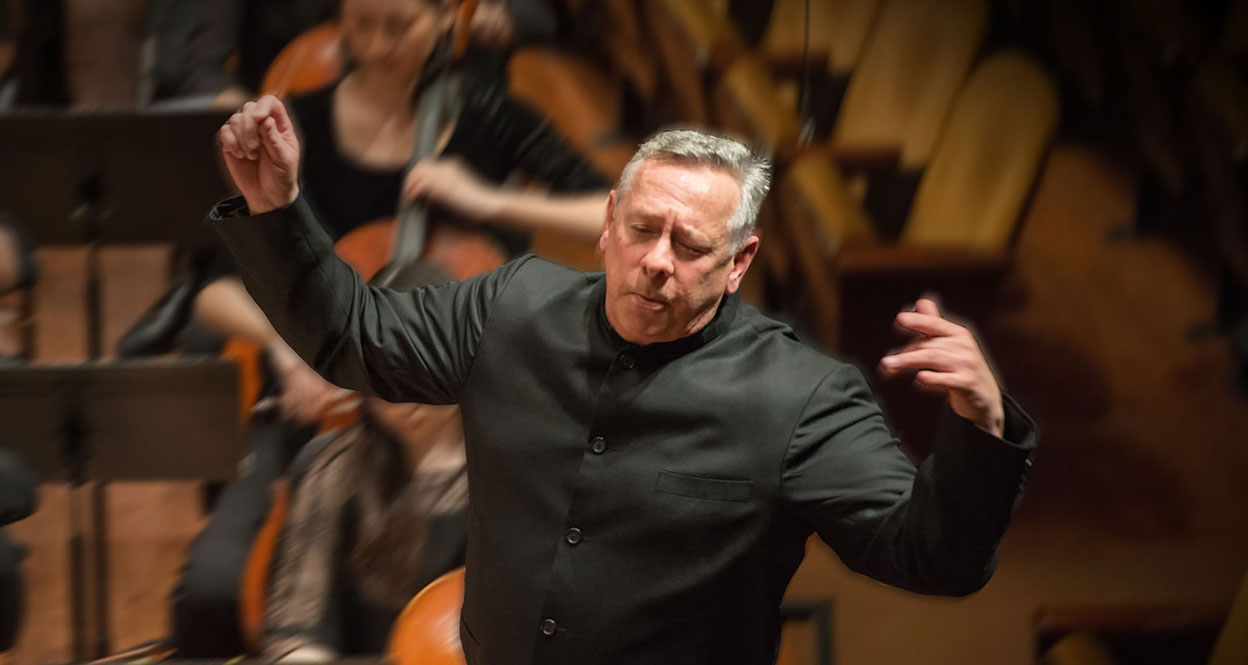
5 Ways With Music and Drama That Share the Bond of Brevity

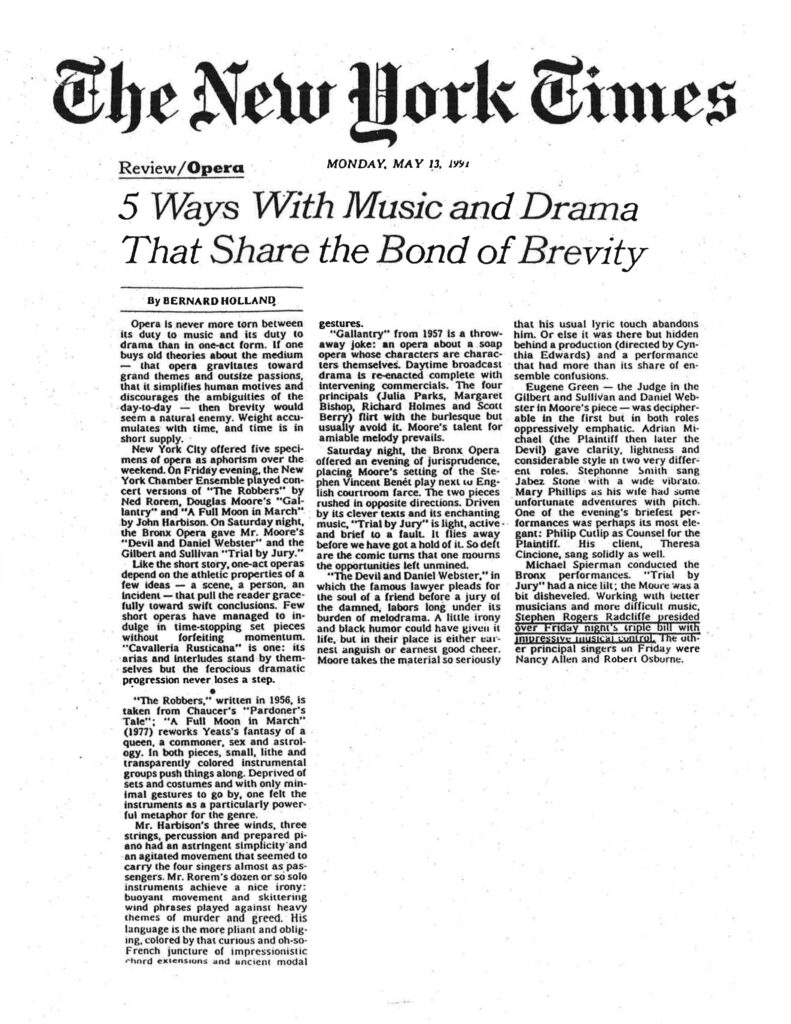
Based on the image provided, here is the retyped article: The New York Times Review/Opera MONDAY, MAY 13, 1991 5 Ways With Music and Drama That Share the Bond of Brevity By BERNARD HOLLAND Opera is never more torn between its duty to music and its duty to drama than in one-act form. If one buys old theories about the medium — that opera gravitates toward grand themes and outsize passions, that it simplifies human motives and discourages the ambiguities of the day-to-day — then brevity would seem a natural enemy. Weight accumulates with time, and time is in short supply. New York City offered five specimens of opera as aphorism over the weekend. On Friday evening, the New York Chamber Ensemble played concert versions of "The Robbers" by Ned Rorem, Douglas Moore's "Gallantry" and "A Full Moon in March" by John Harbison. On Saturday night, the Bronx Opera gave Mr. Moore's "Devil and Daniel Webster" and the Gilbert and Sullivan "Trial by Jury." Like the short story, one-act operas depend on the athletic properties of a few ideas — a scene, a person, an incident — that pull the reader gracefully toward swift conclusions. Few short operas have managed to indulge in time-stopping set pieces without forfeiting momentum. "Cavalleria Rusticana" is one: its arias and interludes stand by themselves but the ferocious dramatic progression never loses a step. • "The Robbers," written in 1956, is taken from Chaucer's "Pardoner's Tale": "A Full Moon in March" (1977) reworks Yeats's fantasy of a queen, a commoner, sex and astrology. In both pieces, small, lithe and transparently colored instrumental groups push things along. Deprived of sets and costumes and with only minimal gestures to go by, one felt the instruments as a particularly powerful metaphor for the genre. Mr. Harbison's three winds, three strings, percussion and prepared piano had an astringent simplicity and an agitated movement that seemed to carry the four singers almost as passengers. Mr. Rorem's dozen or so solo instruments achieve a nice irony: buoyant movement and skittering wind phrases played against heavy themes of murder and greed. His language is the more pliant and obliging, colored by that curious and oh-so-French juncture of impressionistic chord extensions and ancient modal gestures. "Gallantry" from 1957 is a throwaway joke: an opera about a soap opera whose characters are characters themselves. Daytime broadcast drama is re-enacted complete with intervening commercials. The four principals (Julia Parks, Margaret Bishop, Richard Holmes and Scott Berry) flirt with the burlesque but usually avoid it. Moore's talent for amiable melody prevails. Saturday night, the Bronx Opera offered an evening of jurisprudence, placing Moore's setting of the Stephen Vincent Benét play next to English courtroom farce. The two pieces rushed in opposite directions. Driven by its clever texts and its enchanting music, "Trial by Jury" is light, active and brief to a fault. It flies away before we have got a hold of it. So deft are the comic turns that one mourns the opportunities left unmined. "The Devil and Daniel Webster," in which the famous lawyer pleads for the soul of a friend before a jury of the damned, labors long under its burden of melodrama. A little irony and black humor could have given it life, but in their place is either earnest anguish or earnest good cheer. Moore takes the material so seriously that his usual lyric touch abandons him. Or else it was there but hidden behind a production (directed by Cynthia Edwards) and a performance that had more than its share of ensemble confusions. Eugene Green — the Judge in the Gilbert and Sullivan and Daniel Webster in Moore's piece — was decipherable in the first but in both roles oppressively emphatic. Adrian Michael (the Plaintiff then later the Devil) gave clarity, lightness and considerable style in two very different roles. Stephonne Smith sang Jabez Stone with a wide vibrato. Mary Phillips as his wife had some unfortunate adventures with pitch. One of the evening's briefest performances was perhaps its most elegant: Philip Cutlip as Counsel for the Plaintiff. His client, Theresa Cincione, sang solidly as well. Michael Spierman conducted the Bronx performances. "Trial by Jury" had a nice lilt; the Moore was a bit disheveled. Working with better musicians and more difficult music, Stephen Rogers Radcliffe presided over Friday night's triple bill with impressive musical control. The other principal singers on Friday were Nancy Allen and Robert Osborne.

Press | Opera Reviews

The New York Times Logo

Monday, May 13, 1991

5 Ways With Music and Drama That Share the Bond of Brevity

By Bernard Holland

Opera is never more torn between its duty to music and its duty to drama than in one-act form. If one buys old theories about the medium — that opera gravitates toward grand themes and outsize passions, that it simplifies human motives and discourages the ambiguities of the day-to-day — then brevity would seem a natural enemy. Weight accumulates with time, and time is in short supply.

New York City offered five specimens of opera as aphorism over the weekend. On Friday evening, the New York Chamber Ensemble played concert versions of “The Robbers” by Ned Rorem, Douglas Moore’s “Gallantry” and “A Full Moon in March” by John Harbison. On Saturday night, the Bronx Opera gave Mr. Moore’s “Devil and Daniel Webster” and the Gilbert and Sullivan “Trial by Jury.”

Like the short story, one-act operas depend on the athletic properties of a few ideas — a scene, a person, an incident — that pull the reader gracefully toward swift conclusions. Few short operas have managed to indulge in time-stopping set pieces without forfeiting momentum. “Cavalleria Rusticana” is one: its arias and interludes stand by themselves but the ferocious dramatic progression never loses a step.

“The Robbers,” written in 1956, is taken from Chaucer’s “Pardoner’s Tale”: “A Full Moon in March” (1977) reworks Yeats’s fantasy of a queen, a commoner, sex and astrology. In both pieces, small, lithe and transparently colored instrumental groups push things along. Deprived of sets and costumes and with only minimal gestures to go by, one felt the instruments as a particularly powerful metaphor for the genre.

Mr. Harbison’s three winds, three strings, percussion and prepared piano had an astringent simplicity and an agitated movement that seemed to carry the four singers almost as passengers. Mr. Rorem’s dozen or so solo instruments achieve a nice irony: buoyant movement and skittering wind phrases played against heavy themes of murder and greed. His language is the more pliant and obliging, colored by that curious and oh-so-French juncture of impressionistic chord extensions and ancient modal gestures.

“Gallantry” from 1957 is a throwaway joke: an opera about a soap opera whose characters are characters themselves. Daytime broadcast drama is re-enacted complete with intervening commercials. The four principals (Julia Parks, Margaret Bishop, Richard Holmes and Scott Berry) flirt with the burlesque but usually avoid it. Moore’s talent for amiable melody prevails.

Saturday night, the Bronx Opera offered an evening of jurisprudence, placing Moore’s setting of the Stephen Vincent Benét play next to English courtroom farce. The two pieces rushed in opposite directions. Driven by its clever texts and its enchanting music, “Trial by Jury” is light, active and brief to a fault. It flies away before we have got a hold of it. So deft are the comic turns that one mourns the opportunities left unmined.

“The Devil and Daniel Webster,” in which the famous lawyer pleads for the soul of a friend before a jury of the damned, labors long under its burden of melodrama. A little irony and black humor could have given it life, but in their place is either earnest anguish or earnest good cheer. Moore takes the material so seriously that his usual lyric touch abandons him. Or else it was there but hidden behind a production (directed by Cynthia Edwards) and a performance that had more than its share of ensemble confusions.

Eugene Green — the Judge in the Gilbert and Sullivan and Daniel Webster in Moore’s piece — was decipherable in the first but in both roles oppressively emphatic. Adrian Michael (the Plaintiff then later the Devil) gave clarity, lightness and considerable style in two very different roles. Stephonne Smith sang Jabez Stone with a wide vibrato. Mary Phillips as his wife had some unfortunate adventures with pitch. One of the evening’s briefest performances was perhaps its most elegant: Philip Cutlip as Counsel for the Plaintiff. His client, Theresa Cincione, sang solidly as well.

Michael Spierman conducted the Bronx performances. “Trial by Jury” had a nice lilt; the Moore was a bit disheveled. Working with better musicians and more difficult music, Stephen Rogers Radcliffe presided over Friday night’s triple bill with impressive musical control. The other principal singers on Friday were Nancy Allen and Robert Osborne.
Based on the image provided, here is the retyped article: The New York Times Review/Opera MONDAY, MAY 13, 1991 5 Ways With Music and Drama That Share the Bond of Brevity By BERNARD HOLLAND Opera is never more torn between its duty to music and its duty to drama than in one-act form. If one buys old theories about the medium — that opera gravitates toward grand themes and outsize passions, that it simplifies human motives and discourages the ambiguities of the day-to-day — then brevity would seem a natural enemy. Weight accumulates with time, and time is in short supply. New York City offered five specimens of opera as aphorism over the weekend. On Friday evening, the New York Chamber Ensemble played concert versions of "The Robbers" by Ned Rorem, Douglas Moore's "Gallantry" and "A Full Moon in March" by John Harbison. On Saturday night, the Bronx Opera gave Mr. Moore's "Devil and Daniel Webster" and the Gilbert and Sullivan "Trial by Jury." Like the short story, one-act operas depend on the athletic properties of a few ideas — a scene, a person, an incident — that pull the reader gracefully toward swift conclusions. Few short operas have managed to indulge in time-stopping set pieces without forfeiting momentum. "Cavalleria Rusticana" is one: its arias and interludes stand by themselves but the ferocious dramatic progression never loses a step. • "The Robbers," written in 1956, is taken from Chaucer's "Pardoner's Tale": "A Full Moon in March" (1977) reworks Yeats's fantasy of a queen, a commoner, sex and astrology. In both pieces, small, lithe and transparently colored instrumental groups push things along. Deprived of sets and costumes and with only minimal gestures to go by, one felt the instruments as a particularly powerful metaphor for the genre. Mr. Harbison's three winds, three strings, percussion and prepared piano had an astringent simplicity and an agitated movement that seemed to carry the four singers almost as passengers. Mr. Rorem's dozen or so solo instruments achieve a nice irony: buoyant movement and skittering wind phrases played against heavy themes of murder and greed. His language is the more pliant and obliging, colored by that curious and oh-so-French juncture of impressionistic chord extensions and ancient modal gestures. "Gallantry" from 1957 is a throwaway joke: an opera about a soap opera whose characters are characters themselves. Daytime broadcast drama is re-enacted complete with intervening commercials. The four principals (Julia Parks, Margaret Bishop, Richard Holmes and Scott Berry) flirt with the burlesque but usually avoid it. Moore's talent for amiable melody prevails. Saturday night, the Bronx Opera offered an evening of jurisprudence, placing Moore's setting of the Stephen Vincent Benét play next to English courtroom farce. The two pieces rushed in opposite directions. Driven by its clever texts and its enchanting music, "Trial by Jury" is light, active and brief to a fault. It flies away before we have got a hold of it. So deft are the comic turns that one mourns the opportunities left unmined. "The Devil and Daniel Webster," in which the famous lawyer pleads for the soul of a friend before a jury of the damned, labors long under its burden of melodrama. A little irony and black humor could have given it life, but in their place is either earnest anguish or earnest good cheer. Moore takes the material so seriously that his usual lyric touch abandons him. Or else it was there but hidden behind a production (directed by Cynthia Edwards) and a performance that had more than its share of ensemble confusions. Eugene Green — the Judge in the Gilbert and Sullivan and Daniel Webster in Moore's piece — was decipherable in the first but in both roles oppressively emphatic. Adrian Michael (the Plaintiff then later the Devil) gave clarity, lightness and considerable style in two very different roles. Stephonne Smith sang Jabez Stone with a wide vibrato. Mary Phillips as his wife had some unfortunate adventures with pitch. One of the evening's briefest performances was perhaps its most elegant: Philip Cutlip as Counsel for the Plaintiff. His client, Theresa Cincione, sang solidly as well. Michael Spierman conducted the Bronx performances. "Trial by Jury" had a nice lilt; the Moore was a bit disheveled. Working with better musicians and more difficult music, Stephen Rogers Radcliffe presided over Friday night's triple bill with impressive musical control. The other principal singers on Friday were Nancy Allen and Robert Osborne.
Making Connections of Sight and Sound

Here is the full text from the image: ⸻ The New York Times TUESDAY, DECEMBER 12, 1989 Making Connections of Sight and Sound By BERNARD HOLLAND Friday night’s concert at Florence Gould Hall invited the audience to hear pictures and see sounds. Here the New York Chamber Ensemble offered a series of pieces inspired by paintings, or at least the idea of painting. It asked an interesting question. Is there a single sense of beauty common to all art forms, one that transforms itself to fit the various senses? Or do the ears, the eyes and the nose represent esthetic kingdoms of their own, each with its own language and values, and each with its insuperable walls? On Friday, Morton Feldman’s quintet called “De Kooning” offered homage to one particular artist. Tomlinson Griffes, himself a painter, had “Tone Pictures,” and a cut-and-paste art of Georges Braque and his companions was mirrored by the music of Harry Somers and Ottorino Respighi in “Seven Pollock Paintings,” “Picasso Suite” and “Trittico Botticelliano,” respectively — provided either “sonic analogues” (as the program notes described them) or simply metaphors in sound. Less one might argue that this was an appropriate approach, the composers’ task was to articulate Picasso’s cubism with angular blue period with doleful lyricism, one gaunt dual portrait with dissonant counterpoint. Mr. Bourland’s Jackson Pollock pieces were filled with independent instrumental voices, each wiggling on its own course. “Collage” pieced together different metric fragments. Set against these aural puns were the Griffes pieces, with their gentle, pastoral impressions, and the Feldman, whose tiny murmurs seemed at quite a distance from the busy Willem de Kooning paintings being projected simultaneously. Indeed, sight and sound did not so much meet at this concert as simply stand in amicable proximity to each other. It took a third party to bring them together — a composition’s title or an explanatory program note. Music exists only with help from the outside. Claude Debussy understood this when he gave his piano Preludes evocative pictorial names but then put them at the end of the printed score, not the beginning. The New York Chamber Ensemble consists of the Chester String Quartet and about a dozen other musicians (one group of which calls itself Hexagon). They are deftly directed by Stephen Rogers Radcliffe, who is presumably responsible for this kind of unusual and interesting programming idea. That its premise was untenable made the evening no less interesting. ⸻ They are deftly directed by Stephen Rogers Radcliffe, who is presumably responsible for this kind of unusual and interesting programming idea.

Press | Symphonic Reviews

The New York Times Logo

Making Connections of Sight and Sound

Tuesday, December 12, 1989

By Bernard Holland

Friday night’s concert at Florence Gould Hall invited the audience to hear pictures and see sounds. Here the New York Chamber Ensemble offered a series of pieces inspired by paintings, or at least the idea of painting.

It asked an interesting question. Is there a single sense of beauty common to all art forms, one that transforms itself to fit the various senses? Or do the ears, the eyes and the nose represent esthetic kingdoms of their own, each with its own language and values, and each with its insuperable walls?

On Friday, Morton Feldman’s quintet called “De Kooning” offered homage to one particular artist. Tomlinson Griffes, himself a painter, had “Tone Pictures,” and a cut-and-paste art of Georges Braque and his companions was mirrored by the music of Harry Somers and Ottorino Respighi in “Seven Pollock Paintings,” “Picasso Suite” and “Trittico Botticelliano,” respectively — provided either “sonic analogues” (as the program notes described them) or simply metaphors in sound.

Less one might argue that this was an appropriate approach, the composers’ task was to articulate Picasso’s cubism with angular blue period with doleful lyricism, one gaunt dual portrait with dissonant counterpoint. Mr. Bourland’s Jackson Pollock pieces were filled with independent instrumental voices, each wiggling on its own course. “Collage” pieced together different metric fragments.

Set against these aural puns were the Griffes pieces, with their gentle, pastoral impressions, and the Feldman, whose tiny murmurs seemed at quite a distance from the busy Willem de Kooning paintings being projected simultaneously. Indeed, sight and sound did not so much meet at this concert as simply stand in amicable proximity to each other.

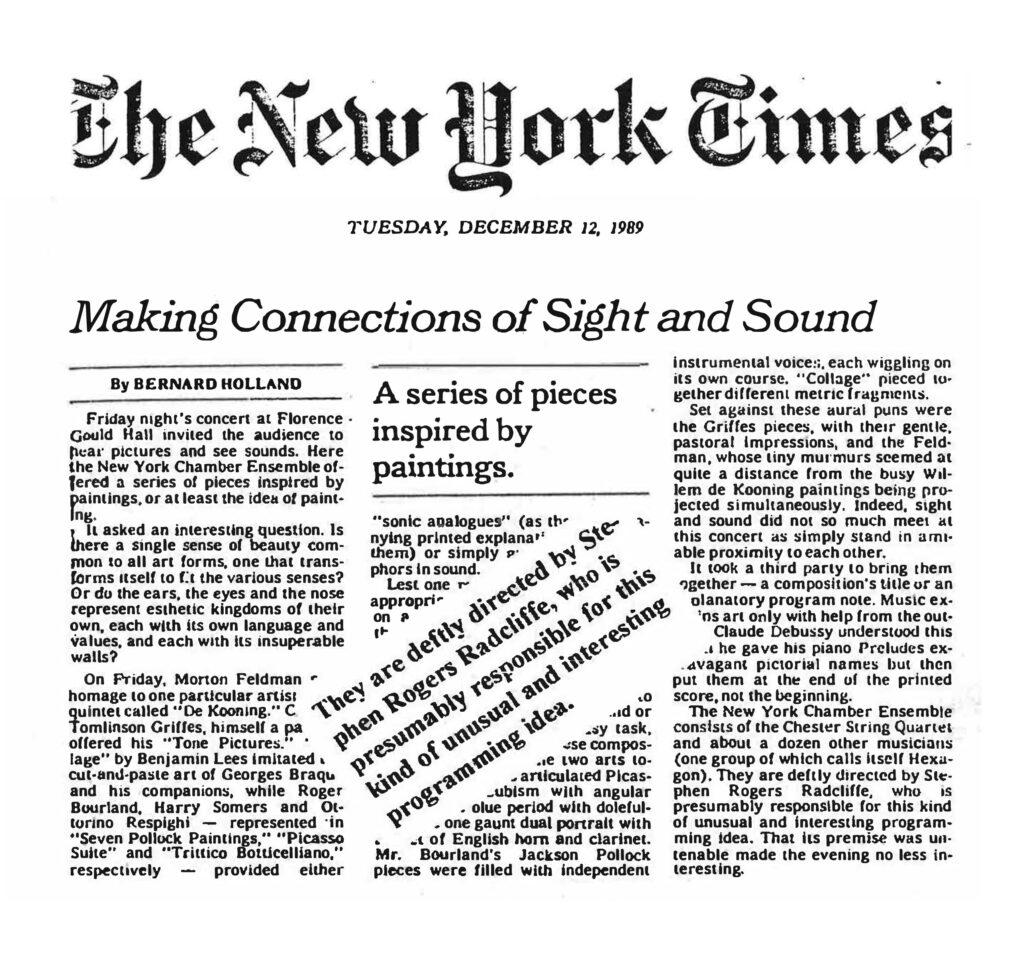
They are deftly directed by Stephen Rogers Radcliffe, who is presumably responsible for this kind of unusual and interesting programming idea.

It took a third party to bring them together — a composition’s title or an explanatory program note. Music exists only with help from the outside. Claude Debussy understood this when he gave his piano Preludes evocative pictorial names but then put them at the end of the printed score, not the beginning.

The New York Chamber Ensemble consists of the Chester String Quartet and about a dozen other musicians (one group of which calls itself Hexagon). They are deftly directed by Stephen Rogers Radcliffe, who is presumably responsible for this kind of unusual and interesting programming idea. That its premise was untenable made the evening no less interesting.

Here is the full text from the image: ⸻ The New York Times TUESDAY, DECEMBER 12, 1989 Making Connections of Sight and Sound By BERNARD HOLLAND Friday night’s concert at Florence Gould Hall invited the audience to hear pictures and see sounds. Here the New York Chamber Ensemble offered a series of pieces inspired by paintings, or at least the idea of painting. It asked an interesting question. Is there a single sense of beauty common to all art forms, one that transforms itself to fit the various senses? Or do the ears, the eyes and the nose represent esthetic kingdoms of their own, each with its own language and values, and each with its insuperable walls? On Friday, Morton Feldman’s quintet called “De Kooning” offered homage to one particular artist. Tomlinson Griffes, himself a painter, had “Tone Pictures,” and a cut-and-paste art of Georges Braque and his companions was mirrored by the music of Harry Somers and Ottorino Respighi in “Seven Pollock Paintings,” “Picasso Suite” and “Trittico Botticelliano,” respectively — provided either “sonic analogues” (as the program notes described them) or simply metaphors in sound. Less one might argue that this was an appropriate approach, the composers’ task was to articulate Picasso’s cubism with angular blue period with doleful lyricism, one gaunt dual portrait with dissonant counterpoint. Mr. Bourland’s Jackson Pollock pieces were filled with independent instrumental voices, each wiggling on its own course. “Collage” pieced together different metric fragments. Set against these aural puns were the Griffes pieces, with their gentle, pastoral impressions, and the Feldman, whose tiny murmurs seemed at quite a distance from the busy Willem de Kooning paintings being projected simultaneously. Indeed, sight and sound did not so much meet at this concert as simply stand in amicable proximity to each other. It took a third party to bring them together — a composition’s title or an explanatory program note. Music exists only with help from the outside. Claude Debussy understood this when he gave his piano Preludes evocative pictorial names but then put them at the end of the printed score, not the beginning. The New York Chamber Ensemble consists of the Chester String Quartet and about a dozen other musicians (one group of which calls itself Hexagon). They are deftly directed by Stephen Rogers Radcliffe, who is presumably responsible for this kind of unusual and interesting programming idea. That its premise was untenable made the evening no less interesting. ⸻ They are deftly directed by Stephen Rogers Radcliffe, who is presumably responsible for this kind of unusual and interesting programming idea.