
Cape May orchestra: Solidity by the sea

The Philadelphia Inquirer 174th Year, No. 4 • South Jersey C • TUESDAY, JUNE 4, 2002 • www.philly.com • 50 C Review Music Cape May orchestra: Solidity by the sea By David Patrick Stearns INQUIRER MUSIC CRITIC CAPE MAY — Gamboling beachgoers in this Victorian-styled resort have an opportunity to cool their sunburns with late-afternoon symphonic music performed literally on the beach. The 18-concert Cape May Music Festival (through June 23) imports ensembles from jazz to early music (including Philadelphia’s Piffaro), the core of it all being the Cape May Festival Orchestra. The group is made up of current and recently graduated conservatory students on what must be hugely enjoyable three-year fellowships, playing alongside principal players drawn from the New York Chamber Ensemble. Sunday’s venue was the 800-seat Convention Hall. The 5 p.m. concert was late enough to leave time for body surfing but early enough to watch dolphins surface not far offshore during intermission. With the stiff ocean winds whistling atmospherically around the Convention Hall, does it matter if the music-making is any good? It always matters, and here, though there’s nothing particularly original in philosophy or concept, solidity is everywhere. With a 44-piece orchestra (half the usual size) in an acoustically dry hall, that’s no small accomplishment. Where weighty sonorities are customarily heard in the slow movement of Beethoven’s Symphony No. 7, music director Stephen Rogers Radcliff went for something intense and penetrating, since weight just wasn’t available to him. The intoxicated high spirits of the symphony’s final movement are often conveyed by the sheer breathlessness of so many players with so much velocity; Radcliffe pushed the accelerator to the floor even higher, while maintaining elegant fleetness. His rhythm has a sense of gravitational movement, shaping as well as measuring the notes. And there were surprises, mostly from the presence of Beethoven’s rarely heard "Leonore Overture No. 1," which was written for the opera Fidelio, minus the majesty that’s such a key factor in later, more appropriate overtures. With any festival, there’s a luck-of-the-draw element. I had the bad luck to miss the Dvorak Cello Concerto with the fascinating Matt Haimovitz on Thursday and the worse luck to hear Beethoven’s Piano Concerto No. 5 ("Emperor") with Ursula Oppens. Hers is a magic name in contemporary music circles, thanks to her fearless and resourceful championing of great, modern musical explorers, such as Elliott Carter and Conlon Nancarrow. However, the special pleading that works on the cutting edge led to horrifying results with Beethoven. Oppens was relentlessly loud, graceless and ham-fisted. How could such a performance receive a standing ovation? Trickery: She jumped ahead of the orchestra with greater frequency and with broader leaps as the performance went on, generating artificial though highly unmusical tension. Contact David Patrick Stearns at 215-854-4907 or dstearns@phillynews.com. The next Cape May Festival Orchestra event features pianist Horacio Gutierrez at 8 p.m. Thursday at Convention Hall, Beach Drive at Stockton Place. Information: 609-884-5404 or www.capemaymac.org.

Press | Symphonic Review

Tuesday, June 4, 2002

Cape May Orchestra: Solidity by the Sea

By David Patrick Stearns

CAPE MAY — Gamboling beachgoers in this Victorian-styled resort have an opportunity to cool their sunburns with late-afternoon symphonic music performed literally on the beach.

The 18-concert Cape May Music Festival (through June 23) imports ensembles from jazz to early music (including Philadelphia’s Piffaro), the core of it all being the Cape May Festival Orchestra. The group is made up of current and recently graduated conservatory students on what must be hugely enjoyable three-year fellowships, playing alongside principal players drawn from the New York Chamber Ensemble.

Sunday’s venue was the 800-seat Convention Hall. The 5 p.m. concert was late enough to leave time for body surfing but early enough to watch dolphins surface not far offshore during intermission. With the stiff ocean winds whistling atmospherically around the Convention Hall, does it matter if the music-making is any good?

It always matters, and here, though there’s nothing particularly original in philosophy or concept, solidity is everywhere. With a 44-piece orchestra (half the usual size) in an acoustically dry hall, that’s no small accomplishment.

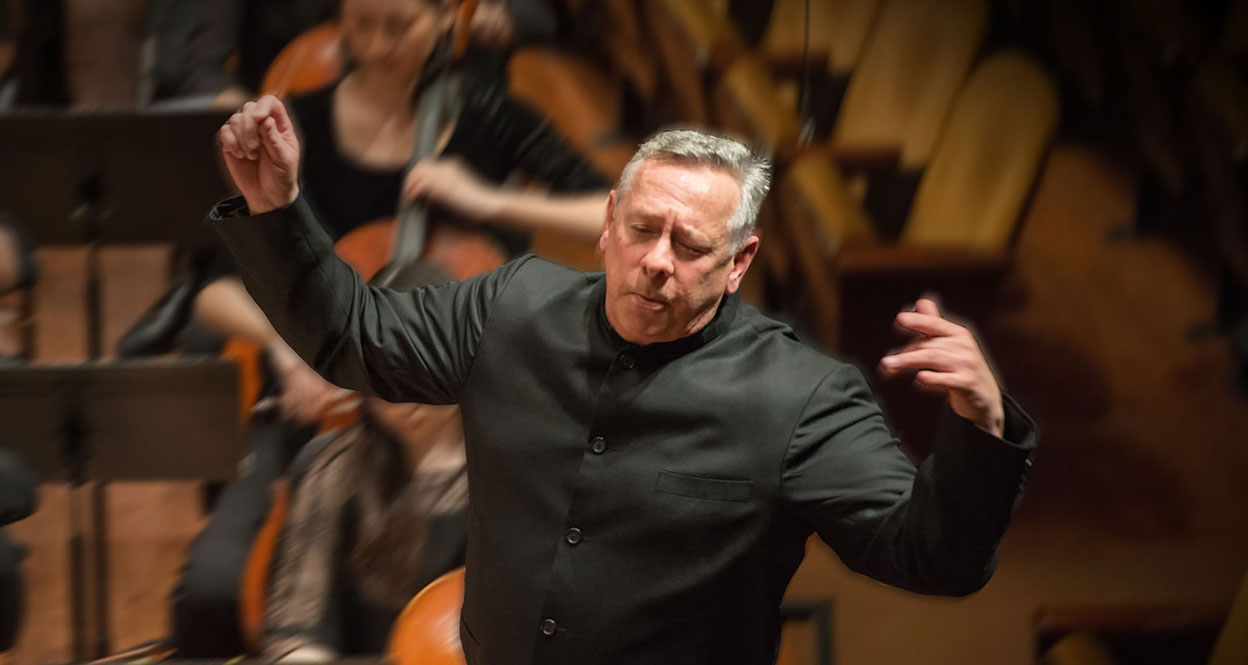
Where weighty sonorities are customarily heard in the slow movement of Beethoven’s Symphony No. 7, music director Stephen Rogers Radcliff went for something intense and penetrating, since weight just wasn’t available to him. The intoxicated high spirits of the symphony’s final movement are often conveyed by the sheer breathlessness of so many players with so much velocity; Radcliffe pushed the accelerator to the floor even higher, while maintaining elegant fleetness. His rhythm has a sense of gravitational movement, shaping as well as measuring the notes.

And there were surprises, mostly from the presence of Beethoven’s rarely heard “Leonore Overture No. 1,” which was written for the opera Fidelio, minus the majesty that’s such a key factor in later, more appropriate overtures.

With any festival, there’s a luck-of-the-draw element. I had the bad luck to miss the Dvorak Cello Concerto with the fascinating Matt Haimovitz on Thursday and the worse luck to hear Beethoven’s Piano Concerto No. 5 (“Emperor”) with Ursula Oppens. Hers is a magic name in contemporary music circles, thanks to her fearless and resourceful championing of great, modern musical explorers, such as Elliott Carter and Conlon Nancarrow.

However, the special pleading that works on the cutting edge led to horrifying results with Beethoven. Oppens was relentlessly loud, graceless and ham-fisted. How could such a performance receive a standing ovation? Trickery: She jumped ahead of the orchestra with greater frequency and with broader leaps as the performance went on, generating artificial though highly unmusical tension.

Contact David Patrick Stearns at 215-854-4907 or dstearns@phillynews.com.

The next Cape May Festival Orchestra event features pianist Horacio Gutierrez at 8 p.m. Thursday at Convention Hall, Beach Drive at Stockton Place. Information: 609-884-5404 or www.capemaymac.org.
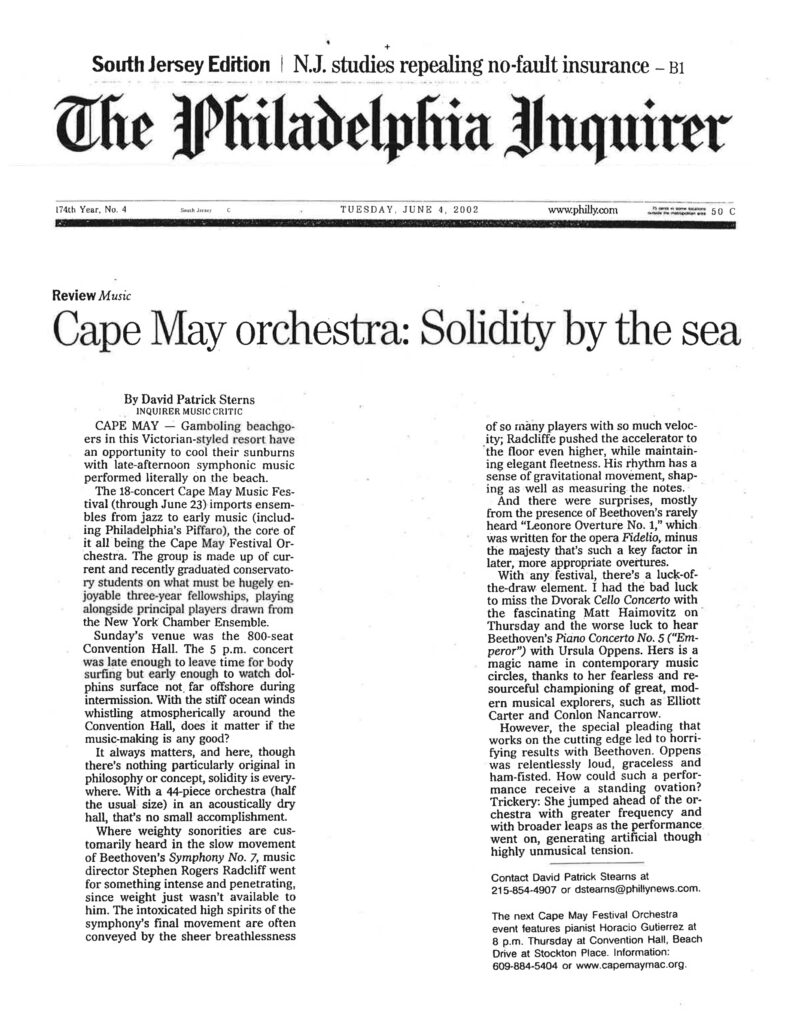
The Philadelphia Inquirer 174th Year, No. 4 • South Jersey C • TUESDAY, JUNE 4, 2002 • www.philly.com • 50 C Review Music Cape May orchestra: Solidity by the sea By David Patrick Stearns INQUIRER MUSIC CRITIC CAPE MAY — Gamboling beachgoers in this Victorian-styled resort have an opportunity to cool their sunburns with late-afternoon symphonic music performed literally on the beach. The 18-concert Cape May Music Festival (through June 23) imports ensembles from jazz to early music (including Philadelphia’s Piffaro), the core of it all being the Cape May Festival Orchestra. The group is made up of current and recently graduated conservatory students on what must be hugely enjoyable three-year fellowships, playing alongside principal players drawn from the New York Chamber Ensemble. Sunday’s venue was the 800-seat Convention Hall. The 5 p.m. concert was late enough to leave time for body surfing but early enough to watch dolphins surface not far offshore during intermission. With the stiff ocean winds whistling atmospherically around the Convention Hall, does it matter if the music-making is any good? It always matters, and here, though there’s nothing particularly original in philosophy or concept, solidity is everywhere. With a 44-piece orchestra (half the usual size) in an acoustically dry hall, that’s no small accomplishment. Where weighty sonorities are customarily heard in the slow movement of Beethoven’s Symphony No. 7, music director Stephen Rogers Radcliff went for something intense and penetrating, since weight just wasn’t available to him. The intoxicated high spirits of the symphony’s final movement are often conveyed by the sheer breathlessness of so many players with so much velocity; Radcliffe pushed the accelerator to the floor even higher, while maintaining elegant fleetness. His rhythm has a sense of gravitational movement, shaping as well as measuring the notes. And there were surprises, mostly from the presence of Beethoven’s rarely heard "Leonore Overture No. 1," which was written for the opera Fidelio, minus the majesty that’s such a key factor in later, more appropriate overtures. With any festival, there’s a luck-of-the-draw element. I had the bad luck to miss the Dvorak Cello Concerto with the fascinating Matt Haimovitz on Thursday and the worse luck to hear Beethoven’s Piano Concerto No. 5 ("Emperor") with Ursula Oppens. Hers is a magic name in contemporary music circles, thanks to her fearless and resourceful championing of great, modern musical explorers, such as Elliott Carter and Conlon Nancarrow. However, the special pleading that works on the cutting edge led to horrifying results with Beethoven. Oppens was relentlessly loud, graceless and ham-fisted. How could such a performance receive a standing ovation? Trickery: She jumped ahead of the orchestra with greater frequency and with broader leaps as the performance went on, generating artificial though highly unmusical tension. Contact David Patrick Stearns at 215-854-4907 or dstearns@phillynews.com. The next Cape May Festival Orchestra event features pianist Horacio Gutierrez at 8 p.m. Thursday at Convention Hall, Beach Drive at Stockton Place. Information: 609-884-5404 or www.capemaymac.org.