Re-creating a Musical Event of 1927

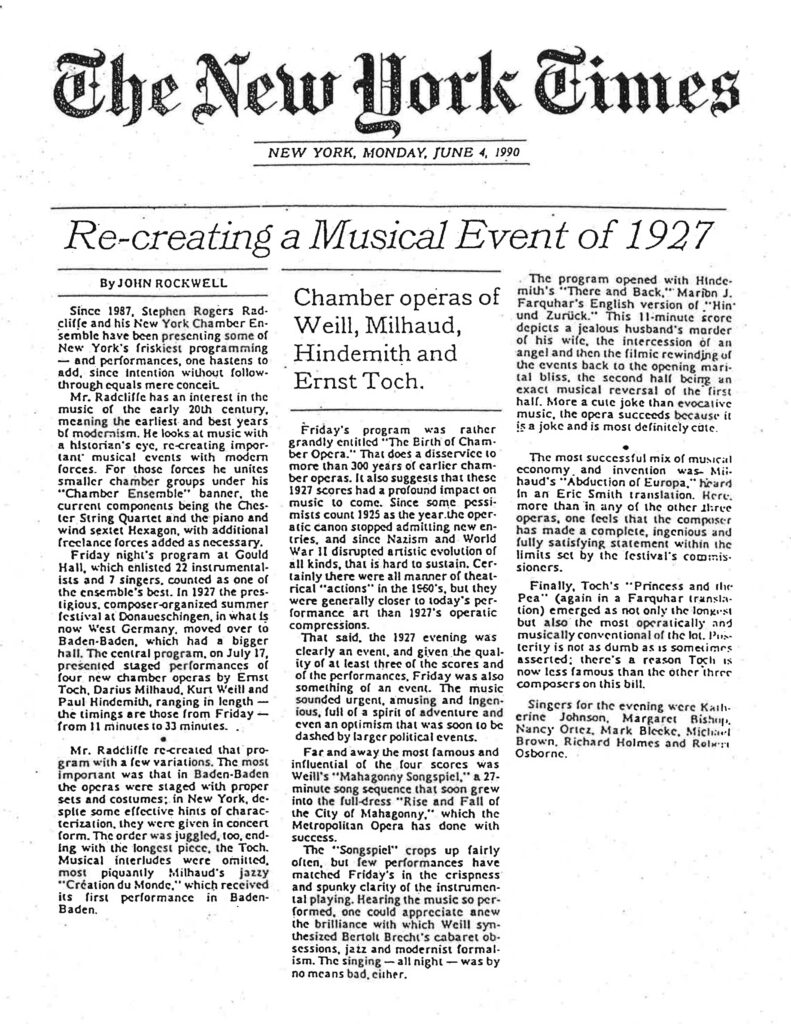
The New York Times NEW YORK, MONDAY, JUNE 4, 1990 Re-creating a Musical Event of 1927 By JOHN ROCKWELL Since 1987, Stephen Rogers Radcliffe and his New York Chamber Ensemble have been presenting some of New York's friskiest programming — and performances, one hastens to add, since intention without follow-through equals mere conceit. Mr. Radcliffe has an interest in the music of the early 20th century, meaning the earliest and best years of modernism. He looks at music with a historian's eye, re-creating important musical events with modern forces. For those forces he unites smaller chamber groups under his "Chamber Ensemble" banner, the current components being the Chester String Quartet and the piano and wind sextet Hexagon, with additional freelance forces added as necessary. Friday night's program at Gould Hall, which enlisted 22 instrumentalists and 7 singers, counted as one of the ensemble's best. In 1927 the prestigious, composer-organized summer festival at Donaueschingen, in what is now West Germany, moved over to Baden-Baden, which had a bigger hall. The central program, on July 17, presented staged performances of four new chamber operas by Ernst Toch, Darius Milhaud, Kurt Weill and Paul Hindemith, ranging in length — the timings are those from Friday — from 11 minutes to 33 minutes. Mr. Radcliffe re-created that program with a few variations. The most important was that in Baden-Baden the operas were staged with proper sets and costumes; in New York, despite some effective hints of characterization, they were given in concert form. The order was juggled, too, ending with the longest piece, the Toch. Musical interludes were omitted, most piquantly Milhaud's jazzy "Création du Monde," which received its first performance in Baden-Baden. Chamber operas of Weill, Milhaud, Hindemith and Ernst Toch. Friday's program was rather grandly entitled "The Birth of Chamber Opera." That does a disservice to more than 300 years of earlier chamber operas. It also suggests that these 1927 scores had a profound impact on music to come. Since some pessimists count 1925 as the year the operatic canon stopped admitting new entries, and since Nazism and World War II disrupted artistic evolution of all kinds, that is hard to sustain. Certainly there were all manner of theatrical "actions" in the 1960's, but they were generally closer to today's performance art than 1927's operatic compressions. That said, the 1927 evening was clearly an event, and given the quality of at least three of the scores and of the performances, Friday was also something of an event. The music sounded urgent, amusing and ingenious, full of a spirit of adventure and even an optimism that was soon to be dashed by larger political events. Far and away the most famous and influential of the four scores was Weill's "Mahagonny Songspiel," a 27-minute song sequence that soon grew into the full-dress "Rise and Fall of the City of Mahagonny," which the Metropolitan Opera has done with success. The "Songspiel" crops up fairly often, but few performances have matched Friday's in the crispness and spunky clarity of the instrumental playing. Hearing the music so performed, one could appreciate anew the brilliance with which Weill synthesized Bertolt Brecht's cabaret obsessions, jazz and modernist formalism. The singing — all night — was by no means bad, either. The program opened with Hindemith's "There and Back," Marion J. Farquhar's English version of "Hin und Zurück." This 11-minute score depicts a jealous husband's murder of his wife, the intercession of an angel and then the filmic rewinding of the events back to the opening marital bliss, the second half being an exact musical reversal of the first half. More a cute joke than evocative music, the opera succeeds because it is a joke and is most definitely cute. The most successful mix of musical economy and invention was Milhaud's "Abduction of Europa," heard in an Eric Smith translation. Here, more than in any of the other three operas, one feels that the composer has made a complete, ingenious and fully satisfying statement within the limits set by the festival's commissioners. Finally, Toch's "Princess and the Pea" (again in a Farquhar translation) emerged as not only the longest but also the most operatically and musically conventional of the lot. Posterity is not as dumb as is sometimes asserted; there's a reason Toch is now less famous than the other three composers on this bill. Singers for the evening were Katherine Johnson, Margaret Bishop, Nancy Ortez, Mark Bleeke, Michael Brown, Richard Holmes and Robert Osborne.

Press | Opera Reviews

The New York Times Logo

Monday, June 4, 1990

Re-creating a Musical Event of 1927

By John Rockwell

Since 1987, Stephen Rogers Radcliffe and his New York Chamber Ensemble have been presenting some of New York’s friskiest programming — and performances, one hastens to add, since intention without follow-through equals mere conceit.

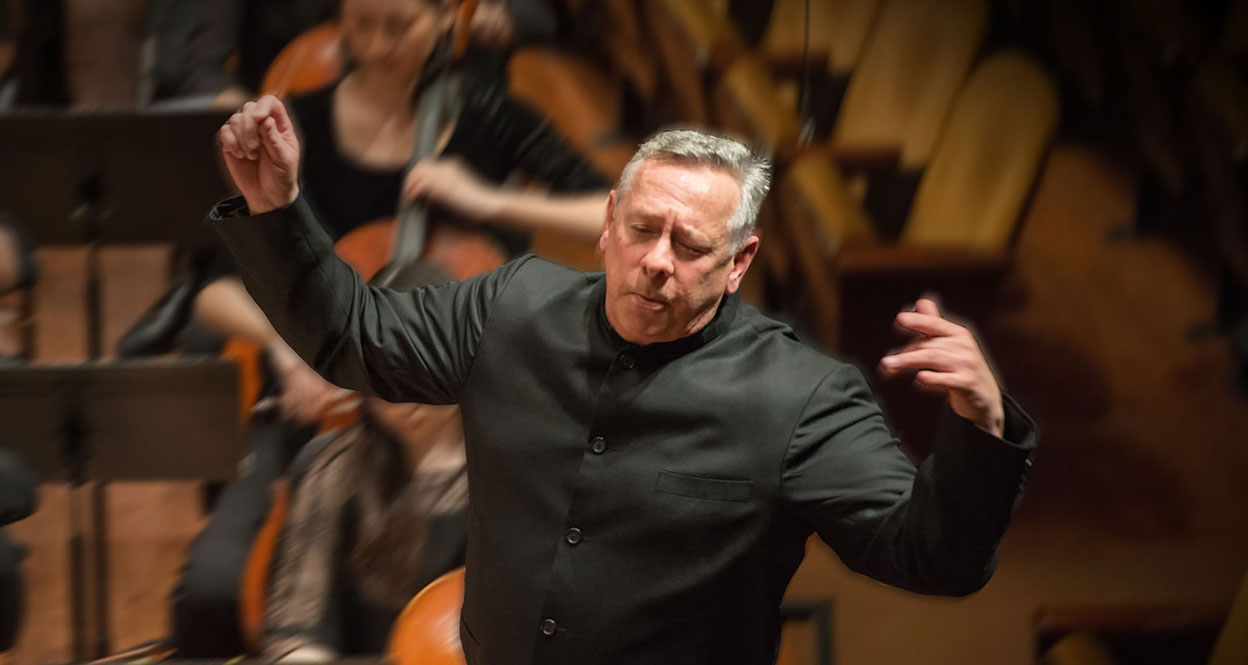
Mr. Radcliffe has an interest in the music of the early 20th century, meaning the earliest and best years of modernism. He looks at music with a historian’s eye, re-creating important musical events with modern forces. For those forces he unites smaller chamber groups under his “Chamber Ensemble” banner, the current components being the Chester String Quartet and the piano and wind sextet Hexagon, with additional freelance forces added as necessary.

Friday night’s program at Gould Hall, which enlisted 22 instrumentalists and 7 singers, counted as one of the ensemble’s best. In 1927 the prestigious, composer-organized summer festival at Donaueschingen, in what is now West Germany, moved over to Baden-Baden, which had a bigger hall. The central program, on July 17, presented staged performances of four new chamber operas by Ernst Toch, Darius Milhaud, Kurt Weill and Paul Hindemith, ranging in length — the timings are those from Friday — from 11 minutes to 33 minutes.

Mr. Radcliffe re-created that program with a few variations. The most important was that in Baden-Baden the operas were staged with proper sets and costumes; in New York, despite some effective hints of characterization, they were given in concert form. The order was juggled, too, ending with the longest piece, the Toch. Musical interludes were omitted, most piquantly Milhaud’s jazzy “Création du Monde,” which received its first performance in Baden-Baden.

Chamber operas of Weill, Milhaud, Hindemith and Ernst Toch.

Friday’s program was rather grandly entitled “The Birth of Chamber Opera.” That does a disservice to more than 300 years of earlier chamber operas. It also suggests that these 1927 scores had a profound impact on music to come. Since some pessimists count 1925 as the year the operatic canon stopped admitting new entries, and since Nazism and World War II disrupted artistic evolution of all kinds, that is hard to sustain. Certainly there were all manner of theatrical “actions” in the 1960’s, but they were generally closer to today’s performance art than 1927’s operatic compressions.

That said, the 1927 evening was clearly an event, and given the quality of at least three of the scores and of the performances, Friday was also something of an event. The music sounded urgent, amusing and ingenious, full of a spirit of adventure and even an optimism that was soon to be dashed by larger political events.

Far and away the most famous and influential of the four scores was Weill’s “Mahagonny Songspiel,” a 27-minute song sequence that soon grew into the full-dress “Rise and Fall of the City of Mahagonny,” which the Metropolitan Opera has done with success.

The “Songspiel” crops up fairly often, but few performances have matched Friday’s in the crispness and spunky clarity of the instrumental playing. Hearing the music so performed, one could appreciate anew the brilliance with which Weill synthesized Bertolt Brecht’s cabaret obsessions, jazz and modernist formalism. The singing — all night — was by no means bad, either.

The program opened with Hindemith’s “There and Back,” Marion J. Farquhar’s English version of “Hin und Zurück.” This 11-minute score depicts a jealous husband’s murder of his wife, the intercession of an angel and then the filmic rewinding of the events back to the opening marital bliss, the second half being an exact musical reversal of the first half. More a cute joke than evocative music, the opera succeeds because it is a joke and is most definitely cute.

The most successful mix of musical economy and invention was Milhaud’s “Abduction of Europa,” heard in an Eric Smith translation. Here, more than in any of the other three operas, one feels that the composer has made a complete, ingenious and fully satisfying statement within the limits set by the festival’s commissioners.

Finally, Toch’s “Princess and the Pea” (again in a Farquhar translation) emerged as not only the longest but also the most operatically and musically conventional of the lot. Posterity is not as dumb as is sometimes asserted; there’s a reason Toch is now less famous than the other three composers on this bill.

Singers for the evening were Katherine Johnson, Margaret Bishop, Nancy Ortez, Mark Bleeke, Michael Brown, Richard Holmes and Robert Osborne.
The New York Times NEW YORK, MONDAY, JUNE 4, 1990 Re-creating a Musical Event of 1927 By JOHN ROCKWELL Since 1987, Stephen Rogers Radcliffe and his New York Chamber Ensemble have been presenting some of New York's friskiest programming — and performances, one hastens to add, since intention without follow-through equals mere conceit. Mr. Radcliffe has an interest in the music of the early 20th century, meaning the earliest and best years of modernism. He looks at music with a historian's eye, re-creating important musical events with modern forces. For those forces he unites smaller chamber groups under his "Chamber Ensemble" banner, the current components being the Chester String Quartet and the piano and wind sextet Hexagon, with additional freelance forces added as necessary. Friday night's program at Gould Hall, which enlisted 22 instrumentalists and 7 singers, counted as one of the ensemble's best. In 1927 the prestigious, composer-organized summer festival at Donaueschingen, in what is now West Germany, moved over to Baden-Baden, which had a bigger hall. The central program, on July 17, presented staged performances of four new chamber operas by Ernst Toch, Darius Milhaud, Kurt Weill and Paul Hindemith, ranging in length — the timings are those from Friday — from 11 minutes to 33 minutes. Mr. Radcliffe re-created that program with a few variations. The most important was that in Baden-Baden the operas were staged with proper sets and costumes; in New York, despite some effective hints of characterization, they were given in concert form. The order was juggled, too, ending with the longest piece, the Toch. Musical interludes were omitted, most piquantly Milhaud's jazzy "Création du Monde," which received its first performance in Baden-Baden. Chamber operas of Weill, Milhaud, Hindemith and Ernst Toch. Friday's program was rather grandly entitled "The Birth of Chamber Opera." That does a disservice to more than 300 years of earlier chamber operas. It also suggests that these 1927 scores had a profound impact on music to come. Since some pessimists count 1925 as the year the operatic canon stopped admitting new entries, and since Nazism and World War II disrupted artistic evolution of all kinds, that is hard to sustain. Certainly there were all manner of theatrical "actions" in the 1960's, but they were generally closer to today's performance art than 1927's operatic compressions. That said, the 1927 evening was clearly an event, and given the quality of at least three of the scores and of the performances, Friday was also something of an event. The music sounded urgent, amusing and ingenious, full of a spirit of adventure and even an optimism that was soon to be dashed by larger political events. Far and away the most famous and influential of the four scores was Weill's "Mahagonny Songspiel," a 27-minute song sequence that soon grew into the full-dress "Rise and Fall of the City of Mahagonny," which the Metropolitan Opera has done with success. The "Songspiel" crops up fairly often, but few performances have matched Friday's in the crispness and spunky clarity of the instrumental playing. Hearing the music so performed, one could appreciate anew the brilliance with which Weill synthesized Bertolt Brecht's cabaret obsessions, jazz and modernist formalism. The singing — all night — was by no means bad, either. The program opened with Hindemith's "There and Back," Marion J. Farquhar's English version of "Hin und Zurück." This 11-minute score depicts a jealous husband's murder of his wife, the intercession of an angel and then the filmic rewinding of the events back to the opening marital bliss, the second half being an exact musical reversal of the first half. More a cute joke than evocative music, the opera succeeds because it is a joke and is most definitely cute. The most successful mix of musical economy and invention was Milhaud's "Abduction of Europa," heard in an Eric Smith translation. Here, more than in any of the other three operas, one feels that the composer has made a complete, ingenious and fully satisfying statement within the limits set by the festival's commissioners. Finally, Toch's "Princess and the Pea" (again in a Farquhar translation) emerged as not only the longest but also the most operatically and musically conventional of the lot. Posterity is not as dumb as is sometimes asserted; there's a reason Toch is now less famous than the other three composers on this bill. Singers for the evening were Katherine Johnson, Margaret Bishop, Nancy Ortez, Mark Bleeke, Michael Brown, Richard Holmes and Robert Osborne.
Music: ‘Verein Revisited,’ By Chamber Ensemble

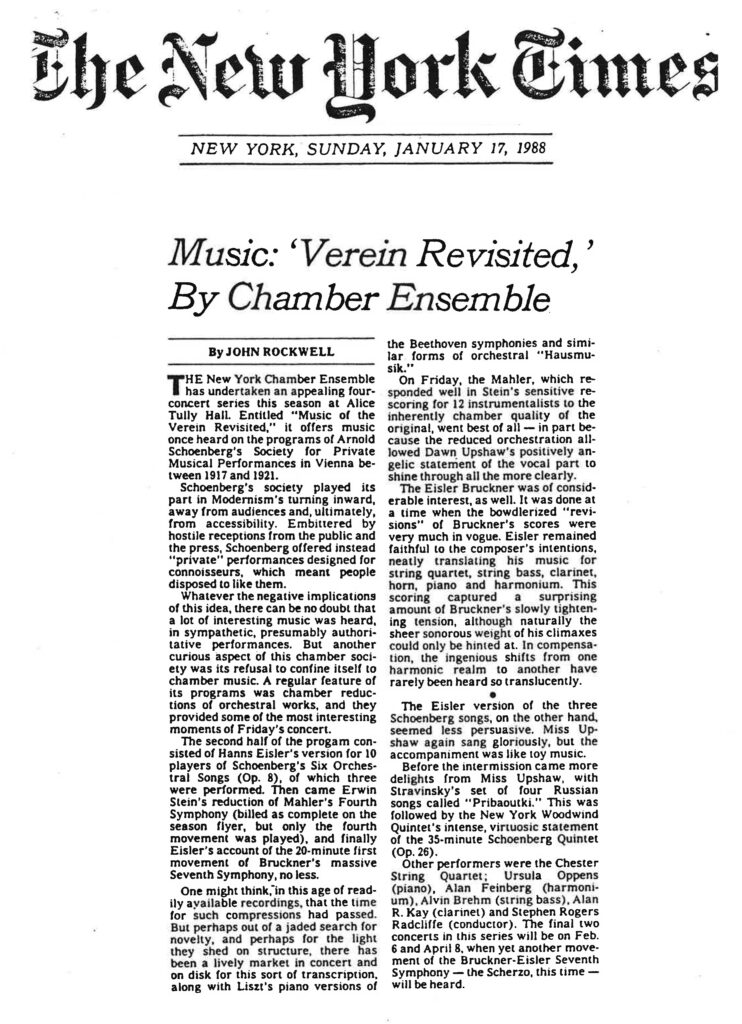
Based on the second image provided, here is the retyped article: The New York Times NEW YORK, SUNDAY, JANUARY 17, 1988 Music: ‘Verein Revisited,’ By Chamber Ensemble By JOHN ROCKWELL The New York Chamber Ensemble has undertaken an appealing four-concert series this season at Alice Tully Hall. Entitled "Music of the Verein Revisited," it offers music once heard on the programs of Arnold Schoenberg's Society for Private Musical Performances in Vienna between 1917 and 1921. Schoenberg's society played its part in Modernism's turning inward, away from audiences and, ultimately, from accessibility. Embittered by hostile receptions from the public and the press, Schoenberg offered instead "private" performances designed for connoisseurs, which meant people disposed to like them. Whatever the negative implications of this idea, there can be no doubt that a lot of interesting music was heard, in sympathetic, presumably authoritative performances. But another curious aspect of this chamber society was its refusal to confine itself to chamber music. A regular feature of its programs was chamber reductions of orchestral works, and they provided some of the most interesting moments of Friday's concert. The second half of the program consisted of Hanns Eisler's version for 10 players of Schoenberg's Six Orchestral Songs (Op. 8), of which three were performed. Then came Erwin Stein's reduction of Mahler's Fourth Symphony (billed as complete on the season flyer, but only the fourth movement was played), and finally Eisler's account of the 20-minute first movement of Bruckner's massive Seventh Symphony, no less. One might think, in this age of readily available recordings, that the time for such compressions had passed. But perhaps out of a jaded search for novelty, and perhaps for the light they shed on structure, there has been a lively market in concert and on disk for this sort of transcription, along with Liszt's piano versions of the Beethoven symphonies and similar forms of orchestral "Hausmusik." On Friday, the Mahler, which responded well in Stein's sensitive re-scoring for 12 instrumentalists to the inherently chamber quality of the original, went best of all — in part because the reduced orchestration allowed Dawn Upshaw's positively angelic statement of the vocal part to shine through all the more clearly. The Eisler Bruckner was of considerable interest, as well. It was done at a time when the bowdlerized "revisions" of Bruckner's scores were very much in vogue. Eisler remained faithful to the composer's intentions, neatly translating his music for string quartet, string bass, clarinet, horn, piano and harmonium. This scoring captured a surprising amount of Bruckner's slowly tightening tension, although naturally the sheer sonorous weight of his climaxes could only be hinted at. In compensation, the ingenious shifts from one harmonic realm to another have rarely been heard so translucently. • The Eisler version of the three Schoenberg songs, on the other hand, seemed less persuasive. Miss Upshaw again sang gloriously, but the accompaniment was like toy music. Before the intermission came more delights from Miss Upshaw, with Stravinsky's set of four Russian songs called "Pribaoutki." This was followed by the New York Woodwind Quintet's intense, virtuosic statement of the 35-minute Schoenberg Quintet (Op. 26). Other performers were the Chester String Quartet; Ursula Oppens (piano), Alan Feinberg (harmonium), Alvin Brehm (string bass), Alan R. Kay (clarinet) and Stephen Rogers Radcliffe (conductor). The final two concerts in this series will be on Feb. 6 and April 8, when yet another movement of the Bruckner-Eisler Seventh Symphony — the Scherzo, this time — will be heard.

Press | Opera Reviews

The New York Times Logo

Sunday, January 17, 1988

Music: ‘Verein Revisited,’ By Chamber Ensemble

By John Rockwell

The New York Chamber Ensemble has undertaken an appealing four-concert series this season at Alice Tully Hall. Entitled “Music of the Verein Revisited,” it offers music once heard on the programs of Arnold Schoenberg’s Society for Private Musical Performances in Vienna between 1917 and 1921.

Schoenberg’s society played its part in Modernism’s turning inward, away from audiences and, ultimately, from accessibility. Embittered by hostile receptions from the public and the press, Schoenberg offered instead “private” performances designed for connoisseurs, which meant people disposed to like them.

Whatever the negative implications of this idea, there can be no doubt that a lot of interesting music was heard, in sympathetic, presumably authoritative performances. But another curious aspect of this chamber society was its refusal to confine itself to chamber music. A regular feature of its programs was chamber reductions of orchestral works, and they provided some of the most interesting moments of Friday’s concert.

The second half of the program consisted of Hanns Eisler’s version for 10 players of Schoenberg’s Six Orchestral Songs (Op. 8), of which three were performed. Then came Erwin Stein’s reduction of Mahler’s Fourth Symphony (billed as complete on the season flyer, but only the fourth movement was played), and finally Eisler’s account of the 20-minute first movement of Bruckner’s massive Seventh Symphony, no less.

One might think, in this age of readily available recordings, that the time for such compressions had passed. But perhaps out of a jaded search for novelty, and perhaps for the light they shed on structure, there has been a lively market in concert and on disk for this sort of transcription, along with Liszt’s piano versions of the Beethoven symphonies and similar forms of orchestral “Hausmusik.”

On Friday, the Mahler, which responded well in Stein’s sensitive re-scoring for 12 instrumentalists to the inherently chamber quality of the original, went best of all — in part because the reduced orchestration allowed Dawn Upshaw’s positively angelic statement of the vocal part to shine through all the more clearly.

The Eisler Bruckner was of considerable interest, as well. It was done at a time when the bowdlerized “revisions” of Bruckner’s scores were very much in vogue. Eisler remained faithful to the composer’s intentions, neatly translating his music for string quartet, string bass, clarinet, horn, piano and harmonium. This scoring captured a surprising amount of Bruckner’s slowly tightening tension, although naturally the sheer sonorous weight of his climaxes could only be hinted at. In compensation, the ingenious shifts from one harmonic realm to another have rarely been heard so translucently.

The Eisler version of the three Schoenberg songs, on the other hand, seemed less persuasive. Miss Upshaw again sang gloriously, but the accompaniment was like toy music.

Before the intermission came more delights from Miss Upshaw, with Stravinsky’s set of four Russian songs called “Pribaoutki.” This was followed by the New York Woodwind Quintet’s intense, virtuosic statement of the 35-minute Schoenberg Quintet (Op. 26).

Other performers were the Chester String Quartet; Ursula Oppens (piano), Alan Feinberg (harmonium), Alvin Brehm (string bass), Alan R. Kay (clarinet) and Stephen Rogers Radcliffe (conductor). The final two concerts in this series will be on Feb. 6 and April 8, when yet another movement of the Bruckner-Eisler Seventh Symphony — the Scherzo, this time — will be heard.

Based on the second image provided, here is the retyped article: The New York Times NEW YORK, SUNDAY, JANUARY 17, 1988 Music: ‘Verein Revisited,’ By Chamber Ensemble By JOHN ROCKWELL The New York Chamber Ensemble has undertaken an appealing four-concert series this season at Alice Tully Hall. Entitled "Music of the Verein Revisited," it offers music once heard on the programs of Arnold Schoenberg's Society for Private Musical Performances in Vienna between 1917 and 1921. Schoenberg's society played its part in Modernism's turning inward, away from audiences and, ultimately, from accessibility. Embittered by hostile receptions from the public and the press, Schoenberg offered instead "private" performances designed for connoisseurs, which meant people disposed to like them. Whatever the negative implications of this idea, there can be no doubt that a lot of interesting music was heard, in sympathetic, presumably authoritative performances. But another curious aspect of this chamber society was its refusal to confine itself to chamber music. A regular feature of its programs was chamber reductions of orchestral works, and they provided some of the most interesting moments of Friday's concert. The second half of the program consisted of Hanns Eisler's version for 10 players of Schoenberg's Six Orchestral Songs (Op. 8), of which three were performed. Then came Erwin Stein's reduction of Mahler's Fourth Symphony (billed as complete on the season flyer, but only the fourth movement was played), and finally Eisler's account of the 20-minute first movement of Bruckner's massive Seventh Symphony, no less. One might think, in this age of readily available recordings, that the time for such compressions had passed. But perhaps out of a jaded search for novelty, and perhaps for the light they shed on structure, there has been a lively market in concert and on disk for this sort of transcription, along with Liszt's piano versions of the Beethoven symphonies and similar forms of orchestral "Hausmusik." On Friday, the Mahler, which responded well in Stein's sensitive re-scoring for 12 instrumentalists to the inherently chamber quality of the original, went best of all — in part because the reduced orchestration allowed Dawn Upshaw's positively angelic statement of the vocal part to shine through all the more clearly. The Eisler Bruckner was of considerable interest, as well. It was done at a time when the bowdlerized "revisions" of Bruckner's scores were very much in vogue. Eisler remained faithful to the composer's intentions, neatly translating his music for string quartet, string bass, clarinet, horn, piano and harmonium. This scoring captured a surprising amount of Bruckner's slowly tightening tension, although naturally the sheer sonorous weight of his climaxes could only be hinted at. In compensation, the ingenious shifts from one harmonic realm to another have rarely been heard so translucently. • The Eisler version of the three Schoenberg songs, on the other hand, seemed less persuasive. Miss Upshaw again sang gloriously, but the accompaniment was like toy music. Before the intermission came more delights from Miss Upshaw, with Stravinsky's set of four Russian songs called "Pribaoutki." This was followed by the New York Woodwind Quintet's intense, virtuosic statement of the 35-minute Schoenberg Quintet (Op. 26). Other performers were the Chester String Quartet; Ursula Oppens (piano), Alan Feinberg (harmonium), Alvin Brehm (string bass), Alan R. Kay (clarinet) and Stephen Rogers Radcliffe (conductor). The final two concerts in this series will be on Feb. 6 and April 8, when yet another movement of the Bruckner-Eisler Seventh Symphony — the Scherzo, this time — will be heard.