An Homage to a Teacher

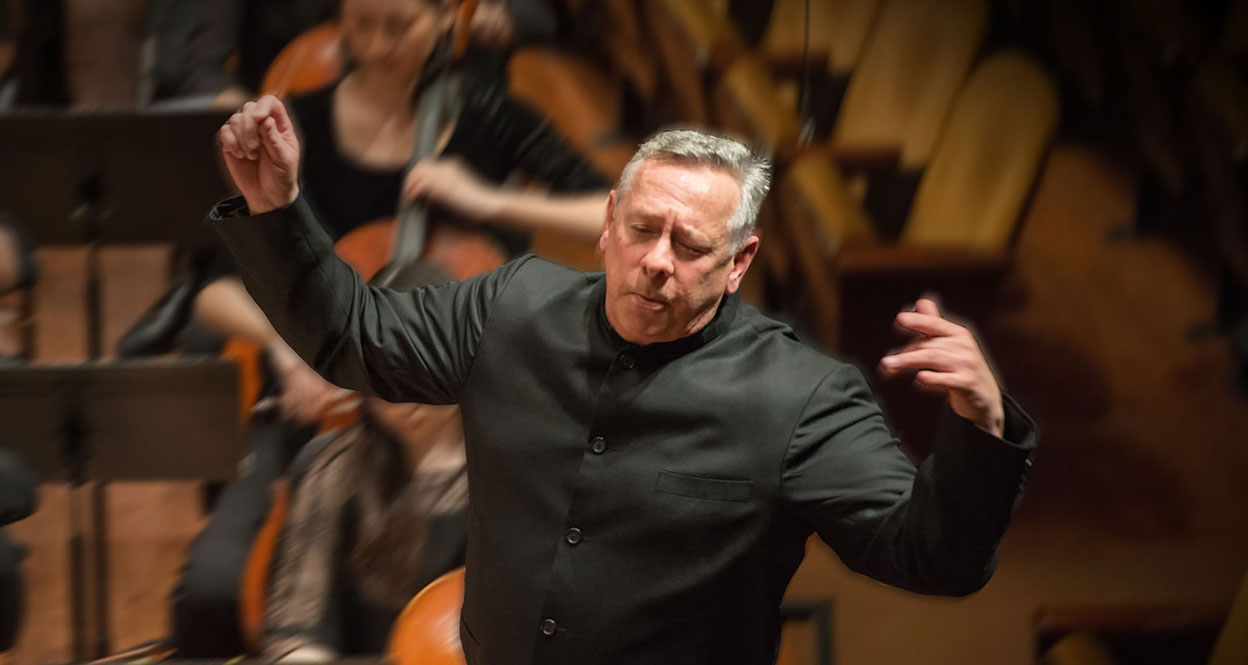
New York Newsday Monday, April 9, 1990 Stephen Rogers Radcliffe, Conductor MUSIC REVIEW An Homage to a Teacher AMERICANS IN PARIS: STUDENTS OF NADIA BOULANGER. Music by Aaron Copland, Roy Harris, David Diamond, Ned Rorem. New York Chamber Ensemble (Chester String Quartet, Hexagon), Stephen Rogers Radcliffe, conductor. Friday night. Florence Gould Hall, Alliance Francaise, 55 E. 59 St., Manhattan. By Peter Goodman THE MARK OF the great teacher is her ability to help the pupil be himself, not merely an image of the mentor. Nadia Boulanger was that sort of teacher. Renowned in the American musical world as the French pedagogue around whom gathered generations of aspiring composers from Virgil Thomson to Philip Glass, it is clear that whatever she taught them, she did not force them into her own mold. On Friday night, the New York Chamber Ensemble, an ambitious young group that includes a string quartet, a wind ensemble and other musicians, presented an attractive program devoted to the work of four of Boulanger's students. It was an evening of prima facie evidence that whatever Nadia Boulanger did, she didn't distort the voices of Aaron Copland, Roy Harris, David Diamond or Ned Rorem. Indeed, only Rorem, the youngest of the four composers, could be said to speak in French. The program opened with two works for clarinet, piano and string quartet: Copland's Sextet, a reworking of his "Short Symphony," and Harris' Concerto for Clarinet, Piano and Strings. Their only similarity was the instrumentation. Copland created the Sextet in 1937 after failing to gain performances of the "Short Symphony," completed in 1933. Although written in his artistic rather than populist style, the similarities between the composer's two voices are plain: harmonies of seconds and ninths, electric rhythms, lovely writing for clarinet, bursts of lyricism squeezed between dense blocks of sound. It's the work of a master, and the Chester String Quartet (part of the ensemble) played with an ease that belied all the difficulty musicians found with the work 45 years ago. Harris' concerto is immediately more lyrical and elegiac, with its slow, deep introduction on clarinet and piano, and its long, singing lines. If Copland was a tough city kid, Harris was a singer from the country. The concerto is full of richness, both harmonic and contrapuntal, and a sense of ease not found in Copland. Ultimately, the concerto is too relaxed and doesn't keep the listener involved. The second half included David Diamond's Concerto for Chamber Orchestra, written in 1940, and Ned Rorem's Eleven Studies for Eleven Players. The Diamond was the most awkward piece on the program, straightforward, with square rhythms and steady pulse and a sense of self-conscious seriousness that kept it from coming alive. Only during the two sprightly, dancing fugues did one hear what seemed to be the composer's natural voice. Rorem, of course, has never hidden his natural voice, witty, epigrammatic, cool and lyrical — French. In the Eleven Studies, various combinations of strings, winds, brass and percussion sing, dance, joke or whisper mysteriously, an exquisite platter of aural hors d'oeuvres. The performances were fine, crisp and lively, particularly the playing of trumpeter Stephen Burns, oboist Matthew Dine and pianist David Korevaar. Steven Rogers Radcliffe conducted. The concert, by the way, was part of a series in Florence Gould Hall, an excellent chamber two stories below ground level at the Alliance Francaise on East 59th Street. It's a hall that deserves more activity. / II [Caption under photo: Stephen Rogers Radcliffe conducted the works composed by Nadia Boulanger's students.]

Press | Symphonic Reviews

Monday, April 9, 1990

An Homage to a Teacher

By Peter Goodman

AMERICANS IN PARIS: STUDENTS OF NADIA BOULANGER.

Music by Aaron Copland, Roy Harris, David Diamond, Ned Rorem. New York Chamber Ensemble (Chester String Quartet, Hexagon), Stephen Rogers Radcliffe, conductor. Friday night. Florence Gould Hall, Alliance Francaise, 55 E. 59 St., Manhattan.

THE MARK OF the great teacher is her ability to help the pupil be himself, not merely an image of the mentor.

Nadia Boulanger was that sort of teacher. Renowned in the American musical world as the French pedagogue around whom gathered generations of aspiring composers from Virgil Thomson to Philip Glass, it is clear that whatever she taught them, she did not force them into her own mold.

On Friday night, the New York Chamber Ensemble, an ambitious young group that includes a string quartet, a wind ensemble and other musicians, presented an attractive program devoted to the work of four of Boulanger’s students. It was an evening of prima facie evidence that whatever Nadia Boulanger did, she didn’t distort the voices of Aaron Copland, Roy Harris, David Diamond or Ned Rorem. Indeed, only Rorem, the youngest of the four composers, could be said to speak in French.

The program opened with two works for clarinet, piano and string quartet: Copland’s Sextet, a reworking of his “Short Symphony,” and Harris’ Concerto for Clarinet, Piano and Strings. Their only similarity was the instrumentation.

Copland created the Sextet in 1937 after failing to gain performances of the “Short Symphony,” completed in 1933. Although written in his artistic rather than populist style, the similarities between the composer’s two voices are plain: harmonies of seconds and ninths, electric rhythms, lovely writing for clarinet, bursts of lyricism squeezed between dense blocks of sound. It’s the work of a master, and the Chester String Quartet (part of the ensemble) played with an ease that belied all the difficulty musicians found with the work 45 years ago.

Harris’ concerto is immediately more lyrical and elegiac, with its slow, deep introduction on clarinet and piano, and its long, singing lines. If Copland was a tough city kid, Harris was a singer from the country. The concerto is full of richness, both harmonic and contrapuntal, and a sense of ease not found in Copland. Ultimately, the concerto is too relaxed and doesn’t keep the listener involved.

The second half included David Diamond’s Concerto for Chamber Orchestra, written in 1940, and Ned Rorem’s Eleven Studies for Eleven Players. The Diamond was the most awkward piece on the program, straightforward, with square rhythms and steady pulse and a sense of self-conscious seriousness that kept it from coming alive. Only during the two sprightly, dancing fugues did one hear what seemed to be the composer’s natural voice.

Rorem, of course, has never hidden his natural voice, witty, epigrammatic, cool and lyrical — French. In the Eleven Studies, various combinations of strings, winds, brass and percussion sing, dance, joke or whisper mysteriously, an exquisite platter of aural hors d’oeuvres.

The performances were fine, crisp and lively, particularly the playing of trumpeter Stephen Burns, oboist Matthew Dine and pianist David Korevaar. Steven Rogers Radcliffe conducted.

The concert, by the way, was part of a series in Florence Gould Hall, an excellent chamber two stories below ground level at the Alliance Francaise on East 59th Street. It’s a hall that deserves more activity. / II

New York Newsday Monday, April 9, 1990 Stephen Rogers Radcliffe, Conductor MUSIC REVIEW An Homage to a Teacher AMERICANS IN PARIS: STUDENTS OF NADIA BOULANGER. Music by Aaron Copland, Roy Harris, David Diamond, Ned Rorem. New York Chamber Ensemble (Chester String Quartet, Hexagon), Stephen Rogers Radcliffe, conductor. Friday night. Florence Gould Hall, Alliance Francaise, 55 E. 59 St., Manhattan. By Peter Goodman THE MARK OF the great teacher is her ability to help the pupil be himself, not merely an image of the mentor. Nadia Boulanger was that sort of teacher. Renowned in the American musical world as the French pedagogue around whom gathered generations of aspiring composers from Virgil Thomson to Philip Glass, it is clear that whatever she taught them, she did not force them into her own mold. On Friday night, the New York Chamber Ensemble, an ambitious young group that includes a string quartet, a wind ensemble and other musicians, presented an attractive program devoted to the work of four of Boulanger's students. It was an evening of prima facie evidence that whatever Nadia Boulanger did, she didn't distort the voices of Aaron Copland, Roy Harris, David Diamond or Ned Rorem. Indeed, only Rorem, the youngest of the four composers, could be said to speak in French. The program opened with two works for clarinet, piano and string quartet: Copland's Sextet, a reworking of his "Short Symphony," and Harris' Concerto for Clarinet, Piano and Strings. Their only similarity was the instrumentation. Copland created the Sextet in 1937 after failing to gain performances of the "Short Symphony," completed in 1933. Although written in his artistic rather than populist style, the similarities between the composer's two voices are plain: harmonies of seconds and ninths, electric rhythms, lovely writing for clarinet, bursts of lyricism squeezed between dense blocks of sound. It's the work of a master, and the Chester String Quartet (part of the ensemble) played with an ease that belied all the difficulty musicians found with the work 45 years ago. Harris' concerto is immediately more lyrical and elegiac, with its slow, deep introduction on clarinet and piano, and its long, singing lines. If Copland was a tough city kid, Harris was a singer from the country. The concerto is full of richness, both harmonic and contrapuntal, and a sense of ease not found in Copland. Ultimately, the concerto is too relaxed and doesn't keep the listener involved. The second half included David Diamond's Concerto for Chamber Orchestra, written in 1940, and Ned Rorem's Eleven Studies for Eleven Players. The Diamond was the most awkward piece on the program, straightforward, with square rhythms and steady pulse and a sense of self-conscious seriousness that kept it from coming alive. Only during the two sprightly, dancing fugues did one hear what seemed to be the composer's natural voice. Rorem, of course, has never hidden his natural voice, witty, epigrammatic, cool and lyrical — French. In the Eleven Studies, various combinations of strings, winds, brass and percussion sing, dance, joke or whisper mysteriously, an exquisite platter of aural hors d'oeuvres. The performances were fine, crisp and lively, particularly the playing of trumpeter Stephen Burns, oboist Matthew Dine and pianist David Korevaar. Steven Rogers Radcliffe conducted. The concert, by the way, was part of a series in Florence Gould Hall, an excellent chamber two stories below ground level at the Alliance Francaise on East 59th Street. It's a hall that deserves more activity. / II [Caption under photo: Stephen Rogers Radcliffe conducted the works composed by Nadia Boulanger's students.]

A Concert Is Heard — 77 Years Later

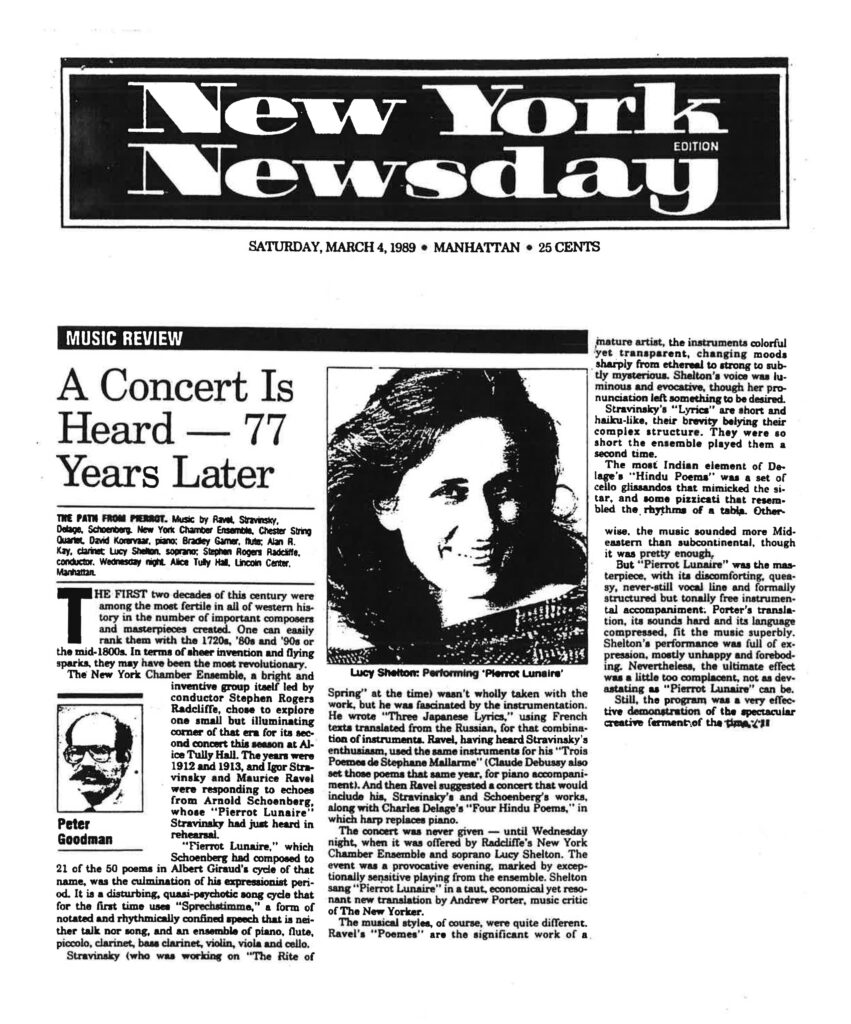
New York Newsday SATURDAY, MARCH 4, 1989 • MANHATTAN • 25 CENTS MUSIC REVIEW A Concert Is Heard — 77 Years Later THE PATH FROM PIERROT. Music by Ravel, Stravinsky, Delage, Schoenberg. New York Chamber Ensemble, Chester String Quartet, David Korevaar, piano; Bradley Garner, flute; Alan R. Kay, clarinet; Lucy Shelton, soprano; Stephen Rogers Radcliffe, conductor. Wednesday night. Alice Tully Hall, Lincoln Center, Manhattan. By Peter Goodman THE FIRST two decades of this century were among the most fertile in all of western history in the number of important composers and masterpieces created. One can easily rank them with the 1720s, '80s and '90s or the mid-1800s. In terms of sheer invention and flying sparks, they may have been the most revolutionary. The New York Chamber Ensemble, a bright and inventive group itself led by conductor Stephen Rogers Radcliffe, chose to explore one small but illuminating corner of that era for its second concert this season at Alice Tully Hall. The years were 1912 and 1913, and Igor Stravinsky and Maurice Ravel were responding to echoes from Arnold Schoenberg, whose "Pierrot Lunaire" Stravinsky had just heard in rehearsal. "Pierrot Lunaire," which Schoenberg had composed to 21 of the 50 poems in Albert Giraud's cycle of that name, was the culmination of his expressionist period. It is a disturbing, quasi-psychotic song cycle that for the first time uses "Sprechstimme," a form of notated and rhythmically confined speech that is neither talk nor song, and an ensemble of piano, flute, piccolo, clarinet, bass clarinet, violin, viola and cello. Stravinsky (who was working on "The Rite of Spring" at the time) wasn't wholly taken with the work, but he was fascinated by the instrumentation. He wrote "Three Japanese Lyrics," using French texts translated from the Russian, for that combination of instruments. Ravel, having heard Stravinsky's enthusiasm, used the same instruments for his "Trois Poèmes de Stephane Mallarmé" (Claude Debussy also set those poems that same year, for piano accompaniment). And then Ravel suggested a concert that would include his, Stravinsky's and Schoenberg's works, along with Charles Delage's "Four Hindu Poems," in which harp replaces piano. The concert was never given — until Wednesday night, when it was offered by Radcliffe's New York Chamber Ensemble and soprano Lucy Shelton. The event was a provocative evening, marked by exceptionally sensitive playing from the ensemble. Shelton sang "Pierrot Lunaire" in a taut, economical yet resonant new translation by Andrew Porter, music critic of The New Yorker. The musical styles, of course, were quite different. Ravel's "Poèmes" are the significant work of a mature artist, the instruments colorful yet transparent, changing moods sharply from ethereal to strong to subtly mysterious. Shelton's voice was luminous and evocative, though her pronunciation left something to be desired. Stravinsky's "Lyrics" are short and haiku-like, their brevity belying their complex structure. They were so short the ensemble played them a second time. The most Indian element of Delage's "Hindu Poems" was a set of cello glissandos that mimicked the sitar, and some pizzicati that resembled the rhythms of a tabla. Otherwise, the music sounded more Mideastern than subcontinental, though it was pretty enough. But "Pierrot Lunaire" was the masterpiece, with its discomforting, queasy, never-still vocal line and formally structured but tonally free instrumental accompaniment. Porter's translation, its sounds hard and its language compressed, fit the music superbly. Shelton's performance was full of expression, mostly unhappy and foreboding. Nevertheless, the ultimate effect was a little too complacent, not as devastating as "Pierrot Lunaire" can be. Still, the program was a very effective demonstration of the spectacular creative ferment of the time.

Press | Symphonic Reviews

Sunday, March 4, 1989

A Concert Is Heard — 77 Years Later

By Peter Goodman

THE PATH FROM PIERROT. Music by Ravel, Stravinsky, Delage, Schoenberg. New York Chamber Ensemble, Chester String Quartet, David Korevaar, piano; Bradley Garner, flute; Alan R. Kay, clarinet; Lucy Shelton, soprano; Stephen Rogers Radcliffe, conductor. Wednesday night. Alice Tully Hall, Lincoln Center, Manhattan.

THE FIRST two decades of this century were among the most fertile in all of western history in the number of important composers and masterpieces created. One can easily rank them with the 1720s, ’80s and ’90s or the mid-1800s. In terms of sheer invention and flying sparks, they may have been the most revolutionary.

The New York Chamber Ensemble, a bright and inventive group itself led by conductor Stephen Rogers Radcliffe, chose to explore one small but illuminating corner of that era for its second concert this season at Alice Tully Hall. The years were 1912 and 1913, and Igor Stravinsky and Maurice Ravel were responding to echoes from Arnold Schoenberg, whose “Pierrot Lunaire” Stravinsky had just heard in rehearsal.

“Pierrot Lunaire,” which Schoenberg had composed to 21 of the 50 poems in Albert Giraud’s cycle of that name, was the culmination of his expressionist period. It is a disturbing, quasi-psychotic song cycle that for the first time uses “Sprechstimme,” a form of notated and rhythmically confined speech that is neither talk nor song, and an ensemble of piano, flute, piccolo, clarinet, bass clarinet, violin, viola and cello.

Stravinsky (who was working on “The Rite of Spring” at the time) wasn’t wholly taken with the work, but he was fascinated by the instrumentation. He wrote “Three Japanese Lyrics,” using French texts translated from the Russian, for that combination of instruments. Ravel, having heard Stravinsky’s enthusiasm, used the same instruments for his “Trois Poèmes de Stephane Mallarmé” (Claude Debussy also set those poems that same year, for piano accompaniment). And then Ravel suggested a concert that would include his, Stravinsky’s and Schoenberg’s works, along with Charles Delage’s “Four Hindu Poems,” in which harp replaces piano.

The concert was never given — until Wednesday night, when it was offered by Radcliffe’s New York Chamber Ensemble and soprano Lucy Shelton. The event was a provocative evening, marked by exceptionally sensitive playing from the ensemble. Shelton sang “Pierrot Lunaire” in a taut, economical yet resonant new translation by Andrew Porter, music critic of The New Yorker.
The musical styles, of course, were quite different. Ravel’s “Poèmes” are the significant work of a mature artist, the instruments colorful yet transparent, changing moods sharply from ethereal to strong to subtly mysterious. Shelton’s voice was luminous and evocative, though her pronunciation left something to be desired.

Stravinsky’s “Lyrics” are short and haiku-like, their brevity belying their complex structure. They were so short the ensemble played them a second time.
The most Indian element of Delage’s “Hindu Poems” was a set of cello glissandos that mimicked the sitar, and some pizzicati that resembled the rhythms of a tabla. Otherwise, the music sounded more Mideastern than subcontinental, though it was pretty enough.

But “Pierrot Lunaire” was the masterpiece, with its discomforting, queasy, never-still vocal line and formally structured but tonally free instrumental accompaniment. Porter’s translation, its sounds hard and its language compressed, fit the music superbly. Shelton’s performance was full of expression, mostly unhappy and foreboding. Nevertheless, the ultimate effect was a little too complacent, not as devastating as “Pierrot Lunaire” can be.

Still, the program was a very effective demonstration of the spectacular creative ferment of the time.

New York Newsday SATURDAY, MARCH 4, 1989 • MANHATTAN • 25 CENTS MUSIC REVIEW A Concert Is Heard — 77 Years Later THE PATH FROM PIERROT. Music by Ravel, Stravinsky, Delage, Schoenberg. New York Chamber Ensemble, Chester String Quartet, David Korevaar, piano; Bradley Garner, flute; Alan R. Kay, clarinet; Lucy Shelton, soprano; Stephen Rogers Radcliffe, conductor. Wednesday night. Alice Tully Hall, Lincoln Center, Manhattan. By Peter Goodman THE FIRST two decades of this century were among the most fertile in all of western history in the number of important composers and masterpieces created. One can easily rank them with the 1720s, '80s and '90s or the mid-1800s. In terms of sheer invention and flying sparks, they may have been the most revolutionary. The New York Chamber Ensemble, a bright and inventive group itself led by conductor Stephen Rogers Radcliffe, chose to explore one small but illuminating corner of that era for its second concert this season at Alice Tully Hall. The years were 1912 and 1913, and Igor Stravinsky and Maurice Ravel were responding to echoes from Arnold Schoenberg, whose "Pierrot Lunaire" Stravinsky had just heard in rehearsal. "Pierrot Lunaire," which Schoenberg had composed to 21 of the 50 poems in Albert Giraud's cycle of that name, was the culmination of his expressionist period. It is a disturbing, quasi-psychotic song cycle that for the first time uses "Sprechstimme," a form of notated and rhythmically confined speech that is neither talk nor song, and an ensemble of piano, flute, piccolo, clarinet, bass clarinet, violin, viola and cello. Stravinsky (who was working on "The Rite of Spring" at the time) wasn't wholly taken with the work, but he was fascinated by the instrumentation. He wrote "Three Japanese Lyrics," using French texts translated from the Russian, for that combination of instruments. Ravel, having heard Stravinsky's enthusiasm, used the same instruments for his "Trois Poèmes de Stephane Mallarmé" (Claude Debussy also set those poems that same year, for piano accompaniment). And then Ravel suggested a concert that would include his, Stravinsky's and Schoenberg's works, along with Charles Delage's "Four Hindu Poems," in which harp replaces piano. The concert was never given — until Wednesday night, when it was offered by Radcliffe's New York Chamber Ensemble and soprano Lucy Shelton. The event was a provocative evening, marked by exceptionally sensitive playing from the ensemble. Shelton sang "Pierrot Lunaire" in a taut, economical yet resonant new translation by Andrew Porter, music critic of The New Yorker. The musical styles, of course, were quite different. Ravel's "Poèmes" are the significant work of a mature artist, the instruments colorful yet transparent, changing moods sharply from ethereal to strong to subtly mysterious. Shelton's voice was luminous and evocative, though her pronunciation left something to be desired. Stravinsky's "Lyrics" are short and haiku-like, their brevity belying their complex structure. They were so short the ensemble played them a second time. The most Indian element of Delage's "Hindu Poems" was a set of cello glissandos that mimicked the sitar, and some pizzicati that resembled the rhythms of a tabla. Otherwise, the music sounded more Mideastern than subcontinental, though it was pretty enough. But "Pierrot Lunaire" was the masterpiece, with its discomforting, queasy, never-still vocal line and formally structured but tonally free instrumental accompaniment. Porter's translation, its sounds hard and its language compressed, fit the music superbly. Shelton's performance was full of expression, mostly unhappy and foreboding. Nevertheless, the ultimate effect was a little too complacent, not as devastating as "Pierrot Lunaire" can be. Still, the program was a very effective demonstration of the spectacular creative ferment of the time.