![York Newsday: New York Newsday New York EDITION MONDAY, JUNE 4, 1990 • MANHATTAN • 25 CENTS MUSIC REVIEW History As Engaging Theater THE NEW YORK CHAMBER ENSEMBLE. Stephen Rogers Radcliffe, music director. Hindemith: "Hin und Zurück" ("There and Back"); Weill: Mahagonny Songspiel; Milhaud: "The Abduction of Europe"; Ernst Toch: "The Princess and the Pea." Starring: Katherine Johnson, Margaret Bishop, Mark Bleeke, Richard Holmes, Robert Osborne, Nancy Ortez, Michael Brown. Florence Gould Hall, Friday night. By Tim Page THE NEW YORK Chamber Ensemble's Friday night re-creation of a particularly important concert from the 1927 Baden-Baden Festival was not only good, vital history but an engaging evening of music theater as well. Some background information: In the summer of 1927, four young composers — Paul Hindemith, Kurt Weill, Darius Milhaud and Ernst Toch — were invited to write short operas for performance in a small theater, with a limited number of soloists and a chamber ensemble instead of a full orchestra. On July 17 of that year, the four works received their world premiere performances at a festival of music in the German spa town of Baden-Baden; three of these were greeted enthusiastically, while the Weill work provoked wildly mixed reactions and even, if contemporary reports can be believed, some fisticuffs. Still, Weill's "Mahagonny Songspiel," to a text by Bertholt Brecht, was the only one of the four to enter the standard repertory and the central "Alabama Song" may be numbered among the composer's best-known creations. I have little patience for Brecht's shrill, debased representation of humanity but the music in this half-hour is wonderful — lean, tuneful, citric and altogether original. No wonder it caused a fuss. Hindemith's "Hin and Zuruck" — "There and Back" — owes a clear debt to the cinema. It might be described as an operatic palindrome that reaches a certain point in its action and is then run backwards. A husband enters to wish his wife a happy birthday, finds an incriminating love note, shoots her, then jumps out a window. The sequence of events is then reversed: the husband falls back through the window, the wife is restored to life, they quarrel about the love note, he wishes her a happy birthday and departs. Hindemith's score mirrors this chain of events: It is vigorous, virtuosic, richly contrapuntal and — no slight intended — sounds just as good backwards as forwards. In general, the music of Darius Milhaud has not worn the years very well (the same may be said of the other composers in the aggregate of French composers known as "Les Six," but Milhaud, with the most inflated reputation, had the farthest to fall). He now is remembered almost exclusively for his little jazz-age masterpiece, "La Creation du Monde," but the sweet pocket opera (nine minutes) he wrote for Baden-Baden, "The Abduction of Europe," deserves an occasional performance. It is exquisitely made, often very funny (including a chorus of mooing cows), imbued throughout with a sort of pastoral elegance that leads to a vaporous and beautiful finale. Unfortunately, the final opera, Ernst Toch's "The Princess and the Pea," is trite throughout, a succession of melodic, harmonic and theatrical predictabilities. Doubly unfortunately, it was by far the longest opera on the program — some 45 minutes. Still, for the sake of history, it had to be included: The New York Chamber Ensemble gave it a lively reading, and Margaret Bishop made a delightfully pouty princess. Indeed, there was little to fault in the evening's performances. The ensemble playing was synchronous and energetic, and Stephen Rogers Radcliffe's leadership was never less than authoritative. The singers — Mark Bleeke, Richard Holmes, Michael Brown, Robert Osborne, Nancy Ortez and Katherine Johnson — were equally fine; I particularly admired the Lotte Lenya-like mix of sweet and sour that Johnson brought to the Weill work. / II [Caption under photo: Conductor Stephen Rogers Radcliffe]](https://stephenrogersradcliffe.com/wp-content/uploads/jupiterx/images/Newsday_June_6_1990-scaled-c967bd5.jpg)
Press | Opera Reviews

Monday, June 4, 1990
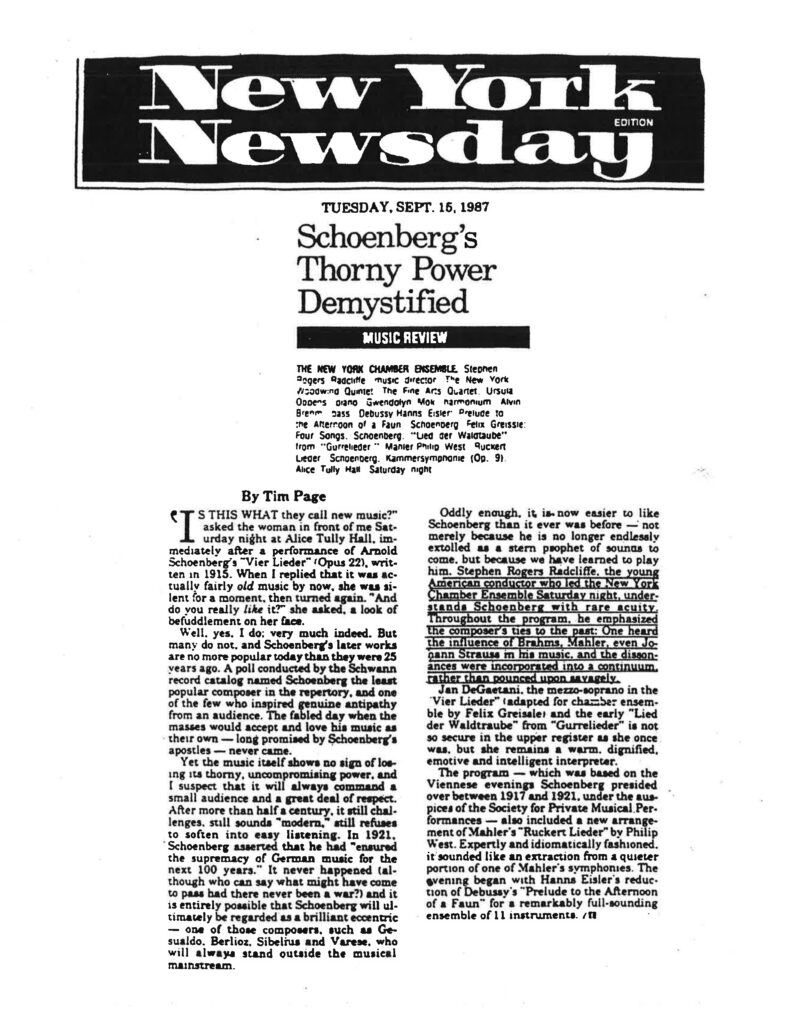
History As Engaging Theater
By Tim Page
THE NEW YORK Chamber Ensemble’s Friday night re-creation of a particularly important concert from the 1927 Baden-Baden Festival was not only good, vital history but an engaging evening of music theater as well.
Some background information: In the summer of 1927, four young composers — Paul Hindemith, Kurt Weill, Darius Milhaud and Ernst Toch — were invited to write short operas for performance in a small theater, with a limited number of soloists and a chamber ensemble instead of a full orchestra. On July 17 of that year, the four works received their world premiere performances at a festival of music in the German spa town of Baden-Baden; three of these were greeted enthusiastically, while the Weill work provoked wildly mixed reactions and even, if contemporary reports can be believed, some fisticuffs.
Still, Weill’s “Mahagonny Songspiel,” to a text by Bertholt Brecht, was the only one of the four to enter the standard repertory and the central “Alabama Song” may be numbered among the composer’s best-known creations. I have little patience for Brecht’s shrill, debased representation of humanity but the music in this half-hour is wonderful — lean, tuneful, citric and altogether original. No wonder it caused a fuss.
Hindemith’s “Hin and Zuruck” — “There and Back” — owes a clear debt to the cinema. It might be described as an operatic palindrome that reaches a certain point in its action and is then run backwards. A husband enters to wish his wife a happy birthday, finds an incriminating love note, shoots her, then jumps out a window. The sequence of events is then reversed: the husband falls back through the window, the wife is restored to life, they quarrel about the love note, he wishes her a happy birthday and departs. Hindemith’s score mirrors this chain of events: It is vigorous, virtuosic, richly contrapuntal and — no slight intended — sounds just as good backwards as forwards.
In general, the music of Darius Milhaud has not worn the years very well (the same may be said of the other composers in the aggregate of French composers known as “Les Six,” but Milhaud, with the most inflated reputation, had the farthest to fall). He now is remembered almost exclusively for his little jazz-age masterpiece, “La Creation du Monde,” but the sweet pocket opera (nine minutes) he wrote for Baden-Baden, “The Abduction of Europe,” deserves an occasional performance. It is exquisitely made, often very funny (including a chorus of mooing cows), imbued throughout with a sort of pastoral elegance that leads to a vaporous and beautiful finale.
Unfortunately, the final opera, Ernst Toch’s “The Princess and the Pea,” is trite throughout, a succession of melodic, harmonic and theatrical predictabilities. Doubly unfortunately, it was by far the longest opera on the program — some 45 minutes. Still, for the sake of history, it had to be included: The New York Chamber Ensemble gave it a lively reading, and Margaret Bishop made a delightfully pouty princess.
Indeed, there was little to fault in the evening’s performances. The ensemble playing was synchronous and energetic, and Stephen Rogers Radcliffe’s leadership was never less than authoritative. The singers — Mark Bleeke, Richard Holmes, Michael Brown, Robert Osborne, Nancy Ortez and Katherine Johnson — were equally fine; I particularly admired the Lotte Lenya-like mix of sweet and sour that Johnson brought to the Weill work. / II
![York Newsday: New York Newsday New York EDITION MONDAY, JUNE 4, 1990 • MANHATTAN • 25 CENTS MUSIC REVIEW History As Engaging Theater THE NEW YORK CHAMBER ENSEMBLE. Stephen Rogers Radcliffe, music director. Hindemith: "Hin und Zurück" ("There and Back"); Weill: Mahagonny Songspiel; Milhaud: "The Abduction of Europe"; Ernst Toch: "The Princess and the Pea." Starring: Katherine Johnson, Margaret Bishop, Mark Bleeke, Richard Holmes, Robert Osborne, Nancy Ortez, Michael Brown. Florence Gould Hall, Friday night. By Tim Page THE NEW YORK Chamber Ensemble's Friday night re-creation of a particularly important concert from the 1927 Baden-Baden Festival was not only good, vital history but an engaging evening of music theater as well. Some background information: In the summer of 1927, four young composers — Paul Hindemith, Kurt Weill, Darius Milhaud and Ernst Toch — were invited to write short operas for performance in a small theater, with a limited number of soloists and a chamber ensemble instead of a full orchestra. On July 17 of that year, the four works received their world premiere performances at a festival of music in the German spa town of Baden-Baden; three of these were greeted enthusiastically, while the Weill work provoked wildly mixed reactions and even, if contemporary reports can be believed, some fisticuffs. Still, Weill's "Mahagonny Songspiel," to a text by Bertholt Brecht, was the only one of the four to enter the standard repertory and the central "Alabama Song" may be numbered among the composer's best-known creations. I have little patience for Brecht's shrill, debased representation of humanity but the music in this half-hour is wonderful — lean, tuneful, citric and altogether original. No wonder it caused a fuss. Hindemith's "Hin and Zuruck" — "There and Back" — owes a clear debt to the cinema. It might be described as an operatic palindrome that reaches a certain point in its action and is then run backwards. A husband enters to wish his wife a happy birthday, finds an incriminating love note, shoots her, then jumps out a window. The sequence of events is then reversed: the husband falls back through the window, the wife is restored to life, they quarrel about the love note, he wishes her a happy birthday and departs. Hindemith's score mirrors this chain of events: It is vigorous, virtuosic, richly contrapuntal and — no slight intended — sounds just as good backwards as forwards. In general, the music of Darius Milhaud has not worn the years very well (the same may be said of the other composers in the aggregate of French composers known as "Les Six," but Milhaud, with the most inflated reputation, had the farthest to fall). He now is remembered almost exclusively for his little jazz-age masterpiece, "La Creation du Monde," but the sweet pocket opera (nine minutes) he wrote for Baden-Baden, "The Abduction of Europe," deserves an occasional performance. It is exquisitely made, often very funny (including a chorus of mooing cows), imbued throughout with a sort of pastoral elegance that leads to a vaporous and beautiful finale. Unfortunately, the final opera, Ernst Toch's "The Princess and the Pea," is trite throughout, a succession of melodic, harmonic and theatrical predictabilities. Doubly unfortunately, it was by far the longest opera on the program — some 45 minutes. Still, for the sake of history, it had to be included: The New York Chamber Ensemble gave it a lively reading, and Margaret Bishop made a delightfully pouty princess. Indeed, there was little to fault in the evening's performances. The ensemble playing was synchronous and energetic, and Stephen Rogers Radcliffe's leadership was never less than authoritative. The singers — Mark Bleeke, Richard Holmes, Michael Brown, Robert Osborne, Nancy Ortez and Katherine Johnson — were equally fine; I particularly admired the Lotte Lenya-like mix of sweet and sour that Johnson brought to the Weill work. / II [Caption under photo: Conductor Stephen Rogers Radcliffe]](https://stephenrogersradcliffe.com/wp-content/uploads/1990/06/Newsday_June_6_1990-791x1024.jpg)