Press | Symphonic Reviews

November 9, 1995
Conductor and Violinist Earn Kudos as Symphony Opens its New Season
By Courtenay Cauble
Kudos must continue to go to Beatrice Brown, the Ridgefield Symphony Orchestra’s Conductor Emeritus, who retired at the end of last season after shepherding and molding the ensemble for 25 years.
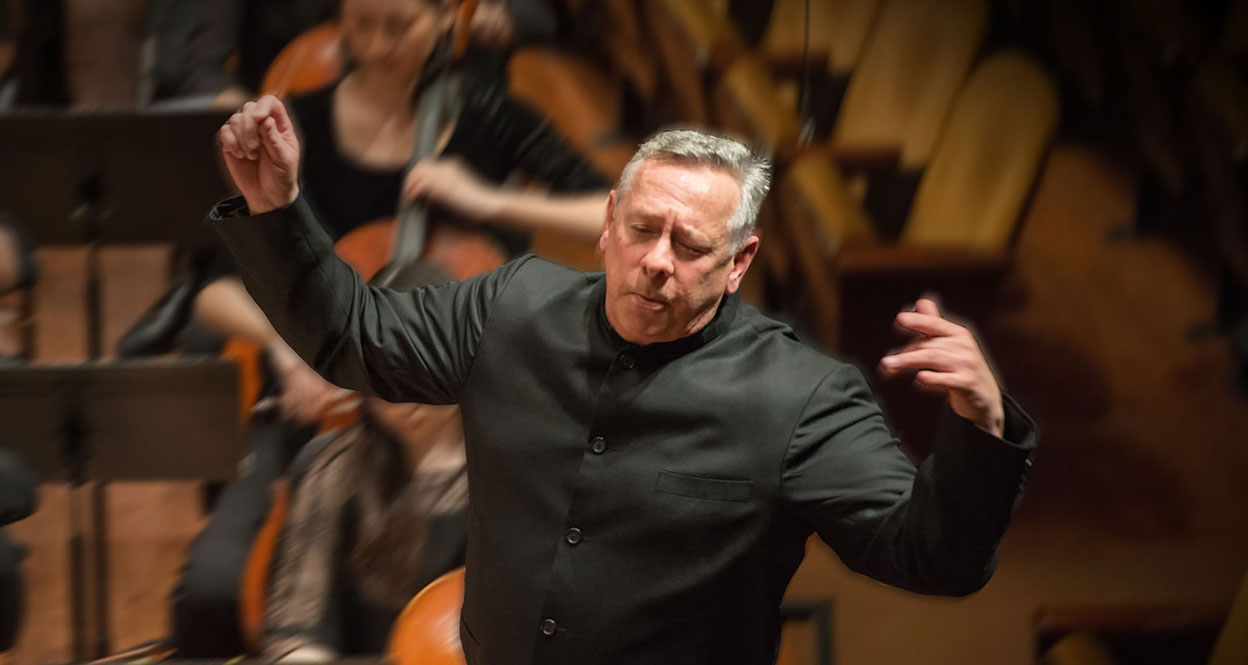
No misgivings about the orchestra’s future, though, could reasonably have survived last Saturday evening’s season opener at Ridgefield’s Anne S. Richardson Auditorium. Guest conductor Stephen Rogers Radcliffe, a 1988 Toscanini International Conductor’s Competition winner and a student of the late Leonard Bernstein, was on the podium, and the soloist for the occasion was the young Russian violinist Dmitri Berlinsky, who played Tchaikovsky’s Concerto for Violin and Orchestra.
It was the first of four programs to be directed by carefully chosen guest conductors who will be competing with each other for the post of RSO permanent music director and conductor. Mr. Radcliffe was the first, and his performance — and that of the aggregate of musicians he had whipped into shape during the preceding week’s rehearsals — was fine enough to set a very high hurdle for the three remaining conductors to leap over.
Maestro Radcliffe’s program was a richly melodic group clearly chosen to alienate no one and to appeal to all. In addition to the Tchaikovsky concerto, the fare included Ravel’s “Pavane for a Dead Princess” and Dvorak’s Symphony Number 8 in G Major, with the performance of the Ravel done in memory of assassinated Israeli Prime Minister Itszak Rabin.
Conductor Radcliffe’s influence, not just on the podium, but quite obviously during rehearsals as well, was evident from the first notes of the Ravel “Pavane” — in his careful shaping of phrases, in his sensitive attention to nuances and accents, and in his ability to evoke attentive responses from his players. If meticulous attention to individual phrases occasionally seemed to impede forward movement in longer melodic lines, the loss was slight in contrast to the gain.
Conductor’s instrument
Mr. Radcliffe’s confident but fluently relaxed technique and manner, along with a musical acumen that must surely have been obvious to his musicians from their first rehearsal, inspired an equally relaxed and confident performance from the ensemble. The orchestra was patently his instrument rather than just a periodic assemblage of musicians being pulled along by a taskmaster.
Violinist Dmitri Berlinsky, who (at 16) was the youngest winner ever of the 1988 Paganini International Violin Competition in Genoa, was a pleasure to hear. He is that rare sort of artist who can make a standard repertoire masterpiece like the Tchaikovsky concerto his own without doing violence to its tradition. He can do that because he is both a polished technician and a sensitive musician.
His intonation and technical mastery are flawless, and he is able to control his inherently lush tone to make it serve the music’s mood, slipping seamlessly from silvery sussurus to the most brilliant fireworks without ever compromising musical taste. Perhaps most impressive Saturday evening was the feeling one got that although Mr. Berlinsky had obviously practiced and polished the interpretation of each passage to technical perfection, he consistently communicated the impression of spontaneity and freshness of feeling. It is, of course, emotion — whether in drama or in music — that separates a fully satisfying performance from one that is merely technically brilliant.
Mr. Radcliffe’s collaboration was admirable too, not just because of the aforementioned characteristic attention to nuances and phrasing but also because of an impressive shared awareness of where musical movement was leading — an awareness that made climaxes truly climactic and fashioned musical lines into complete statements.
The concluding Dvorak G Major Symphony was entirely Maestro Radcliffe’s showpiece. He conducted the splendid, well-constructed work without a score, effectively sharing his interpretive vision of its varied moods with his players and communicating both the spirit of the work and his love for it to the audience. His will be a hard act to follow.
The RSO’s next program, set for Dec. 2 and featuring guest conductor Peter Sacco and New York Philharmonic principal clarinetist Stanley Drucker, will include Dvorak’s Carnival Overture, Debussy’s First Rhapsody for Clarinet and Orchestra, Rossini’s Introduction, Theme, and Variations for Clarinet and Orchestra, and Mendelssohn’s Symphony No. 5 in D Major (“Reformation”).