
Skip to content

Press | Opera Review

Tuesday, June 5, 1990

Mini-Operas Make Comeback

By Dale Harris

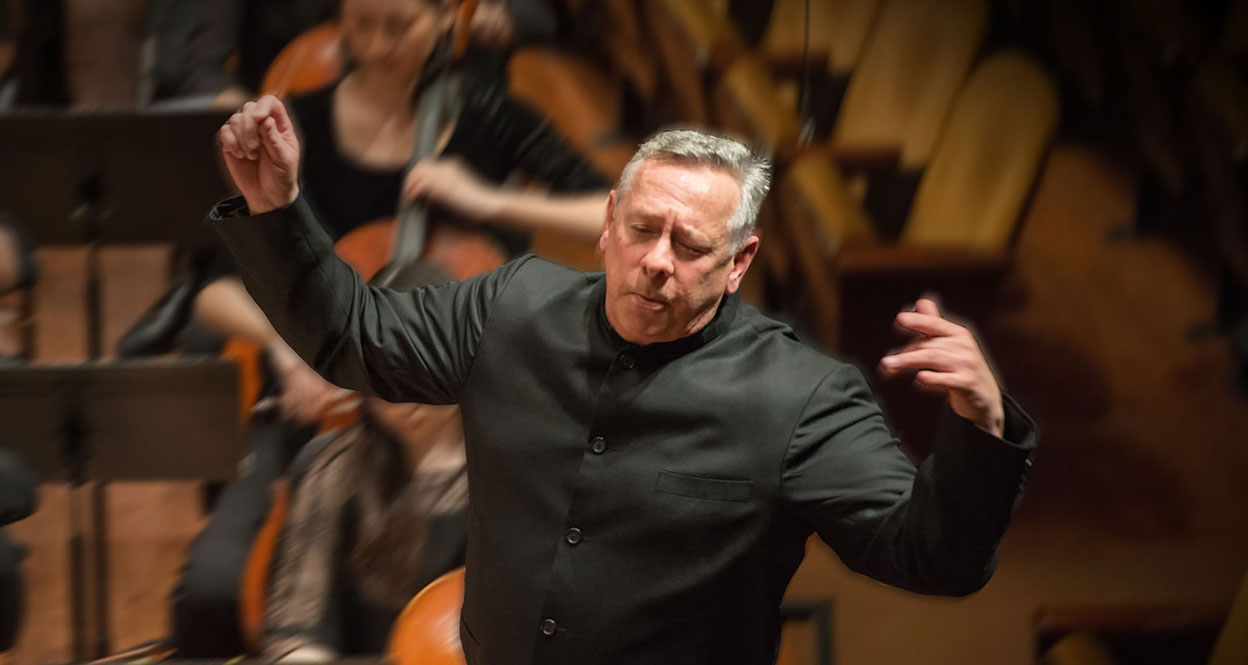
FRIDAY evening’s concert by the New York Chamber Ensemble at Florence Gould Hall was at once enjoyable and enlightening. Led by Stephen Rogers Radcliffe, the group resuscitated one of the most interesting events in the history of 20th-century music: the program of four miniature operas given at the Baden-Baden Festival of 1927.

The year 1927 was a time of crisis for music in general and for opera in particular. In their very different ways, Hindemith’s “Hin und Zurueck,” Kurt Weill’s “Mahagonny Songspiel,” Ernst Toch’s “Princess and the Pea” and Milhaud’s “Rape of Europa” were all modernist manifestoes, provocative attempts to reanimate the corpse of post-Wagnerian opera.

The operas, naturally enough, caused a great deal of friction in conservative German musical circles. It’s no accident that within a few years every one of these composers was a refugee from the Nazis.

The Hindemith mocks the conventions of tragedy, the Milhaud of classical myth, the Toch of fairy-tale romance.
Historical importance is one thing, agelessness another. It was edifying to hear these three. It was exciting to hear the Weill, the only one that looks as though it will last another 50 years.
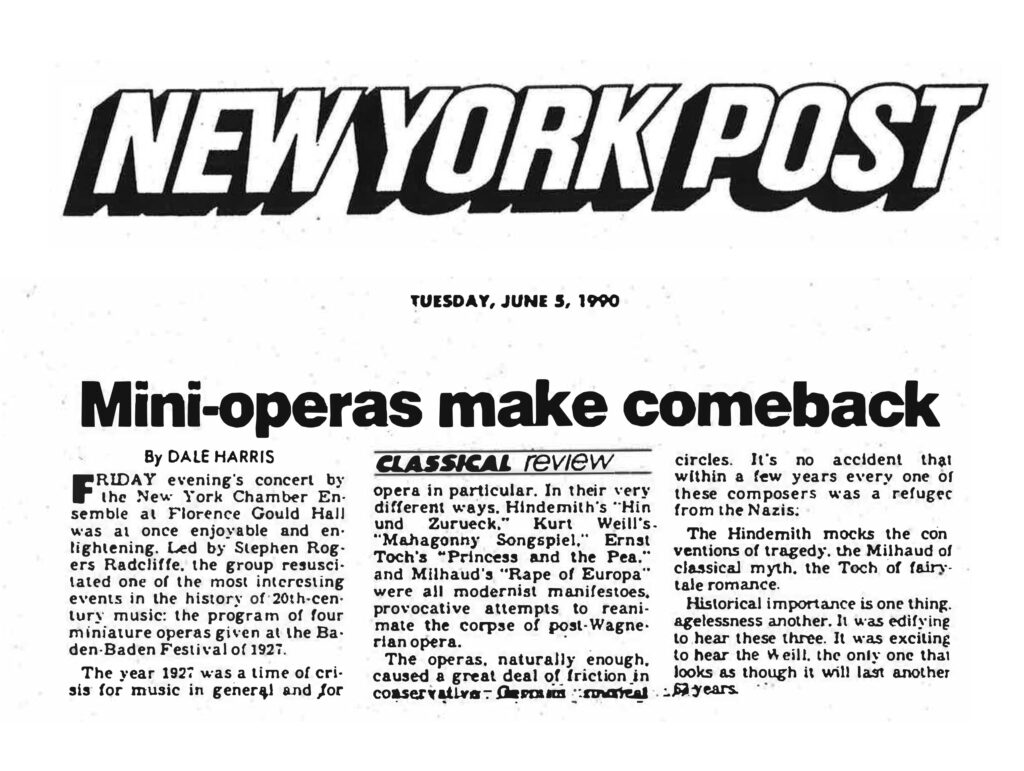
NEW YORK POST TUESDAY, JUNE 5, 1990 Mini-operas make comeback By DALE HARRIS CLASSICAL review FRIDAY evening's concert by the New York Chamber Ensemble at Florence Gould Hall was at once enjoyable and enlightening. Led by Stephen Rogers Radcliffe, the group resuscitated one of the most interesting events in the history of 20th-century music: the program of four miniature operas given at the Baden-Baden Festival of 1927. The year 1927 was a time of crisis for music in general and for opera in particular. In their very different ways, Hindemith's "Hin und Zurueck," Kurt Weill's "Mahagonny Songspiel," Ernst Toch's "Princess and the Pea" and Milhaud's "Rape of Europa" were all modernist manifestoes, provocative attempts to reanimate the corpse of post-Wagnerian opera. The operas, naturally enough, caused a great deal of friction in conservative German musical circles. It's no accident that within a few years every one of these composers was a refugee from the Nazis. The Hindemith mocks the conventions of tragedy, the Milhaud of classical myth, the Toch of fairy-tale romance. Historical importance is one thing, agelessness another. It was edifying to hear these three. It was exciting to hear the Weill, the only one that looks as though it will last another 50 years.
×