Press | Symphonic Review

Week of June 4-10, 1996
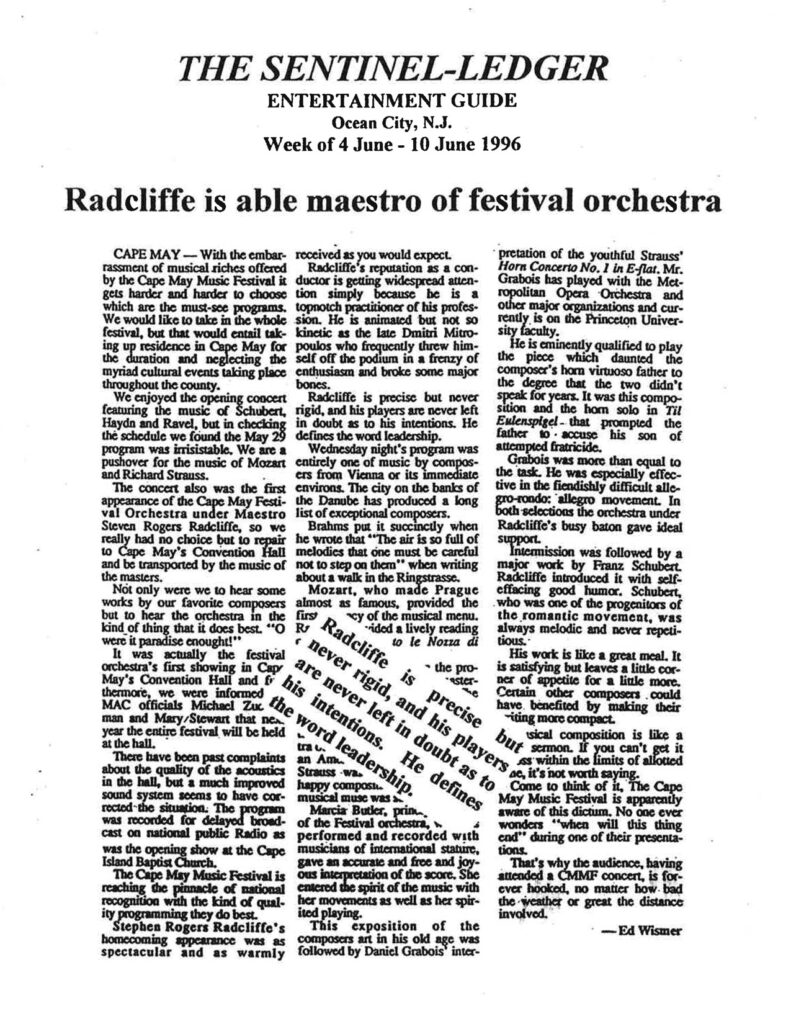
Radcliffe is able Maestro of Festival Orchestra
By Ed Wismer
CAPE MAY — With the embarrassment of musical riches offered by the Cape May Music Festival it gets harder and harder to choose which are the must-see programs. We would like to take in the whole festival, but that would entail taking up residence in Cape May for the duration and neglecting the myriad cultural events taking place throughout the county.
We enjoyed the opening concert featuring the music of Schubert, Haydn and Ravel, but in checking the schedule we found the May 29 program was irresistible. We are a pushover for the music of Mozart and Richard Strauss.
The concert also was the first appearance of the Cape May Festival Orchestra under Maestro Stephen Rogers Radcliffe, so we really had no choice but to repair to Cape May’s Convention Hall and be transported by the music of the masters.
Not only were we to hear some works by our favorite composers but to hear the orchestra in the kind of thing that it does best — “O were it paradise enough!”
It was actually the festival orchestra’s first showing in Cape May’s Convention Hall and, furthermore, we were informed by MAC officials Michael Zuckerman and Mary Stewart that next year the entire festival will be held at the hall.
There have been past complaints about the quality of the acoustics in the hall, but a much improved sound system seems to have corrected the situation. The program was recorded for delayed broadcast on National Public Radio as was the opening show at the Cape Island Baptist Church.
The Cape May Music Festival is reaching the pinnacle of national recognition with the kind of quality programming they do best.
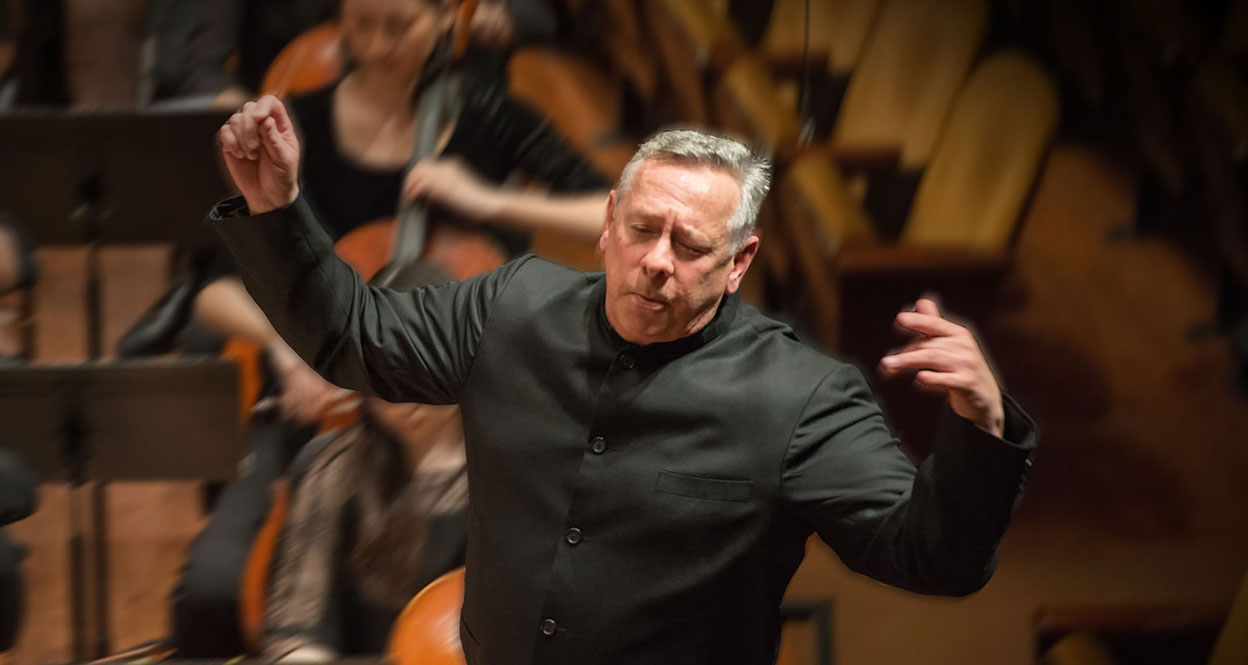
Stephen Rogers Radcliffe’s homecoming appearance was as spectacular and as warmly received as you would expect. Radcliffe’s reputation as a conductor is getting widespread attention simply because he is a topnotch practitioner of his profession. He is animated but not so kinetic as the late Dmitri Mitropoulos who frequently threw himself off the podium in a frenzy of enthusiasm and broke some major bones.
Radcliffe is precise but never rigid, and his players are never left in doubt as to his intentions. He defines the word leadership.
Wednesday night’s program was entirely one of music by composers from Vienna or its immediate environs. The city on the banks of the Danube has produced a long list of exceptional composers.
Brahms put it succinctly when he wrote that “The air is so full of melodies that one must be careful not to step on them” when writing about a walk in the Ringstrasse.
Mozart, who made Prague almost as famous, provided the first part of the musical menu. Radcliffe provided a lively reading of the Nozze di Figaro overture.
Marcia Butler, principal clarinet of the Festival orchestra, performed and recorded with musicians of international stature, gave an accurate and free and joyous interpretation of the score. She entered the spirit of the music with her movements as well as her spirited playing.
This exposition of the composers’ art in his old age was followed by Daniel Grabois’ interpretation of the youthful Strauss’ *Horn Concerto No. 1 in E-flat, Mr. Grabois has played with the Metropolitan Opera Orchestra and other major organizations and currently is on the Princeton University faculty.
He is eminently qualified to play the piece which daunted the composer’s horn virtuoso father to the degree that the two didn’t speak for years. It was this composition and the horn solo in Till Eulenspiegel that prompted the father to accuse his son of attempted fratricide.
Grabois was more than equal to the task. He was especially effective in the fiendishly difficult allegro con brio movement. In both selections the orchestra under Radcliffe’s busy baton gave ideal support.
Intermission was followed by a major work by Franz Schubert. Radcliffe introduced it with self-effacing good humor. Schubert, who was one of the progenitors of the romantic movement, was always melodic and never repetitious.
His work is like a great meal. It is satisfying but leaves a little corner of appetite for a little more. Certain other composers could have benefited by making their writing more compact.
Musical composition is like a sermon. If you can’t get it across within the limits of allotted time, it’s not worth saying. Come to think of it, The Cape May Music Festival is apparently aware of this dictum. No one ever wonders “when will this thing end” during one of their presentations.
That’s why the audience, having attended a CMMF concert, is forever hooked, no matter how bad the weather or great the distance involved.
— Ed Wismer