Press | Symphonic Reviews

Monday, December 17, 1990
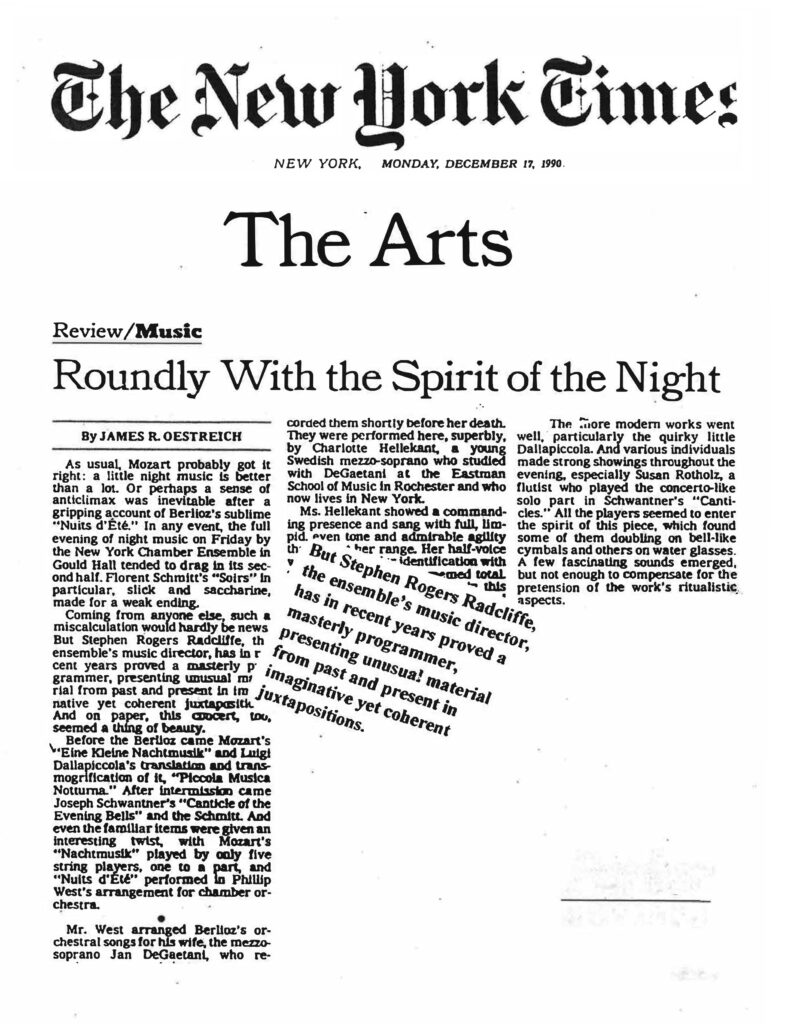
Roundly With the Spirit of the Night
By James R. Oestreich
As usual, Mozart probably got it right: a little night music is better than a lot. Or perhaps a sense of anticlimax was inevitable after a gripping account of Berlioz’s sublime “Nuits d’Été.” In any event, the full evening of night music on Friday by the New York Chamber Ensemble at Florence Gould Hall tended to drag in its second half. Florent Schmitt’s “Soirs,” in particular, slick and saccharine, made for a weak ending.
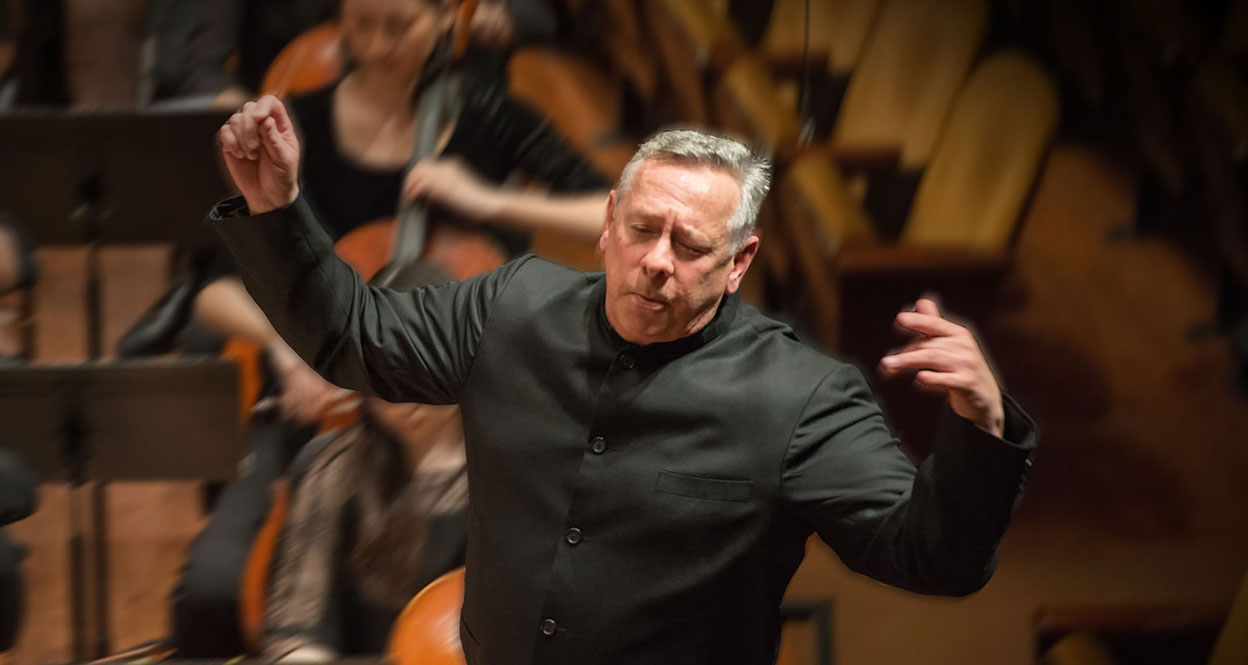
Coming from anyone else, such a miscalculation would hardly be news. But Stephen Rogers Radcliffe, the ensemble’s music director, has in recent years proved a masterly programmer, presenting unusual material from past and present in imaginative yet coherent juxtapositions. And on paper, this concert, too, seemed a thing of beauty.
Before the Berlioz came Mozart’s “Eine Kleine Nachtmusik” and Luigi Dallapiccola’s translation and transmogrification of it, “Piccola Musica Notturna.” After intermission came Joseph Schwantner’s “Canticle of the Evening Bells” and the Schmitt. And even the familiar items were given an interesting twist, with Mozart’s “Nachtmusik” played by only five string players, one to a part, and “Nuits d’Été” performed in Philip West’s arrangement for chamber orchestra.
Mr. West arranged Berlioz’s orchestral songs for his wife, the mezzo-soprano Jan DeGaetani, who recorded them shortly before her death. They were performed here, superbly, by Charlotte Hellekant, a young Swedish mezzo-soprano who studied with DeGaetani at the Eastman School of Music in Rochester and who now lives in New York.
Ms. Hellekant showed a commanding presence and sang with full, limpid, even tone and admirable agility in her range. Her half-voice was especially beautiful. Identification with the text was keen, though occasionally generalized.
But Stephen Rogers Radcliffe, the ensemble’s music director, has in recent years proved a masterly programmer, presenting unusual material from past and present in imaginative yet coherent juxtapositions.
The more modern works went well, particularly the quirky little Dallapiccola. And various individuals made strong showings throughout the evening, especially Susan Rotholz, a flutist who played the concerto-like solo part in Schwantner’s “Canticles.” All the players seemed to enter the spirit of this piece, which found some of them doubling on bells, cymbals and others on water glasses. A few fascinating sounds emerged, but not enough to compensate for the pretension of the work’s ritualistic aspects.