
Skip to content

Press | Symphonic Reviews

Sunday, July 3, 1994

Third orchestra concert at festival

By Gregory Milliron

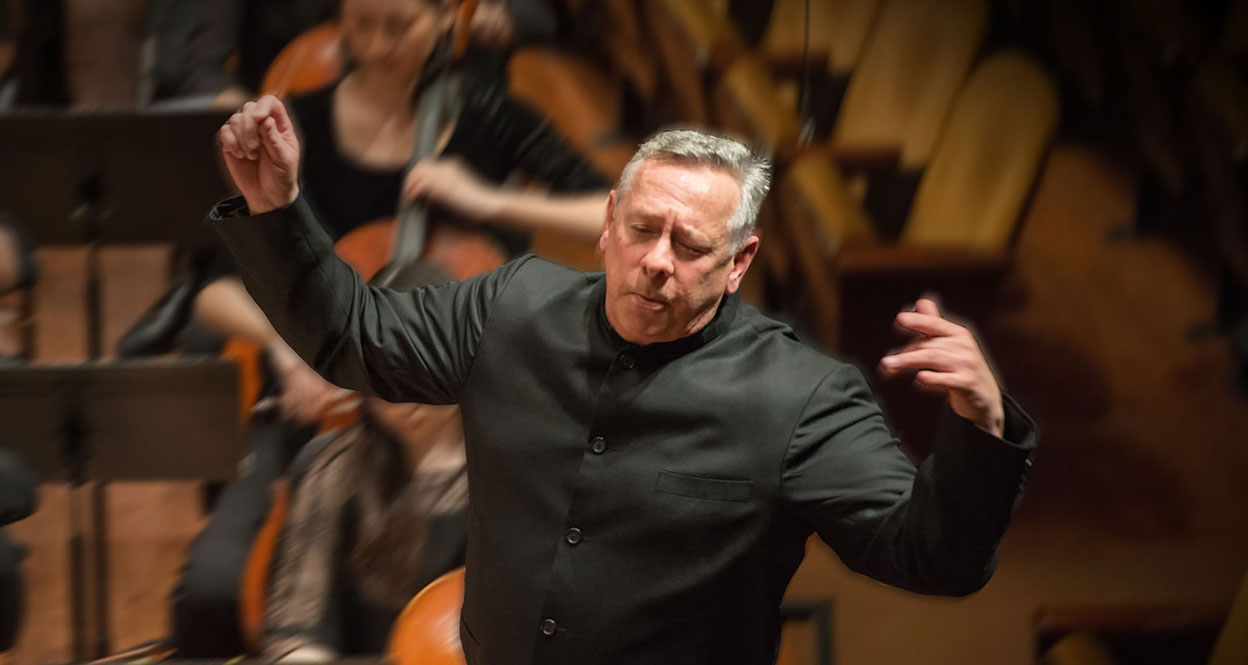
In its third concert of the 1994 Music Festival of Arkansas, the orchestra performed an eclectic mix of works. The program consisted of Maurice Ravel’s “Pavane pour une Infante Defunte,” Peter Schickele’s “Five of a Kind: Concerto for Brass Quintet” and Tchaikovsky’s “Symphony No. 5 in E Minor.” For this concert, Carlton Woods relinquished the podium to guest conductor Stephen Rogers Radcliffe, the popular up-and-coming conductor and artistic director of the Cape May Music Festival and artistic advisor to the Nassau Symphony Orchestra.

The program for this evening’s concert was indeed eclectic, but not as powerful as the previous festival concerts. The repertoire suffered most from the piece for brass quintet and orchestra by Schickele, also known as P.D.Q. Bach. This attempt at a “semiserious” piece of music by Schickele fell quite short of most, if not all, of his creative efforts involving the famed P.D.Q. Bach.

This should in no way detract from the performance given by the brass quintet. They performed with an attitude of professionalism and wonderful ability. Their performance was excellent, filled with vitality and humor. The music was simply not worthy of the quintet of the festival orchestra. It seems as if Schickele needs to commit himself to either P.D.Q. Bach the humorist or a more serious frame of mind. I would prefer more “discoveries” of the music of P.D.Q. Bach.

The orchestra’s performance of Ravel’s “Pavane pour une Infante Defunte” was touching. Although the title, translated to Pavane for a dead infant, suggests a dark scene, the melodic and harmonic structures of this piece are more reflective in nature. This piece requires a delicate touch from the entire orchestra. Radcliffe and the festival orchestra achieved this touch, and it was most evident in the string section. The violas were the real heroes on this night. Their rich, warm tones, so important to the orchestration of Ravel, dominated the texture of the performance. They provided the melancholy which is so needed in this wonderful piece.

The violas were the real heroes on this night. Their rich, warm tones, so important to the orchestration of Ravel, dominated the texture of the performance.

The orchestra also performed Tchaikovsky’s Fifth Symphony. Although many feel this piece is not as monumental as his Sixth Symphony, it does retain a grip on the standard repertoire of symphony orchestras around the world.

The Festival Orchestra handled the huge work well. Radcliffe seemed to be in full control of the many emotions of the work. Once again, the string section of the festival orchestra shone like a white hot star. Its tone is so incredibly warm, so appropriate to the romantic tendencies supplied by Tchaikovsky in his symphony. The brass section should also be commended for their performance although, at times, it seemed a bit out of control. Nonetheless, the entire ensemble presented a top-rate performance of a difficult work.

The maturity of this group has increased with each performance. I was impressed with the student orchestra, performing without most of the faculty members, that performed at the Concerto Night/Honors Concert. All of the concerts and recitals from this festival have been well worth the time and effort of attendance.
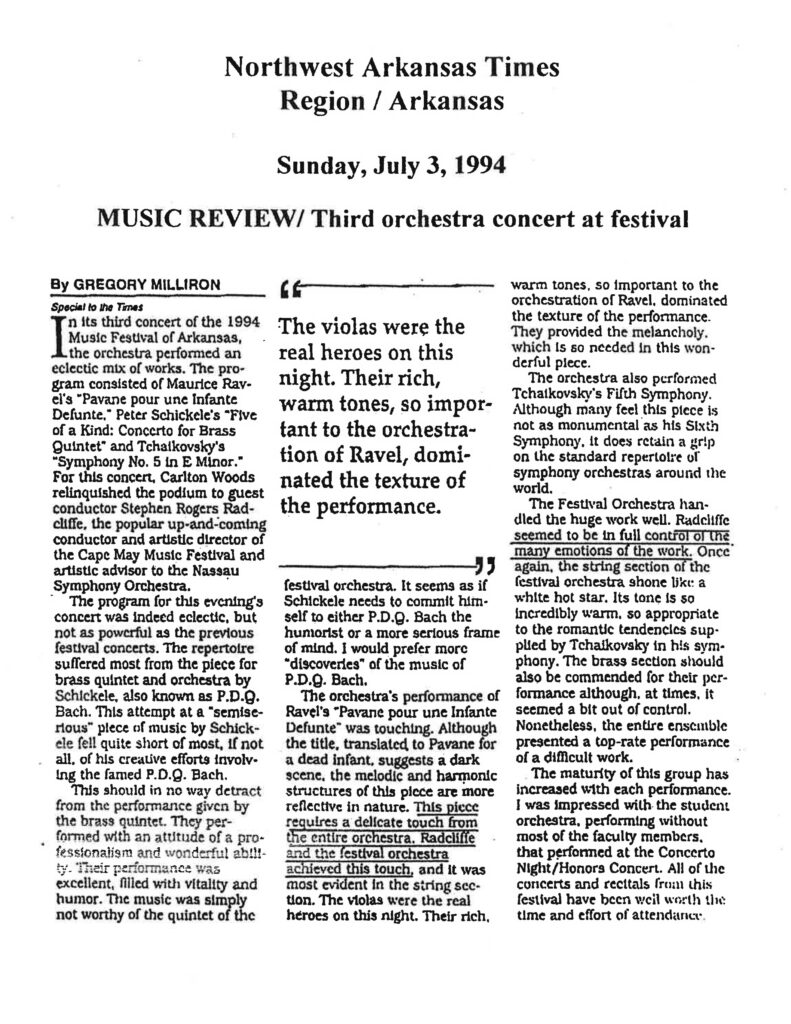
Northwest Arkansas Times Region / Arkansas Sunday, July 3, 1994 MUSIC REVIEW/ Third orchestra concert at festival By GREGORY MILLIRON Special to the Times In its third concert of the 1994 Music Festival of Arkansas, the orchestra performed an eclectic mix of works. The program consisted of Maurice Ravel's "Pavane pour une Infante Defunte," Peter Schickele's "Five of a Kind: Concerto for Brass Quintet" and Tchaikovsky's "Symphony No. 5 in E Minor." For this concert, Carlton Woods relinquished the podium to guest conductor Stephen Rogers Radcliffe, the popular up-and-coming conductor and artistic director of the Cape May Music Festival and artistic advisor to the Nassau Symphony Orchestra. The program for this evening's concert was indeed eclectic, but not as powerful as the previous festival concerts. The repertoire suffered most from the piece for brass quintet and orchestra by Schickele, also known as P.D.Q. Bach. This attempt at a "semiserious" piece of music by Schickele fell quite short of most, if not all, of his creative efforts involving the famed P.D.Q. Bach. This should in no way detract from the performance given by the brass quintet. They performed with an attitude of professionalism and wonderful ability. Their performance was excellent, filled with vitality and humor. The music was simply not worthy of the quintet of the festival orchestra. It seems as if Schickele needs to commit himself to either P.D.Q. Bach the humorist or a more serious frame of mind. I would prefer more "discoveries" of the music of P.D.Q. Bach. The orchestra's performance of Ravel's "Pavane pour une Infante Defunte" was touching. Although the title, translated to Pavane for a dead infant, suggests a dark scene, the melodic and harmonic structures of this piece are more reflective in nature. This piece requires a delicate touch from the entire orchestra. Radcliffe and the festival orchestra achieved this touch, and it was most evident in the string section. The violas were the real heroes on this night. Their rich, warm tones, so important to the orchestration of Ravel, dominated the texture of the performance. They provided the melancholy which is so needed in this wonderful piece. > The violas were the real heroes on this night. Their rich, warm tones, so important to the orchestration of Ravel, dominated the texture of the performance. > The orchestra also performed Tchaikovsky's Fifth Symphony. Although many feel this piece is not as monumental as his Sixth Symphony, it does retain a grip on the standard repertoire of symphony orchestras around the world. The Festival Orchestra handled the huge work well. Radcliffe seemed to be in full control of the many emotions of the work. Once again, the string section of the festival orchestra shone like a white hot star. Its tone is so incredibly warm, so appropriate to the romantic tendencies supplied by Tchaikovsky in his symphony. The brass section should also be commended for their performance although, at times, it seemed a bit out of control. Nonetheless, the entire ensemble presented a top-rate performance of a difficult work. The maturity of this group has increased with each performance. I was impressed with the student orchestra, performing without most of the faculty members, that performed at the Concerto Night/Honors Concert. All of the concerts and recitals from this festival have been well worth the time and effort of attendance.
×