Festival Orchestra Goes Pops

THE SENTINEL-LEDGER Ocean City, N.J. Week of 7-13 June 1994 Festival Orchestra goes pops By ED WISMER Sentinel-Ledger Critic OCEAN CITY — The second Cape May Music Festival event to be held on the Music Pier for 1994 took place June 4 and it was a real "Popper." The Cape May Festival Orchestra played a program of light classics and the best of Broadway. This does seem like carrying coals to Newcastle because of the similarity of programming by our own sensational Ocean City Pops, but good music is sempiternal and it's truly a case of the more, the merrier. It best represents another opportunity to spread culture in this area through cooperation by the Pashley Insurance Agency, The Sentinel-Ledger and the city of Ocean City. All concerned are to be commended for their support of the arts. The Festival Orchestra had the pleasure and privilege of playing in Ocean City's state of the art facility. Festival artistic director Stephen Rogers Radcliffe mounted the podium and started the proceedings off with a flourish. Pops orchestras and programs are proliferating exponentially. Most of us think of Pops orchestras starting with that part-time fireman Arthur Fiedler up in Boston, but pops programing was quite popular at the turn of the 20th century and before. A Sousa program would have consisted of light classics, popular songs and show tunes (many of which Sousa wrote himself a la John Williams). We have heard Radcliffe's orchestra do some very ambitious work in the past and recall an occasion when a 19th century synthesizer was used to intensify the sound. Radcliffe is experimental and innovative in his approach and one can always expect some extra pyrotechnics. He did not disappoint us this time either. The program consisted of works inspired by folk music and dance that was multi-ethnic. Radcliffe led off with a Rossini Overture that was impressively played and followed it with Dvorak's Slavonic Dance Op. 46, No. 8 (one of the more lively numbers in this evocative suite). > Artistic Director Stephen Rogers Radcliffe is fun to watch > Radcliffe is fun to watch. His kinetic gyrations were most evident in the Dvorak but he only enlivens proceedings thusly when it is appropriate. The late Dmitri Mitroupolis was overly physical and often fell right off the podium. Radcliffe's feet enthusiastically left the floor at times but he was always in control. Ralph Vaughan Williams' Fantasia on Greensleeves followed it, and along with Faure's Pavane Op. 50, brought a more solemn and sedate mood to the concert. The wind section was outstanding in these two pieces. An unfamiliar tarantelle by Camille Saint Saens proved to be a lively and lovely example of how versatile the French composer could be. The Bizet Suite from Carmen featured "just right" vigorous tempi and playing that was, at the same time, abandoned and precise. The brass players took full advantage of Bizet's proclivity for writing superbly for their instruments. The final portion of the program consisted of two genuine Broadway classics in the form of selections from Gershwin's folk opera Porgy and Bess and Bernstein's West Side Story highlights. Both came in the form of fresh sounding and unfamiliar arrangements that featured innovative instrumental scoring that gave them new life. These evinced a standing ovation which was rewarded with an encore of Flimsy Korsetoff's (pardon an old musician's pun) Flight of the Bumble Bee which hummed right along. It is a certainty that the audience felt that it had a grand night out, topped off with truly professional musicianship and the sponsors could openly glow with pride. The whole affair added new vistas of cultural excellence that upheld the tradition of fine entertainment values exemplified by both cities. [Sidebar Text] CAPE MAY — The fifth annual Cape May Music Festival began May 15 and continues through June 26, hosting what is described as some of the world's most accomplished soloists and chamber musicians in music from the Renaissance and Vivaldi to the jazz era. The Festival Orchestra is conducted by Stephen Rogers Radcliffe. The festival is sponsored by the Mid-Atlantic Center for the Arts (884-5404), in association with the Cape May Institute.

Press | Symphonic Review

June 7-13, 1994

Festival Orchestra Goes Pops

By Ed Wismer

OCEAN CITY — The second Cape May Music Festival event to be held on the Music Pier for 1994 took place June 4 and it was a real “Popper.”

The Cape May Festival Orchestra played a program of light classics and the best of Broadway. This does seem like carrying coals to Newcastle because of the similarity of programming by our own sensational Ocean City Pops, but good music is sempiternal and it’s truly a case of the more, the merrier.

It best represents another opportunity to spread culture in this area through cooperation by the Pashley Insurance Agency, The Sentinel-Ledger and the city of Ocean City. All concerned are to be commended for their support of the arts.

The Festival Orchestra had the pleasure and privilege of playing in Ocean City’s state of the art facility.

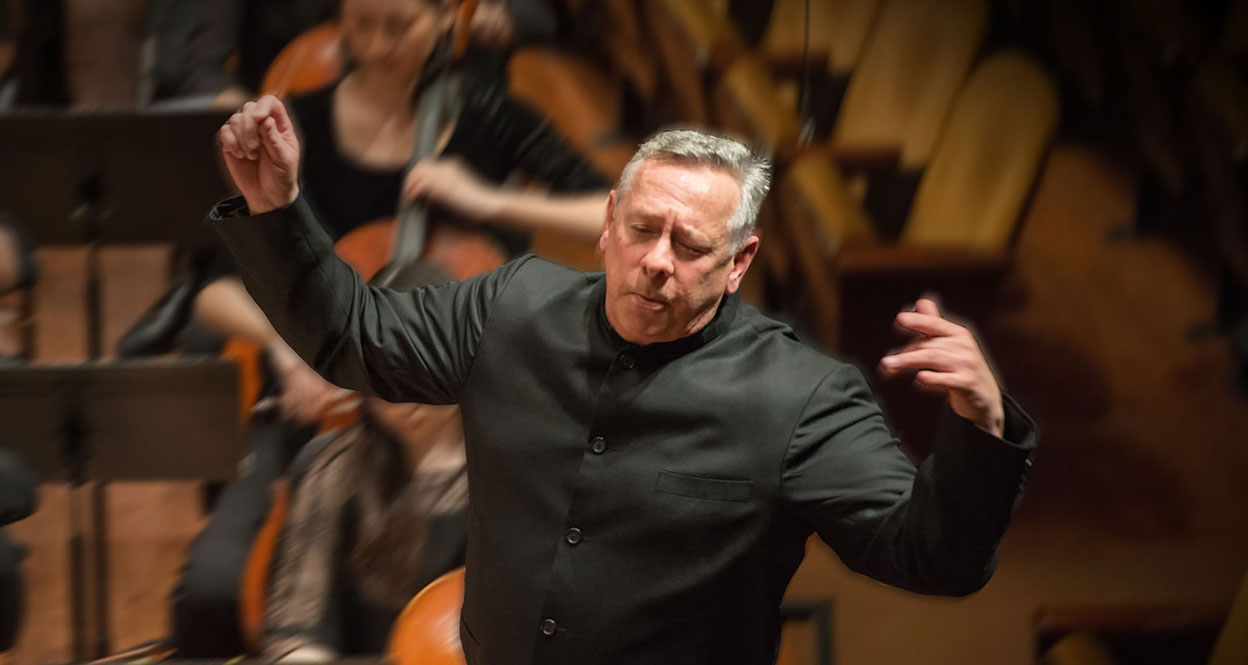
Festival artistic director Stephen Rogers Radcliffe mounted the podium and started the proceedings off with a flourish. Pops orchestras and programs are proliferating exponentially. Most of us think of Pops orchestras starting with that part-time fireman Arthur Fiedler up in Boston, but pops programing was quite popular at the turn of the 20th century and before.

A Sousa program would have consisted of light classics, popular songs and show tunes (many of which Sousa wrote himself a la John Williams). We have heard Radcliffe’s orchestra do some very ambitious work in the past and recall an occasion when a 19th century synthesizer was used to intensify the sound. Radcliffe is experimental and innovative in his approach and one can always expect some extra pyrotechnics. He did not disappoint us this time either.

The program consisted of works inspired by folk music and dance that was multi-ethnic. Radcliffe led off with a Rossini Overture that was impressively played and followed it with Dvorak’s Slavonic Dance Op. 46, No. 8 (one of the more lively numbers in this evocative suite).

Radcliffe is fun to watch. His kinetic gyrations were most evident in the Dvorak but he only enlivens proceedings thusly when it is appropriate. The late Dmitri Mitroupolis was overly physical and often fell right off the podium. Radcliffe’s feet enthusiastically left the floor at times but he was always in control. Ralph Vaughan Williams’ Fantasia on Greensleeves followed it, and along with Faure’s Pavane Op. 50, brought a more solemn and sedate mood to the concert. The wind section was outstanding in these two pieces. An unfamiliar tarantelle by Camille Saint Saens proved to be a lively and lovely example of how versatile the French composer could be.

The Bizet Suite from Carmen featured “just right” vigorous tempi and playing that was, at the same time, abandoned and precise. The brass players took full advantage of Bizet’s proclivity for writing superbly for their instruments.

The final portion of the program consisted of two genuine Broadway classics in the form of selections from Gershwin’s folk opera Porgy and Bess and Bernstein’s West Side Story highlights. Both came in the form of fresh sounding and unfamiliar arrangements that featured innovative instrumental scoring that gave them new life. These evinced a standing ovation which was rewarded with an encore of Flimsy Korsetoff’s (pardon an old musician’s pun) Flight of the Bumble Bee which hummed right along.

It is a certainty that the audience felt that it had a grand night out, topped off with truly professional musicianship and the sponsors could openly glow with pride.

The whole affair added new vistas of cultural excellence that upheld the tradition of fine entertainment values exemplified by both cities.

CAPE MAY — The fifth annual Cape May Music Festival began May 15 and continues through June 26, hosting what is described as some of the world’s most accomplished soloists and chamber musicians in music from the Renaissance and Vivaldi to the jazz era.

The Festival Orchestra is conducted by Stephen Rogers Radcliffe. The festival is sponsored by the Mid-Atlantic Center for the Arts (884-5404), in association with the Cape May Institute.

THE SENTINEL-LEDGER Ocean City, N.J. Week of 7-13 June 1994 Festival Orchestra goes pops By ED WISMER Sentinel-Ledger Critic OCEAN CITY — The second Cape May Music Festival event to be held on the Music Pier for 1994 took place June 4 and it was a real "Popper." The Cape May Festival Orchestra played a program of light classics and the best of Broadway. This does seem like carrying coals to Newcastle because of the similarity of programming by our own sensational Ocean City Pops, but good music is sempiternal and it's truly a case of the more, the merrier. It best represents another opportunity to spread culture in this area through cooperation by the Pashley Insurance Agency, The Sentinel-Ledger and the city of Ocean City. All concerned are to be commended for their support of the arts. The Festival Orchestra had the pleasure and privilege of playing in Ocean City's state of the art facility. Festival artistic director Stephen Rogers Radcliffe mounted the podium and started the proceedings off with a flourish. Pops orchestras and programs are proliferating exponentially. Most of us think of Pops orchestras starting with that part-time fireman Arthur Fiedler up in Boston, but pops programing was quite popular at the turn of the 20th century and before. A Sousa program would have consisted of light classics, popular songs and show tunes (many of which Sousa wrote himself a la John Williams). We have heard Radcliffe's orchestra do some very ambitious work in the past and recall an occasion when a 19th century synthesizer was used to intensify the sound. Radcliffe is experimental and innovative in his approach and one can always expect some extra pyrotechnics. He did not disappoint us this time either. The program consisted of works inspired by folk music and dance that was multi-ethnic. Radcliffe led off with a Rossini Overture that was impressively played and followed it with Dvorak's Slavonic Dance Op. 46, No. 8 (one of the more lively numbers in this evocative suite). > Artistic Director Stephen Rogers Radcliffe is fun to watch > Radcliffe is fun to watch. His kinetic gyrations were most evident in the Dvorak but he only enlivens proceedings thusly when it is appropriate. The late Dmitri Mitroupolis was overly physical and often fell right off the podium. Radcliffe's feet enthusiastically left the floor at times but he was always in control. Ralph Vaughan Williams' Fantasia on Greensleeves followed it, and along with Faure's Pavane Op. 50, brought a more solemn and sedate mood to the concert. The wind section was outstanding in these two pieces. An unfamiliar tarantelle by Camille Saint Saens proved to be a lively and lovely example of how versatile the French composer could be. The Bizet Suite from Carmen featured "just right" vigorous tempi and playing that was, at the same time, abandoned and precise. The brass players took full advantage of Bizet's proclivity for writing superbly for their instruments. The final portion of the program consisted of two genuine Broadway classics in the form of selections from Gershwin's folk opera Porgy and Bess and Bernstein's West Side Story highlights. Both came in the form of fresh sounding and unfamiliar arrangements that featured innovative instrumental scoring that gave them new life. These evinced a standing ovation which was rewarded with an encore of Flimsy Korsetoff's (pardon an old musician's pun) Flight of the Bumble Bee which hummed right along. It is a certainty that the audience felt that it had a grand night out, topped off with truly professional musicianship and the sponsors could openly glow with pride. The whole affair added new vistas of cultural excellence that upheld the tradition of fine entertainment values exemplified by both cities. [Sidebar Text] CAPE MAY — The fifth annual Cape May Music Festival began May 15 and continues through June 26, hosting what is described as some of the world's most accomplished soloists and chamber musicians in music from the Renaissance and Vivaldi to the jazz era. The Festival Orchestra is conducted by Stephen Rogers Radcliffe. The festival is sponsored by the Mid-Atlantic Center for the Arts (884-5404), in association with the Cape May Institute.

5 Ways With Music and Drama That Share the Bond of Brevity

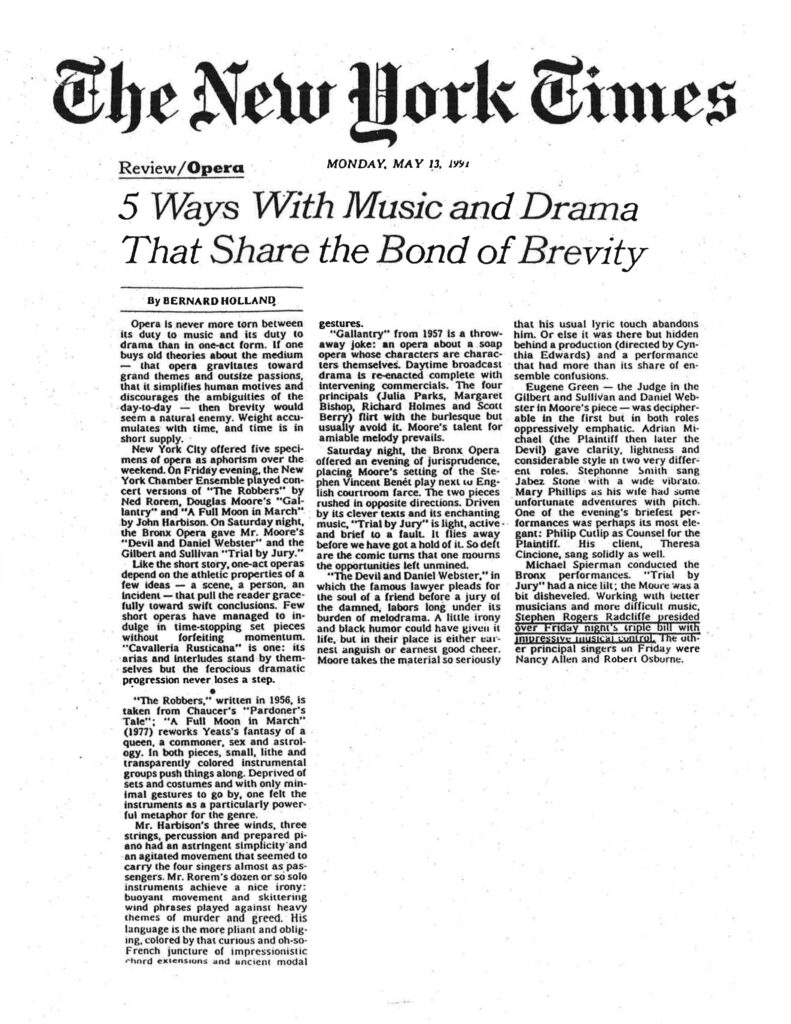
Based on the image provided, here is the retyped article: The New York Times Review/Opera MONDAY, MAY 13, 1991 5 Ways With Music and Drama That Share the Bond of Brevity By BERNARD HOLLAND Opera is never more torn between its duty to music and its duty to drama than in one-act form. If one buys old theories about the medium — that opera gravitates toward grand themes and outsize passions, that it simplifies human motives and discourages the ambiguities of the day-to-day — then brevity would seem a natural enemy. Weight accumulates with time, and time is in short supply. New York City offered five specimens of opera as aphorism over the weekend. On Friday evening, the New York Chamber Ensemble played concert versions of "The Robbers" by Ned Rorem, Douglas Moore's "Gallantry" and "A Full Moon in March" by John Harbison. On Saturday night, the Bronx Opera gave Mr. Moore's "Devil and Daniel Webster" and the Gilbert and Sullivan "Trial by Jury." Like the short story, one-act operas depend on the athletic properties of a few ideas — a scene, a person, an incident — that pull the reader gracefully toward swift conclusions. Few short operas have managed to indulge in time-stopping set pieces without forfeiting momentum. "Cavalleria Rusticana" is one: its arias and interludes stand by themselves but the ferocious dramatic progression never loses a step. • "The Robbers," written in 1956, is taken from Chaucer's "Pardoner's Tale": "A Full Moon in March" (1977) reworks Yeats's fantasy of a queen, a commoner, sex and astrology. In both pieces, small, lithe and transparently colored instrumental groups push things along. Deprived of sets and costumes and with only minimal gestures to go by, one felt the instruments as a particularly powerful metaphor for the genre. Mr. Harbison's three winds, three strings, percussion and prepared piano had an astringent simplicity and an agitated movement that seemed to carry the four singers almost as passengers. Mr. Rorem's dozen or so solo instruments achieve a nice irony: buoyant movement and skittering wind phrases played against heavy themes of murder and greed. His language is the more pliant and obliging, colored by that curious and oh-so-French juncture of impressionistic chord extensions and ancient modal gestures. "Gallantry" from 1957 is a throwaway joke: an opera about a soap opera whose characters are characters themselves. Daytime broadcast drama is re-enacted complete with intervening commercials. The four principals (Julia Parks, Margaret Bishop, Richard Holmes and Scott Berry) flirt with the burlesque but usually avoid it. Moore's talent for amiable melody prevails. Saturday night, the Bronx Opera offered an evening of jurisprudence, placing Moore's setting of the Stephen Vincent Benét play next to English courtroom farce. The two pieces rushed in opposite directions. Driven by its clever texts and its enchanting music, "Trial by Jury" is light, active and brief to a fault. It flies away before we have got a hold of it. So deft are the comic turns that one mourns the opportunities left unmined. "The Devil and Daniel Webster," in which the famous lawyer pleads for the soul of a friend before a jury of the damned, labors long under its burden of melodrama. A little irony and black humor could have given it life, but in their place is either earnest anguish or earnest good cheer. Moore takes the material so seriously that his usual lyric touch abandons him. Or else it was there but hidden behind a production (directed by Cynthia Edwards) and a performance that had more than its share of ensemble confusions. Eugene Green — the Judge in the Gilbert and Sullivan and Daniel Webster in Moore's piece — was decipherable in the first but in both roles oppressively emphatic. Adrian Michael (the Plaintiff then later the Devil) gave clarity, lightness and considerable style in two very different roles. Stephonne Smith sang Jabez Stone with a wide vibrato. Mary Phillips as his wife had some unfortunate adventures with pitch. One of the evening's briefest performances was perhaps its most elegant: Philip Cutlip as Counsel for the Plaintiff. His client, Theresa Cincione, sang solidly as well. Michael Spierman conducted the Bronx performances. "Trial by Jury" had a nice lilt; the Moore was a bit disheveled. Working with better musicians and more difficult music, Stephen Rogers Radcliffe presided over Friday night's triple bill with impressive musical control. The other principal singers on Friday were Nancy Allen and Robert Osborne.

Press | Opera Reviews

The New York Times Logo

Monday, May 13, 1991

5 Ways With Music and Drama That Share the Bond of Brevity

By Bernard Holland

Opera is never more torn between its duty to music and its duty to drama than in one-act form. If one buys old theories about the medium — that opera gravitates toward grand themes and outsize passions, that it simplifies human motives and discourages the ambiguities of the day-to-day — then brevity would seem a natural enemy. Weight accumulates with time, and time is in short supply.

New York City offered five specimens of opera as aphorism over the weekend. On Friday evening, the New York Chamber Ensemble played concert versions of “The Robbers” by Ned Rorem, Douglas Moore’s “Gallantry” and “A Full Moon in March” by John Harbison. On Saturday night, the Bronx Opera gave Mr. Moore’s “Devil and Daniel Webster” and the Gilbert and Sullivan “Trial by Jury.”

Like the short story, one-act operas depend on the athletic properties of a few ideas — a scene, a person, an incident — that pull the reader gracefully toward swift conclusions. Few short operas have managed to indulge in time-stopping set pieces without forfeiting momentum. “Cavalleria Rusticana” is one: its arias and interludes stand by themselves but the ferocious dramatic progression never loses a step.

“The Robbers,” written in 1956, is taken from Chaucer’s “Pardoner’s Tale”: “A Full Moon in March” (1977) reworks Yeats’s fantasy of a queen, a commoner, sex and astrology. In both pieces, small, lithe and transparently colored instrumental groups push things along. Deprived of sets and costumes and with only minimal gestures to go by, one felt the instruments as a particularly powerful metaphor for the genre.

Mr. Harbison’s three winds, three strings, percussion and prepared piano had an astringent simplicity and an agitated movement that seemed to carry the four singers almost as passengers. Mr. Rorem’s dozen or so solo instruments achieve a nice irony: buoyant movement and skittering wind phrases played against heavy themes of murder and greed. His language is the more pliant and obliging, colored by that curious and oh-so-French juncture of impressionistic chord extensions and ancient modal gestures.

“Gallantry” from 1957 is a throwaway joke: an opera about a soap opera whose characters are characters themselves. Daytime broadcast drama is re-enacted complete with intervening commercials. The four principals (Julia Parks, Margaret Bishop, Richard Holmes and Scott Berry) flirt with the burlesque but usually avoid it. Moore’s talent for amiable melody prevails.

Saturday night, the Bronx Opera offered an evening of jurisprudence, placing Moore’s setting of the Stephen Vincent Benét play next to English courtroom farce. The two pieces rushed in opposite directions. Driven by its clever texts and its enchanting music, “Trial by Jury” is light, active and brief to a fault. It flies away before we have got a hold of it. So deft are the comic turns that one mourns the opportunities left unmined.

“The Devil and Daniel Webster,” in which the famous lawyer pleads for the soul of a friend before a jury of the damned, labors long under its burden of melodrama. A little irony and black humor could have given it life, but in their place is either earnest anguish or earnest good cheer. Moore takes the material so seriously that his usual lyric touch abandons him. Or else it was there but hidden behind a production (directed by Cynthia Edwards) and a performance that had more than its share of ensemble confusions.

Eugene Green — the Judge in the Gilbert and Sullivan and Daniel Webster in Moore’s piece — was decipherable in the first but in both roles oppressively emphatic. Adrian Michael (the Plaintiff then later the Devil) gave clarity, lightness and considerable style in two very different roles. Stephonne Smith sang Jabez Stone with a wide vibrato. Mary Phillips as his wife had some unfortunate adventures with pitch. One of the evening’s briefest performances was perhaps its most elegant: Philip Cutlip as Counsel for the Plaintiff. His client, Theresa Cincione, sang solidly as well.

Michael Spierman conducted the Bronx performances. “Trial by Jury” had a nice lilt; the Moore was a bit disheveled. Working with better musicians and more difficult music, Stephen Rogers Radcliffe presided over Friday night’s triple bill with impressive musical control. The other principal singers on Friday were Nancy Allen and Robert Osborne.

Based on the image provided, here is the retyped article: The New York Times Review/Opera MONDAY, MAY 13, 1991 5 Ways With Music and Drama That Share the Bond of Brevity By BERNARD HOLLAND Opera is never more torn between its duty to music and its duty to drama than in one-act form. If one buys old theories about the medium — that opera gravitates toward grand themes and outsize passions, that it simplifies human motives and discourages the ambiguities of the day-to-day — then brevity would seem a natural enemy. Weight accumulates with time, and time is in short supply. New York City offered five specimens of opera as aphorism over the weekend. On Friday evening, the New York Chamber Ensemble played concert versions of "The Robbers" by Ned Rorem, Douglas Moore's "Gallantry" and "A Full Moon in March" by John Harbison. On Saturday night, the Bronx Opera gave Mr. Moore's "Devil and Daniel Webster" and the Gilbert and Sullivan "Trial by Jury." Like the short story, one-act operas depend on the athletic properties of a few ideas — a scene, a person, an incident — that pull the reader gracefully toward swift conclusions. Few short operas have managed to indulge in time-stopping set pieces without forfeiting momentum. "Cavalleria Rusticana" is one: its arias and interludes stand by themselves but the ferocious dramatic progression never loses a step. • "The Robbers," written in 1956, is taken from Chaucer's "Pardoner's Tale": "A Full Moon in March" (1977) reworks Yeats's fantasy of a queen, a commoner, sex and astrology. In both pieces, small, lithe and transparently colored instrumental groups push things along. Deprived of sets and costumes and with only minimal gestures to go by, one felt the instruments as a particularly powerful metaphor for the genre. Mr. Harbison's three winds, three strings, percussion and prepared piano had an astringent simplicity and an agitated movement that seemed to carry the four singers almost as passengers. Mr. Rorem's dozen or so solo instruments achieve a nice irony: buoyant movement and skittering wind phrases played against heavy themes of murder and greed. His language is the more pliant and obliging, colored by that curious and oh-so-French juncture of impressionistic chord extensions and ancient modal gestures. "Gallantry" from 1957 is a throwaway joke: an opera about a soap opera whose characters are characters themselves. Daytime broadcast drama is re-enacted complete with intervening commercials. The four principals (Julia Parks, Margaret Bishop, Richard Holmes and Scott Berry) flirt with the burlesque but usually avoid it. Moore's talent for amiable melody prevails. Saturday night, the Bronx Opera offered an evening of jurisprudence, placing Moore's setting of the Stephen Vincent Benét play next to English courtroom farce. The two pieces rushed in opposite directions. Driven by its clever texts and its enchanting music, "Trial by Jury" is light, active and brief to a fault. It flies away before we have got a hold of it. So deft are the comic turns that one mourns the opportunities left unmined. "The Devil and Daniel Webster," in which the famous lawyer pleads for the soul of a friend before a jury of the damned, labors long under its burden of melodrama. A little irony and black humor could have given it life, but in their place is either earnest anguish or earnest good cheer. Moore takes the material so seriously that his usual lyric touch abandons him. Or else it was there but hidden behind a production (directed by Cynthia Edwards) and a performance that had more than its share of ensemble confusions. Eugene Green — the Judge in the Gilbert and Sullivan and Daniel Webster in Moore's piece — was decipherable in the first but in both roles oppressively emphatic. Adrian Michael (the Plaintiff then later the Devil) gave clarity, lightness and considerable style in two very different roles. Stephonne Smith sang Jabez Stone with a wide vibrato. Mary Phillips as his wife had some unfortunate adventures with pitch. One of the evening's briefest performances was perhaps its most elegant: Philip Cutlip as Counsel for the Plaintiff. His client, Theresa Cincione, sang solidly as well. Michael Spierman conducted the Bronx performances. "Trial by Jury" had a nice lilt; the Moore was a bit disheveled. Working with better musicians and more difficult music, Stephen Rogers Radcliffe presided over Friday night's triple bill with impressive musical control. The other principal singers on Friday were Nancy Allen and Robert Osborne.

Roundly With the Spirit of the Night

Press | Symphonic Reviews

The New York Times Logo

Monday, December 17, 1990

Roundly With the Spirit of the Night

By James R. Oestreich

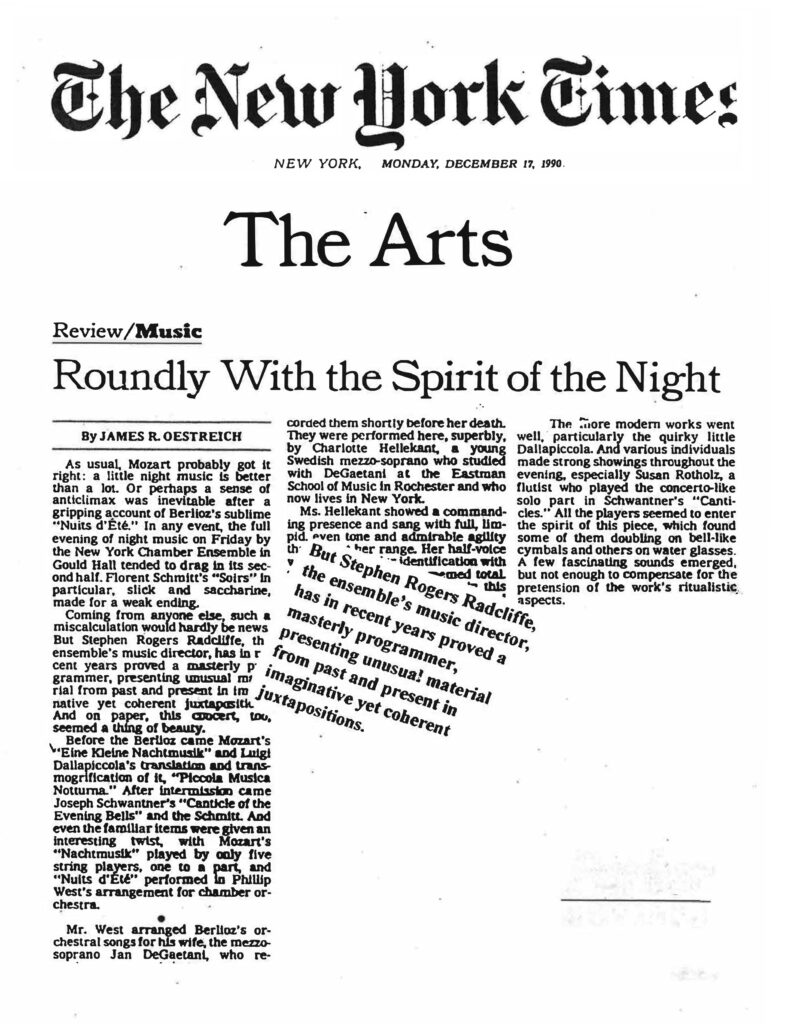
As usual, Mozart probably got it right: a little night music is better than a lot. Or perhaps a sense of anticlimax was inevitable after a gripping account of Berlioz’s sublime “Nuits d’Été.” In any event, the full evening of night music on Friday by the New York Chamber Ensemble at Florence Gould Hall tended to drag in its second half. Florent Schmitt’s “Soirs,” in particular, slick and saccharine, made for a weak ending.

Coming from anyone else, such a miscalculation would hardly be news. But Stephen Rogers Radcliffe, the ensemble’s music director, has in recent years proved a masterly programmer, presenting unusual material from past and present in imaginative yet coherent juxtapositions. And on paper, this concert, too, seemed a thing of beauty.

Before the Berlioz came Mozart’s “Eine Kleine Nachtmusik” and Luigi Dallapiccola’s translation and transmogrification of it, “Piccola Musica Notturna.” After intermission came Joseph Schwantner’s “Canticle of the Evening Bells” and the Schmitt. And even the familiar items were given an interesting twist, with Mozart’s “Nachtmusik” played by only five string players, one to a part, and “Nuits d’Été” performed in Philip West’s arrangement for chamber orchestra.

Mr. West arranged Berlioz’s orchestral songs for his wife, the mezzo-soprano Jan DeGaetani, who recorded them shortly before her death. They were performed here, superbly, by Charlotte Hellekant, a young Swedish mezzo-soprano who studied with DeGaetani at the Eastman School of Music in Rochester and who now lives in New York.

Ms. Hellekant showed a commanding presence and sang with full, limpid, even tone and admirable agility in her range. Her half-voice was especially beautiful. Identification with the text was keen, though occasionally generalized.

But Stephen Rogers Radcliffe, the ensemble’s music director, has in recent years proved a masterly programmer, presenting unusual material from past and present in imaginative yet coherent juxtapositions.

The more modern works went well, particularly the quirky little Dallapiccola. And various individuals made strong showings throughout the evening, especially Susan Rotholz, a flutist who played the concerto-like solo part in Schwantner’s “Canticles.” All the players seemed to enter the spirit of this piece, which found some of them doubling on bells, cymbals and others on water glasses. A few fascinating sounds emerged, but not enough to compensate for the pretension of the work’s ritualistic aspects.

Mini-Operas Make Comeback

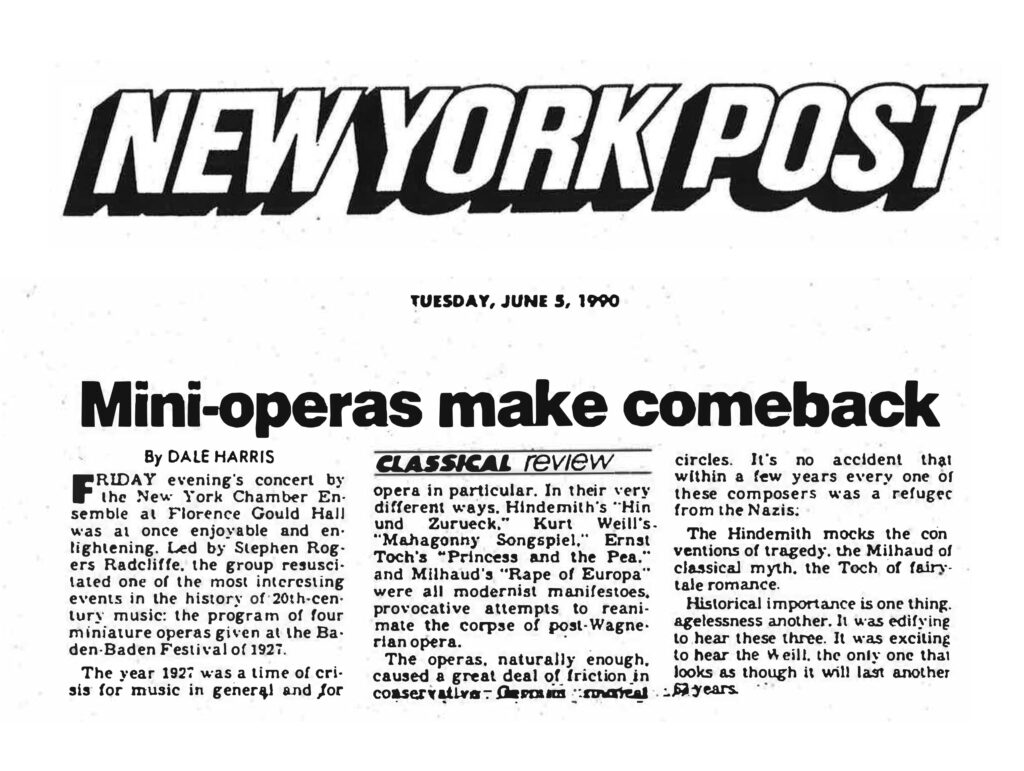
NEW YORK POST TUESDAY, JUNE 5, 1990 Mini-operas make comeback By DALE HARRIS CLASSICAL review FRIDAY evening's concert by the New York Chamber Ensemble at Florence Gould Hall was at once enjoyable and enlightening. Led by Stephen Rogers Radcliffe, the group resuscitated one of the most interesting events in the history of 20th-century music: the program of four miniature operas given at the Baden-Baden Festival of 1927. The year 1927 was a time of crisis for music in general and for opera in particular. In their very different ways, Hindemith's "Hin und Zurueck," Kurt Weill's "Mahagonny Songspiel," Ernst Toch's "Princess and the Pea" and Milhaud's "Rape of Europa" were all modernist manifestoes, provocative attempts to reanimate the corpse of post-Wagnerian opera. The operas, naturally enough, caused a great deal of friction in conservative German musical circles. It's no accident that within a few years every one of these composers was a refugee from the Nazis. The Hindemith mocks the conventions of tragedy, the Milhaud of classical myth, the Toch of fairy-tale romance. Historical importance is one thing, agelessness another. It was edifying to hear these three. It was exciting to hear the Weill, the only one that looks as though it will last another 50 years.

Press | Opera Review

Tuesday, June 5, 1990

Mini-Operas Make Comeback

By Dale Harris

FRIDAY evening’s concert by the New York Chamber Ensemble at Florence Gould Hall was at once enjoyable and enlightening. Led by Stephen Rogers Radcliffe, the group resuscitated one of the most interesting events in the history of 20th-century music: the program of four miniature operas given at the Baden-Baden Festival of 1927.

The year 1927 was a time of crisis for music in general and for opera in particular. In their very different ways, Hindemith’s “Hin und Zurueck,” Kurt Weill’s “Mahagonny Songspiel,” Ernst Toch’s “Princess and the Pea” and Milhaud’s “Rape of Europa” were all modernist manifestoes, provocative attempts to reanimate the corpse of post-Wagnerian opera.

The operas, naturally enough, caused a great deal of friction in conservative German musical circles. It’s no accident that within a few years every one of these composers was a refugee from the Nazis.

The Hindemith mocks the conventions of tragedy, the Milhaud of classical myth, the Toch of fairy-tale romance.
Historical importance is one thing, agelessness another. It was edifying to hear these three. It was exciting to hear the Weill, the only one that looks as though it will last another 50 years.

NEW YORK POST TUESDAY, JUNE 5, 1990 Mini-operas make comeback By DALE HARRIS CLASSICAL review FRIDAY evening's concert by the New York Chamber Ensemble at Florence Gould Hall was at once enjoyable and enlightening. Led by Stephen Rogers Radcliffe, the group resuscitated one of the most interesting events in the history of 20th-century music: the program of four miniature operas given at the Baden-Baden Festival of 1927. The year 1927 was a time of crisis for music in general and for opera in particular. In their very different ways, Hindemith's "Hin und Zurueck," Kurt Weill's "Mahagonny Songspiel," Ernst Toch's "Princess and the Pea" and Milhaud's "Rape of Europa" were all modernist manifestoes, provocative attempts to reanimate the corpse of post-Wagnerian opera. The operas, naturally enough, caused a great deal of friction in conservative German musical circles. It's no accident that within a few years every one of these composers was a refugee from the Nazis. The Hindemith mocks the conventions of tragedy, the Milhaud of classical myth, the Toch of fairy-tale romance. Historical importance is one thing, agelessness another. It was edifying to hear these three. It was exciting to hear the Weill, the only one that looks as though it will last another 50 years.

Re-creating a Musical Event of 1927

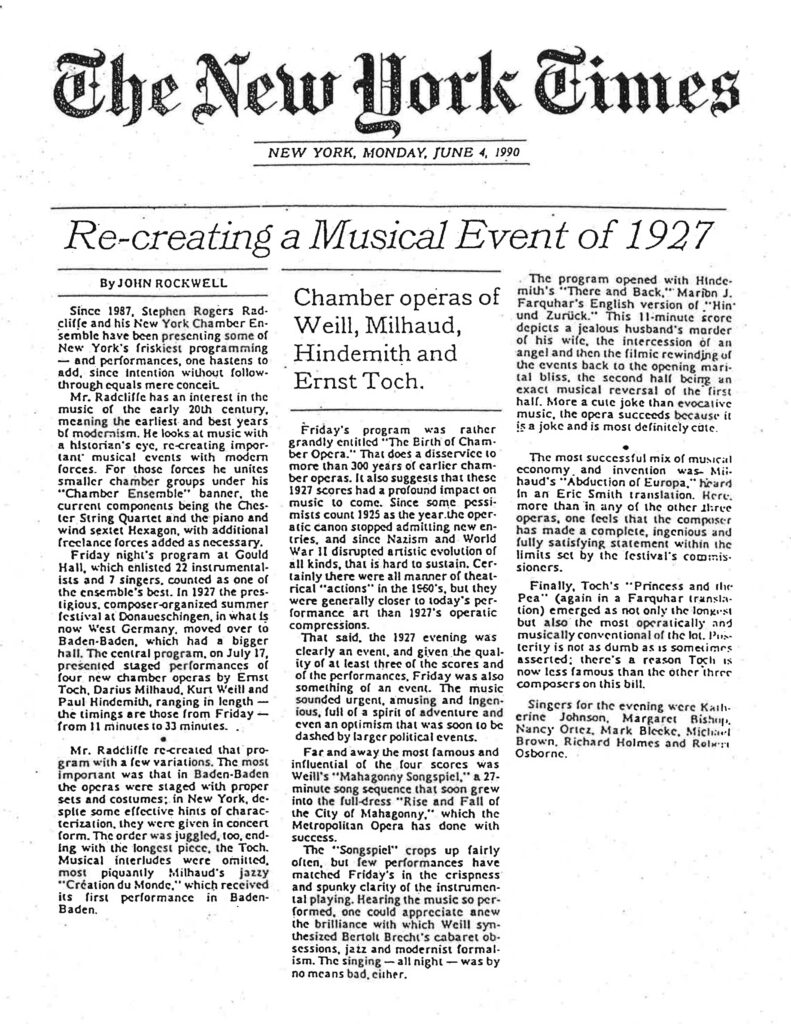
The New York Times NEW YORK, MONDAY, JUNE 4, 1990 Re-creating a Musical Event of 1927 By JOHN ROCKWELL Since 1987, Stephen Rogers Radcliffe and his New York Chamber Ensemble have been presenting some of New York's friskiest programming — and performances, one hastens to add, since intention without follow-through equals mere conceit. Mr. Radcliffe has an interest in the music of the early 20th century, meaning the earliest and best years of modernism. He looks at music with a historian's eye, re-creating important musical events with modern forces. For those forces he unites smaller chamber groups under his "Chamber Ensemble" banner, the current components being the Chester String Quartet and the piano and wind sextet Hexagon, with additional freelance forces added as necessary. Friday night's program at Gould Hall, which enlisted 22 instrumentalists and 7 singers, counted as one of the ensemble's best. In 1927 the prestigious, composer-organized summer festival at Donaueschingen, in what is now West Germany, moved over to Baden-Baden, which had a bigger hall. The central program, on July 17, presented staged performances of four new chamber operas by Ernst Toch, Darius Milhaud, Kurt Weill and Paul Hindemith, ranging in length — the timings are those from Friday — from 11 minutes to 33 minutes. Mr. Radcliffe re-created that program with a few variations. The most important was that in Baden-Baden the operas were staged with proper sets and costumes; in New York, despite some effective hints of characterization, they were given in concert form. The order was juggled, too, ending with the longest piece, the Toch. Musical interludes were omitted, most piquantly Milhaud's jazzy "Création du Monde," which received its first performance in Baden-Baden. Chamber operas of Weill, Milhaud, Hindemith and Ernst Toch. Friday's program was rather grandly entitled "The Birth of Chamber Opera." That does a disservice to more than 300 years of earlier chamber operas. It also suggests that these 1927 scores had a profound impact on music to come. Since some pessimists count 1925 as the year the operatic canon stopped admitting new entries, and since Nazism and World War II disrupted artistic evolution of all kinds, that is hard to sustain. Certainly there were all manner of theatrical "actions" in the 1960's, but they were generally closer to today's performance art than 1927's operatic compressions. That said, the 1927 evening was clearly an event, and given the quality of at least three of the scores and of the performances, Friday was also something of an event. The music sounded urgent, amusing and ingenious, full of a spirit of adventure and even an optimism that was soon to be dashed by larger political events. Far and away the most famous and influential of the four scores was Weill's "Mahagonny Songspiel," a 27-minute song sequence that soon grew into the full-dress "Rise and Fall of the City of Mahagonny," which the Metropolitan Opera has done with success. The "Songspiel" crops up fairly often, but few performances have matched Friday's in the crispness and spunky clarity of the instrumental playing. Hearing the music so performed, one could appreciate anew the brilliance with which Weill synthesized Bertolt Brecht's cabaret obsessions, jazz and modernist formalism. The singing — all night — was by no means bad, either. The program opened with Hindemith's "There and Back," Marion J. Farquhar's English version of "Hin und Zurück." This 11-minute score depicts a jealous husband's murder of his wife, the intercession of an angel and then the filmic rewinding of the events back to the opening marital bliss, the second half being an exact musical reversal of the first half. More a cute joke than evocative music, the opera succeeds because it is a joke and is most definitely cute. The most successful mix of musical economy and invention was Milhaud's "Abduction of Europa," heard in an Eric Smith translation. Here, more than in any of the other three operas, one feels that the composer has made a complete, ingenious and fully satisfying statement within the limits set by the festival's commissioners. Finally, Toch's "Princess and the Pea" (again in a Farquhar translation) emerged as not only the longest but also the most operatically and musically conventional of the lot. Posterity is not as dumb as is sometimes asserted; there's a reason Toch is now less famous than the other three composers on this bill. Singers for the evening were Katherine Johnson, Margaret Bishop, Nancy Ortez, Mark Bleeke, Michael Brown, Richard Holmes and Robert Osborne.

Press | Opera Reviews

The New York Times Logo

Monday, June 4, 1990

Re-creating a Musical Event of 1927

By John Rockwell

Since 1987, Stephen Rogers Radcliffe and his New York Chamber Ensemble have been presenting some of New York’s friskiest programming — and performances, one hastens to add, since intention without follow-through equals mere conceit.

Mr. Radcliffe has an interest in the music of the early 20th century, meaning the earliest and best years of modernism. He looks at music with a historian’s eye, re-creating important musical events with modern forces. For those forces he unites smaller chamber groups under his “Chamber Ensemble” banner, the current components being the Chester String Quartet and the piano and wind sextet Hexagon, with additional freelance forces added as necessary.

Friday night’s program at Gould Hall, which enlisted 22 instrumentalists and 7 singers, counted as one of the ensemble’s best. In 1927 the prestigious, composer-organized summer festival at Donaueschingen, in what is now West Germany, moved over to Baden-Baden, which had a bigger hall. The central program, on July 17, presented staged performances of four new chamber operas by Ernst Toch, Darius Milhaud, Kurt Weill and Paul Hindemith, ranging in length — the timings are those from Friday — from 11 minutes to 33 minutes.

Mr. Radcliffe re-created that program with a few variations. The most important was that in Baden-Baden the operas were staged with proper sets and costumes; in New York, despite some effective hints of characterization, they were given in concert form. The order was juggled, too, ending with the longest piece, the Toch. Musical interludes were omitted, most piquantly Milhaud’s jazzy “Création du Monde,” which received its first performance in Baden-Baden.

Chamber operas of Weill, Milhaud, Hindemith and Ernst Toch.

Friday’s program was rather grandly entitled “The Birth of Chamber Opera.” That does a disservice to more than 300 years of earlier chamber operas. It also suggests that these 1927 scores had a profound impact on music to come. Since some pessimists count 1925 as the year the operatic canon stopped admitting new entries, and since Nazism and World War II disrupted artistic evolution of all kinds, that is hard to sustain. Certainly there were all manner of theatrical “actions” in the 1960’s, but they were generally closer to today’s performance art than 1927’s operatic compressions.

That said, the 1927 evening was clearly an event, and given the quality of at least three of the scores and of the performances, Friday was also something of an event. The music sounded urgent, amusing and ingenious, full of a spirit of adventure and even an optimism that was soon to be dashed by larger political events.

Far and away the most famous and influential of the four scores was Weill’s “Mahagonny Songspiel,” a 27-minute song sequence that soon grew into the full-dress “Rise and Fall of the City of Mahagonny,” which the Metropolitan Opera has done with success.

The “Songspiel” crops up fairly often, but few performances have matched Friday’s in the crispness and spunky clarity of the instrumental playing. Hearing the music so performed, one could appreciate anew the brilliance with which Weill synthesized Bertolt Brecht’s cabaret obsessions, jazz and modernist formalism. The singing — all night — was by no means bad, either.

The program opened with Hindemith’s “There and Back,” Marion J. Farquhar’s English version of “Hin und Zurück.” This 11-minute score depicts a jealous husband’s murder of his wife, the intercession of an angel and then the filmic rewinding of the events back to the opening marital bliss, the second half being an exact musical reversal of the first half. More a cute joke than evocative music, the opera succeeds because it is a joke and is most definitely cute.

The most successful mix of musical economy and invention was Milhaud’s “Abduction of Europa,” heard in an Eric Smith translation. Here, more than in any of the other three operas, one feels that the composer has made a complete, ingenious and fully satisfying statement within the limits set by the festival’s commissioners.

Finally, Toch’s “Princess and the Pea” (again in a Farquhar translation) emerged as not only the longest but also the most operatically and musically conventional of the lot. Posterity is not as dumb as is sometimes asserted; there’s a reason Toch is now less famous than the other three composers on this bill.

Singers for the evening were Katherine Johnson, Margaret Bishop, Nancy Ortez, Mark Bleeke, Michael Brown, Richard Holmes and Robert Osborne.

The New York Times NEW YORK, MONDAY, JUNE 4, 1990 Re-creating a Musical Event of 1927 By JOHN ROCKWELL Since 1987, Stephen Rogers Radcliffe and his New York Chamber Ensemble have been presenting some of New York's friskiest programming — and performances, one hastens to add, since intention without follow-through equals mere conceit. Mr. Radcliffe has an interest in the music of the early 20th century, meaning the earliest and best years of modernism. He looks at music with a historian's eye, re-creating important musical events with modern forces. For those forces he unites smaller chamber groups under his "Chamber Ensemble" banner, the current components being the Chester String Quartet and the piano and wind sextet Hexagon, with additional freelance forces added as necessary. Friday night's program at Gould Hall, which enlisted 22 instrumentalists and 7 singers, counted as one of the ensemble's best. In 1927 the prestigious, composer-organized summer festival at Donaueschingen, in what is now West Germany, moved over to Baden-Baden, which had a bigger hall. The central program, on July 17, presented staged performances of four new chamber operas by Ernst Toch, Darius Milhaud, Kurt Weill and Paul Hindemith, ranging in length — the timings are those from Friday — from 11 minutes to 33 minutes. Mr. Radcliffe re-created that program with a few variations. The most important was that in Baden-Baden the operas were staged with proper sets and costumes; in New York, despite some effective hints of characterization, they were given in concert form. The order was juggled, too, ending with the longest piece, the Toch. Musical interludes were omitted, most piquantly Milhaud's jazzy "Création du Monde," which received its first performance in Baden-Baden. Chamber operas of Weill, Milhaud, Hindemith and Ernst Toch. Friday's program was rather grandly entitled "The Birth of Chamber Opera." That does a disservice to more than 300 years of earlier chamber operas. It also suggests that these 1927 scores had a profound impact on music to come. Since some pessimists count 1925 as the year the operatic canon stopped admitting new entries, and since Nazism and World War II disrupted artistic evolution of all kinds, that is hard to sustain. Certainly there were all manner of theatrical "actions" in the 1960's, but they were generally closer to today's performance art than 1927's operatic compressions. That said, the 1927 evening was clearly an event, and given the quality of at least three of the scores and of the performances, Friday was also something of an event. The music sounded urgent, amusing and ingenious, full of a spirit of adventure and even an optimism that was soon to be dashed by larger political events. Far and away the most famous and influential of the four scores was Weill's "Mahagonny Songspiel," a 27-minute song sequence that soon grew into the full-dress "Rise and Fall of the City of Mahagonny," which the Metropolitan Opera has done with success. The "Songspiel" crops up fairly often, but few performances have matched Friday's in the crispness and spunky clarity of the instrumental playing. Hearing the music so performed, one could appreciate anew the brilliance with which Weill synthesized Bertolt Brecht's cabaret obsessions, jazz and modernist formalism. The singing — all night — was by no means bad, either. The program opened with Hindemith's "There and Back," Marion J. Farquhar's English version of "Hin und Zurück." This 11-minute score depicts a jealous husband's murder of his wife, the intercession of an angel and then the filmic rewinding of the events back to the opening marital bliss, the second half being an exact musical reversal of the first half. More a cute joke than evocative music, the opera succeeds because it is a joke and is most definitely cute. The most successful mix of musical economy and invention was Milhaud's "Abduction of Europa," heard in an Eric Smith translation. Here, more than in any of the other three operas, one feels that the composer has made a complete, ingenious and fully satisfying statement within the limits set by the festival's commissioners. Finally, Toch's "Princess and the Pea" (again in a Farquhar translation) emerged as not only the longest but also the most operatically and musically conventional of the lot. Posterity is not as dumb as is sometimes asserted; there's a reason Toch is now less famous than the other three composers on this bill. Singers for the evening were Katherine Johnson, Margaret Bishop, Nancy Ortez, Mark Bleeke, Michael Brown, Richard Holmes and Robert Osborne.

History As Engaging Theater

York Newsday: New York Newsday New York EDITION MONDAY, JUNE 4, 1990 • MANHATTAN • 25 CENTS MUSIC REVIEW History As Engaging Theater THE NEW YORK CHAMBER ENSEMBLE. Stephen Rogers Radcliffe, music director. Hindemith: "Hin und Zurück" ("There and Back"); Weill: Mahagonny Songspiel; Milhaud: "The Abduction of Europe"; Ernst Toch: "The Princess and the Pea." Starring: Katherine Johnson, Margaret Bishop, Mark Bleeke, Richard Holmes, Robert Osborne, Nancy Ortez, Michael Brown. Florence Gould Hall, Friday night. By Tim Page THE NEW YORK Chamber Ensemble's Friday night re-creation of a particularly important concert from the 1927 Baden-Baden Festival was not only good, vital history but an engaging evening of music theater as well. Some background information: In the summer of 1927, four young composers — Paul Hindemith, Kurt Weill, Darius Milhaud and Ernst Toch — were invited to write short operas for performance in a small theater, with a limited number of soloists and a chamber ensemble instead of a full orchestra. On July 17 of that year, the four works received their world premiere performances at a festival of music in the German spa town of Baden-Baden; three of these were greeted enthusiastically, while the Weill work provoked wildly mixed reactions and even, if contemporary reports can be believed, some fisticuffs. Still, Weill's "Mahagonny Songspiel," to a text by Bertholt Brecht, was the only one of the four to enter the standard repertory and the central "Alabama Song" may be numbered among the composer's best-known creations. I have little patience for Brecht's shrill, debased representation of humanity but the music in this half-hour is wonderful — lean, tuneful, citric and altogether original. No wonder it caused a fuss. Hindemith's "Hin and Zuruck" — "There and Back" — owes a clear debt to the cinema. It might be described as an operatic palindrome that reaches a certain point in its action and is then run backwards. A husband enters to wish his wife a happy birthday, finds an incriminating love note, shoots her, then jumps out a window. The sequence of events is then reversed: the husband falls back through the window, the wife is restored to life, they quarrel about the love note, he wishes her a happy birthday and departs. Hindemith's score mirrors this chain of events: It is vigorous, virtuosic, richly contrapuntal and — no slight intended — sounds just as good backwards as forwards. In general, the music of Darius Milhaud has not worn the years very well (the same may be said of the other composers in the aggregate of French composers known as "Les Six," but Milhaud, with the most inflated reputation, had the farthest to fall). He now is remembered almost exclusively for his little jazz-age masterpiece, "La Creation du Monde," but the sweet pocket opera (nine minutes) he wrote for Baden-Baden, "The Abduction of Europe," deserves an occasional performance. It is exquisitely made, often very funny (including a chorus of mooing cows), imbued throughout with a sort of pastoral elegance that leads to a vaporous and beautiful finale. Unfortunately, the final opera, Ernst Toch's "The Princess and the Pea," is trite throughout, a succession of melodic, harmonic and theatrical predictabilities. Doubly unfortunately, it was by far the longest opera on the program — some 45 minutes. Still, for the sake of history, it had to be included: The New York Chamber Ensemble gave it a lively reading, and Margaret Bishop made a delightfully pouty princess. Indeed, there was little to fault in the evening's performances. The ensemble playing was synchronous and energetic, and Stephen Rogers Radcliffe's leadership was never less than authoritative. The singers — Mark Bleeke, Richard Holmes, Michael Brown, Robert Osborne, Nancy Ortez and Katherine Johnson — were equally fine; I particularly admired the Lotte Lenya-like mix of sweet and sour that Johnson brought to the Weill work. / II [Caption under photo: Conductor Stephen Rogers Radcliffe]

Press | Opera Reviews

Monday, June 4, 1990

History As Engaging Theater

By Tim Page

THE NEW YORK Chamber Ensemble’s Friday night re-creation of a particularly important concert from the 1927 Baden-Baden Festival was not only good, vital history but an engaging evening of music theater as well.

Some background information: In the summer of 1927, four young composers — Paul Hindemith, Kurt Weill, Darius Milhaud and Ernst Toch — were invited to write short operas for performance in a small theater, with a limited number of soloists and a chamber ensemble instead of a full orchestra. On July 17 of that year, the four works received their world premiere performances at a festival of music in the German spa town of Baden-Baden; three of these were greeted enthusiastically, while the Weill work provoked wildly mixed reactions and even, if contemporary reports can be believed, some fisticuffs.

Still, Weill’s “Mahagonny Songspiel,” to a text by Bertholt Brecht, was the only one of the four to enter the standard repertory and the central “Alabama Song” may be numbered among the composer’s best-known creations. I have little patience for Brecht’s shrill, debased representation of humanity but the music in this half-hour is wonderful — lean, tuneful, citric and altogether original. No wonder it caused a fuss.

Hindemith’s “Hin and Zuruck” — “There and Back” — owes a clear debt to the cinema. It might be described as an operatic palindrome that reaches a certain point in its action and is then run backwards. A husband enters to wish his wife a happy birthday, finds an incriminating love note, shoots her, then jumps out a window. The sequence of events is then reversed: the husband falls back through the window, the wife is restored to life, they quarrel about the love note, he wishes her a happy birthday and departs. Hindemith’s score mirrors this chain of events: It is vigorous, virtuosic, richly contrapuntal and — no slight intended — sounds just as good backwards as forwards.

In general, the music of Darius Milhaud has not worn the years very well (the same may be said of the other composers in the aggregate of French composers known as “Les Six,” but Milhaud, with the most inflated reputation, had the farthest to fall). He now is remembered almost exclusively for his little jazz-age masterpiece, “La Creation du Monde,” but the sweet pocket opera (nine minutes) he wrote for Baden-Baden, “The Abduction of Europe,” deserves an occasional performance. It is exquisitely made, often very funny (including a chorus of mooing cows), imbued throughout with a sort of pastoral elegance that leads to a vaporous and beautiful finale.

Unfortunately, the final opera, Ernst Toch’s “The Princess and the Pea,” is trite throughout, a succession of melodic, harmonic and theatrical predictabilities. Doubly unfortunately, it was by far the longest opera on the program — some 45 minutes. Still, for the sake of history, it had to be included: The New York Chamber Ensemble gave it a lively reading, and Margaret Bishop made a delightfully pouty princess.

Indeed, there was little to fault in the evening’s performances. The ensemble playing was synchronous and energetic, and Stephen Rogers Radcliffe’s leadership was never less than authoritative. The singers — Mark Bleeke, Richard Holmes, Michael Brown, Robert Osborne, Nancy Ortez and Katherine Johnson — were equally fine; I particularly admired the Lotte Lenya-like mix of sweet and sour that Johnson brought to the Weill work. / II

York Newsday: New York Newsday New York EDITION MONDAY, JUNE 4, 1990 • MANHATTAN • 25 CENTS MUSIC REVIEW History As Engaging Theater THE NEW YORK CHAMBER ENSEMBLE. Stephen Rogers Radcliffe, music director. Hindemith: "Hin und Zurück" ("There and Back"); Weill: Mahagonny Songspiel; Milhaud: "The Abduction of Europe"; Ernst Toch: "The Princess and the Pea." Starring: Katherine Johnson, Margaret Bishop, Mark Bleeke, Richard Holmes, Robert Osborne, Nancy Ortez, Michael Brown. Florence Gould Hall, Friday night. By Tim Page THE NEW YORK Chamber Ensemble's Friday night re-creation of a particularly important concert from the 1927 Baden-Baden Festival was not only good, vital history but an engaging evening of music theater as well. Some background information: In the summer of 1927, four young composers — Paul Hindemith, Kurt Weill, Darius Milhaud and Ernst Toch — were invited to write short operas for performance in a small theater, with a limited number of soloists and a chamber ensemble instead of a full orchestra. On July 17 of that year, the four works received their world premiere performances at a festival of music in the German spa town of Baden-Baden; three of these were greeted enthusiastically, while the Weill work provoked wildly mixed reactions and even, if contemporary reports can be believed, some fisticuffs. Still, Weill's "Mahagonny Songspiel," to a text by Bertholt Brecht, was the only one of the four to enter the standard repertory and the central "Alabama Song" may be numbered among the composer's best-known creations. I have little patience for Brecht's shrill, debased representation of humanity but the music in this half-hour is wonderful — lean, tuneful, citric and altogether original. No wonder it caused a fuss. Hindemith's "Hin and Zuruck" — "There and Back" — owes a clear debt to the cinema. It might be described as an operatic palindrome that reaches a certain point in its action and is then run backwards. A husband enters to wish his wife a happy birthday, finds an incriminating love note, shoots her, then jumps out a window. The sequence of events is then reversed: the husband falls back through the window, the wife is restored to life, they quarrel about the love note, he wishes her a happy birthday and departs. Hindemith's score mirrors this chain of events: It is vigorous, virtuosic, richly contrapuntal and — no slight intended — sounds just as good backwards as forwards. In general, the music of Darius Milhaud has not worn the years very well (the same may be said of the other composers in the aggregate of French composers known as "Les Six," but Milhaud, with the most inflated reputation, had the farthest to fall). He now is remembered almost exclusively for his little jazz-age masterpiece, "La Creation du Monde," but the sweet pocket opera (nine minutes) he wrote for Baden-Baden, "The Abduction of Europe," deserves an occasional performance. It is exquisitely made, often very funny (including a chorus of mooing cows), imbued throughout with a sort of pastoral elegance that leads to a vaporous and beautiful finale. Unfortunately, the final opera, Ernst Toch's "The Princess and the Pea," is trite throughout, a succession of melodic, harmonic and theatrical predictabilities. Doubly unfortunately, it was by far the longest opera on the program — some 45 minutes. Still, for the sake of history, it had to be included: The New York Chamber Ensemble gave it a lively reading, and Margaret Bishop made a delightfully pouty princess. Indeed, there was little to fault in the evening's performances. The ensemble playing was synchronous and energetic, and Stephen Rogers Radcliffe's leadership was never less than authoritative. The singers — Mark Bleeke, Richard Holmes, Michael Brown, Robert Osborne, Nancy Ortez and Katherine Johnson — were equally fine; I particularly admired the Lotte Lenya-like mix of sweet and sour that Johnson brought to the Weill work. / II [Caption under photo: Conductor Stephen Rogers Radcliffe]

An Homage to a Teacher

New York Newsday Monday, April 9, 1990 Stephen Rogers Radcliffe, Conductor MUSIC REVIEW An Homage to a Teacher AMERICANS IN PARIS: STUDENTS OF NADIA BOULANGER. Music by Aaron Copland, Roy Harris, David Diamond, Ned Rorem. New York Chamber Ensemble (Chester String Quartet, Hexagon), Stephen Rogers Radcliffe, conductor. Friday night. Florence Gould Hall, Alliance Francaise, 55 E. 59 St., Manhattan. By Peter Goodman THE MARK OF the great teacher is her ability to help the pupil be himself, not merely an image of the mentor. Nadia Boulanger was that sort of teacher. Renowned in the American musical world as the French pedagogue around whom gathered generations of aspiring composers from Virgil Thomson to Philip Glass, it is clear that whatever she taught them, she did not force them into her own mold. On Friday night, the New York Chamber Ensemble, an ambitious young group that includes a string quartet, a wind ensemble and other musicians, presented an attractive program devoted to the work of four of Boulanger's students. It was an evening of prima facie evidence that whatever Nadia Boulanger did, she didn't distort the voices of Aaron Copland, Roy Harris, David Diamond or Ned Rorem. Indeed, only Rorem, the youngest of the four composers, could be said to speak in French. The program opened with two works for clarinet, piano and string quartet: Copland's Sextet, a reworking of his "Short Symphony," and Harris' Concerto for Clarinet, Piano and Strings. Their only similarity was the instrumentation. Copland created the Sextet in 1937 after failing to gain performances of the "Short Symphony," completed in 1933. Although written in his artistic rather than populist style, the similarities between the composer's two voices are plain: harmonies of seconds and ninths, electric rhythms, lovely writing for clarinet, bursts of lyricism squeezed between dense blocks of sound. It's the work of a master, and the Chester String Quartet (part of the ensemble) played with an ease that belied all the difficulty musicians found with the work 45 years ago. Harris' concerto is immediately more lyrical and elegiac, with its slow, deep introduction on clarinet and piano, and its long, singing lines. If Copland was a tough city kid, Harris was a singer from the country. The concerto is full of richness, both harmonic and contrapuntal, and a sense of ease not found in Copland. Ultimately, the concerto is too relaxed and doesn't keep the listener involved. The second half included David Diamond's Concerto for Chamber Orchestra, written in 1940, and Ned Rorem's Eleven Studies for Eleven Players. The Diamond was the most awkward piece on the program, straightforward, with square rhythms and steady pulse and a sense of self-conscious seriousness that kept it from coming alive. Only during the two sprightly, dancing fugues did one hear what seemed to be the composer's natural voice. Rorem, of course, has never hidden his natural voice, witty, epigrammatic, cool and lyrical — French. In the Eleven Studies, various combinations of strings, winds, brass and percussion sing, dance, joke or whisper mysteriously, an exquisite platter of aural hors d'oeuvres. The performances were fine, crisp and lively, particularly the playing of trumpeter Stephen Burns, oboist Matthew Dine and pianist David Korevaar. Steven Rogers Radcliffe conducted. The concert, by the way, was part of a series in Florence Gould Hall, an excellent chamber two stories below ground level at the Alliance Francaise on East 59th Street. It's a hall that deserves more activity. / II [Caption under photo: Stephen Rogers Radcliffe conducted the works composed by Nadia Boulanger's students.]

Press | Symphonic Reviews

Monday, April 9, 1990

An Homage to a Teacher

By Peter Goodman

AMERICANS IN PARIS: STUDENTS OF NADIA BOULANGER.

Music by Aaron Copland, Roy Harris, David Diamond, Ned Rorem. New York Chamber Ensemble (Chester String Quartet, Hexagon), Stephen Rogers Radcliffe, conductor. Friday night. Florence Gould Hall, Alliance Francaise, 55 E. 59 St., Manhattan.

THE MARK OF the great teacher is her ability to help the pupil be himself, not merely an image of the mentor.

Nadia Boulanger was that sort of teacher. Renowned in the American musical world as the French pedagogue around whom gathered generations of aspiring composers from Virgil Thomson to Philip Glass, it is clear that whatever she taught them, she did not force them into her own mold.

On Friday night, the New York Chamber Ensemble, an ambitious young group that includes a string quartet, a wind ensemble and other musicians, presented an attractive program devoted to the work of four of Boulanger’s students. It was an evening of prima facie evidence that whatever Nadia Boulanger did, she didn’t distort the voices of Aaron Copland, Roy Harris, David Diamond or Ned Rorem. Indeed, only Rorem, the youngest of the four composers, could be said to speak in French.

The program opened with two works for clarinet, piano and string quartet: Copland’s Sextet, a reworking of his “Short Symphony,” and Harris’ Concerto for Clarinet, Piano and Strings. Their only similarity was the instrumentation.

Copland created the Sextet in 1937 after failing to gain performances of the “Short Symphony,” completed in 1933. Although written in his artistic rather than populist style, the similarities between the composer’s two voices are plain: harmonies of seconds and ninths, electric rhythms, lovely writing for clarinet, bursts of lyricism squeezed between dense blocks of sound. It’s the work of a master, and the Chester String Quartet (part of the ensemble) played with an ease that belied all the difficulty musicians found with the work 45 years ago.

Harris’ concerto is immediately more lyrical and elegiac, with its slow, deep introduction on clarinet and piano, and its long, singing lines. If Copland was a tough city kid, Harris was a singer from the country. The concerto is full of richness, both harmonic and contrapuntal, and a sense of ease not found in Copland. Ultimately, the concerto is too relaxed and doesn’t keep the listener involved.

The second half included David Diamond’s Concerto for Chamber Orchestra, written in 1940, and Ned Rorem’s Eleven Studies for Eleven Players. The Diamond was the most awkward piece on the program, straightforward, with square rhythms and steady pulse and a sense of self-conscious seriousness that kept it from coming alive. Only during the two sprightly, dancing fugues did one hear what seemed to be the composer’s natural voice.

Rorem, of course, has never hidden his natural voice, witty, epigrammatic, cool and lyrical — French. In the Eleven Studies, various combinations of strings, winds, brass and percussion sing, dance, joke or whisper mysteriously, an exquisite platter of aural hors d’oeuvres.

The performances were fine, crisp and lively, particularly the playing of trumpeter Stephen Burns, oboist Matthew Dine and pianist David Korevaar. Steven Rogers Radcliffe conducted.

The concert, by the way, was part of a series in Florence Gould Hall, an excellent chamber two stories below ground level at the Alliance Francaise on East 59th Street. It’s a hall that deserves more activity. / II

New York Newsday Monday, April 9, 1990 Stephen Rogers Radcliffe, Conductor MUSIC REVIEW An Homage to a Teacher AMERICANS IN PARIS: STUDENTS OF NADIA BOULANGER. Music by Aaron Copland, Roy Harris, David Diamond, Ned Rorem. New York Chamber Ensemble (Chester String Quartet, Hexagon), Stephen Rogers Radcliffe, conductor. Friday night. Florence Gould Hall, Alliance Francaise, 55 E. 59 St., Manhattan. By Peter Goodman THE MARK OF the great teacher is her ability to help the pupil be himself, not merely an image of the mentor. Nadia Boulanger was that sort of teacher. Renowned in the American musical world as the French pedagogue around whom gathered generations of aspiring composers from Virgil Thomson to Philip Glass, it is clear that whatever she taught them, she did not force them into her own mold. On Friday night, the New York Chamber Ensemble, an ambitious young group that includes a string quartet, a wind ensemble and other musicians, presented an attractive program devoted to the work of four of Boulanger's students. It was an evening of prima facie evidence that whatever Nadia Boulanger did, she didn't distort the voices of Aaron Copland, Roy Harris, David Diamond or Ned Rorem. Indeed, only Rorem, the youngest of the four composers, could be said to speak in French. The program opened with two works for clarinet, piano and string quartet: Copland's Sextet, a reworking of his "Short Symphony," and Harris' Concerto for Clarinet, Piano and Strings. Their only similarity was the instrumentation. Copland created the Sextet in 1937 after failing to gain performances of the "Short Symphony," completed in 1933. Although written in his artistic rather than populist style, the similarities between the composer's two voices are plain: harmonies of seconds and ninths, electric rhythms, lovely writing for clarinet, bursts of lyricism squeezed between dense blocks of sound. It's the work of a master, and the Chester String Quartet (part of the ensemble) played with an ease that belied all the difficulty musicians found with the work 45 years ago. Harris' concerto is immediately more lyrical and elegiac, with its slow, deep introduction on clarinet and piano, and its long, singing lines. If Copland was a tough city kid, Harris was a singer from the country. The concerto is full of richness, both harmonic and contrapuntal, and a sense of ease not found in Copland. Ultimately, the concerto is too relaxed and doesn't keep the listener involved. The second half included David Diamond's Concerto for Chamber Orchestra, written in 1940, and Ned Rorem's Eleven Studies for Eleven Players. The Diamond was the most awkward piece on the program, straightforward, with square rhythms and steady pulse and a sense of self-conscious seriousness that kept it from coming alive. Only during the two sprightly, dancing fugues did one hear what seemed to be the composer's natural voice. Rorem, of course, has never hidden his natural voice, witty, epigrammatic, cool and lyrical — French. In the Eleven Studies, various combinations of strings, winds, brass and percussion sing, dance, joke or whisper mysteriously, an exquisite platter of aural hors d'oeuvres. The performances were fine, crisp and lively, particularly the playing of trumpeter Stephen Burns, oboist Matthew Dine and pianist David Korevaar. Steven Rogers Radcliffe conducted. The concert, by the way, was part of a series in Florence Gould Hall, an excellent chamber two stories below ground level at the Alliance Francaise on East 59th Street. It's a hall that deserves more activity. / II [Caption under photo: Stephen Rogers Radcliffe conducted the works composed by Nadia Boulanger's students.]

Radcliffe leads young virtuosos

The ADVOCATE SERVING THE COMMUNITY SINCE 1829 • STAMFORD, CONNECTICUT • TUESDAY, MARCH 20, 1990 Radcliffe leads young virtuosos By John S. Sweeney Music Critic What is happening to the musical training of today's young people? Truly astonishing things, the Rondo Chamber Orchestra demonstrated Sunday afternoon at the Norwalk Concert Hall. Four virtuosos, none over 15 years of age, conducted by Stephen Radcliffe, already a veteran at 29, made remarkable music together. Radcliffe, who already has made his mark as a youthful conductor to watch, is a native of Greenwich and received his early musical training in the Greenwich public schools. What impressed most on Sunday was not the technical skills of the players, although they were of the highest order, but the real understanding of the music they performed. One would not expect musicians so young to grasp the subtleties of Bach, Haydn or Mozart as fully as did these performers. The youthful artists all played a full-length concerto, thus giving them a complete performing experience and their audience the opportunity to become fully acquainted with their musicianship. A sterling performance of Bach's D minor Concerto for two violins by two pupils of Alfred Markov, founder of Rondo, opened the program. Both 15 years old, Leonard Primak was born in Kiev and Gregory Kalinovsky in Leningrad. Their schooling was of the most solid discipline, with intonation, bowing, and dynamics all first rate. Radcliffe focused his ensemble with knowing craft, conducting with an easy, flowing style that brought rhythmic vitality and dynamic balances into place. Things got even better with Taiwan-born Kenneth Kuo, also 15, in Haydn's C major cello concerto. Kuo played with admirable security, executing the treacherous passages in thumb position with excellent intonation and control of bowing with a focused, well-rounded tone. His understanding of the slow movement, his sense of phrasing, his splendid balance with the orchestra, and the elan of his finale, making no concessions to difficulties, all belied his youth. Radcliffe drew from his orchestra a refined and stylistically impeccable accompaniment. His discerning sense of balance allowed his soloist to play his virtuoso passages without forcing the tone, yet provided solid support when required. Janacek's early work for strings, "Idyll," made an excellent foil on an otherwise baroque and classical program. Radcliffe extracted three contrasting movements from the work, each with an individual Slavic charm. His conducting was simple, technically skillful and idiomatically expressive without any trace of exaggeration or distortion. Alisa Kaplan, an engaging and self-possessed 12-year-old, stole the show with her surprisingly mature performance of Mozart's A major Piano Concerto, K. 414. Struggling with a less-than-perfect Steinway grand, her technical skills were superior and her style absolutely correct. She played her cadenzas with a remarkable understanding of their improvisational nature. Her rhythm never faltered even when, here and there, no doubt because of the jitters, a memory lapse occured. The accompaniment by the orchestra was commendable in its grace and dynamic control. Radcliffe followed his soloist's stylistic intentions with perfect faithfulness. [Photo Caption: STEPHEN R. RADCLIFFE]

Press | Symphonic Reviews

Tuesday, March 20, 1990

Radcliffe Leads Young Virtuosos

By John S. Sweeney, Music Critic

What is happening to the musical training of today’s young people?

Truly astonishing things, the Rondo Chamber Orchestra demonstrated Sunday afternoon at the Norwalk Concert Hall. Four virtuosos, none over 15 years of age, conducted by Stephen Radcliffe, already a veteran at 29, made remarkable music together.
Radcliffe, who already has made his mark as a youthful conductor to watch, is a native of Greenwich and received his early musical training in the Greenwich public schools.

What impressed most on Sunday was not the technical skills of the players, although they were of the highest order, but the real understanding of the music they performed. One would not expect musicians so young to grasp the subtleties of Bach, Haydn or Mozart as fully as did these performers.

The youthful artists all played a full-length concerto, thus giving them a complete performing experience and their audience the opportunity to become fully acquainted with their musicianship.

A sterling performance of Bach’s D minor Concerto for two violins by two pupils of Alfred Markov, founder of Rondo, opened the program. Both 15 years old, Leonard Primak was born in Kiev and Gregory Kalinovsky in Leningrad.

Their schooling was of the most solid discipline, with intonation, bowing, and dynamics all first rate. Radcliffe focused his ensemble with knowing craft, conducting with an easy, flowing style that brought rhythmic vitality and dynamic balances into place.

Things got even better with Taiwan-born Kenneth Kuo, also 15, in Haydn’s C major cello concerto. Kuo played with admirable security, executing the treacherous passages in thumb position with excellent intonation and control of bowing with a focused, well-rounded tone.

His understanding of the slow movement, his sense of phrasing, his splendid balance with the orchestra, and the elan of his finale, making no concessions to difficulties, all belied his youth.
Radcliffe drew from his orchestra a refined and stylistically impeccable accompaniment. His discerning sense of balance allowed his soloist to play his virtuoso passages without forcing the tone, yet provided solid support when required.

Janacek’s early work for strings, “Idyll,” made an excellent foil on an otherwise baroque and classical program. Radcliffe extracted three contrasting movements from the work, each with an individual Slavic charm.

His conducting was simple, technically skillful and idiomatically expressive without any trace of exaggeration or distortion.

Alisa Kaplan, an engaging and self-possessed 12-year-old, stole the show with her surprisingly mature performance of Mozart’s A major Piano Concerto, K. 414. Struggling with a less-than-perfect Steinway grand, her technical skills were superior and her style absolutely correct.

She played her cadenzas with a remarkable understanding of their improvisational nature. Her rhythm never faltered even when, here and there, no doubt because of the jitters, a memory lapse occured.

The accompaniment by the orchestra was commendable in its grace and dynamic control. Radcliffe followed his soloist’s stylistic intentions with perfect faithfulness.

The ADVOCATE SERVING THE COMMUNITY SINCE 1829 • STAMFORD, CONNECTICUT • TUESDAY, MARCH 20, 1990 Radcliffe leads young virtuosos By John S. Sweeney Music Critic What is happening to the musical training of today's young people? Truly astonishing things, the Rondo Chamber Orchestra demonstrated Sunday afternoon at the Norwalk Concert Hall. Four virtuosos, none over 15 years of age, conducted by Stephen Radcliffe, already a veteran at 29, made remarkable music together. Radcliffe, who already has made his mark as a youthful conductor to watch, is a native of Greenwich and received his early musical training in the Greenwich public schools. What impressed most on Sunday was not the technical skills of the players, although they were of the highest order, but the real understanding of the music they performed. One would not expect musicians so young to grasp the subtleties of Bach, Haydn or Mozart as fully as did these performers. The youthful artists all played a full-length concerto, thus giving them a complete performing experience and their audience the opportunity to become fully acquainted with their musicianship. A sterling performance of Bach's D minor Concerto for two violins by two pupils of Alfred Markov, founder of Rondo, opened the program. Both 15 years old, Leonard Primak was born in Kiev and Gregory Kalinovsky in Leningrad. Their schooling was of the most solid discipline, with intonation, bowing, and dynamics all first rate. Radcliffe focused his ensemble with knowing craft, conducting with an easy, flowing style that brought rhythmic vitality and dynamic balances into place. Things got even better with Taiwan-born Kenneth Kuo, also 15, in Haydn's C major cello concerto. Kuo played with admirable security, executing the treacherous passages in thumb position with excellent intonation and control of bowing with a focused, well-rounded tone. His understanding of the slow movement, his sense of phrasing, his splendid balance with the orchestra, and the elan of his finale, making no concessions to difficulties, all belied his youth. Radcliffe drew from his orchestra a refined and stylistically impeccable accompaniment. His discerning sense of balance allowed his soloist to play his virtuoso passages without forcing the tone, yet provided solid support when required. Janacek's early work for strings, "Idyll," made an excellent foil on an otherwise baroque and classical program. Radcliffe extracted three contrasting movements from the work, each with an individual Slavic charm. His conducting was simple, technically skillful and idiomatically expressive without any trace of exaggeration or distortion. Alisa Kaplan, an engaging and self-possessed 12-year-old, stole the show with her surprisingly mature performance of Mozart's A major Piano Concerto, K. 414. Struggling with a less-than-perfect Steinway grand, her technical skills were superior and her style absolutely correct. She played her cadenzas with a remarkable understanding of their improvisational nature. Her rhythm never faltered even when, here and there, no doubt because of the jitters, a memory lapse occured. The accompaniment by the orchestra was commendable in its grace and dynamic control. Radcliffe followed his soloist's stylistic intentions with perfect faithfulness. [Photo Caption: STEPHEN R. RADCLIFFE]

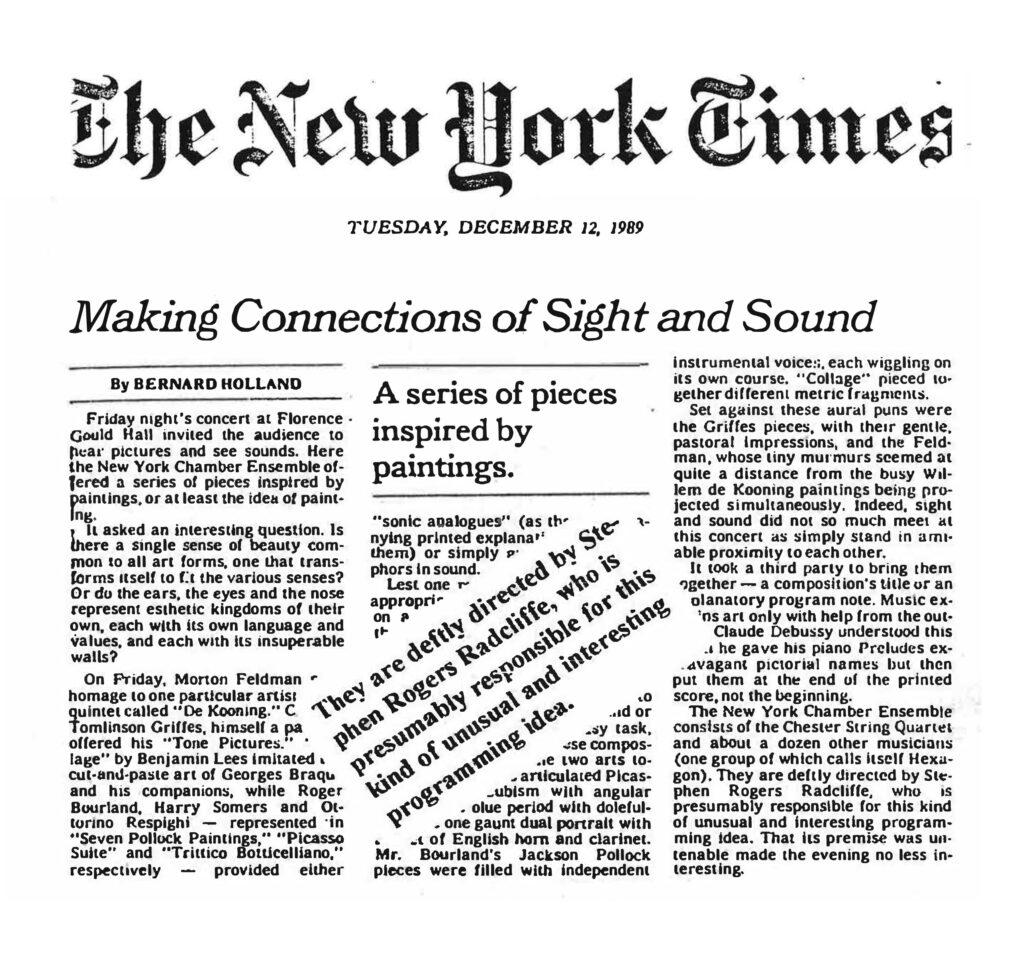
Making Connections of Sight and Sound

Here is the full text from the image: ⸻ The New York Times TUESDAY, DECEMBER 12, 1989 Making Connections of Sight and Sound By BERNARD HOLLAND Friday night’s concert at Florence Gould Hall invited the audience to hear pictures and see sounds. Here the New York Chamber Ensemble offered a series of pieces inspired by paintings, or at least the idea of painting. It asked an interesting question. Is there a single sense of beauty common to all art forms, one that transforms itself to fit the various senses? Or do the ears, the eyes and the nose represent esthetic kingdoms of their own, each with its own language and values, and each with its insuperable walls? On Friday, Morton Feldman’s quintet called “De Kooning” offered homage to one particular artist. Tomlinson Griffes, himself a painter, had “Tone Pictures,” and a cut-and-paste art of Georges Braque and his companions was mirrored by the music of Harry Somers and Ottorino Respighi in “Seven Pollock Paintings,” “Picasso Suite” and “Trittico Botticelliano,” respectively — provided either “sonic analogues” (as the program notes described them) or simply metaphors in sound. Less one might argue that this was an appropriate approach, the composers’ task was to articulate Picasso’s cubism with angular blue period with doleful lyricism, one gaunt dual portrait with dissonant counterpoint. Mr. Bourland’s Jackson Pollock pieces were filled with independent instrumental voices, each wiggling on its own course. “Collage” pieced together different metric fragments. Set against these aural puns were the Griffes pieces, with their gentle, pastoral impressions, and the Feldman, whose tiny murmurs seemed at quite a distance from the busy Willem de Kooning paintings being projected simultaneously. Indeed, sight and sound did not so much meet at this concert as simply stand in amicable proximity to each other. It took a third party to bring them together — a composition’s title or an explanatory program note. Music exists only with help from the outside. Claude Debussy understood this when he gave his piano Preludes evocative pictorial names but then put them at the end of the printed score, not the beginning. The New York Chamber Ensemble consists of the Chester String Quartet and about a dozen other musicians (one group of which calls itself Hexagon). They are deftly directed by Stephen Rogers Radcliffe, who is presumably responsible for this kind of unusual and interesting programming idea. That its premise was untenable made the evening no less interesting. ⸻ They are deftly directed by Stephen Rogers Radcliffe, who is presumably responsible for this kind of unusual and interesting programming idea.

Press | Symphonic Reviews

The New York Times Logo

Making Connections of Sight and Sound

Tuesday, December 12, 1989

By Bernard Holland

Friday night’s concert at Florence Gould Hall invited the audience to hear pictures and see sounds. Here the New York Chamber Ensemble offered a series of pieces inspired by paintings, or at least the idea of painting.

It asked an interesting question. Is there a single sense of beauty common to all art forms, one that transforms itself to fit the various senses? Or do the ears, the eyes and the nose represent esthetic kingdoms of their own, each with its own language and values, and each with its insuperable walls?

On Friday, Morton Feldman’s quintet called “De Kooning” offered homage to one particular artist. Tomlinson Griffes, himself a painter, had “Tone Pictures,” and a cut-and-paste art of Georges Braque and his companions was mirrored by the music of Harry Somers and Ottorino Respighi in “Seven Pollock Paintings,” “Picasso Suite” and “Trittico Botticelliano,” respectively — provided either “sonic analogues” (as the program notes described them) or simply metaphors in sound.

Less one might argue that this was an appropriate approach, the composers’ task was to articulate Picasso’s cubism with angular blue period with doleful lyricism, one gaunt dual portrait with dissonant counterpoint. Mr. Bourland’s Jackson Pollock pieces were filled with independent instrumental voices, each wiggling on its own course. “Collage” pieced together different metric fragments.

Set against these aural puns were the Griffes pieces, with their gentle, pastoral impressions, and the Feldman, whose tiny murmurs seemed at quite a distance from the busy Willem de Kooning paintings being projected simultaneously. Indeed, sight and sound did not so much meet at this concert as simply stand in amicable proximity to each other.

They are deftly directed by Stephen Rogers Radcliffe, who is presumably responsible for this kind of unusual and interesting programming idea.

It took a third party to bring them together — a composition’s title or an explanatory program note. Music exists only with help from the outside. Claude Debussy understood this when he gave his piano Preludes evocative pictorial names but then put them at the end of the printed score, not the beginning.

The New York Chamber Ensemble consists of the Chester String Quartet and about a dozen other musicians (one group of which calls itself Hexagon). They are deftly directed by Stephen Rogers Radcliffe, who is presumably responsible for this kind of unusual and interesting programming idea. That its premise was untenable made the evening no less interesting.

Here is the full text from the image: ⸻ The New York Times TUESDAY, DECEMBER 12, 1989 Making Connections of Sight and Sound By BERNARD HOLLAND Friday night’s concert at Florence Gould Hall invited the audience to hear pictures and see sounds. Here the New York Chamber Ensemble offered a series of pieces inspired by paintings, or at least the idea of painting. It asked an interesting question. Is there a single sense of beauty common to all art forms, one that transforms itself to fit the various senses? Or do the ears, the eyes and the nose represent esthetic kingdoms of their own, each with its own language and values, and each with its insuperable walls? On Friday, Morton Feldman’s quintet called “De Kooning” offered homage to one particular artist. Tomlinson Griffes, himself a painter, had “Tone Pictures,” and a cut-and-paste art of Georges Braque and his companions was mirrored by the music of Harry Somers and Ottorino Respighi in “Seven Pollock Paintings,” “Picasso Suite” and “Trittico Botticelliano,” respectively — provided either “sonic analogues” (as the program notes described them) or simply metaphors in sound. Less one might argue that this was an appropriate approach, the composers’ task was to articulate Picasso’s cubism with angular blue period with doleful lyricism, one gaunt dual portrait with dissonant counterpoint. Mr. Bourland’s Jackson Pollock pieces were filled with independent instrumental voices, each wiggling on its own course. “Collage” pieced together different metric fragments. Set against these aural puns were the Griffes pieces, with their gentle, pastoral impressions, and the Feldman, whose tiny murmurs seemed at quite a distance from the busy Willem de Kooning paintings being projected simultaneously. Indeed, sight and sound did not so much meet at this concert as simply stand in amicable proximity to each other. It took a third party to bring them together — a composition’s title or an explanatory program note. Music exists only with help from the outside. Claude Debussy understood this when he gave his piano Preludes evocative pictorial names but then put them at the end of the printed score, not the beginning. The New York Chamber Ensemble consists of the Chester String Quartet and about a dozen other musicians (one group of which calls itself Hexagon). They are deftly directed by Stephen Rogers Radcliffe, who is presumably responsible for this kind of unusual and interesting programming idea. That its premise was untenable made the evening no less interesting. ⸻ They are deftly directed by Stephen Rogers Radcliffe, who is presumably responsible for this kind of unusual and interesting programming idea.

A Program Built on ‘Pierrot Lunaire’

Here is the full text as it appears in the image: ⸻ The New York Times NEW YORK, SUNDAY, MARCH 5, 1989 Reviews/Music A Program Built on ‘Pierrot Lunaire’ By MICHAEL KIMMELMAN It is not hard to imagine what so impressed Stravinsky when he heard Schoenberg’s “Pierrot Lunaire” for the first time in the winter of 1912. Three-quarters of a century later, a listener can still be made to feel unsettled by the music’s urgency and strangeness. The group of 21 “songs” (to be rendered in sprechstimme, or a kind of notated speech) is typically described as Expressionistic. But it will not necessarily strike a modern listener that way, at least not if the term is meant to imply a connection with paintings by Nolde or Kandinsky. Certainly in a performance like the one offered by the New York Chamber Ensemble and Lucy Shelton, the soprano, at Alice Tully Hall on Wednesday evening, it was another sense of “Pierrot” that obtained — one conforming more to Schoenberg’s injunction that the musicians sustain a “light, ironical, satirical tone.” The Chester String Quartet and its guests — David Korevaar, pianist, and Bradley Garner and Alan R. Kay performing on several wind instruments — were under the baton of Stephen Rogers Radcliffe. The group placed itself at one side of the stage while Ms. Shelton sang on a platform at the other, giving to both soloist and ensemble an appropriately equal weight. There is something pristine and almost precious about this music, with its distilled and compact episodes. Mr. Radcliffe made his players pay close attention to the composer’s directions for detached notes, exactness of attack and a clarity of instrumental textures, all of which emphasized what a bizarre accompaniment Schoenberg has provided for Albert Giraud’s eerie and ruthless poems. This was a fine, contained performance, even if Ms. Shelton, despite her easy tone and precision at conveying the mood of each piece, failed to project clearly more than a few words of Andrew Porter’s English translation from the German text. “Pierrot” was the evening’s principal offering and its inspiration. The event re-created a program, conceived by Ravel 76 years ago but never realized. Having heard Schoenberg’s piece, Stravinsky composed a haiku-like set of “Three Japanese Lyrics,” utilizing the same configuration of instrumentalists. He spoke about “Pierrot” to Ravel, with whom he was then collaborating on the orchestration of Mussorgsky’s “Kovantchina,” and the Frenchman decided he would also try his hand at writing for a chamber group. “Trois Poèmes de Stéphane Mallarmé” was completed in 1913 and Ravel put forward the idea that it be performed alongside the pieces by Stravinsky and Schoenberg, with the evening rounded out by “Quatre Poèmes Hindous,” a set of songs by Maurice Delage, one of Ravel’s pupils and a friend of Stravinsky. All the works are small, on the scale of Schoenberg’s songs for “Pierrot.” Stravinsky’s are the tiniest gems and they received on Wednesday evening two gentle run-throughs, the second even more playful and full of color than the first. One might have wished for overt sensuousness from Ms. Shelton in the Ravel and, in the Delage, some wonderment when delivering lines describing the birth of Buddha. There may not be quite the same swings of mood in these splendid miniatures as there are in “Pierrot,” but only a performer deploying a wide expressive range can do them full justice.

Press | Opera Reviews

The New York Times Logo

A Program Built on ‘Pierrot Lunaire’

Sunday, March 5, 1989

By Michael Kimmelman

It is not hard to imagine what so impressed Stravinsky when he heard Schoenberg’s “Pierrot Lunaire” for the first time in the winter of 1912. Three-quarters of a century later, a listener can still be made to feel unsettled by the music’s urgency and strangeness.

The group of 21 “songs” (to be rendered in sprechstimme, or a kind of notated speech) is typically described as Expressionistic. But it will not necessarily strike a modern listener that way, at least not if the term is meant to imply a connection with paintings by Nolde or Kandinsky. Certainly in a performance like the one offered by the New York Chamber Ensemble and Lucy Shelton, the soprano, at Alice Tully Hall on Wednesday evening, it was another sense of “Pierrot” that obtained — one conforming more to Schoenberg’s injunction that the musicians sustain a “light, ironical, satirical tone.”

The Chester String Quartet and its guests — David Korevaar, pianist, and Bradley Garner and Alan R. Kay performing on several wind instruments — were under the baton of Stephen Rogers Radcliffe. The group placed itself at one side of the stage while Ms. Shelton sang on a platform at the other, giving to both soloist and ensemble an appropriately equal weight. There is something pristine and almost precious about this music, with its distilled and compact episodes. Mr. Radcliffe made his players pay close attention to the composer’s directions for detached notes, exactness of attack and a clarity of instrumental textures, all of which emphasized what a bizarre accompaniment Schoenberg has provided for Albert Giraud’s eerie and ruthless poems.

This was a fine, contained performance, even if Ms. Shelton, despite her easy tone and precision at conveying the mood of each piece, failed to project clearly more than a few words of Andrew Porter’s English translation from the German text.

“Pierrot” was the evening’s principal offering and its inspiration. The event re-created a program, conceived by Ravel 76 years ago but never realized. Having heard Schoenberg’s piece, Stravinsky composed a haiku-like set of “Three Japanese Lyrics,” utilizing the same configuration of instrumentalists. He spoke about “Pierrot” to Ravel, with whom he was then collaborating on the orchestration of Mussorgsky’s “Kovantchina,” and the Frenchman decided he would also try his hand at writing for a chamber group. “Trois Poèmes de Stéphane Mallarmé” was completed in 1913 and Ravel put forward the idea that it be performed alongside the pieces by Stravinsky and Schoenberg, with the evening rounded out by “Quatre Poèmes Hindous,” a set of songs by Maurice Delage, one of Ravel’s pupils and a friend of Stravinsky.

All the works are small, on the scale of Schoenberg’s songs for “Pierrot.” Stravinsky’s are the tiniest gems and they received on Wednesday evening two gentle run-throughs, the second even more playful and full of color than the first. One might have wished for overt sensuousness from Ms. Shelton in the Ravel and, in the Delage, some wonderment when delivering lines describing the birth of Buddha. There may not be quite the same swings of mood in these splendid miniatures as there are in “Pierrot,” but only a performer deploying a wide expressive range can do them full justice.

The New York Times NEW YORK, MONDAY, SEPTEMBER 14, 1987 Music: Verein Revisited, With Jan DeGaetani By MICHAEL KIMMELMAN In 1918, Schoenberg founded the Verein für Musikalisch Privataufführungen, a society devoted to the presentation of contemporary music from Mahler and Strauss onward. Admission to the society’s concerts was by subscription only; critics were not invited, and rehearsal time was ample. Berg, Webern and other composers active after the First World War belonged to the society, which became one of Austria’s most distinguished cultural institutions until its demise in 1923. The society employed pianists and then chamber ensembles for its concerts, so among the central occupations of members became the transcription of orchestral scores for smaller forces. Dozens of works were rearranged, sometimes by the composers themselves. Saturday evening’s engaging program at Alice Tully Hall by the New York Chamber Ensemble was the first in a series of concerts entitled “Music of the Verein Revisited.” The performing ensemble, which incorporated the Fine Arts Quartet, the New York Woodwind Quintet and a handful of others, played works by Debussy, Schoenberg and Mahler. Stephen Rogers Radcliffe conducted, and the mezzo-soprano Jan DeGaetani was soloist. Debussy’s “Prelude to the Afternoon of a Faun,” transcribed by Hanns Eisler, opened the program. Performed by 11 players, including the pianist Ursula Oppens, the work sounded less plush and colorful than usual, with the winds gaining even more prominence and the strings receding into the background. Still, the benefits of hearing a piece such as this stripped to the bone became apparent: textures were clear and there was no blanket of sound covering up the musical machinery. Miss DeGaetani next rendered three sets of songs: Schoenberg’s “Vier Lieder” (Op. 22), arranged by Felix Greissle; Schoenberg’s “Gurre-Lieder,” arranged by the composer; and Mahler’s “Rückert Lieder,” transcribed by Philip West. Again, the music was on a scale that drew the listener to it and allowed small details to gain prominence. It also suited the temperament of the evening’s soloist, who did not have to battle large numbers of instrumentalists to make herself heard. Throughout, Miss DeGaetani offered performances of exactitude, purity and elegance. Words meant something to Ms. DeGaetani; tones were struck clearly and precisely. She created an atmosphere of rapt concentration, and she sang in beautifully constructed, carefully measured phrases. In particular, the final lines of Mahler’s “Ich Bin der Welt Abhanden Gekommen” were spun out in silken tones. Mr. Radcliffe served ably as partner without drawing from his players quite the same level of refinement. His best work of the evening came during an unusually spirited and thoughtful version of Schoenberg’s “Kammersymphonie” (Op. 9), which closed the program. Future performances in the four-concert Verein series by the New York Chamber Ensemble are scheduled for Jan. 15, Feb. 6 and April 8 at Alice Tully Hall.