Cape May Festival adds music to the Shore mix

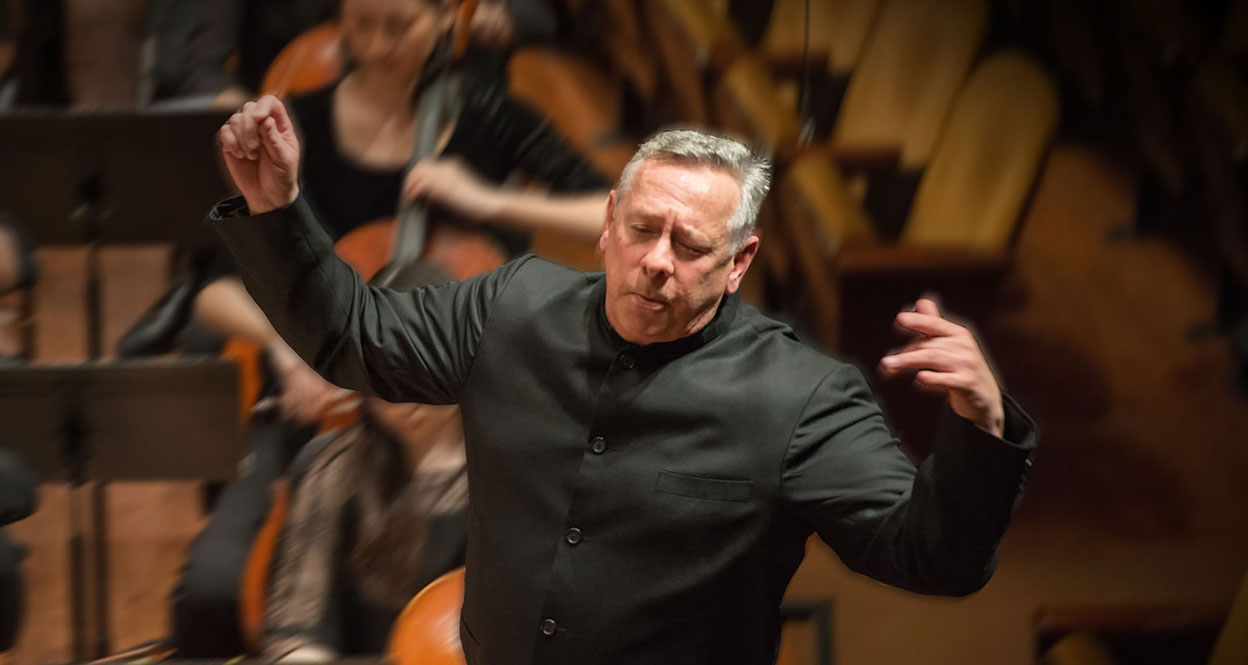
The Philadelphia Inquirer Saturday, June 14, 1997 Review: Music Cape May Festival adds music to the Shore mix By Daniel Webster INQUIRER MUSIC CRITIC Climate, culture, commerce: That was the formula laid out Thursday by New Jersey state arts council spokesman David Miller in his preface to the concert by the Cape May Festival Orchestra. Miller called the festival a model of what can happen when a resort community adds the arts to its traditional mix of sun and beachfront games. The concert, coming midway in a season that begins in late May and runs through June 29, brought around 250 vacationers into Cape May's Convention Hall to sit on folding chairs to hear music by Stravinsky, Beethoven and Mendelssohn. Artistic director Stephen Rogers Radcliffe noted that the eight-year-old festival was designed as a boost to the "shoulder season," the early beach weeks before sun and water temperature guarantee full hotels. Radcliffe's musical forces are built around his New York Chamber Ensemble, which performs as an entity and whose players function as principals amid the young professionals who fill out the festival orchestra. In the course of the festival's history, a stage shell has been installed and some reflecting panels placed in the ceiling in an effort to focus the acoustics. More panels would help, but the hall was not designed as a musical setting, and Radcliffe sees adapting to the hall as one of the experiences helpful to his young players. His program balanced popular favorites — Beethoven's Symphony No. 5 and Mendelssohn's Violin Concerto — with Stravinsky's tangy Dances Concertantes. He guided the orchestra through Stravinsky's laconic metric scheme with admirable poise. The performance preserved the irony of this gloss on conventional ballet writing while solo players injected dots of sound and theatrical melodic fragments. The winds and brass have an advantage in this hall, but in Stravinsky, their prominence was both welcome and vital. Violinist Corey Cerovsek was soloist in Mendelssohn's concerto. Steering clear of the staginess that has become a kind of norm with this piece, Cerovsek put his considerable virtuosity to musical ends. He shaded phrases, touched lightly some of the sweeps — like those opening the final movement — and found delicacy in writing that often sounds like shouting. The inner colors in his playing of the middle movement drew similar playing from the orchestra in this fresh reading. Audience response led Cerovsek to play a Kreisler nugget in which virtuosity again was bent to the task of mining the musical depth of the piece. After all that, the Beethoven symphony, played by an ensemble similar in size to those of Beethoven's time, sounded young, alert and a little brash. [Photo Caption] Stephen Rogers Radcliffe is the festival's artistic director. [Boxed Text] Cape May Music Festival Stephen Rogers Radcliffe conducts various programs in the festival, at Convention Hall, Cape May, through June 29. Information: 609-884-5404.

Press | Symphonic Review

Sunday, June 14, 1997

Cape May Festival adds music to the Shore mix

By Daniel Webster

Climate, culture, commerce: That was the formula laid out Thursday by New Jersey state arts council spokesman David Miller in his preface to the concert by the Cape May Festival Orchestra. Miller called the festival a model of what can happen when a resort community adds the arts to its traditional mix of sun and beachfront games.

The concert, coming midway in a season that begins in late May and runs through June 29, brought around 250 vacationers into Cape May’s Convention Hall to sit on folding chairs to hear music by Stravinsky, Beethoven and Mendelssohn. Artistic director Stephen Rogers Radcliffe noted that the eight-year-old festival was designed as a boost to the “shoulder season,” the early beach weeks before sun and water temperature guarantee full hotels.
Radcliffe’s musical forces are built around his New York Chamber Ensemble, which performs as an entity and whose players function as principals amid the young professionals who fill out the festival orchestra.

In the course of the festival’s history, a stage shell has been installed and some reflecting panels placed in the ceiling in an effort to focus the acoustics. More panels would help, but the hall was not designed as a musical setting, and Radcliffe sees adapting to the hall as one of the experiences helpful to his young players.

His program balanced popular favorites — Beethoven’s Symphony No. 5 and Mendelssohn’s Violin Concerto — with Stravinsky’s tangy Dances Concertantes. He guided the orchestra through Stravinsky’s laconic metric scheme with admirable poise. The performance preserved the irony of this gloss on conventional ballet writing while solo players injected dots of sound and theatrical melodic fragments. The winds and brass have an advantage in this hall, but in Stravinsky, their prominence was both welcome and vital.

Violinist Corey Cerovsek was soloist in Mendelssohn’s concerto. Steering clear of the staginess that has become a kind of norm with this piece, Cerovsek put his considerable virtuosity to musical ends. He shaded phrases, touched lightly some of the sweeps — like those opening the final movement — and found delicacy in writing that often sounds like shouting. The inner colors in his playing of the middle movement drew similar playing from the orchestra in this fresh reading.

Audience response led Cerovsek to play a Kreisler nugget in which virtuosity again was bent to the task of mining the musical depth of the piece.

After all that, the Beethoven symphony, played by an ensemble similar in size to those of Beethoven’s time, sounded young, alert and a little brash.

Cape May Music Festival
Stephen Rogers Radcliffe conducts various programs in the festival, at Convention Hall, Cape May, through June 29. Information: 609-884-5404.

The Philadelphia Inquirer Saturday, June 14, 1997 Review: Music Cape May Festival adds music to the Shore mix By Daniel Webster INQUIRER MUSIC CRITIC Climate, culture, commerce: That was the formula laid out Thursday by New Jersey state arts council spokesman David Miller in his preface to the concert by the Cape May Festival Orchestra. Miller called the festival a model of what can happen when a resort community adds the arts to its traditional mix of sun and beachfront games. The concert, coming midway in a season that begins in late May and runs through June 29, brought around 250 vacationers into Cape May's Convention Hall to sit on folding chairs to hear music by Stravinsky, Beethoven and Mendelssohn. Artistic director Stephen Rogers Radcliffe noted that the eight-year-old festival was designed as a boost to the "shoulder season," the early beach weeks before sun and water temperature guarantee full hotels. Radcliffe's musical forces are built around his New York Chamber Ensemble, which performs as an entity and whose players function as principals amid the young professionals who fill out the festival orchestra. In the course of the festival's history, a stage shell has been installed and some reflecting panels placed in the ceiling in an effort to focus the acoustics. More panels would help, but the hall was not designed as a musical setting, and Radcliffe sees adapting to the hall as one of the experiences helpful to his young players. His program balanced popular favorites — Beethoven's Symphony No. 5 and Mendelssohn's Violin Concerto — with Stravinsky's tangy Dances Concertantes. He guided the orchestra through Stravinsky's laconic metric scheme with admirable poise. The performance preserved the irony of this gloss on conventional ballet writing while solo players injected dots of sound and theatrical melodic fragments. The winds and brass have an advantage in this hall, but in Stravinsky, their prominence was both welcome and vital. Violinist Corey Cerovsek was soloist in Mendelssohn's concerto. Steering clear of the staginess that has become a kind of norm with this piece, Cerovsek put his considerable virtuosity to musical ends. He shaded phrases, touched lightly some of the sweeps — like those opening the final movement — and found delicacy in writing that often sounds like shouting. The inner colors in his playing of the middle movement drew similar playing from the orchestra in this fresh reading. Audience response led Cerovsek to play a Kreisler nugget in which virtuosity again was bent to the task of mining the musical depth of the piece. After all that, the Beethoven symphony, played by an ensemble similar in size to those of Beethoven's time, sounded young, alert and a little brash. [Photo Caption] Stephen Rogers Radcliffe is the festival's artistic director. [Boxed Text] Cape May Music Festival Stephen Rogers Radcliffe conducts various programs in the festival, at Convention Hall, Cape May, through June 29. Information: 609-884-5404.

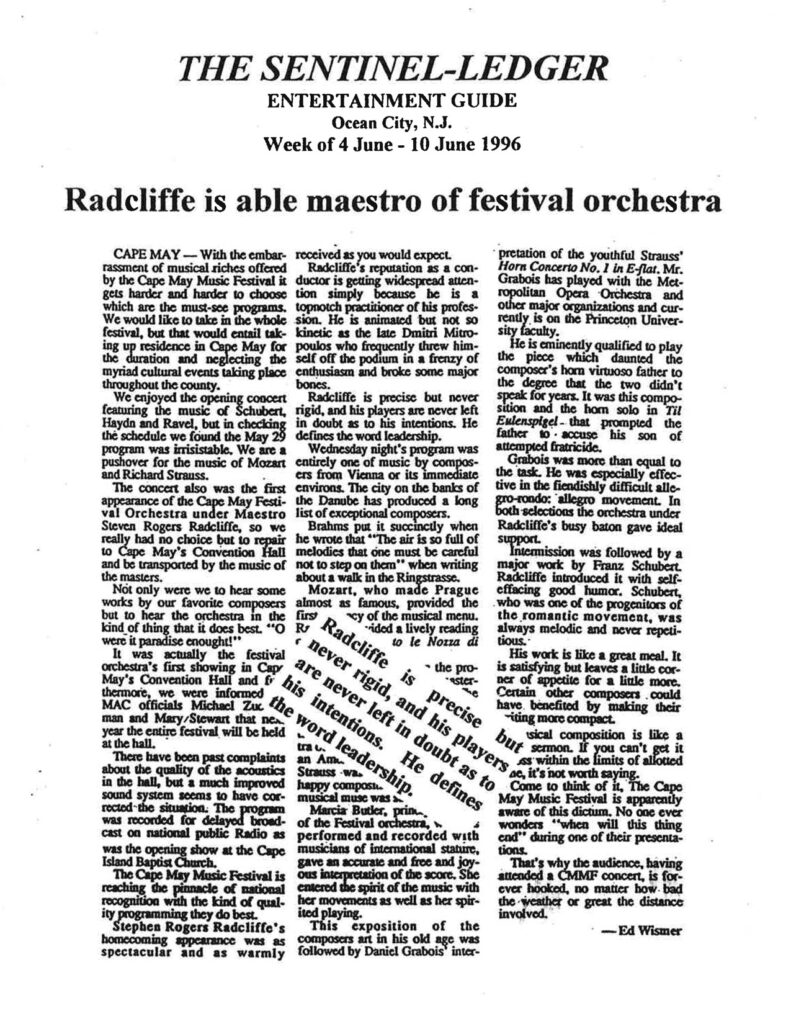
Radcliffe is able Maestro of Festival Orchestra

THE SENTINEL-LEDGER ENTERTAINMENT GUIDE Ocean City, N.J. Week of 4 June – 10 June 1996 Radcliffe is able maestro of festival orchestra CAPE MAY — With the embarrassment of musical riches offered by the Cape May Music Festival it gets harder and harder to choose which are the must-see programs. We would like to take in the whole festival, but that would entail taking up residence in Cape May for the duration and neglecting the myriad cultural events taking place throughout the county. We enjoyed the opening concert featuring the music of Schubert, Haydn and Ravel, but in checking the schedule we found the May 29 program was irresistible. We are a pushover for the music of Mozart and Richard Strauss. The concert also was the first appearance of the Cape May Festival Orchestra under Maestro Stephen Rogers Radcliffe, so we really had no choice but to repair to Cape May’s Convention Hall and be transported by the music of the masters. Not only were we to hear some works by our favorite composers but to hear the orchestra in the kind of thing that it does best — “O were it paradise enough!” It was actually the festival orchestra’s first showing in Cape May’s Convention Hall and, furthermore, we were informed by MAC officials Michael Zuckerman and Mary Stewart that next year the entire festival will be held at the hall. There have been past complaints about the quality of the acoustics in the hall, but a much improved sound system seems to have corrected the situation. The program was recorded for delayed broadcast on National Public Radio as was the opening show at the Cape Island Baptist Church. The Cape May Music Festival is reaching the pinnacle of national recognition with the kind of quality programming they do best. Stephen Rogers Radcliffe’s homecoming appearance was as spectacular and as warmly received as you would expect. Radcliffe’s reputation as a conductor is getting widespread attention simply because he is a topnotch practitioner of his profession. He is animated but not so kinetic as the late Dmitri Mitropoulos who frequently threw himself off the podium in a frenzy of enthusiasm and broke some major bones. Radcliffe is precise but never rigid, and his players are never left in doubt as to his intentions. He defines the word leadership. Wednesday night’s program was entirely one of music by composers from Vienna or its immediate environs. The city on the banks of the Danube has produced a long list of exceptional composers. Brahms put it succinctly when he wrote that “The air is so full of melodies that one must be careful not to step on them” when writing about a walk in the Ringstrasse. Mozart, who made Prague almost as famous, provided the first part of the musical menu. Radcliffe provided a lively reading of the Nozze di Figaro overture. Marcia Butler, principal clarinet of the Festival orchestra, performed and recorded with musicians of international stature, gave an accurate and free and joyous interpretation of the score. She entered the spirit of the music with her movements as well as her spirited playing. This exposition of the composers’ art in his old age was followed by Daniel Grabois’ interpretation of the youthful Strauss’ *Horn Concerto No. 1 in E-flat, Mr. Grabois has played with the Metropolitan Opera Orchestra and other major organizations and currently is on the Princeton University faculty. He is eminently qualified to play the piece which daunted the composer’s horn virtuoso father to the degree that the two didn’t speak for years. It was this composition and the horn solo in Till Eulenspiegel that prompted the father to accuse his son of attempted fratricide. Grabois was more than equal to the task. He was especially effective in the fiendishly difficult allegro con brio movement. In both selections the orchestra under Radcliffe’s busy baton gave ideal support. Intermission was followed by a major work by Franz Schubert. Radcliffe introduced it with self-effacing good humor. Schubert, who was one of the progenitors of the romantic movement, was always melodic and never repetitious. His work is like a great meal. It is satisfying but leaves a little corner of appetite for a little more. Certain other composers could have benefited by making their writing more compact. Musical composition is like a sermon. If you can’t get it across within the limits of allotted time, it’s not worth saying. Come to think of it, The Cape May Music Festival is apparently aware of this dictum. No one ever wonders “when will this thing end” during one of their presentations. That’s why the audience, having attended a CMMF concert, is forever hooked, no matter how bad the weather or great the distance involved. — Ed Wismer

Press | Symphonic Review

Week of June 4-10, 1996

Radcliffe is able Maestro of Festival Orchestra

By Ed Wismer

CAPE MAY — With the embarrassment of musical riches offered by the Cape May Music Festival it gets harder and harder to choose which are the must-see programs. We would like to take in the whole festival, but that would entail taking up residence in Cape May for the duration and neglecting the myriad cultural events taking place throughout the county.

We enjoyed the opening concert featuring the music of Schubert, Haydn and Ravel, but in checking the schedule we found the May 29 program was irresistible. We are a pushover for the music of Mozart and Richard Strauss.

The concert also was the first appearance of the Cape May Festival Orchestra under Maestro Stephen Rogers Radcliffe, so we really had no choice but to repair to Cape May’s Convention Hall and be transported by the music of the masters.

Not only were we to hear some works by our favorite composers but to hear the orchestra in the kind of thing that it does best — “O were it paradise enough!”

It was actually the festival orchestra’s first showing in Cape May’s Convention Hall and, furthermore, we were informed by MAC officials Michael Zuckerman and Mary Stewart that next year the entire festival will be held at the hall.

There have been past complaints about the quality of the acoustics in the hall, but a much improved sound system seems to have corrected the situation. The program was recorded for delayed broadcast on National Public Radio as was the opening show at the Cape Island Baptist Church.

The Cape May Music Festival is reaching the pinnacle of national recognition with the kind of quality programming they do best.

Stephen Rogers Radcliffe’s homecoming appearance was as spectacular and as warmly received as you would expect. Radcliffe’s reputation as a conductor is getting widespread attention simply because he is a topnotch practitioner of his profession. He is animated but not so kinetic as the late Dmitri Mitropoulos who frequently threw himself off the podium in a frenzy of enthusiasm and broke some major bones.

Radcliffe is precise but never rigid, and his players are never left in doubt as to his intentions. He defines the word leadership.

Wednesday night’s program was entirely one of music by composers from Vienna or its immediate environs. The city on the banks of the Danube has produced a long list of exceptional composers.

Brahms put it succinctly when he wrote that “The air is so full of melodies that one must be careful not to step on them” when writing about a walk in the Ringstrasse.

Mozart, who made Prague almost as famous, provided the first part of the musical menu. Radcliffe provided a lively reading of the Nozze di Figaro overture.

Marcia Butler, principal clarinet of the Festival orchestra, performed and recorded with musicians of international stature, gave an accurate and free and joyous interpretation of the score. She entered the spirit of the music with her movements as well as her spirited playing.

This exposition of the composers’ art in his old age was followed by Daniel Grabois’ interpretation of the youthful Strauss’ *Horn Concerto No. 1 in E-flat, Mr. Grabois has played with the Metropolitan Opera Orchestra and other major organizations and currently is on the Princeton University faculty.

He is eminently qualified to play the piece which daunted the composer’s horn virtuoso father to the degree that the two didn’t speak for years. It was this composition and the horn solo in Till Eulenspiegel that prompted the father to accuse his son of attempted fratricide.

Grabois was more than equal to the task. He was especially effective in the fiendishly difficult allegro con brio movement. In both selections the orchestra under Radcliffe’s busy baton gave ideal support.

Intermission was followed by a major work by Franz Schubert. Radcliffe introduced it with self-effacing good humor. Schubert, who was one of the progenitors of the romantic movement, was always melodic and never repetitious.

His work is like a great meal. It is satisfying but leaves a little corner of appetite for a little more. Certain other composers could have benefited by making their writing more compact.

Musical composition is like a sermon. If you can’t get it across within the limits of allotted time, it’s not worth saying. Come to think of it, The Cape May Music Festival is apparently aware of this dictum. No one ever wonders “when will this thing end” during one of their presentations.

That’s why the audience, having attended a CMMF concert, is forever hooked, no matter how bad the weather or great the distance involved.

— Ed Wismer

THE SENTINEL-LEDGER ENTERTAINMENT GUIDE Ocean City, N.J. Week of 4 June – 10 June 1996 Radcliffe is able maestro of festival orchestra CAPE MAY — With the embarrassment of musical riches offered by the Cape May Music Festival it gets harder and harder to choose which are the must-see programs. We would like to take in the whole festival, but that would entail taking up residence in Cape May for the duration and neglecting the myriad cultural events taking place throughout the county. We enjoyed the opening concert featuring the music of Schubert, Haydn and Ravel, but in checking the schedule we found the May 29 program was irresistible. We are a pushover for the music of Mozart and Richard Strauss. The concert also was the first appearance of the Cape May Festival Orchestra under Maestro Stephen Rogers Radcliffe, so we really had no choice but to repair to Cape May’s Convention Hall and be transported by the music of the masters. Not only were we to hear some works by our favorite composers but to hear the orchestra in the kind of thing that it does best — “O were it paradise enough!” It was actually the festival orchestra’s first showing in Cape May’s Convention Hall and, furthermore, we were informed by MAC officials Michael Zuckerman and Mary Stewart that next year the entire festival will be held at the hall. There have been past complaints about the quality of the acoustics in the hall, but a much improved sound system seems to have corrected the situation. The program was recorded for delayed broadcast on National Public Radio as was the opening show at the Cape Island Baptist Church. The Cape May Music Festival is reaching the pinnacle of national recognition with the kind of quality programming they do best. Stephen Rogers Radcliffe’s homecoming appearance was as spectacular and as warmly received as you would expect. Radcliffe’s reputation as a conductor is getting widespread attention simply because he is a topnotch practitioner of his profession. He is animated but not so kinetic as the late Dmitri Mitropoulos who frequently threw himself off the podium in a frenzy of enthusiasm and broke some major bones. Radcliffe is precise but never rigid, and his players are never left in doubt as to his intentions. He defines the word leadership. Wednesday night’s program was entirely one of music by composers from Vienna or its immediate environs. The city on the banks of the Danube has produced a long list of exceptional composers. Brahms put it succinctly when he wrote that “The air is so full of melodies that one must be careful not to step on them” when writing about a walk in the Ringstrasse. Mozart, who made Prague almost as famous, provided the first part of the musical menu. Radcliffe provided a lively reading of the Nozze di Figaro overture. Marcia Butler, principal clarinet of the Festival orchestra, performed and recorded with musicians of international stature, gave an accurate and free and joyous interpretation of the score. She entered the spirit of the music with her movements as well as her spirited playing. This exposition of the composers’ art in his old age was followed by Daniel Grabois’ interpretation of the youthful Strauss’ *Horn Concerto No. 1 in E-flat, Mr. Grabois has played with the Metropolitan Opera Orchestra and other major organizations and currently is on the Princeton University faculty. He is eminently qualified to play the piece which daunted the composer’s horn virtuoso father to the degree that the two didn’t speak for years. It was this composition and the horn solo in Till Eulenspiegel that prompted the father to accuse his son of attempted fratricide. Grabois was more than equal to the task. He was especially effective in the fiendishly difficult allegro con brio movement. In both selections the orchestra under Radcliffe’s busy baton gave ideal support. Intermission was followed by a major work by Franz Schubert. Radcliffe introduced it with self-effacing good humor. Schubert, who was one of the progenitors of the romantic movement, was always melodic and never repetitious. His work is like a great meal. It is satisfying but leaves a little corner of appetite for a little more. Certain other composers could have benefited by making their writing more compact. Musical composition is like a sermon. If you can’t get it across within the limits of allotted time, it’s not worth saying. Come to think of it, The Cape May Music Festival is apparently aware of this dictum. No one ever wonders “when will this thing end” during one of their presentations. That’s why the audience, having attended a CMMF concert, is forever hooked, no matter how bad the weather or great the distance involved. — Ed Wismer

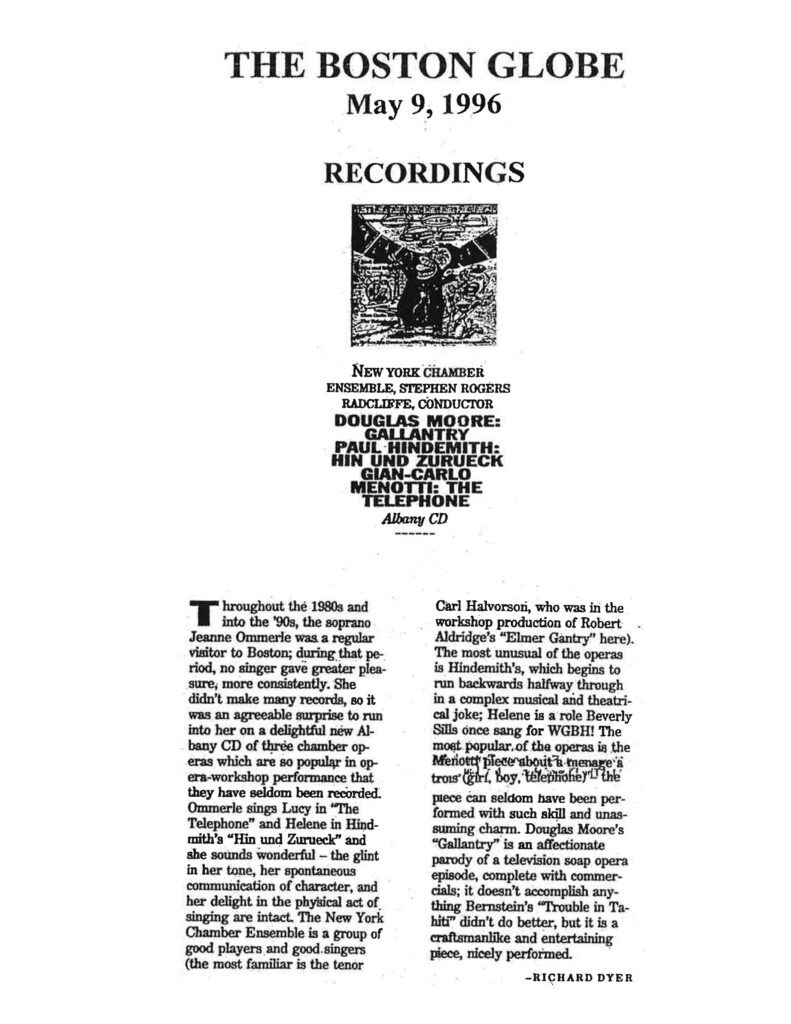
The Boston Globe Recording Review

THE BOSTON GLOBE May 9, 1996 RECORDINGS NEW YORK CHAMBER ENSEMBLE, STEPHEN ROGERS RADCLIFFE, CONDUCTOR DOUGLAS MOORE: GALLANTRY PAUL HINDEMITH: HIN UND ZURUECK GIAN-CARLO MENOTTI: THE TELEPHONE Albany CD Throughout the 1980s and into the ’90s, the soprano Jeanne Ommerle was a regular visitor to Boston; during that period, no singer gave greater pleasure, more consistently. She didn’t make many records, so it was an agreeable surprise to run into her on a delightful new Albany CD of three chamber operas which are so popular in opera-workshop performance that they have seldom been recorded. Ommerle sings Lucy in “The Telephone” and Helene in Hindemith’s “Hin und Zurueck,” and she sounds wonderful — the glint in her tone, her spontaneous communication of character, and her delight in the physical act of singing are intact. The New York Chamber Ensemble is a group of good players and good singers (the most familiar is the tenor Carl Halvorson, who was in the workshop production of Robert Aldridge’s “Elmer Gantry” here). The most unusual of the operas is Hindemith’s, which begins to run backwards halfway through in a complex musical and theatrical joke; Helene is a role Beverly Sills once sang for WGBH! The most popular of the operas is the Menotti piece about a ménage à trois of girl, boy, telephone! The piece can seldom have been performed with such skill and unassuming charm. Douglas Moore’s “Gallantry” is an affectionate parody of a television soap opera episode, complete with commercials; it doesn’t accomplish anything Bernstein’s “Trouble in Tahiti” didn’t do better, but it is a craftsmanlike and entertaining piece, nicely performed. — RICHARD DYER ⸻ If you’d like, I can also standardize all of these clippings into a consistent press-archive format for Stephen’s website (publication, date, reviewer, repertoire, label, performers).

Press | Recording Review

Thursday, May 9, 1996

By Richard Dyer

New York Chamber Ensemble,
Stephen Rogers Radcliffe, Conductor
Douglas Moore: Gallantry
Paul Hindemith: Hin Und Zurueck
Gian-carlo Menotti: The Telephone
Albany CD

Throughout the 1980s and into the ’90s, the soprano Jeanne Ommerle was a regular visitor to Boston; during that period, no singer gave greater pleasure, more consistently. She didn’t make many records, so it was an agreeable surprise to run into her on a delightful new Albany CD of three chamber operas which are so popular in opera-workshop performance that they have seldom been recorded.

Ommerle sings Lucy in “The Telephone” and Helene in Hindemith’s “Hin und Zurueck,” and she sounds wonderful — the glint in her tone, her spontaneous communication of character, and her delight in the physical act of singing are intact. The New York Chamber Ensemble is a group of good players and good singers (the most familiar is the tenor Carl Halvorson, who was in the workshop production of Robert Aldridge’s “Elmer Gantry” here).

The most unusual of the operas is Hindemith’s, which begins to run backwards halfway through in a complex musical and theatrical joke; Helene is a role Beverly Sills once sang for WGBH! The most popular of the operas is the Menotti piece about a ménage à trois of girl, boy, telephone! The piece can seldom have been performed with such skill and unassuming charm.

Douglas Moore’s “Gallantry” is an affectionate parody of a television soap opera episode, complete with commercials; it doesn’t accomplish anything Bernstein’s “Trouble in Tahiti” didn’t do better, but it is a craftsmanlike and entertaining piece, nicely performed.

— RICHARD DYER

THE BOSTON GLOBE May 9, 1996 RECORDINGS NEW YORK CHAMBER ENSEMBLE, STEPHEN ROGERS RADCLIFFE, CONDUCTOR DOUGLAS MOORE: GALLANTRY PAUL HINDEMITH: HIN UND ZURUECK GIAN-CARLO MENOTTI: THE TELEPHONE Albany CD Throughout the 1980s and into the ’90s, the soprano Jeanne Ommerle was a regular visitor to Boston; during that period, no singer gave greater pleasure, more consistently. She didn’t make many records, so it was an agreeable surprise to run into her on a delightful new Albany CD of three chamber operas which are so popular in opera-workshop performance that they have seldom been recorded. Ommerle sings Lucy in “The Telephone” and Helene in Hindemith’s “Hin und Zurueck,” and she sounds wonderful — the glint in her tone, her spontaneous communication of character, and her delight in the physical act of singing are intact. The New York Chamber Ensemble is a group of good players and good singers (the most familiar is the tenor Carl Halvorson, who was in the workshop production of Robert Aldridge’s “Elmer Gantry” here). The most unusual of the operas is Hindemith’s, which begins to run backwards halfway through in a complex musical and theatrical joke; Helene is a role Beverly Sills once sang for WGBH! The most popular of the operas is the Menotti piece about a ménage à trois of girl, boy, telephone! The piece can seldom have been performed with such skill and unassuming charm. Douglas Moore’s “Gallantry” is an affectionate parody of a television soap opera episode, complete with commercials; it doesn’t accomplish anything Bernstein’s “Trouble in Tahiti” didn’t do better, but it is a craftsmanlike and entertaining piece, nicely performed. — RICHARD DYER ⸻ If you’d like, I can also standardize all of these clippings into a consistent press-archive format for Stephen’s website (publication, date, reviewer, repertoire, label, performers).

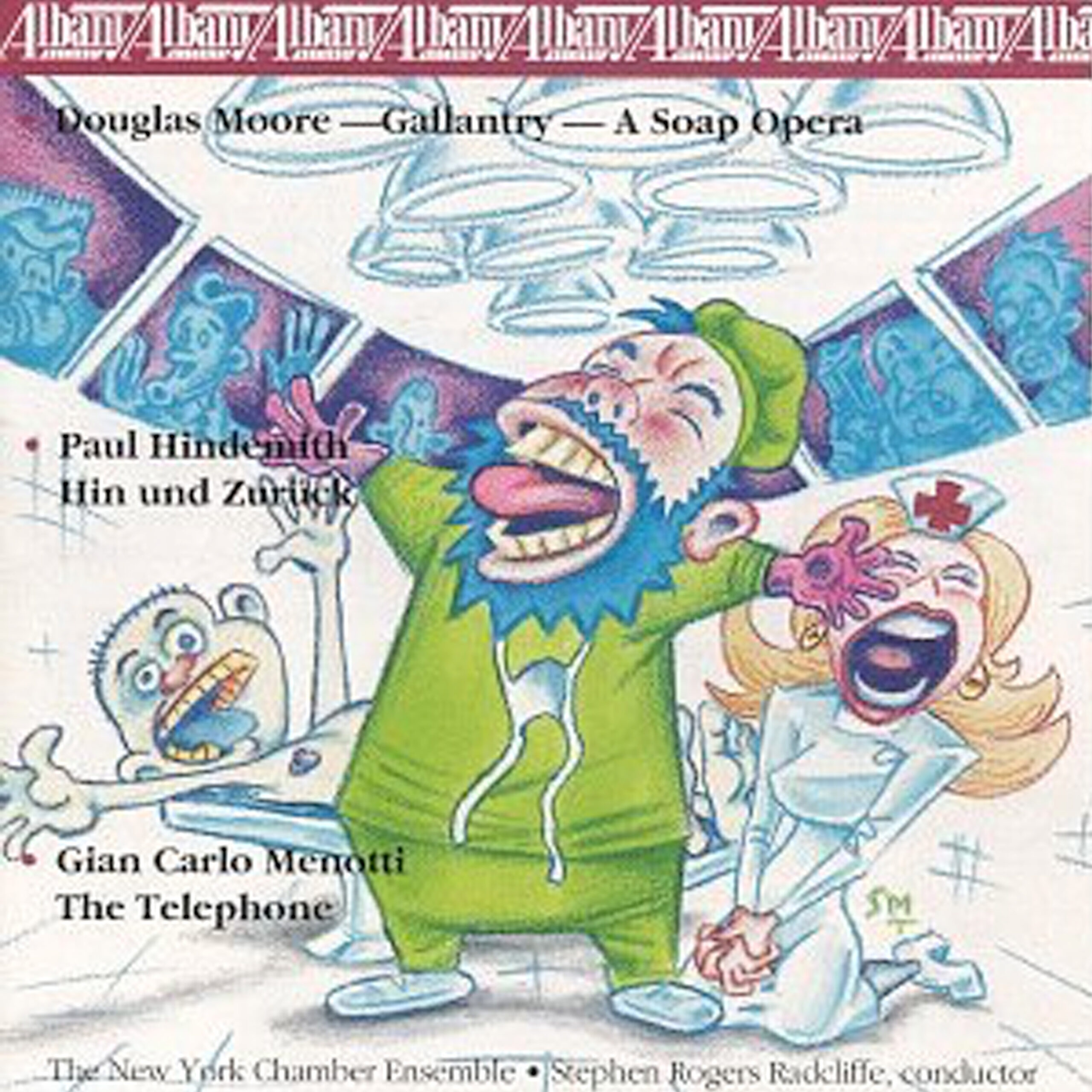
MOORE: Gallantry—A Soap Opera HINDEMITH: Hin und Zurück MENOTTI: The Telephone

Fanfare The Magazine for Serious Record Collectors March/April 1996 • Volume 19, Number 4 MOORE: Gallantry—A Soap Opera¹. HINDEMITH: Hin und Zurück². MENOTTI: The Telephone³. Stephen Rogers Radcliffe conducting; Jeanne Ommerlé, soprano (Helene²; Lucy³); Margaret Bishop, soprano (Lola¹); Julia Parks, mezzo-soprano (Announcer¹); Carl Halvorson, tenor (Donald¹; Robert²); Robert Osborne, tenor (Orderly²); Richard Holmes, baritone (Dr. Gregg¹; A Doctor²; Ben³); Austin Wright Moore, bass (A Sage³); The New York Chamber Ensemble. ALBANY TROY 173 [DDD]; 60:49. Produced by Dan Kincaid. (Distributed by Albany Music.) This group, with some of the same singers, performed these three comic one-acts at a luncheon concert in New York City’s Bryant Park a few summers back. I thought the trio most amusing, and, checking my watch, thought, "What a neat CD they would make!" Wishes do come true, sometimes. Douglas Moore’s 1957 Gallantry is a loving spoof of television soap operas, complete with commercial interruptions. In the commercials, a slinky lady announcer advertises soap and wax; in the drama itself a surgeon is trying to seduce his nurse-anesthetist, but she loves another, who turns out to be the patient on the operating table. . . . Moore wrote charming music for this blend of farce and sentiment, with a variety of arias and duets. To turn the finale into a quartet, the surgeon joins the announcer in endorsing the products while a love duet is still going on. My favorite exchange goes: > Donald (casually): How is Mrs. Gregg, Doctor? > Lola (stunned): Mrs. Gregg? > Donald: Yes! how is your wife, Doctor? > Dr. Gregg (disdainfully): Put the patient to sleep, Miss Markham. > Hindemith’s 1927 "sketch with music" centers on the cinematic trick of reversing the action: husband suspects wife of infidelity; they argue, and the truth comes out; he shoots her; doctor arrives and takes her away; husband leaps out window. A sage appears and decides to turn it all around. Husband leaps back in; wife is carried back in; bullet returns to gun; argument goes backward to a happy ending. This performance is in an English translation (the performance on a Candide LP is sung in German). Accompaniment is by two pianos and six woodwinds; it all takes but eleven minutes. The music is lively fun, and this performance makes the most of it. Menotti’s 1946 The Telephone has been a continuing success for half a century; its wit and elegance are typical of his early operas. The plot situation and the spirit of the piece are exactly the opposite of that other telephone opera, Poulenc’s La Voix humaine. Ben is trying to propose to Lucy, but her telephone keeps interrupting; he leaves and phones in his proposal, which she accepts. I’ve never heard The Telephone done better than on this disc: Jeanne Ommerlé is a breezy delight as the scatterbrained heroine, and she sings the high-lying near-monolog with silken ease. The instrumentalists are all first-rate, with especially lovely oboe playing by Marcia Butler. The recordings are bright and clear; full texts are included. An ugly cartoon cover becomes quite funny once you know Moore’s piece. I can’t imagine any listener not being amused and charmed by this disc. James H. North

Press | Recording Review

March/April 1996 • Volume 19, Number 4

MOORE: Gallantry—A Soap Opera¹
HINDEMITH:
Hin und Zurück²
MENOTTI:
The Telephone³


Stephen Rogers Radcliffe conducting;
Jeanne Ommerlé, soprano (Helene²; Lucy³);
Margaret Bishop, soprano (Lola¹);
Julia Parks, mezzo-soprano (Announcer¹);
Carl Halvorson, tenor (Donald¹; Robert²);
Robert Osborne, tenor (Orderly²);
Richard Holmes, baritone (Dr. Gregg¹; A Doctor²; Ben³);
Austin Wright Moore, bass (A Sage³);
The New York Chamber Ensemble.
ALBANY TROY 173 [DDD]; 60:49.
Produced by Dan Kincaid. (Distributed by Albany Music.)

By James H. North

This group, with some of the same singers, performed these three comic one-acts at a luncheon concert in New York City’s Bryant Park a few summers back. I thought the trio most amusing, and, checking my watch, thought, “What a neat CD they would make!” Wishes do come true, sometimes.

Douglas Moore’s 1957 Gallantry is a loving spoof of television soap operas, complete with commercial interruptions. In the commercials, a slinky lady announcer advertises soap and wax; in the drama itself a surgeon is trying to seduce his nurse-anesthetist, but she loves another, who turns out to be the patient on the operating table. . . . Moore wrote charming music for this blend of farce and sentiment, with a variety of arias and duets. To turn the finale into a quartet, the surgeon joins the announcer in endorsing the products while a love duet is still going on. My favorite exchange goes:

Donald (casually): How is Mrs. Gregg, Doctor?
Lola (stunned): Mrs. Gregg?
Donald: Yes! how is your wife, Doctor?
Dr. Gregg (disdainfully): Put the patient to sleep, Miss Markham.

Hindemith’s 1927 “sketch with music” centers on the cinematic trick of reversing the action: husband suspects wife of infidelity; they argue, and the truth comes out; he shoots her; doctor arrives and takes her away; husband leaps out window. A sage appears and decides to turn it all around. Husband leaps back in; wife is carried back in; bullet returns to gun; argument goes backward to a happy ending. This performance is in an English translation (the performance on a Candide LP is sung in German). Accompaniment is by two pianos and six woodwinds; it all takes but eleven minutes. The music is lively fun, and this performance makes the most of it.

Menotti’s 1946 The Telephone has been a continuing success for half a century; its wit and elegance are typical of his early operas. The plot situation and the spirit of the piece are exactly the opposite of that other telephone opera, Poulenc’s La Voix humaine. Ben is trying to propose to Lucy, but her telephone keeps interrupting; he leaves and phones in his proposal, which she accepts. I’ve never heard The Telephone done better than on this disc: Jeanne Ommerlé is a breezy delight as the scatterbrained heroine, and she sings the high-lying near-monolog with silken ease. The instrumentalists are all first-rate, with especially lovely oboe playing by Marcia Butler.

The recordings are bright and clear; full texts are included. An ugly cartoon cover becomes quite funny once you know Moore’s piece. I can’t imagine any listener not being amused and charmed by this disc.

James H. North

Fanfare The Magazine for Serious Record Collectors March/April 1996 • Volume 19, Number 4 MOORE: Gallantry—A Soap Opera¹. HINDEMITH: Hin und Zurück². MENOTTI: The Telephone³. Stephen Rogers Radcliffe conducting; Jeanne Ommerlé, soprano (Helene²; Lucy³); Margaret Bishop, soprano (Lola¹); Julia Parks, mezzo-soprano (Announcer¹); Carl Halvorson, tenor (Donald¹; Robert²); Robert Osborne, tenor (Orderly²); Richard Holmes, baritone (Dr. Gregg¹; A Doctor²; Ben³); Austin Wright Moore, bass (A Sage³); The New York Chamber Ensemble. ALBANY TROY 173 [DDD]; 60:49. Produced by Dan Kincaid. (Distributed by Albany Music.) This group, with some of the same singers, performed these three comic one-acts at a luncheon concert in New York City’s Bryant Park a few summers back. I thought the trio most amusing, and, checking my watch, thought, "What a neat CD they would make!" Wishes do come true, sometimes. Douglas Moore’s 1957 Gallantry is a loving spoof of television soap operas, complete with commercial interruptions. In the commercials, a slinky lady announcer advertises soap and wax; in the drama itself a surgeon is trying to seduce his nurse-anesthetist, but she loves another, who turns out to be the patient on the operating table. . . . Moore wrote charming music for this blend of farce and sentiment, with a variety of arias and duets. To turn the finale into a quartet, the surgeon joins the announcer in endorsing the products while a love duet is still going on. My favorite exchange goes: > Donald (casually): How is Mrs. Gregg, Doctor? > Lola (stunned): Mrs. Gregg? > Donald: Yes! how is your wife, Doctor? > Dr. Gregg (disdainfully): Put the patient to sleep, Miss Markham. > Hindemith’s 1927 "sketch with music" centers on the cinematic trick of reversing the action: husband suspects wife of infidelity; they argue, and the truth comes out; he shoots her; doctor arrives and takes her away; husband leaps out window. A sage appears and decides to turn it all around. Husband leaps back in; wife is carried back in; bullet returns to gun; argument goes backward to a happy ending. This performance is in an English translation (the performance on a Candide LP is sung in German). Accompaniment is by two pianos and six woodwinds; it all takes but eleven minutes. The music is lively fun, and this performance makes the most of it. Menotti’s 1946 The Telephone has been a continuing success for half a century; its wit and elegance are typical of his early operas. The plot situation and the spirit of the piece are exactly the opposite of that other telephone opera, Poulenc’s La Voix humaine. Ben is trying to propose to Lucy, but her telephone keeps interrupting; he leaves and phones in his proposal, which she accepts. I’ve never heard The Telephone done better than on this disc: Jeanne Ommerlé is a breezy delight as the scatterbrained heroine, and she sings the high-lying near-monolog with silken ease. The instrumentalists are all first-rate, with especially lovely oboe playing by Marcia Butler. The recordings are bright and clear; full texts are included. An ugly cartoon cover becomes quite funny once you know Moore’s piece. I can’t imagine any listener not being amused and charmed by this disc. James H. North

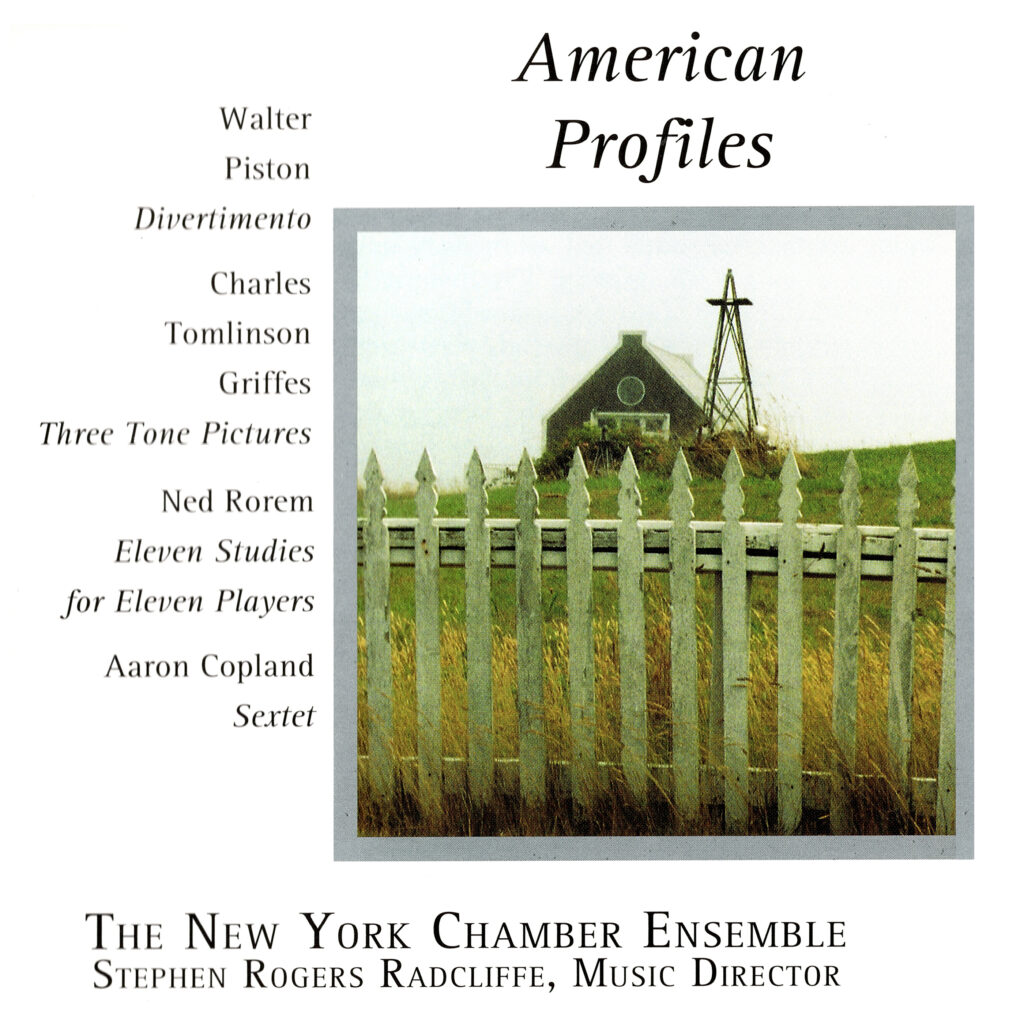
AMERICAN PROFILES. Stephen Rogers Radcliffe conducting the New York Chamber Ensemble

Fanfare The Magazine for Serious Record Collectors March/April 1996 • Volume 19, Number 4 AMERICAN PROFILES. Stephen Rogers Radcliffe conducting the New York Chamber Ensemble. ALBANY TROY 175 [DDD]; 64:26. PISTON: Divertimento. GRIFFES: Three Tone Pictures. ROREM: Eleven Studies for Eleven Players. COPLAND: Sextet. While each of these pieces has been recorded before—all but the Piston currently have at least one recording in the catalog—it was an excellent idea to bring all four together on a single disc. They work together extremely well because of their differences as much as because of what they have in common. Piston’s three-movement Divertimento is, like all of this composer’s music, a sturdily crafted work in which strong, memorable thematic material is supported by solid, occasionally dissonant counterpoint. The two lively, thoroughly neo-classical outer movements surround a central slow movement based on a wonderful, flowing oboe melody. The Griffes pieces, arranged by the composer from his original version for piano, are attractive little landscapes, featuring the composer’s special brand of impressionism. Rorem’s Studies are a series of miniatures, varying widely in mood as well as instrumentation, that show the composer’s fine sense of detail, wry sense of humor, and irrepressible melodic gift. The final work, Copland’s own arrangement of his Short Symphony, is a masterpiece of American neo-Classicism. Nervous, muscular, and economical, the brief three-movement work is one of Copland’s most rhythmically challenging pieces. The performances are very good. The bouncy vitality of the Copland and Piston works is particularly well captured by Radcliffe and his excellent musicians. The Rorem pieces are played with lots of detail and show off individual members of the ensemble to great advantage. My only reservations concern the Griffes pieces where the beat seems all too heavy and the instrumental blends a bit rough. In addition, the piano, although nicely played by David Korevaar, is overly prominent, suggesting more a concerto than a work for chamber orchestra. The recording is good, quite clean and natural, but a little bit close. These flaws aside, this is a most enjoyable disc that should find a welcome place in every collection of American music. Richard Burke

Press | Recording Review

March/April 1996 • Volume 19, Number 4

AMERICAN PROFILES

Stephen Rogers Radcliffe conducting the New York Chamber Ensemble

ALBANY TROY 175 [DDD]; 64:26.

PISTON: Divertimento
GRIFFES: Three Tone Pictures
ROREM:
Eleven Studies for Eleven Players
COPLAND:
Sextet

By Richard Burke

While each of these pieces has been recorded before—all but the Piston currently have at least one recording in the catalog—it was an excellent idea to bring all four together on a single disc. They work together extremely well because of their differences as much as because of what they have in common. Piston’s three-movement Divertimento is, like all of this composer’s music, a sturdily crafted work in which strong, memorable thematic material is supported by solid, occasionally dissonant counterpoint. The two lively, thoroughly neo-classical outer movements surround a central slow movement based on a wonderful, flowing oboe melody. The Griffes pieces, arranged by the composer from his original version for piano, are attractive little landscapes, featuring the composer’s special brand of impressionism. Rorem’s Studies are a series of miniatures, varying widely in mood as well as instrumentation, that show the composer’s fine sense of detail, wry sense of humor, and irrepressible melodic gift. The final work, Copland’s own arrangement of his Short Symphony, is a masterpiece of American neo-Classicism. Nervous, muscular, and economical, the brief three-movement work is one of Copland’s most rhythmically challenging pieces.

The performances are very good. The bouncy vitality of the Copland and Piston works is particularly well captured by Radcliffe and his excellent musicians. The Rorem pieces are played with lots of detail and show off individual members of the ensemble to great advantage. My only reservations concern the Griffes pieces where the beat seems all too heavy and the instrumental blends a bit rough. In addition, the piano, although nicely played by David Korevaar, is overly prominent, suggesting more a concerto than a work for chamber orchestra. The recording is good, quite clean and natural, but a little bit close. These flaws aside, this is a most enjoyable disc that should find a welcome place in every collection of American music.

Fanfare The Magazine for Serious Record Collectors March/April 1996 • Volume 19, Number 4 AMERICAN PROFILES. Stephen Rogers Radcliffe conducting the New York Chamber Ensemble. ALBANY TROY 175 [DDD]; 64:26. PISTON: Divertimento. GRIFFES: Three Tone Pictures. ROREM: Eleven Studies for Eleven Players. COPLAND: Sextet. While each of these pieces has been recorded before—all but the Piston currently have at least one recording in the catalog—it was an excellent idea to bring all four together on a single disc. They work together extremely well because of their differences as much as because of what they have in common. Piston’s three-movement Divertimento is, like all of this composer’s music, a sturdily crafted work in which strong, memorable thematic material is supported by solid, occasionally dissonant counterpoint. The two lively, thoroughly neo-classical outer movements surround a central slow movement based on a wonderful, flowing oboe melody. The Griffes pieces, arranged by the composer from his original version for piano, are attractive little landscapes, featuring the composer’s special brand of impressionism. Rorem’s Studies are a series of miniatures, varying widely in mood as well as instrumentation, that show the composer’s fine sense of detail, wry sense of humor, and irrepressible melodic gift. The final work, Copland’s own arrangement of his Short Symphony, is a masterpiece of American neo-Classicism. Nervous, muscular, and economical, the brief three-movement work is one of Copland’s most rhythmically challenging pieces. The performances are very good. The bouncy vitality of the Copland and Piston works is particularly well captured by Radcliffe and his excellent musicians. The Rorem pieces are played with lots of detail and show off individual members of the ensemble to great advantage. My only reservations concern the Griffes pieces where the beat seems all too heavy and the instrumental blends a bit rough. In addition, the piano, although nicely played by David Korevaar, is overly prominent, suggesting more a concerto than a work for chamber orchestra. The recording is good, quite clean and natural, but a little bit close. These flaws aside, this is a most enjoyable disc that should find a welcome place in every collection of American music. Richard Burke

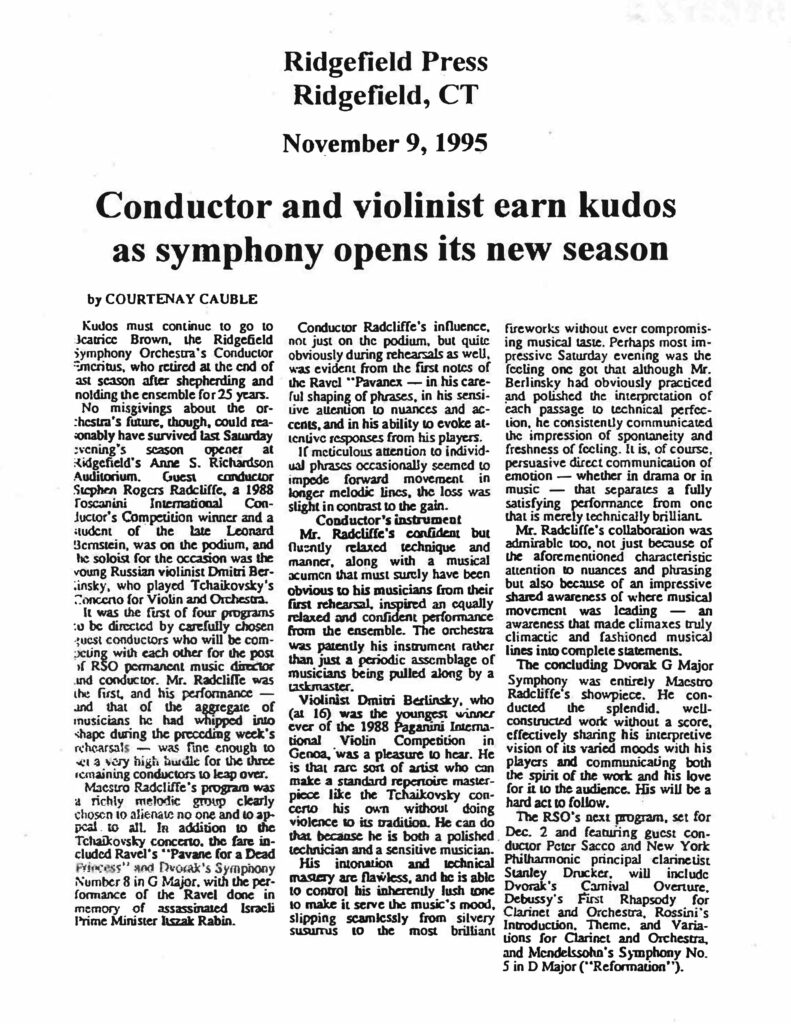
Conductor and Violinist Earn Kudos as Symphony Opens Its New Season

Ridgefield Press Ridgefield, CT November 9, 1995 Conductor and violinist earn kudos as symphony opens its new season by COURTENAY CAUBLE Kudos must continue to go to Beatrice Brown, the Ridgefield Symphony Orchestra's Conductor Emeritus, who retired at the end of last season after shepherding and molding the ensemble for 25 years. No misgivings about the orchestra's future, though, could reasonably have survived last Saturday evening's season opener at Ridgefield's Anne S. Richardson Auditorium. Guest conductor Stephen Rogers Radcliffe, a 1988 Toscanini International Conductor's Competition winner and a student of the late Leonard Bernstein, was on the podium, and the soloist for the occasion was the young Russian violinist Dmitri Berlinsky, who played Tchaikovsky's Concerto for Violin and Orchestra. It was the first of four programs to be directed by carefully chosen guest conductors who will be competing with each other for the post of RSO permanent music director and conductor. Mr. Radcliffe was the first, and his performance — and that of the aggregate of musicians he had whipped into shape during the preceding week's rehearsals — was fine enough to set a very high hurdle for the three remaining conductors to leap over. Maestro Radcliffe's program was a richly melodic group clearly chosen to alienate no one and to appeal to all. In addition to the Tchaikovsky concerto, the fare included Ravel's "Pavane for a Dead Princess" and Dvorak's Symphony Number 8 in G Major, with the performance of the Ravel done in memory of assassinated Israeli Prime Minister Itszak Rabin. Conductor Radcliffe's influence, not just on the podium, but quite obviously during rehearsals as well, was evident from the first notes of the Ravel "Pavane" — in his careful shaping of phrases, in his sensitive attention to nuances and accents, and in his ability to evoke attentive responses from his players. If meticulous attention to individual phrases occasionally seemed to impede forward movement in longer melodic lines, the loss was slight in contrast to the gain. Conductor's instrument Mr. Radcliffe's confident but fluently relaxed technique and manner, along with a musical acumen that must surely have been obvious to his musicians from their first rehearsal, inspired an equally relaxed and confident performance from the ensemble. The orchestra was patently his instrument rather than just a periodic assemblage of musicians being pulled along by a taskmaster. Violinist Dmitri Berlinsky, who (at 16) was the youngest winner ever of the 1988 Paganini International Violin Competition in Genoa, was a pleasure to hear. He is that rare sort of artist who can make a standard repertoire masterpiece like the Tchaikovsky concerto his own without doing violence to its tradition. He can do that because he is both a polished technician and a sensitive musician. His intonation and technical mastery are flawless, and he is able to control his inherently lush tone to make it serve the music's mood, slipping seamlessly from silvery sussurus to the most brilliant fireworks without ever compromising musical taste. Perhaps most impressive Saturday evening was the feeling one got that although Mr. Berlinsky had obviously practiced and polished the interpretation of each passage to technical perfection, he consistently communicated the impression of spontaneity and freshness of feeling. It is, of course, emotion — whether in drama or in music — that separates a fully satisfying performance from one that is merely technically brilliant. Mr. Radcliffe's collaboration was admirable too, not just because of the aforementioned characteristic attention to nuances and phrasing but also because of an impressive shared awareness of where musical movement was leading — an awareness that made climaxes truly climactic and fashioned musical lines into complete statements. The concluding Dvorak G Major Symphony was entirely Maestro Radcliffe's showpiece. He conducted the splendid, well-constructed work without a score, effectively sharing his interpretive vision of its varied moods with his players and communicating both the spirit of the work and his love for it to the audience. His will be a hard act to follow. The RSO's next program, set for Dec. 2 and featuring guest conductor Peter Sacco and New York Philharmonic principal clarinetist Stanley Drucker, will include Dvorak's Carnival Overture, Debussy's First Rhapsody for Clarinet and Orchestra, Rossini's Introduction, Theme, and Variations for Clarinet and Orchestra, and Mendelssohn's Symphony No. 5 in D Major ("Reformation").

Press | Symphonic Reviews

November 9, 1995

Conductor and Violinist Earn Kudos as Symphony Opens its New Season

By Courtenay Cauble

Kudos must continue to go to Beatrice Brown, the Ridgefield Symphony Orchestra’s Conductor Emeritus, who retired at the end of last season after shepherding and molding the ensemble for 25 years.

No misgivings about the orchestra’s future, though, could reasonably have survived last Saturday evening’s season opener at Ridgefield’s Anne S. Richardson Auditorium. Guest conductor Stephen Rogers Radcliffe, a 1988 Toscanini International Conductor’s Competition winner and a student of the late Leonard Bernstein, was on the podium, and the soloist for the occasion was the young Russian violinist Dmitri Berlinsky, who played Tchaikovsky’s Concerto for Violin and Orchestra.

It was the first of four programs to be directed by carefully chosen guest conductors who will be competing with each other for the post of RSO permanent music director and conductor. Mr. Radcliffe was the first, and his performance — and that of the aggregate of musicians he had whipped into shape during the preceding week’s rehearsals — was fine enough to set a very high hurdle for the three remaining conductors to leap over.

Maestro Radcliffe’s program was a richly melodic group clearly chosen to alienate no one and to appeal to all. In addition to the Tchaikovsky concerto, the fare included Ravel’s “Pavane for a Dead Princess” and Dvorak’s Symphony Number 8 in G Major, with the performance of the Ravel done in memory of assassinated Israeli Prime Minister Itszak Rabin.

Conductor Radcliffe’s influence, not just on the podium, but quite obviously during rehearsals as well, was evident from the first notes of the Ravel “Pavane” — in his careful shaping of phrases, in his sensitive attention to nuances and accents, and in his ability to evoke attentive responses from his players. If meticulous attention to individual phrases occasionally seemed to impede forward movement in longer melodic lines, the loss was slight in contrast to the gain.

Conductor’s instrument
Mr. Radcliffe’s confident but fluently relaxed technique and manner, along with a musical acumen that must surely have been obvious to his musicians from their first rehearsal, inspired an equally relaxed and confident performance from the ensemble. The orchestra was patently his instrument rather than just a periodic assemblage of musicians being pulled along by a taskmaster.

Violinist Dmitri Berlinsky, who (at 16) was the youngest winner ever of the 1988 Paganini International Violin Competition in Genoa, was a pleasure to hear. He is that rare sort of artist who can make a standard repertoire masterpiece like the Tchaikovsky concerto his own without doing violence to its tradition. He can do that because he is both a polished technician and a sensitive musician.

His intonation and technical mastery are flawless, and he is able to control his inherently lush tone to make it serve the music’s mood, slipping seamlessly from silvery sussurus to the most brilliant fireworks without ever compromising musical taste. Perhaps most impressive Saturday evening was the feeling one got that although Mr. Berlinsky had obviously practiced and polished the interpretation of each passage to technical perfection, he consistently communicated the impression of spontaneity and freshness of feeling. It is, of course, emotion — whether in drama or in music — that separates a fully satisfying performance from one that is merely technically brilliant.

Mr. Radcliffe’s collaboration was admirable too, not just because of the aforementioned characteristic attention to nuances and phrasing but also because of an impressive shared awareness of where musical movement was leading — an awareness that made climaxes truly climactic and fashioned musical lines into complete statements.

The concluding Dvorak G Major Symphony was entirely Maestro Radcliffe’s showpiece. He conducted the splendid, well-constructed work without a score, effectively sharing his interpretive vision of its varied moods with his players and communicating both the spirit of the work and his love for it to the audience. His will be a hard act to follow.

The RSO’s next program, set for Dec. 2 and featuring guest conductor Peter Sacco and New York Philharmonic principal clarinetist Stanley Drucker, will include Dvorak’s Carnival Overture, Debussy’s First Rhapsody for Clarinet and Orchestra, Rossini’s Introduction, Theme, and Variations for Clarinet and Orchestra, and Mendelssohn’s Symphony No. 5 in D Major (“Reformation”).

Ridgefield Press Ridgefield, CT November 9, 1995 Conductor and violinist earn kudos as symphony opens its new season by COURTENAY CAUBLE Kudos must continue to go to Beatrice Brown, the Ridgefield Symphony Orchestra's Conductor Emeritus, who retired at the end of last season after shepherding and molding the ensemble for 25 years. No misgivings about the orchestra's future, though, could reasonably have survived last Saturday evening's season opener at Ridgefield's Anne S. Richardson Auditorium. Guest conductor Stephen Rogers Radcliffe, a 1988 Toscanini International Conductor's Competition winner and a student of the late Leonard Bernstein, was on the podium, and the soloist for the occasion was the young Russian violinist Dmitri Berlinsky, who played Tchaikovsky's Concerto for Violin and Orchestra. It was the first of four programs to be directed by carefully chosen guest conductors who will be competing with each other for the post of RSO permanent music director and conductor. Mr. Radcliffe was the first, and his performance — and that of the aggregate of musicians he had whipped into shape during the preceding week's rehearsals — was fine enough to set a very high hurdle for the three remaining conductors to leap over. Maestro Radcliffe's program was a richly melodic group clearly chosen to alienate no one and to appeal to all. In addition to the Tchaikovsky concerto, the fare included Ravel's "Pavane for a Dead Princess" and Dvorak's Symphony Number 8 in G Major, with the performance of the Ravel done in memory of assassinated Israeli Prime Minister Itszak Rabin. Conductor Radcliffe's influence, not just on the podium, but quite obviously during rehearsals as well, was evident from the first notes of the Ravel "Pavane" — in his careful shaping of phrases, in his sensitive attention to nuances and accents, and in his ability to evoke attentive responses from his players. If meticulous attention to individual phrases occasionally seemed to impede forward movement in longer melodic lines, the loss was slight in contrast to the gain. Conductor's instrument Mr. Radcliffe's confident but fluently relaxed technique and manner, along with a musical acumen that must surely have been obvious to his musicians from their first rehearsal, inspired an equally relaxed and confident performance from the ensemble. The orchestra was patently his instrument rather than just a periodic assemblage of musicians being pulled along by a taskmaster. Violinist Dmitri Berlinsky, who (at 16) was the youngest winner ever of the 1988 Paganini International Violin Competition in Genoa, was a pleasure to hear. He is that rare sort of artist who can make a standard repertoire masterpiece like the Tchaikovsky concerto his own without doing violence to its tradition. He can do that because he is both a polished technician and a sensitive musician. His intonation and technical mastery are flawless, and he is able to control his inherently lush tone to make it serve the music's mood, slipping seamlessly from silvery sussurus to the most brilliant fireworks without ever compromising musical taste. Perhaps most impressive Saturday evening was the feeling one got that although Mr. Berlinsky had obviously practiced and polished the interpretation of each passage to technical perfection, he consistently communicated the impression of spontaneity and freshness of feeling. It is, of course, emotion — whether in drama or in music — that separates a fully satisfying performance from one that is merely technically brilliant. Mr. Radcliffe's collaboration was admirable too, not just because of the aforementioned characteristic attention to nuances and phrasing but also because of an impressive shared awareness of where musical movement was leading — an awareness that made climaxes truly climactic and fashioned musical lines into complete statements. The concluding Dvorak G Major Symphony was entirely Maestro Radcliffe's showpiece. He conducted the splendid, well-constructed work without a score, effectively sharing his interpretive vision of its varied moods with his players and communicating both the spirit of the work and his love for it to the audience. His will be a hard act to follow. The RSO's next program, set for Dec. 2 and featuring guest conductor Peter Sacco and New York Philharmonic principal clarinetist Stanley Drucker, will include Dvorak's Carnival Overture, Debussy's First Rhapsody for Clarinet and Orchestra, Rossini's Introduction, Theme, and Variations for Clarinet and Orchestra, and Mendelssohn's Symphony No. 5 in D Major ("Reformation").

Bachmann, Radcliffe et al provide sparkle to the Cape May Festival

OCEAN CITY SENTINEL LEDGER June 6, 1995 Bachmann, Radcliffe et al provide sparkle to the Cape May Festival CAPE MAY — As with past years, the Cape May Music Festival 1995 edition is a gala celebration of great music, and on Wednesday, May 31 we were fortunate enough to witness a fantastic performance of Piotr Tchaikovsky’s Violin Concerto in D and the Mozart Symphony No. 39 in E flat. The featured soloist in the Tchaikovsky concerto was violin virtuoso Maria Bachmann, with Stephen Rogers Radcliffe and the Cape May Festival Orchestra. Ms. Bachmann is about to hit the big time of concert artists by virtue of a management contract with Columbia Artists and has been recommended by Leonard Slatkin, conductor of the National Symphony in Washington D.C. She has performed with the South Jersey Symphony and the Bridgeton Symphony, but will now enter a new high-profile phase of her career. The Tchaikovsky concerto evokes mental pictures of the majesty of czarist Russia contrasted with the wildly energetic gyrations of peasant dancing. Anyone cognizant of Slavic culture finds the elegance and vigor of the music entrancing; anyone familiar with great violin masterpieces knows that this concerto is no exercise for beginners. The concerto had to run a fierce gauntlet of fault finding when it was introduced in 1881 by the Vienna Philharmonic with Adolf Brodsky as soloist and Hans Richter on the podium. It was butchered by critic Eduard Hanslick and even Tchaikovsky’s patroness Nadezda von Meck was highly critical of the first movement. Some violinists of the day called it unplayable, but even with its minefield of difficult passages, it is only second to the Mendelssohn concerto in popularity with violinists and audiences today. Time has given Tchaikovsky his revenge. The Cape May Festival Orchestra has the discipline, economy and responsiveness to Radcliffe’s excellent conducting to bring off even the uneven tempo of the scherzo movement of the Brahms and later to be equally effective in Tchaikovsky and Mozart. Stephen Rogers Radcliffe’s cohorts did a magnificent job on the Variations complex score. Brahms probably wrote some of his best for woodwinds and that section of the orchestra often provides the identifying Brahms sound. The Cape May Festival Orchestra has the discipline, economy and responsiveness to Radcliffe’s excellent conducting to bring off even the uneven tempo of the scherzo movement of the Brahms and later to be equally effective in Tchaikovsky and Mozart. Maria Bachmann’s association with Columbia Artists began at midnight after her bravura performance of the Tchaikovsky violin concerto was completed with a flair and strength that seemed phenomenal for one so slightly built. She is a powerful performer and her opening statement of the initial theme informed the audience that she was not a lightweight by any measure. There was a perfect amalgam between her and the orchestra; the only disappointment for us was a slight letdown in the second movement of the concerto. In the finale (a wild dance), Bachmann was ready to join the ranks of Szigeti, Morini and other female violinists who give the boys a run for their money. Radcliffe’s reading of the Mozart symphony was right on the money and the final allegro echoed the good-humored portions of the film Amadeus. We believe the 33-piece orchestra of incredibly gifted young musicians is the best the festival has ever assembled. Personnel changes from year to year are inevitable but there seems to be an unending supply of accomplished youngsters forthcoming annually from conservatories. We hope that they continue to find steady employment in the field that they obviously love. — Ed Wismer

Press | Symphonic Review

Tuesday, June 6, 1995

Bachmann, Radcliffe et al provide sparkle to the Cape May Festival

By Ed Wismer

CAPE MAY — As with past years, the Cape May Music Festival 1995 edition is a gala celebration of great music, and on Wednesday, May 31 we were fortunate enough to witness a fantastic performance of Piotr Tchaikovsky’s Violin Concerto in D and the Mozart Symphony No. 39 in E flat.

The featured soloist in the Tchaikovsky concerto was violin virtuoso Maria Bachmann, with Stephen Rogers Radcliffe and the Cape May Festival Orchestra.

Ms. Bachmann is about to hit the big time of concert artists by virtue of a management contract with Columbia Artists and has been recommended by Leonard Slatkin, conductor of the National Symphony in Washington D.C.

She has performed with the South Jersey Symphony and the Bridgeton Symphony, but will now enter a new high-profile phase of her career.

The Tchaikovsky concerto evokes mental pictures of the majesty of czarist Russia contrasted with the wildly energetic gyrations of peasant dancing.

Anyone cognizant of Slavic culture finds the elegance and vigor of the music entrancing; anyone familiar with great violin masterpieces knows that this concerto is no exercise for beginners.

The concerto had to run a fierce gauntlet of fault finding when it was introduced in 1881 by the Vienna Philharmonic with Adolf Brodsky as soloist and Hans Richter on the podium. It was butchered by critic Eduard Hanslick and even Tchaikovsky’s patroness Nadezda von Meck was highly critical of the first movement. Some violinists of the day called it unplayable, but even with its minefield of difficult passages, it is only second to the Mendelssohn concerto in popularity with violinists and audiences today. Time has given Tchaikovsky his revenge.

The Cape May Festival Orchestra has the discipline, economy and responsiveness to Radcliffe’s excellent conducting to bring off even the uneven tempo of the scherzo movement of the Brahms and later to be equally effective in Tchaikovsky and Mozart.

Stephen Rogers Radcliffe’s cohorts did a magnificent job on the Variations complex score. Brahms probably wrote some of his best for woodwinds and that section of the orchestra often provides the identifying Brahms sound.

The Cape May Festival Orchestra has the discipline, economy and responsiveness to Radcliffe’s excellent conducting to bring off even the uneven tempo of the scherzo movement of the Brahms and later to be equally effective in Tchaikovsky and Mozart.

Maria Bachmann’s association with Columbia Artists began at midnight after her bravura performance of the Tchaikovsky violin concerto was completed with a flair and strength that seemed phenomenal for one so slightly built. She is a powerful performer and her opening statement of the initial theme informed the audience that she was not a lightweight by any measure.

There was a perfect amalgam between her and the orchestra; the only disappointment for us was a slight letdown in the second movement of the concerto. In the finale (a wild dance), Bachmann was ready to join the ranks of Szigeti, Morini and other female violinists who give the boys a run for their money.

Radcliffe’s reading of the Mozart symphony was right on the money and the final allegro echoed the good-humored portions of the film Amadeus.

We believe the 33-piece orchestra of incredibly gifted young musicians is the best the festival has ever assembled. Personnel changes from year to year are inevitable but there seems to be an unending supply of accomplished youngsters forthcoming annually from conservatories.

We hope that they continue to find steady employment in the field that they obviously love.

— Ed Wismer

THE SENTINEL-LEDGER Ocean City, N.J. Week of 7-13 June 1994 Festival Orchestra goes pops By ED WISMER Sentinel-Ledger Critic OCEAN CITY — The second Cape May Music Festival event to be held on the Music Pier for 1994 took place June 4 and it was a real "Popper." The Cape May Festival Orchestra played a program of light classics and the best of Broadway. This does seem like carrying coals to Newcastle because of the similarity of programming by our own sensational Ocean City Pops, but good music is sempiternal and it's truly a case of the more, the merrier. It best represents another opportunity to spread culture in this area through cooperation by the Pashley Insurance Agency, The Sentinel-Ledger and the city of Ocean City. All concerned are to be commended for their support of the arts. The Festival Orchestra had the pleasure and privilege of playing in Ocean City's state of the art facility. Festival artistic director Stephen Rogers Radcliffe mounted the podium and started the proceedings off with a flourish. Pops orchestras and programs are proliferating exponentially. Most of us think of Pops orchestras starting with that part-time fireman Arthur Fiedler up in Boston, but pops programing was quite popular at the turn of the 20th century and before. A Sousa program would have consisted of light classics, popular songs and show tunes (many of which Sousa wrote himself a la John Williams). We have heard Radcliffe's orchestra do some very ambitious work in the past and recall an occasion when a 19th century synthesizer was used to intensify the sound. Radcliffe is experimental and innovative in his approach and one can always expect some extra pyrotechnics. He did not disappoint us this time either. The program consisted of works inspired by folk music and dance that was multi-ethnic. Radcliffe led off with a Rossini Overture that was impressively played and followed it with Dvorak's Slavonic Dance Op. 46, No. 8 (one of the more lively numbers in this evocative suite). > Artistic Director Stephen Rogers Radcliffe is fun to watch > Radcliffe is fun to watch. His kinetic gyrations were most evident in the Dvorak but he only enlivens proceedings thusly when it is appropriate. The late Dmitri Mitroupolis was overly physical and often fell right off the podium. Radcliffe's feet enthusiastically left the floor at times but he was always in control. Ralph Vaughan Williams' Fantasia on Greensleeves followed it, and along with Faure's Pavane Op. 50, brought a more solemn and sedate mood to the concert. The wind section was outstanding in these two pieces. An unfamiliar tarantelle by Camille Saint Saens proved to be a lively and lovely example of how versatile the French composer could be. The Bizet Suite from Carmen featured "just right" vigorous tempi and playing that was, at the same time, abandoned and precise. The brass players took full advantage of Bizet's proclivity for writing superbly for their instruments. The final portion of the program consisted of two genuine Broadway classics in the form of selections from Gershwin's folk opera Porgy and Bess and Bernstein's West Side Story highlights. Both came in the form of fresh sounding and unfamiliar arrangements that featured innovative instrumental scoring that gave them new life. These evinced a standing ovation which was rewarded with an encore of Flimsy Korsetoff's (pardon an old musician's pun) Flight of the Bumble Bee which hummed right along. It is a certainty that the audience felt that it had a grand night out, topped off with truly professional musicianship and the sponsors could openly glow with pride. The whole affair added new vistas of cultural excellence that upheld the tradition of fine entertainment values exemplified by both cities. [Sidebar Text] CAPE MAY — The fifth annual Cape May Music Festival began May 15 and continues through June 26, hosting what is described as some of the world's most accomplished soloists and chamber musicians in music from the Renaissance and Vivaldi to the jazz era. The Festival Orchestra is conducted by Stephen Rogers Radcliffe. The festival is sponsored by the Mid-Atlantic Center for the Arts (884-5404), in association with the Cape May Institute.

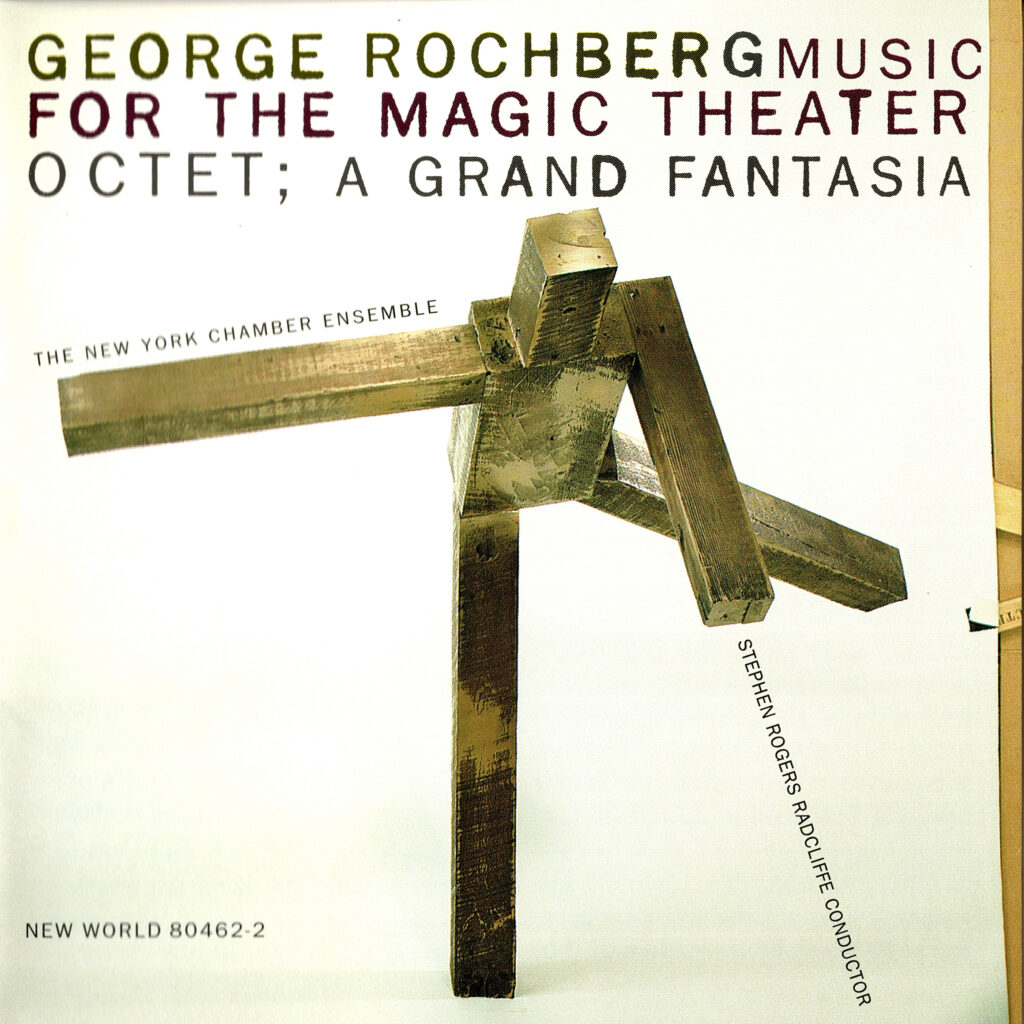
ROCHBERG: Music for the Magic Theater – Review

Fanfare The Magazine for Serious Record Collectors January/February 1995 • Volume 18, Number 3 ROCHBERG: Music for the Magic Theater. Octet; A Grand Fantasia. Stephen Rogers Radcliffe conducting the New York Chamber Ensemble. NEW WORLD 80462-2 [DDD]; 48:39. Produced by Daniel Kincaid. Our esteemed editor continues to send me discs of George Rochberg's music, even though I have expressed a general distaste for it. It makes sense that each of Fanfare's reviewers gets mostly music that he or she appreciates; we are more likely to be knowledgeable about the music and informed about competing recordings that way, but it also accounts for the so-often-favorable reviews which have bothered some of our correspondents. An occasional counterview may be bracing, and I welcome another chance to understand any composer. Rochberg, of course, has been many things at many times; his compositional life was long an evolving struggle to find his own style, at a time (ca. 1945–75) when style was strictly dictated by a few academics (if you don't write my way, you don't pass my course, so you won't get the degree, so you can't succeed in the academic world of music, so you give up composing as a career). Music for the Magic Theater (1965) found Rochberg at a turning point; he had previously followed the required atonal serialism, and had experimented with music of chance, only to find unexpected, depressing similarities between the two systems. Here Rochberg tries to merge music past with music present and future by using collage, which was not yet fashionable, although Ives's music was beginning to be known. Collage brings much variety to these twenty-seven minutes, but it also exemplifies the problem I have with Rochberg's music: it seems so internally disconnected, with one minute's Mozart likely to be followed by another's Mahler or Miles Davis. The three "Acts" of this magic theater go from confusion of past and present, to wallowing in the past, and finally trying and dissolving the present "into what?" This seems to me more like sophisticated navel-gazing than making music. The booklet points out that B. A. Zimmermann was exactly Rochberg's age, forcing me to ask why I accept the German composer's collages more than the American's. It is because Zimmermann does so much more with his inherited material; he works it over thoroughly, transforming it into something all his own. For the record, the fifteen instrumentalists here (yes, yes: Schoenberg and Berg) make many beautiful and intriguing sounds, and they are expertly recorded. Octet; A Grand Fantasia (1980) consists of twelve brief pieces scored for two to eight players (flute, clarinet, horn, violin, viola, cello, bass, and piano). References to the past are now more subtle, more a matter of style than of substance. The variety of tempos and moods (listing them all would take nearly as long as hearing them) is somehow more acceptable as a suite of short pieces than as chunks within larger movements. It also enables me to pinpoint a preference for Rochberg in slow tempos to Rochberg at speed. I give him much credit for leading the assault on an intolerable musical establishment, but I still don't like Rochberg's own solutions much. I hope this review is useful to someone; if you disagree with each thought I have expressed, you better go out and buy this record. James H. North • • • It's easy to speak of a kinship of Rochberg to Ives. Ives was the first to play about with polystylistics, emulsions in the main of highbrow with low. In the listening, however, the Ives-Rochberg connection plays as tenuous. We make better use of space contemplating Rochberg's entirely self-conscious move in the early 60s from serial atonality to (what has been called by the less than enthralled) pastiche. This bouncing about from musical style to style is today much in vogue, thanks in large measure to several of George Rochberg's pivotal works. The more appropriate comparison is to Lucas Foss, a Rochberg contemporary whose esthetic flexibility measures as relatively opportunistic. His obvious qualities notwithstanding, is Rochberg's a baleful influence on impressionable minds? In an environment where Steve Martland is packaged—in semi-beefcake, heaven help us!—as a hot property, the question is silly. Rather, let us see an unusually good and honest composer having hung an existential right on the road to what seemed to him, if not to everyone, a dead end. With regard to the discomfort Rochberg's suspiciously entertaining alternatives inflict on those for whom Theodore Adorno wields papal authority (to name but one arbiter), I offer this useless opinion. Perhaps—just perhaps—it is Rochberg's nature to entertain, his sojourn in Second Vienna's long shadow an aspect of development toward what he has become—a fulfillment that has helped shape today's postmodern terrain, moreover. (Escapes from serialism's constraints have led in startlingly disparate directions: Stefan Wolpe's for one, Giacinto Scelsi's for another.) Schwann Opus show Rochberg's cassettes, mostly CRI, outnumbering CDs. It's gratifying to see a skimpy CDiscography graced by these well-played and -recorded additions. Mike Silverton

Press | Recording Review

January/February 1995 • Volume 18, Number 3

ROCHBERG: Music for the Magic Theater. Octet; A Grand Fantasia.
Stephen Rogers Radcliffe conducting the New York Chamber Ensemble.
NEW WORLD 80462-2 [DDD]; 48:39.
Produced by Daniel Kincaid.

By James H. North

Our esteemed editor continues to send me discs of George Rochberg’s music, even though I have expressed a general distaste for it. It makes sense that each of Fanfare’s reviewers gets mostly music that he or she appreciates; we are more likely to be knowledgeable about the music and informed about competing recordings that way, but it also accounts for the so-often-favorable reviews which have bothered some of our correspondents. An occasional counterview may be bracing, and I welcome another chance to understand any composer. Rochberg, of course, has been many things at many times; his compositional life was long an evolving struggle to find his own style, at a time (ca. 1945–75) when style was strictly dictated by a few academics (if you don’t write my way, you don’t pass my course, so you won’t get the degree, so you can’t succeed in the academic world of music, so you give up composing as a career).

Music for the Magic Theater (1965) found Rochberg at a turning point; he had previously followed the required atonal serialism, and had experimented with music of chance, only to find unexpected, depressing similarities between the two systems. Here Rochberg tries to merge music past with music present and future by using collage, which was not yet fashionable, although Ives’s music was beginning to be known. Collage brings much variety to these twenty-seven minutes, but it also exemplifies the problem I have with Rochberg’s music: it seems so internally disconnected, with one minute’s Mozart likely to be followed by another’s Mahler or Miles Davis. The three “Acts” of this magic theater go from confusion of past and present, to wallowing in the past, and finally trying and dissolving the present “into what?” This seems to me more like sophisticated navel-gazing than making music. The booklet points out that B. A. Zimmermann was exactly Rochberg’s age, forcing me to ask why I accept the German composer’s collages more than the American’s. It is because Zimmermann does so much more with his inherited material; he works it over thoroughly, transforming it into something all his own. For the record, the fifteen instrumentalists here (yes, yes: Schoenberg and Berg) make many beautiful and intriguing sounds, and they are expertly recorded.

Octet; A Grand Fantasia (1980) consists of twelve brief pieces scored for two to eight players (flute, clarinet, horn, violin, viola, cello, bass, and piano). References to the past are now more subtle, more a matter of style than of substance. The variety of tempos and moods (listing them all would take nearly as long as hearing them) is somehow more acceptable as a suite of short pieces than as chunks within larger movements. It also enables me to pinpoint a preference for Rochberg in slow tempos to Rochberg at speed. I give him much credit for leading the assault on an intolerable musical establishment, but I still don’t like Rochberg’s own solutions much.

I hope this review is useful to someone; if you disagree with each thought I have expressed, you better go out and buy this record.

By Mike Silverton

It’s easy to speak of a kinship of Rochberg to Ives. Ives was the first to play about with polystylistics, emulsions in the main of highbrow with low. In the listening, however, the Ives-Rochberg connection plays as tenuous. We make better use of space contemplating Rochberg’s entirely self-conscious move in the early 60s from serial atonality to (what has been called by the less than enthralled) pastiche. This bouncing about from musical style to style is today much in vogue, thanks in large measure to several of George Rochberg’s pivotal works. The more appropriate comparison is to Lucas Foss, a Rochberg contemporary whose esthetic flexibility measures as relatively opportunistic. His obvious qualities notwithstanding, is Rochberg’s a baleful influence on impressionable minds? In an environment where Steve Martland is packaged—in semi-beefcake, heaven help us!—as a hot property, the question is silly. Rather, let us see an unusually good and honest composer having hung an existential right on the road to what seemed to him, if not to everyone, a dead end. With regard to the discomfort Rochberg’s suspiciously entertaining alternatives inflict on those for whom Theodore Adorno wields papal authority (to name but one arbiter), I offer this useless opinion. Perhaps—just perhaps—it is Rochberg’s nature to entertain, his sojourn in Second Vienna’s long shadow an aspect of development toward what he has become—a fulfillment that has helped shape today’s postmodern terrain, moreover. (Escapes from serialism’s constraints have led in startlingly disparate directions: Stefan Wolpe’s for one, Giacinto Scelsi’s for another.) Schwann Opus show Rochberg’s cassettes, mostly CRI, outnumbering CDs. It’s gratifying to see a skimpy CDiscography graced by these well-played and -recorded additions.
Mike Silverton

Fanfare The Magazine for Serious Record Collectors January/February 1995 • Volume 18, Number 3 ROCHBERG: Music for the Magic Theater. Octet; A Grand Fantasia. Stephen Rogers Radcliffe conducting the New York Chamber Ensemble. NEW WORLD 80462-2 [DDD]; 48:39. Produced by Daniel Kincaid. Our esteemed editor continues to send me discs of George Rochberg's music, even though I have expressed a general distaste for it. It makes sense that each of Fanfare's reviewers gets mostly music that he or she appreciates; we are more likely to be knowledgeable about the music and informed about competing recordings that way, but it also accounts for the so-often-favorable reviews which have bothered some of our correspondents. An occasional counterview may be bracing, and I welcome another chance to understand any composer. Rochberg, of course, has been many things at many times; his compositional life was long an evolving struggle to find his own style, at a time (ca. 1945–75) when style was strictly dictated by a few academics (if you don't write my way, you don't pass my course, so you won't get the degree, so you can't succeed in the academic world of music, so you give up composing as a career). Music for the Magic Theater (1965) found Rochberg at a turning point; he had previously followed the required atonal serialism, and had experimented with music of chance, only to find unexpected, depressing similarities between the two systems. Here Rochberg tries to merge music past with music present and future by using collage, which was not yet fashionable, although Ives's music was beginning to be known. Collage brings much variety to these twenty-seven minutes, but it also exemplifies the problem I have with Rochberg's music: it seems so internally disconnected, with one minute's Mozart likely to be followed by another's Mahler or Miles Davis. The three "Acts" of this magic theater go from confusion of past and present, to wallowing in the past, and finally trying and dissolving the present "into what?" This seems to me more like sophisticated navel-gazing than making music. The booklet points out that B. A. Zimmermann was exactly Rochberg's age, forcing me to ask why I accept the German composer's collages more than the American's. It is because Zimmermann does so much more with his inherited material; he works it over thoroughly, transforming it into something all his own. For the record, the fifteen instrumentalists here (yes, yes: Schoenberg and Berg) make many beautiful and intriguing sounds, and they are expertly recorded. Octet; A Grand Fantasia (1980) consists of twelve brief pieces scored for two to eight players (flute, clarinet, horn, violin, viola, cello, bass, and piano). References to the past are now more subtle, more a matter of style than of substance. The variety of tempos and moods (listing them all would take nearly as long as hearing them) is somehow more acceptable as a suite of short pieces than as chunks within larger movements. It also enables me to pinpoint a preference for Rochberg in slow tempos to Rochberg at speed. I give him much credit for leading the assault on an intolerable musical establishment, but I still don't like Rochberg's own solutions much. I hope this review is useful to someone; if you disagree with each thought I have expressed, you better go out and buy this record. James H. North • • • It's easy to speak of a kinship of Rochberg to Ives. Ives was the first to play about with polystylistics, emulsions in the main of highbrow with low. In the listening, however, the Ives-Rochberg connection plays as tenuous. We make better use of space contemplating Rochberg's entirely self-conscious move in the early 60s from serial atonality to (what has been called by the less than enthralled) pastiche. This bouncing about from musical style to style is today much in vogue, thanks in large measure to several of George Rochberg's pivotal works. The more appropriate comparison is to Lucas Foss, a Rochberg contemporary whose esthetic flexibility measures as relatively opportunistic. His obvious qualities notwithstanding, is Rochberg's a baleful influence on impressionable minds? In an environment where Steve Martland is packaged—in semi-beefcake, heaven help us!—as a hot property, the question is silly. Rather, let us see an unusually good and honest composer having hung an existential right on the road to what seemed to him, if not to everyone, a dead end. With regard to the discomfort Rochberg's suspiciously entertaining alternatives inflict on those for whom Theodore Adorno wields papal authority (to name but one arbiter), I offer this useless opinion. Perhaps—just perhaps—it is Rochberg's nature to entertain, his sojourn in Second Vienna's long shadow an aspect of development toward what he has become—a fulfillment that has helped shape today's postmodern terrain, moreover. (Escapes from serialism's constraints have led in startlingly disparate directions: Stefan Wolpe's for one, Giacinto Scelsi's for another.) Schwann Opus show Rochberg's cassettes, mostly CRI, outnumbering CDs. It's gratifying to see a skimpy CDiscography graced by these well-played and -recorded additions. Mike Silverton

Rochberg: “Music for the Magic Theater.” New World Records

ATHENS DAILY NEWS/ATHENS BANNER-HERALD, Sunday, October 23, 1994 – Page 15A By Ernie Torres Weekend News Editor George Rochberg Rochberg: "Music for the Magic Theater." New World Records. (48:41) ★★★★ The two chamber works on this New World recording by Stephen Rogers Radcliffe and the New York Chamber Ensemble offer an interesting look at George Rochberg's singular brand of modernism. It's not music for the unadventurous, but it's by no means inaccessible. Taking its name from the Magic Theater in "Steppenwolf," the Hermann Hesse novel, "Music for the Magic Theater" is a sound collage of sorts from 1965 in which Rochberg reexamines the music of the past and the present. Over the course of three "acts" there are musical quotations from Mozart's K. 287 Divertimento; Beethoven's Op. 130 String Quartet; Mahler's Ninth Symphony; Webern; Varese; Stockhausen; Miles Davis' "Stella by Starlight"; and Rochberg's own Second String Quartet. Act 1 juxtaposes Mozart with austere and dissonant modernism; Act 2 is mostly Mozart, Miles and melodic; Act 3 is a return to our century's tonal austerity, with a searching, ambiguous and quiet ending. "Music for the Magic Theater" is scored for a 15-piece chamber ensemble. Also on this disc is Rochberg's Octet: A Grand Fantasia from 1980, which is scored for flute, clarinet, horn, violin, viola, cello, bass and piano. Consisting of 12 short sections, the Octet gets off to a fast and gruff beginning but gives way to mostly slow and medium-slow tem- [text cuts off] [Photo Caption] ROCHBERG

Press | Recording Review

Sunday, October 23, 1994

Rochberg: "Music for the Magic Theater." New World Records

By Ernie Torres

George Rochberg

Rochberg: “Music for the Magic Theater.” New World Records. (48:41) ★★★★

The two chamber works on this New World recording by Stephen Rogers Radcliffe and the New York Chamber Ensemble offer an interesting look at George Rochberg’s singular brand of modernism. It’s not music for the unadventurous, but it’s by no means inaccessible.

Taking its name from the “Magic Theater” in Steppenwolf, the Hermann Hesse novel, “Music for the Magic Theater” is a sound collage of sorts from 1965 in which Rochberg reexamines the music of the past and the present. Over the course of three “acts” there are musical quotations from Mozart’s K. 287 Divertimento; Beethoven’s Op. 130 String Quartet; Mahler’s Ninth Symphony; Webern; Varèse; Stockhausen; Miles Davis’ “Stella by Starlight”; and Rochberg’s own Second String Quartet. Act 1 juxtaposes Mozart with austere and dissonant modernism; Act 2 is mostly Mozart, Mahler and melodic; Act 3 is a return to our century’s tonal austerity, with a searching, ambiguous and quiet ending.

“Music for the Magic Theater” is scored for a 13-piece chamber ensemble. Also on this disc is Rochberg’s Octet: A Grand Fantasia from 1980, which is scored for flute, clarinet, horn, violin, viola, cello, bass and piano. Consisting of 12 short sections, the Octet gets off to a fast and gruff beginning but gives way to mostly slow and medium-slow tempos.

ATHENS DAILY NEWS/ATHENS BANNER-HERALD, Sunday, October 23, 1994 – Page 15A By Ernie Torres Weekend News Editor George Rochberg Rochberg: "Music for the Magic Theater." New World Records. (48:41) ★★★★ The two chamber works on this New World recording by Stephen Rogers Radcliffe and the New York Chamber Ensemble offer an interesting look at George Rochberg's singular brand of modernism. It's not music for the unadventurous, but it's by no means inaccessible. Taking its name from the Magic Theater in "Steppenwolf," the Hermann Hesse novel, "Music for the Magic Theater" is a sound collage of sorts from 1965 in which Rochberg reexamines the music of the past and the present. Over the course of three "acts" there are musical quotations from Mozart's K. 287 Divertimento; Beethoven's Op. 130 String Quartet; Mahler's Ninth Symphony; Webern; Varese; Stockhausen; Miles Davis' "Stella by Starlight"; and Rochberg's own Second String Quartet. Act 1 juxtaposes Mozart with austere and dissonant modernism; Act 2 is mostly Mozart, Miles and melodic; Act 3 is a return to our century's tonal austerity, with a searching, ambiguous and quiet ending. "Music for the Magic Theater" is scored for a 15-piece chamber ensemble. Also on this disc is Rochberg's Octet: A Grand Fantasia from 1980, which is scored for flute, clarinet, horn, violin, viola, cello, bass and piano. Consisting of 12 short sections, the Octet gets off to a fast and gruff beginning but gives way to mostly slow and medium-slow tem- [text cuts off] [Photo Caption] ROCHBERG

Third Orchestra Concert at Festival

Northwest Arkansas Times Region / Arkansas Sunday, July 3, 1994 MUSIC REVIEW/ Third orchestra concert at festival By GREGORY MILLIRON Special to the Times In its third concert of the 1994 Music Festival of Arkansas, the orchestra performed an eclectic mix of works. The program consisted of Maurice Ravel's "Pavane pour une Infante Defunte," Peter Schickele's "Five of a Kind: Concerto for Brass Quintet" and Tchaikovsky's "Symphony No. 5 in E Minor." For this concert, Carlton Woods relinquished the podium to guest conductor Stephen Rogers Radcliffe, the popular up-and-coming conductor and artistic director of the Cape May Music Festival and artistic advisor to the Nassau Symphony Orchestra. The program for this evening's concert was indeed eclectic, but not as powerful as the previous festival concerts. The repertoire suffered most from the piece for brass quintet and orchestra by Schickele, also known as P.D.Q. Bach. This attempt at a "semiserious" piece of music by Schickele fell quite short of most, if not all, of his creative efforts involving the famed P.D.Q. Bach. This should in no way detract from the performance given by the brass quintet. They performed with an attitude of professionalism and wonderful ability. Their performance was excellent, filled with vitality and humor. The music was simply not worthy of the quintet of the festival orchestra. It seems as if Schickele needs to commit himself to either P.D.Q. Bach the humorist or a more serious frame of mind. I would prefer more "discoveries" of the music of P.D.Q. Bach. The orchestra's performance of Ravel's "Pavane pour une Infante Defunte" was touching. Although the title, translated to Pavane for a dead infant, suggests a dark scene, the melodic and harmonic structures of this piece are more reflective in nature. This piece requires a delicate touch from the entire orchestra. Radcliffe and the festival orchestra achieved this touch, and it was most evident in the string section. The violas were the real heroes on this night. Their rich, warm tones, so important to the orchestration of Ravel, dominated the texture of the performance. They provided the melancholy which is so needed in this wonderful piece. > The violas were the real heroes on this night. Their rich, warm tones, so important to the orchestration of Ravel, dominated the texture of the performance. > The orchestra also performed Tchaikovsky's Fifth Symphony. Although many feel this piece is not as monumental as his Sixth Symphony, it does retain a grip on the standard repertoire of symphony orchestras around the world. The Festival Orchestra handled the huge work well. Radcliffe seemed to be in full control of the many emotions of the work. Once again, the string section of the festival orchestra shone like a white hot star. Its tone is so incredibly warm, so appropriate to the romantic tendencies supplied by Tchaikovsky in his symphony. The brass section should also be commended for their performance although, at times, it seemed a bit out of control. Nonetheless, the entire ensemble presented a top-rate performance of a difficult work. The maturity of this group has increased with each performance. I was impressed with the student orchestra, performing without most of the faculty members, that performed at the Concerto Night/Honors Concert. All of the concerts and recitals from this festival have been well worth the time and effort of attendance.

Press | Symphonic Reviews

Sunday, July 3, 1994

Third orchestra concert at festival

By Gregory Milliron

In its third concert of the 1994 Music Festival of Arkansas, the orchestra performed an eclectic mix of works. The program consisted of Maurice Ravel’s “Pavane pour une Infante Defunte,” Peter Schickele’s “Five of a Kind: Concerto for Brass Quintet” and Tchaikovsky’s “Symphony No. 5 in E Minor.” For this concert, Carlton Woods relinquished the podium to guest conductor Stephen Rogers Radcliffe, the popular up-and-coming conductor and artistic director of the Cape May Music Festival and artistic advisor to the Nassau Symphony Orchestra.

The program for this evening’s concert was indeed eclectic, but not as powerful as the previous festival concerts. The repertoire suffered most from the piece for brass quintet and orchestra by Schickele, also known as P.D.Q. Bach. This attempt at a “semiserious” piece of music by Schickele fell quite short of most, if not all, of his creative efforts involving the famed P.D.Q. Bach.

This should in no way detract from the performance given by the brass quintet. They performed with an attitude of professionalism and wonderful ability. Their performance was excellent, filled with vitality and humor. The music was simply not worthy of the quintet of the festival orchestra. It seems as if Schickele needs to commit himself to either P.D.Q. Bach the humorist or a more serious frame of mind. I would prefer more “discoveries” of the music of P.D.Q. Bach.

The orchestra’s performance of Ravel’s “Pavane pour une Infante Defunte” was touching. Although the title, translated to Pavane for a dead infant, suggests a dark scene, the melodic and harmonic structures of this piece are more reflective in nature. This piece requires a delicate touch from the entire orchestra. Radcliffe and the festival orchestra achieved this touch, and it was most evident in the string section. The violas were the real heroes on this night. Their rich, warm tones, so important to the orchestration of Ravel, dominated the texture of the performance. They provided the melancholy which is so needed in this wonderful piece.

The violas were the real heroes on this night. Their rich, warm tones, so important to the orchestration of Ravel, dominated the texture of the performance.

The orchestra also performed Tchaikovsky’s Fifth Symphony. Although many feel this piece is not as monumental as his Sixth Symphony, it does retain a grip on the standard repertoire of symphony orchestras around the world.

The Festival Orchestra handled the huge work well. Radcliffe seemed to be in full control of the many emotions of the work. Once again, the string section of the festival orchestra shone like a white hot star. Its tone is so incredibly warm, so appropriate to the romantic tendencies supplied by Tchaikovsky in his symphony. The brass section should also be commended for their performance although, at times, it seemed a bit out of control. Nonetheless, the entire ensemble presented a top-rate performance of a difficult work.

The maturity of this group has increased with each performance. I was impressed with the student orchestra, performing without most of the faculty members, that performed at the Concerto Night/Honors Concert. All of the concerts and recitals from this festival have been well worth the time and effort of attendance.

Northwest Arkansas Times Region / Arkansas Sunday, July 3, 1994 MUSIC REVIEW/ Third orchestra concert at festival By GREGORY MILLIRON Special to the Times In its third concert of the 1994 Music Festival of Arkansas, the orchestra performed an eclectic mix of works. The program consisted of Maurice Ravel's "Pavane pour une Infante Defunte," Peter Schickele's "Five of a Kind: Concerto for Brass Quintet" and Tchaikovsky's "Symphony No. 5 in E Minor." For this concert, Carlton Woods relinquished the podium to guest conductor Stephen Rogers Radcliffe, the popular up-and-coming conductor and artistic director of the Cape May Music Festival and artistic advisor to the Nassau Symphony Orchestra. The program for this evening's concert was indeed eclectic, but not as powerful as the previous festival concerts. The repertoire suffered most from the piece for brass quintet and orchestra by Schickele, also known as P.D.Q. Bach. This attempt at a "semiserious" piece of music by Schickele fell quite short of most, if not all, of his creative efforts involving the famed P.D.Q. Bach. This should in no way detract from the performance given by the brass quintet. They performed with an attitude of professionalism and wonderful ability. Their performance was excellent, filled with vitality and humor. The music was simply not worthy of the quintet of the festival orchestra. It seems as if Schickele needs to commit himself to either P.D.Q. Bach the humorist or a more serious frame of mind. I would prefer more "discoveries" of the music of P.D.Q. Bach. The orchestra's performance of Ravel's "Pavane pour une Infante Defunte" was touching. Although the title, translated to Pavane for a dead infant, suggests a dark scene, the melodic and harmonic structures of this piece are more reflective in nature. This piece requires a delicate touch from the entire orchestra. Radcliffe and the festival orchestra achieved this touch, and it was most evident in the string section. The violas were the real heroes on this night. Their rich, warm tones, so important to the orchestration of Ravel, dominated the texture of the performance. They provided the melancholy which is so needed in this wonderful piece. > The violas were the real heroes on this night. Their rich, warm tones, so important to the orchestration of Ravel, dominated the texture of the performance. > The orchestra also performed Tchaikovsky's Fifth Symphony. Although many feel this piece is not as monumental as his Sixth Symphony, it does retain a grip on the standard repertoire of symphony orchestras around the world. The Festival Orchestra handled the huge work well. Radcliffe seemed to be in full control of the many emotions of the work. Once again, the string section of the festival orchestra shone like a white hot star. Its tone is so incredibly warm, so appropriate to the romantic tendencies supplied by Tchaikovsky in his symphony. The brass section should also be commended for their performance although, at times, it seemed a bit out of control. Nonetheless, the entire ensemble presented a top-rate performance of a difficult work. The maturity of this group has increased with each performance. I was impressed with the student orchestra, performing without most of the faculty members, that performed at the Concerto Night/Honors Concert. All of the concerts and recitals from this festival have been well worth the time and effort of attendance.