Beethoven Performed in Seemless Fashion During Symphony Concert

Sunday, Feb. 2, 2003 Sioux City Journal Vol. 139 No. 150 • Sioux City, Iowa • METRO EDITION Beethoven performed in seemless fashion during symphony concert By Bruce R. Miller Journal staff writer [REVIEW] At Saturday's Sioux City Symphony concert, pianist Ursula Oppens did what so many guest artists don't. She listened. Throughout Beethoven's Piano Concerto in E-Flat Major, Opus 73, Oppens complemented what the resident musicians did; she didn't just expect them to keep up with her. The result was a seamless performance that must have been as exciting for the orchestra as it was for the audience. Ironically, the piece was one Beethoven wrote after he had lost his hearing. Filled with rapid runs, it could have been a "look at me" turn for the two-time Grammy winner. Instead, Oppens played as if she had been a member of the orchestra for years. Slipping into the stormy duel between the cellos and the violins, she gave the work the understated surprise it needed. In the second movement, she created the piano equivalent of Frank Lloyd Wright's Fallingwater, a fluid aria that got Oppens to embrace the piano and dig into the music's very definite structure. She even nodded her head in ways that suggested the fire of the work's creator. Because the orchestra and the guest artist were so well matched, heat seemed to rise from the stage. In truth, the building's thermostat was set a bit high. But the musicians could have melted ice with their performance. Unfortunately, the first ("Overture to Fidelio") and last (Symphony No. 7 in A Major, Opus 92) offerings didn't have as much heat as the centerpiece. The timpanist was challenged on both, but overwhelmed in the former, impressed in the latter. The oboes got a chance to solo in the symphony as well. But this was really a night for strings. In all three selections, the pace was intense. The workout was a good one. While the overture wasn't as memorable as it could have been, it made the concerto all the more special. The symphony, as a result, was a bit of a let-down, even though it asked more of its players and reeked of the familiar. There were sections that have been lifted for film scores, movements that have served as inspiration for others (including Schubert). The play "Amadeus" made much of Mozart's excess ("too many notes, the royal said). But Beethoven insisted every one he put on paper was important. When the symphony was performed in 1813, Mozart's old nemesis Antonio Salieri led the percussion section. It's easy to see the necessity of every melody, counter-melody and beat. The stuff works because it's so intricate. One look at conductor Stephen Rogers Radcliffe revealed as much. He got the best exercise of all. And he enjoyed the perks of a guest performer who wasn't around for the glory. She was there for the workout, too.

Press | Symphonic Review

Sunday, February 2, 2003

Beethoven Performed in Seemless Fashion During Symphony Concert

By Bruce R. Miller

At Saturday’s Sioux City Symphony concert, pianist Ursula Oppens did what so many guest artists don’t.
She listened.

Throughout Beethoven’s Piano Concerto in E-Flat Major, Opus 73, Oppens complemented what the resident musicians did; she didn’t just expect them to keep up with her. The result was a seamless performance that must have been as exciting for the orchestra as it was for the audience.

Ironically, the piece was one Beethoven wrote after he had lost his hearing. Filled with rapid runs, it could have been a “look at me” turn for the two-time Grammy winner. Instead, Oppens played as if she had been a member of the orchestra for years.

Slipping into the stormy duel between the cellos and the violins, she gave the work the understated surprise it needed. In the second movement, she created the piano equivalent of Frank Lloyd Wright’s Fallingwater, a fluid aria that got Oppens to embrace the piano and dig into the music’s very definite structure. She even nodded her head in ways that suggested the fire of the work’s creator.

Because the orchestra and the guest artist were so well matched, heat seemed to rise from the stage. In truth, the building’s thermostat was set a bit high. But the musicians could have melted ice with their performance.

Unfortunately, the first (“Overture to Fidelio”) and last (Symphony No. 7 in A Major, Opus 92) offerings didn’t have as much heat as the centerpiece.

The timpanist was challenged on both, but overwhelmed in the former, impressed in the latter.

The oboes got a chance to solo in the symphony as well. But this was really a night for strings. In all three selections, the pace was intense. The workout was a good one.

While the overture wasn’t as memorable as it could have been, it made the concerto all the more special. The symphony, as a result, was a bit of a let-down, even though it asked more of its players and reeked of the familiar. There were sections that have been lifted for film scores, movements that have served as inspiration for others (including Schubert).

The play “Amadeus” made much of Mozart’s excess (“too many notes, the royal said). But Beethoven insisted every one he put on paper was important. When the symphony was performed in 1813, Mozart’s old nemesis Antonio Salieri led the percussion section. It’s easy to see the necessity of every melody, counter-melody and beat. The stuff works because it’s so intricate.

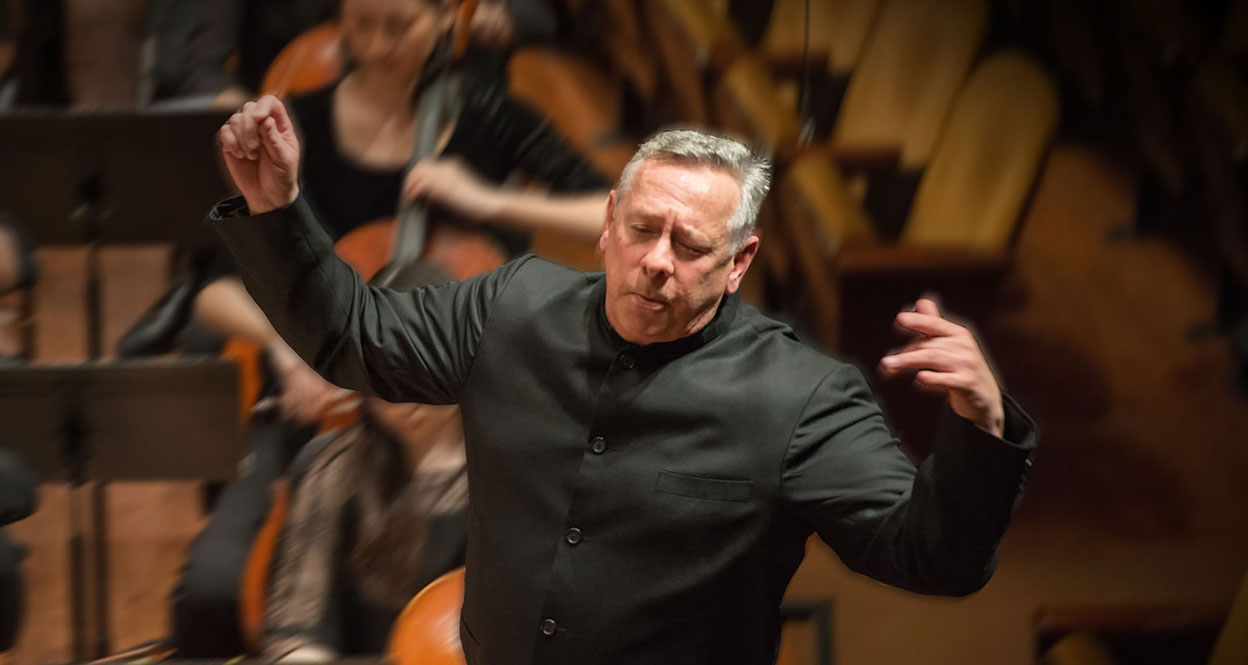
One look at conductor Stephen Rogers Radcliffe revealed as much. He got the best exercise of all.

And he enjoyed the perks of a guest performer who wasn’t around for the glory.

She was there for the workout, too.

Sunday, Feb. 2, 2003 Sioux City Journal Vol. 139 No. 150 • Sioux City, Iowa • METRO EDITION Beethoven performed in seemless fashion during symphony concert By Bruce R. Miller Journal staff writer [REVIEW] At Saturday's Sioux City Symphony concert, pianist Ursula Oppens did what so many guest artists don't. She listened. Throughout Beethoven's Piano Concerto in E-Flat Major, Opus 73, Oppens complemented what the resident musicians did; she didn't just expect them to keep up with her. The result was a seamless performance that must have been as exciting for the orchestra as it was for the audience. Ironically, the piece was one Beethoven wrote after he had lost his hearing. Filled with rapid runs, it could have been a "look at me" turn for the two-time Grammy winner. Instead, Oppens played as if she had been a member of the orchestra for years. Slipping into the stormy duel between the cellos and the violins, she gave the work the understated surprise it needed. In the second movement, she created the piano equivalent of Frank Lloyd Wright's Fallingwater, a fluid aria that got Oppens to embrace the piano and dig into the music's very definite structure. She even nodded her head in ways that suggested the fire of the work's creator. Because the orchestra and the guest artist were so well matched, heat seemed to rise from the stage. In truth, the building's thermostat was set a bit high. But the musicians could have melted ice with their performance. Unfortunately, the first ("Overture to Fidelio") and last (Symphony No. 7 in A Major, Opus 92) offerings didn't have as much heat as the centerpiece. The timpanist was challenged on both, but overwhelmed in the former, impressed in the latter. The oboes got a chance to solo in the symphony as well. But this was really a night for strings. In all three selections, the pace was intense. The workout was a good one. While the overture wasn't as memorable as it could have been, it made the concerto all the more special. The symphony, as a result, was a bit of a let-down, even though it asked more of its players and reeked of the familiar. There were sections that have been lifted for film scores, movements that have served as inspiration for others (including Schubert). The play "Amadeus" made much of Mozart's excess ("too many notes, the royal said). But Beethoven insisted every one he put on paper was important. When the symphony was performed in 1813, Mozart's old nemesis Antonio Salieri led the percussion section. It's easy to see the necessity of every melody, counter-melody and beat. The stuff works because it's so intricate. One look at conductor Stephen Rogers Radcliffe revealed as much. He got the best exercise of all. And he enjoyed the perks of a guest performer who wasn't around for the glory. She was there for the workout, too.

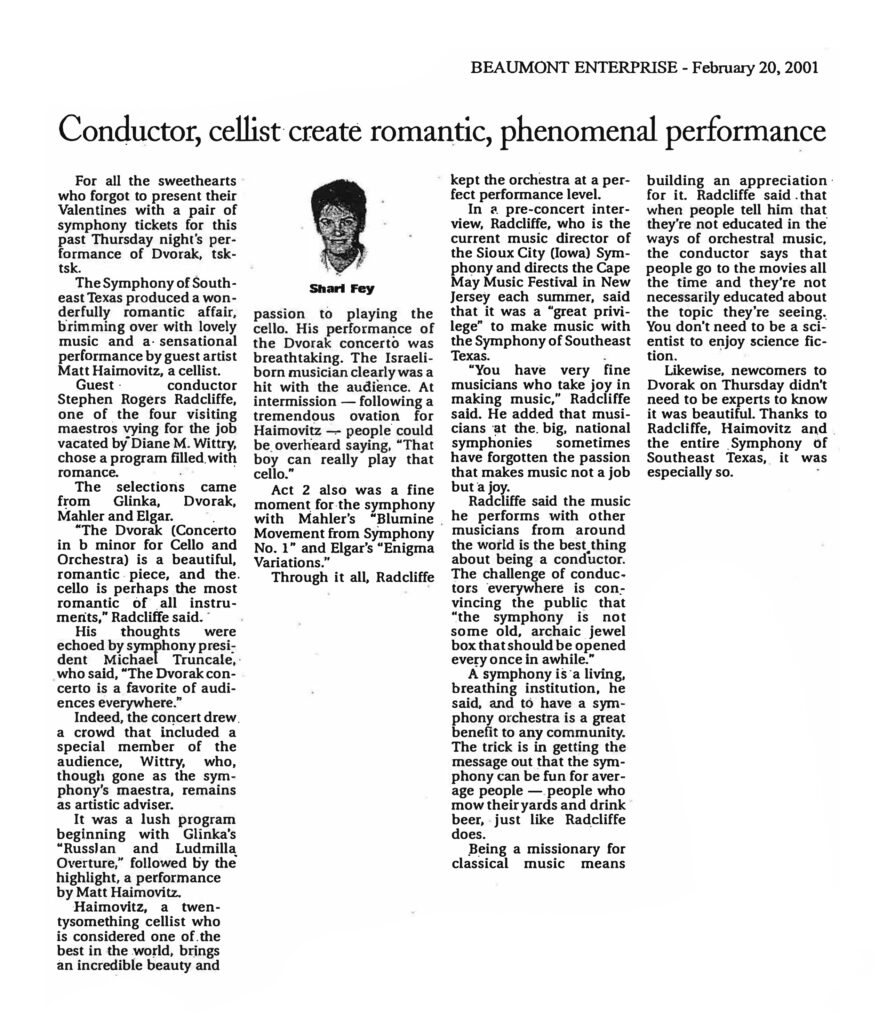
Cape May orchestra: Solidity by the sea

The Philadelphia Inquirer 174th Year, No. 4 • South Jersey C • TUESDAY, JUNE 4, 2002 • www.philly.com • 50 C Review Music Cape May orchestra: Solidity by the sea By David Patrick Stearns INQUIRER MUSIC CRITIC CAPE MAY — Gamboling beachgoers in this Victorian-styled resort have an opportunity to cool their sunburns with late-afternoon symphonic music performed literally on the beach. The 18-concert Cape May Music Festival (through June 23) imports ensembles from jazz to early music (including Philadelphia’s Piffaro), the core of it all being the Cape May Festival Orchestra. The group is made up of current and recently graduated conservatory students on what must be hugely enjoyable three-year fellowships, playing alongside principal players drawn from the New York Chamber Ensemble. Sunday’s venue was the 800-seat Convention Hall. The 5 p.m. concert was late enough to leave time for body surfing but early enough to watch dolphins surface not far offshore during intermission. With the stiff ocean winds whistling atmospherically around the Convention Hall, does it matter if the music-making is any good? It always matters, and here, though there’s nothing particularly original in philosophy or concept, solidity is everywhere. With a 44-piece orchestra (half the usual size) in an acoustically dry hall, that’s no small accomplishment. Where weighty sonorities are customarily heard in the slow movement of Beethoven’s Symphony No. 7, music director Stephen Rogers Radcliff went for something intense and penetrating, since weight just wasn’t available to him. The intoxicated high spirits of the symphony’s final movement are often conveyed by the sheer breathlessness of so many players with so much velocity; Radcliffe pushed the accelerator to the floor even higher, while maintaining elegant fleetness. His rhythm has a sense of gravitational movement, shaping as well as measuring the notes. And there were surprises, mostly from the presence of Beethoven’s rarely heard "Leonore Overture No. 1," which was written for the opera Fidelio, minus the majesty that’s such a key factor in later, more appropriate overtures. With any festival, there’s a luck-of-the-draw element. I had the bad luck to miss the Dvorak Cello Concerto with the fascinating Matt Haimovitz on Thursday and the worse luck to hear Beethoven’s Piano Concerto No. 5 ("Emperor") with Ursula Oppens. Hers is a magic name in contemporary music circles, thanks to her fearless and resourceful championing of great, modern musical explorers, such as Elliott Carter and Conlon Nancarrow. However, the special pleading that works on the cutting edge led to horrifying results with Beethoven. Oppens was relentlessly loud, graceless and ham-fisted. How could such a performance receive a standing ovation? Trickery: She jumped ahead of the orchestra with greater frequency and with broader leaps as the performance went on, generating artificial though highly unmusical tension. Contact David Patrick Stearns at 215-854-4907 or dstearns@phillynews.com. The next Cape May Festival Orchestra event features pianist Horacio Gutierrez at 8 p.m. Thursday at Convention Hall, Beach Drive at Stockton Place. Information: 609-884-5404 or www.capemaymac.org.

Press | Symphonic Review

Tuesday, June 4, 2002

Cape May Orchestra: Solidity by the Sea

By David Patrick Stearns

CAPE MAY — Gamboling beachgoers in this Victorian-styled resort have an opportunity to cool their sunburns with late-afternoon symphonic music performed literally on the beach.

The 18-concert Cape May Music Festival (through June 23) imports ensembles from jazz to early music (including Philadelphia’s Piffaro), the core of it all being the Cape May Festival Orchestra. The group is made up of current and recently graduated conservatory students on what must be hugely enjoyable three-year fellowships, playing alongside principal players drawn from the New York Chamber Ensemble.

Sunday’s venue was the 800-seat Convention Hall. The 5 p.m. concert was late enough to leave time for body surfing but early enough to watch dolphins surface not far offshore during intermission. With the stiff ocean winds whistling atmospherically around the Convention Hall, does it matter if the music-making is any good?

It always matters, and here, though there’s nothing particularly original in philosophy or concept, solidity is everywhere. With a 44-piece orchestra (half the usual size) in an acoustically dry hall, that’s no small accomplishment.

Where weighty sonorities are customarily heard in the slow movement of Beethoven’s Symphony No. 7, music director Stephen Rogers Radcliff went for something intense and penetrating, since weight just wasn’t available to him. The intoxicated high spirits of the symphony’s final movement are often conveyed by the sheer breathlessness of so many players with so much velocity; Radcliffe pushed the accelerator to the floor even higher, while maintaining elegant fleetness. His rhythm has a sense of gravitational movement, shaping as well as measuring the notes.

And there were surprises, mostly from the presence of Beethoven’s rarely heard “Leonore Overture No. 1,” which was written for the opera Fidelio, minus the majesty that’s such a key factor in later, more appropriate overtures.

With any festival, there’s a luck-of-the-draw element. I had the bad luck to miss the Dvorak Cello Concerto with the fascinating Matt Haimovitz on Thursday and the worse luck to hear Beethoven’s Piano Concerto No. 5 (“Emperor”) with Ursula Oppens. Hers is a magic name in contemporary music circles, thanks to her fearless and resourceful championing of great, modern musical explorers, such as Elliott Carter and Conlon Nancarrow.

However, the special pleading that works on the cutting edge led to horrifying results with Beethoven. Oppens was relentlessly loud, graceless and ham-fisted. How could such a performance receive a standing ovation? Trickery: She jumped ahead of the orchestra with greater frequency and with broader leaps as the performance went on, generating artificial though highly unmusical tension.

Contact David Patrick Stearns at 215-854-4907 or dstearns@phillynews.com.

The next Cape May Festival Orchestra event features pianist Horacio Gutierrez at 8 p.m. Thursday at Convention Hall, Beach Drive at Stockton Place. Information: 609-884-5404 or www.capemaymac.org.

The Philadelphia Inquirer 174th Year, No. 4 • South Jersey C • TUESDAY, JUNE 4, 2002 • www.philly.com • 50 C Review Music Cape May orchestra: Solidity by the sea By David Patrick Stearns INQUIRER MUSIC CRITIC CAPE MAY — Gamboling beachgoers in this Victorian-styled resort have an opportunity to cool their sunburns with late-afternoon symphonic music performed literally on the beach. The 18-concert Cape May Music Festival (through June 23) imports ensembles from jazz to early music (including Philadelphia’s Piffaro), the core of it all being the Cape May Festival Orchestra. The group is made up of current and recently graduated conservatory students on what must be hugely enjoyable three-year fellowships, playing alongside principal players drawn from the New York Chamber Ensemble. Sunday’s venue was the 800-seat Convention Hall. The 5 p.m. concert was late enough to leave time for body surfing but early enough to watch dolphins surface not far offshore during intermission. With the stiff ocean winds whistling atmospherically around the Convention Hall, does it matter if the music-making is any good? It always matters, and here, though there’s nothing particularly original in philosophy or concept, solidity is everywhere. With a 44-piece orchestra (half the usual size) in an acoustically dry hall, that’s no small accomplishment. Where weighty sonorities are customarily heard in the slow movement of Beethoven’s Symphony No. 7, music director Stephen Rogers Radcliff went for something intense and penetrating, since weight just wasn’t available to him. The intoxicated high spirits of the symphony’s final movement are often conveyed by the sheer breathlessness of so many players with so much velocity; Radcliffe pushed the accelerator to the floor even higher, while maintaining elegant fleetness. His rhythm has a sense of gravitational movement, shaping as well as measuring the notes. And there were surprises, mostly from the presence of Beethoven’s rarely heard "Leonore Overture No. 1," which was written for the opera Fidelio, minus the majesty that’s such a key factor in later, more appropriate overtures. With any festival, there’s a luck-of-the-draw element. I had the bad luck to miss the Dvorak Cello Concerto with the fascinating Matt Haimovitz on Thursday and the worse luck to hear Beethoven’s Piano Concerto No. 5 ("Emperor") with Ursula Oppens. Hers is a magic name in contemporary music circles, thanks to her fearless and resourceful championing of great, modern musical explorers, such as Elliott Carter and Conlon Nancarrow. However, the special pleading that works on the cutting edge led to horrifying results with Beethoven. Oppens was relentlessly loud, graceless and ham-fisted. How could such a performance receive a standing ovation? Trickery: She jumped ahead of the orchestra with greater frequency and with broader leaps as the performance went on, generating artificial though highly unmusical tension. Contact David Patrick Stearns at 215-854-4907 or dstearns@phillynews.com. The next Cape May Festival Orchestra event features pianist Horacio Gutierrez at 8 p.m. Thursday at Convention Hall, Beach Drive at Stockton Place. Information: 609-884-5404 or www.capemaymac.org.

Orchestra presents monumental symphony in ‘The Resurrection’

Sioux City Journal April 12, 1998 Orchestra presents monumental symphony in ‘The Resurrection’ By Judi Hazlett Journal staff writer [Review] There may be bigger orchestras performing Mahler in bigger cities, but you’ll have to look long and hard to find any that will beat what happened right here in Sioux City Saturday night. It was a monumental musical event as the Sioux City Symphony Orchestra played a monumental symphony. Gustav Mahler’s Symphony No. 2, "The Resurrection," is a work of gigantic imagination and creativity in itself, but performing it takes on superhuman proportions. For the orchestra, its length and challenges loom large. Logistically, to get a huge orchestra on the stage at Eppley Auditorium, plus a huge chorus, two soloists and the conductor takes more than just a bit of doing. But the SCSO did it — with lots of style, class and panache, thanks to music director and conductor Stephen Rogers Radcliffe. He kept everything together in a performance that was sustained and deliberate, through the revealing slow and soft parts as well as the Mahler "tornadoes" that whirl everything up and around, then just as quickly suspend you in the storm’s peaceful center before whirling you around some more. Radcliffe never rushed it, but kept it unfolding and growing right into the magnificent finale of the fifth movement. That’s when the meaning of the word resurrection hits home. Out of Mahler’s beginning first movement — a funeral march — themes move through four more movements with moments depicting earthly bliss, turmoil, despair, mourning and the ever-present specter of death. Finally, Mahler realizes death can be transcendent, which, as Radcliffe pointed out, makes this symphony an appropriate one for the resurrection of Christ celebrated by Christians at Easter. The fourth movement introduces a solo voice but the fifth movement pulls out all the stops. It featured knockout performances by mezzo soprano Lucille Beer and soprano Sara Seglem as soloists. Their voices were added to the smooth, full vocalizations of the combined voices of the Siouxland Master Chorale, directed by Gregory Fuller; the Northwestern College Choir, directed by Kimberly Utke; the Wayne State College Choir, directed by David Lawrence; and the Siouxland Community Chorus, directed by Shirley Neugebauer-Luebke. As good as this all was, the evening really belonged to the orchestra, which underwent a resurrection of its own with Saturday’s performance. The musicians play almost every minute of the two and a half hour work, and work it is. Kudos to the brass and horns, which were brilliant, and the strings for providing the glue. Clearly there are the resources here for big works like this.

Press | Symphonic Review

Sunday, April 12, 1998

Orchestra presents monumental symphony in ‘The Resurrection’

By Judi Hazlett

There may be bigger orchestras performing Mahler in bigger cities, but you’ll have to look long and hard to find any that will beat what happened right here in Sioux City Saturday night.

It was a monumental musical event as the Sioux City Symphony Orchestra played a monumental symphony.

Gustav Mahler’s Symphony No. 2, “The Resurrection,” is a work of gigantic imagination and creativity in itself, but performing it takes on superhuman proportions. For the orchestra, its length and challenges loom large. Logistically, to get a huge orchestra on the stage at Eppley Auditorium, plus a huge chorus, two soloists and the conductor takes more than just a bit of doing.

But the SCSO did it — with lots of style, class and panache, thanks to music director and conductor Stephen Rogers Radcliffe. He kept everything together in a performance that was sustained and deliberate, through the revealing slow and soft parts as well as the Mahler “tornadoes” that whirl everything up and around, then just as quickly suspend you in the storm’s peaceful center before whirling you around some more.

Radcliffe never rushed it, but kept it unfolding and growing right into the magnificent finale of the fifth movement.

That’s when the meaning of the word resurrection hits home. Out of Mahler’s beginning first movement — a funeral march — themes move through four more movements with moments depicting earthly bliss, turmoil, despair, mourning and the ever-present specter of death.

Finally, Mahler realizes death can be transcendent, which, as Radcliffe pointed out, makes this symphony an appropriate one for the resurrection of Christ celebrated by Christians at Easter.

The fourth movement introduces a solo voice but the fifth movement pulls out all the stops. It featured knockout performances by mezzo soprano Lucille Beer and soprano Sara Seglem as soloists. Their voices were added to the smooth, full vocalizations of the combined voices of the Siouxland Master Chorale, directed by Gregory Fuller; the Northwestern College Choir, directed by Kimberly Utke; the Wayne State College Choir, directed by David Lawrence; and the Siouxland Community Chorus, directed by Shirley Neugebauer-Luebke.

As good as this all was, the evening really belonged to the orchestra, which underwent a resurrection of its own with Saturday’s performance. The musicians play almost every minute of the two and a half hour work, and work it is. Kudos to the brass and horns, which were brilliant, and the strings for providing the glue. Clearly there are the resources here for big works like this.

Sioux City Journal April 12, 1998 Orchestra presents monumental symphony in ‘The Resurrection’ By Judi Hazlett Journal staff writer [Review] There may be bigger orchestras performing Mahler in bigger cities, but you’ll have to look long and hard to find any that will beat what happened right here in Sioux City Saturday night. It was a monumental musical event as the Sioux City Symphony Orchestra played a monumental symphony. Gustav Mahler’s Symphony No. 2, "The Resurrection," is a work of gigantic imagination and creativity in itself, but performing it takes on superhuman proportions. For the orchestra, its length and challenges loom large. Logistically, to get a huge orchestra on the stage at Eppley Auditorium, plus a huge chorus, two soloists and the conductor takes more than just a bit of doing. But the SCSO did it — with lots of style, class and panache, thanks to music director and conductor Stephen Rogers Radcliffe. He kept everything together in a performance that was sustained and deliberate, through the revealing slow and soft parts as well as the Mahler "tornadoes" that whirl everything up and around, then just as quickly suspend you in the storm’s peaceful center before whirling you around some more. Radcliffe never rushed it, but kept it unfolding and growing right into the magnificent finale of the fifth movement. That’s when the meaning of the word resurrection hits home. Out of Mahler’s beginning first movement — a funeral march — themes move through four more movements with moments depicting earthly bliss, turmoil, despair, mourning and the ever-present specter of death. Finally, Mahler realizes death can be transcendent, which, as Radcliffe pointed out, makes this symphony an appropriate one for the resurrection of Christ celebrated by Christians at Easter. The fourth movement introduces a solo voice but the fifth movement pulls out all the stops. It featured knockout performances by mezzo soprano Lucille Beer and soprano Sara Seglem as soloists. Their voices were added to the smooth, full vocalizations of the combined voices of the Siouxland Master Chorale, directed by Gregory Fuller; the Northwestern College Choir, directed by Kimberly Utke; the Wayne State College Choir, directed by David Lawrence; and the Siouxland Community Chorus, directed by Shirley Neugebauer-Luebke. As good as this all was, the evening really belonged to the orchestra, which underwent a resurrection of its own with Saturday’s performance. The musicians play almost every minute of the two and a half hour work, and work it is. Kudos to the brass and horns, which were brilliant, and the strings for providing the glue. Clearly there are the resources here for big works like this.

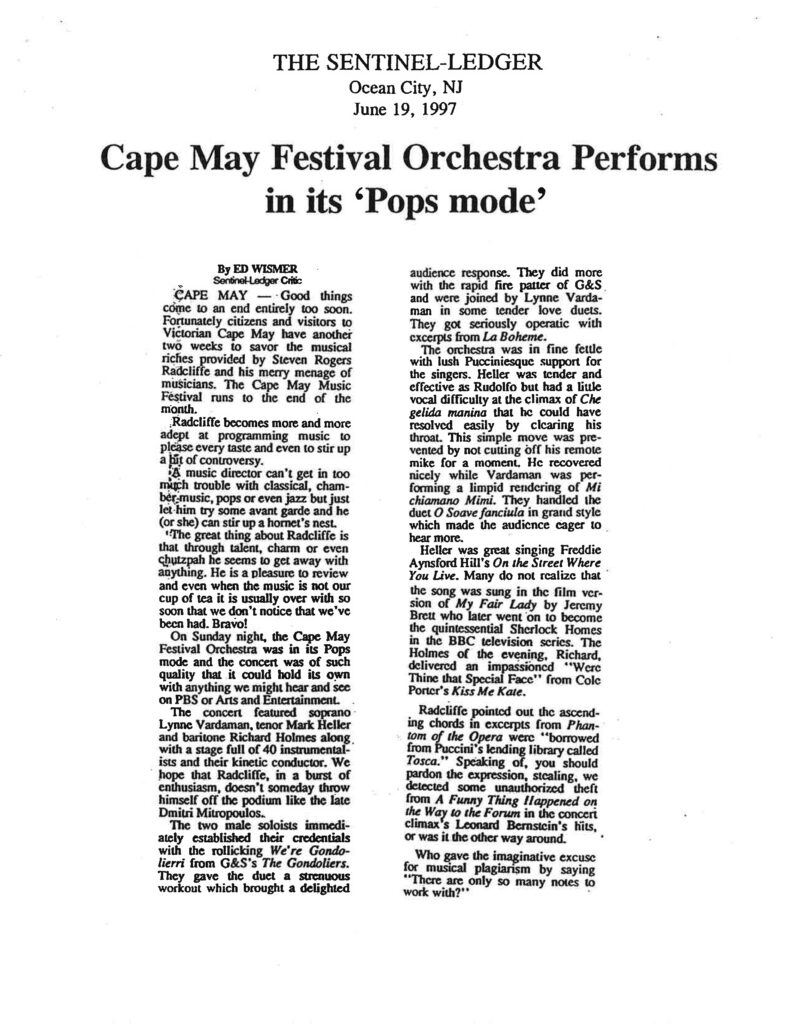
Cape May Festival Orchestra Performs in its ‘Pops mode’

THE SENTINEL-LEDGER Ocean City, NJ June 19, 1997 Cape May Festival Orchestra Performs in its ‘Pops mode’ By ED WISMER Sentinel-Ledger Critic CAPE MAY — Good things come to an end entirely too soon. Fortunately citizens and visitors to Victorian Cape May have another two weeks to savor the musical riches provided by Stephen Rogers Radcliffe and his merry menage of musicians. The Cape May Music Festival runs to the end of the month. Radcliffe becomes more and more adept at programming music to please every taste and even to stir up a bit of controversy. A music director can't get in too much trouble with classical, chamber music, pops or even jazz but just let him try some avant garde and he (or she) can stir up a hornet's nest. The great thing about Radcliffe is that through talent, charm or even chutzpah he seems to get away with anything. He is a pleasure to review and even when the music is not our cup of tea it is usually over with so soon that we don't notice that we've been had. Bravo! On Sunday night, the Cape May Festival Orchestra was in its Pops mode and the concert was of such quality that it could hold its own with anything we might hear and see on PBS or Arts and Entertainment. The concert featured soprano Lynne Vardaman, tenor Mark Heller and baritone Richard Holmes along with a stage full of 40 instrumentalists and their kinetic conductor. We hope that Radcliffe, in a burst of enthusiasm, doesn't someday throw himself off the podium like the late Dmitri Mitropoulos. The two male soloists immediately established their credentials with the rollicking We're Gondolieri from G&S's The Gondoliers. They gave the duet a strenuous workout which brought a delighted audience response. They did more with the rapid fire patter of G&S and were joined by Lynne Vardaman in some tender love duets. They got seriously operatic with excerpts from La Boheme. The orchestra was in fine fettle with lush Pucciniesque support for the singers. Heller was tender and effective as Rudolfo but had a little vocal difficulty at the climax of Che gelida manina that he could have resolved easily by clearing his throat. This simple move was prevented by not cutting off his remote mike for a moment. He recovered nicely while Vardaman was performing a limpid rendering of Mi chiamano Mimi. They handled the duet O Soave fanciula in grand style which made the audience eager to hear more. Heller was great singing Freddie Aynsford Hill's On the Street Where You Live. Many do not realize that the song was sung in the film version of My Fair Lady by Jeremy Brett who later went on to become the quintessential Sherlock Holmes in the BBC television series. The Holmes of the evening, Richard, delivered an impassioned "Were Thine that Special Face" from Cole Porter's Kiss Me Kate. Radcliffe pointed out the ascending chords in excerpts from Phantom of the Opera were "borrowed from Puccini's lending library called Tosca." Speaking of, you should pardon the expression, stealing, we detected some unauthorized theft from A Funny Thing Happened on the Way to the Forum in the concert climax's Leonard Bernstein's hits, or was it the other way around. Who gave the imaginative excuse for musical plagiarism by saying "There are only so many notes to work with?"

Press | Symphonic Review

June 19, 1997

Cape May Festival Orchestra Performs in its ‘Pops mode’

By Ed Wismer

CAPE MAY — Good things come to an end entirely too soon. Fortunately citizens and visitors to Victorian Cape May have another two weeks to savor the musical riches provided by Stephen Rogers Radcliffe and his merry menage of musicians. The Cape May Music Festival runs to the end of the month.

Radcliffe becomes more and more adept at programming music to please every taste and even to stir up a bit of controversy.

A music director can’t get in too much trouble with classical, chamber music, pops or even jazz but just let him try some avant garde and he (or she) can stir up a hornet’s nest.

The great thing about Radcliffe is that through talent, charm or even chutzpah he seems to get away with anything. He is a pleasure to review and even when the music is not our cup of tea it is usually over with so soon that we don’t notice that we’ve been had. Bravo!

On Sunday night, the Cape May Festival Orchestra was in its Pops mode and the concert was of such quality that it could hold its own with anything we might hear and see on PBS or Arts and Entertainment.

The concert featured soprano Lynne Vardaman, tenor Mark Heller and baritone Richard Holmes along with a stage full of 40 instrumentalists and their kinetic conductor. We hope that Radcliffe, in a burst of enthusiasm, doesn’t someday throw himself off the podium like the late Dmitri Mitropoulos.
The two male soloists immediately established their credentials with the rollicking We’re Gondolieri from G&S’s The Gondoliers. They gave the duet a strenuous workout which brought a delighted audience response. They did more with the rapid fire patter of G&S and were joined by Lynne Vardaman in some tender love duets. They got seriously operatic with excerpts from La Boheme.
The orchestra was in fine fettle with lush Pucciniesque support for the singers. Heller was tender and effective as Rudolfo but had a little vocal difficulty at the climax of Che gelida manina that he could have resolved easily by clearing his throat. This simple move was prevented by not cutting off his remote mike for a moment. He recovered nicely while Vardaman was performing a limpid rendering of Mi chiamano Mimi. They handled the duet O Soave fanciula in grand style which made the audience eager to hear more.

Heller was great singing Freddie Aynsford Hill’s On the Street Where You Live. Many do not realize that the song was sung in the film version of My Fair Lady by Jeremy Brett who later went on to become the quintessential Sherlock Holmes in the BBC television series. The Holmes of the evening, Richard, delivered an impassioned “Were Thine that Special Face” from Cole Porter’s Kiss Me Kate.

Radcliffe pointed out the ascending chords in excerpts from Phantom of the Opera were “borrowed from Puccini’s lending library called Tosca.” Speaking of, you should pardon the expression, stealing, we detected some unauthorized theft from A Funny Thing Happened on the Way to the Forum in the concert climax’s Leonard Bernstein’s hits, or was it the other way around.

Who gave the imaginative excuse for musical plagiarism by saying “There are only so many notes to work with?”

THE SENTINEL-LEDGER Ocean City, NJ June 19, 1997 Cape May Festival Orchestra Performs in its ‘Pops mode’ By ED WISMER Sentinel-Ledger Critic CAPE MAY — Good things come to an end entirely too soon. Fortunately citizens and visitors to Victorian Cape May have another two weeks to savor the musical riches provided by Stephen Rogers Radcliffe and his merry menage of musicians. The Cape May Music Festival runs to the end of the month. Radcliffe becomes more and more adept at programming music to please every taste and even to stir up a bit of controversy. A music director can't get in too much trouble with classical, chamber music, pops or even jazz but just let him try some avant garde and he (or she) can stir up a hornet's nest. The great thing about Radcliffe is that through talent, charm or even chutzpah he seems to get away with anything. He is a pleasure to review and even when the music is not our cup of tea it is usually over with so soon that we don't notice that we've been had. Bravo! On Sunday night, the Cape May Festival Orchestra was in its Pops mode and the concert was of such quality that it could hold its own with anything we might hear and see on PBS or Arts and Entertainment. The concert featured soprano Lynne Vardaman, tenor Mark Heller and baritone Richard Holmes along with a stage full of 40 instrumentalists and their kinetic conductor. We hope that Radcliffe, in a burst of enthusiasm, doesn't someday throw himself off the podium like the late Dmitri Mitropoulos. The two male soloists immediately established their credentials with the rollicking We're Gondolieri from G&S's The Gondoliers. They gave the duet a strenuous workout which brought a delighted audience response. They did more with the rapid fire patter of G&S and were joined by Lynne Vardaman in some tender love duets. They got seriously operatic with excerpts from La Boheme. The orchestra was in fine fettle with lush Pucciniesque support for the singers. Heller was tender and effective as Rudolfo but had a little vocal difficulty at the climax of Che gelida manina that he could have resolved easily by clearing his throat. This simple move was prevented by not cutting off his remote mike for a moment. He recovered nicely while Vardaman was performing a limpid rendering of Mi chiamano Mimi. They handled the duet O Soave fanciula in grand style which made the audience eager to hear more. Heller was great singing Freddie Aynsford Hill's On the Street Where You Live. Many do not realize that the song was sung in the film version of My Fair Lady by Jeremy Brett who later went on to become the quintessential Sherlock Holmes in the BBC television series. The Holmes of the evening, Richard, delivered an impassioned "Were Thine that Special Face" from Cole Porter's Kiss Me Kate. Radcliffe pointed out the ascending chords in excerpts from Phantom of the Opera were "borrowed from Puccini's lending library called Tosca." Speaking of, you should pardon the expression, stealing, we detected some unauthorized theft from A Funny Thing Happened on the Way to the Forum in the concert climax's Leonard Bernstein's hits, or was it the other way around. Who gave the imaginative excuse for musical plagiarism by saying "There are only so many notes to work with?"

Cape May Festival adds music to the Shore mix

The Philadelphia Inquirer Saturday, June 14, 1997 Review: Music Cape May Festival adds music to the Shore mix By Daniel Webster INQUIRER MUSIC CRITIC Climate, culture, commerce: That was the formula laid out Thursday by New Jersey state arts council spokesman David Miller in his preface to the concert by the Cape May Festival Orchestra. Miller called the festival a model of what can happen when a resort community adds the arts to its traditional mix of sun and beachfront games. The concert, coming midway in a season that begins in late May and runs through June 29, brought around 250 vacationers into Cape May's Convention Hall to sit on folding chairs to hear music by Stravinsky, Beethoven and Mendelssohn. Artistic director Stephen Rogers Radcliffe noted that the eight-year-old festival was designed as a boost to the "shoulder season," the early beach weeks before sun and water temperature guarantee full hotels. Radcliffe's musical forces are built around his New York Chamber Ensemble, which performs as an entity and whose players function as principals amid the young professionals who fill out the festival orchestra. In the course of the festival's history, a stage shell has been installed and some reflecting panels placed in the ceiling in an effort to focus the acoustics. More panels would help, but the hall was not designed as a musical setting, and Radcliffe sees adapting to the hall as one of the experiences helpful to his young players. His program balanced popular favorites — Beethoven's Symphony No. 5 and Mendelssohn's Violin Concerto — with Stravinsky's tangy Dances Concertantes. He guided the orchestra through Stravinsky's laconic metric scheme with admirable poise. The performance preserved the irony of this gloss on conventional ballet writing while solo players injected dots of sound and theatrical melodic fragments. The winds and brass have an advantage in this hall, but in Stravinsky, their prominence was both welcome and vital. Violinist Corey Cerovsek was soloist in Mendelssohn's concerto. Steering clear of the staginess that has become a kind of norm with this piece, Cerovsek put his considerable virtuosity to musical ends. He shaded phrases, touched lightly some of the sweeps — like those opening the final movement — and found delicacy in writing that often sounds like shouting. The inner colors in his playing of the middle movement drew similar playing from the orchestra in this fresh reading. Audience response led Cerovsek to play a Kreisler nugget in which virtuosity again was bent to the task of mining the musical depth of the piece. After all that, the Beethoven symphony, played by an ensemble similar in size to those of Beethoven's time, sounded young, alert and a little brash. [Photo Caption] Stephen Rogers Radcliffe is the festival's artistic director. [Boxed Text] Cape May Music Festival Stephen Rogers Radcliffe conducts various programs in the festival, at Convention Hall, Cape May, through June 29. Information: 609-884-5404.

Press | Symphonic Review

Sunday, June 14, 1997

Cape May Festival adds music to the Shore mix

By Daniel Webster

Climate, culture, commerce: That was the formula laid out Thursday by New Jersey state arts council spokesman David Miller in his preface to the concert by the Cape May Festival Orchestra. Miller called the festival a model of what can happen when a resort community adds the arts to its traditional mix of sun and beachfront games.

The concert, coming midway in a season that begins in late May and runs through June 29, brought around 250 vacationers into Cape May’s Convention Hall to sit on folding chairs to hear music by Stravinsky, Beethoven and Mendelssohn. Artistic director Stephen Rogers Radcliffe noted that the eight-year-old festival was designed as a boost to the “shoulder season,” the early beach weeks before sun and water temperature guarantee full hotels.
Radcliffe’s musical forces are built around his New York Chamber Ensemble, which performs as an entity and whose players function as principals amid the young professionals who fill out the festival orchestra.

In the course of the festival’s history, a stage shell has been installed and some reflecting panels placed in the ceiling in an effort to focus the acoustics. More panels would help, but the hall was not designed as a musical setting, and Radcliffe sees adapting to the hall as one of the experiences helpful to his young players.

His program balanced popular favorites — Beethoven’s Symphony No. 5 and Mendelssohn’s Violin Concerto — with Stravinsky’s tangy Dances Concertantes. He guided the orchestra through Stravinsky’s laconic metric scheme with admirable poise. The performance preserved the irony of this gloss on conventional ballet writing while solo players injected dots of sound and theatrical melodic fragments. The winds and brass have an advantage in this hall, but in Stravinsky, their prominence was both welcome and vital.

Violinist Corey Cerovsek was soloist in Mendelssohn’s concerto. Steering clear of the staginess that has become a kind of norm with this piece, Cerovsek put his considerable virtuosity to musical ends. He shaded phrases, touched lightly some of the sweeps — like those opening the final movement — and found delicacy in writing that often sounds like shouting. The inner colors in his playing of the middle movement drew similar playing from the orchestra in this fresh reading.

Audience response led Cerovsek to play a Kreisler nugget in which virtuosity again was bent to the task of mining the musical depth of the piece.

After all that, the Beethoven symphony, played by an ensemble similar in size to those of Beethoven’s time, sounded young, alert and a little brash.

Cape May Music Festival
Stephen Rogers Radcliffe conducts various programs in the festival, at Convention Hall, Cape May, through June 29. Information: 609-884-5404.

The Philadelphia Inquirer Saturday, June 14, 1997 Review: Music Cape May Festival adds music to the Shore mix By Daniel Webster INQUIRER MUSIC CRITIC Climate, culture, commerce: That was the formula laid out Thursday by New Jersey state arts council spokesman David Miller in his preface to the concert by the Cape May Festival Orchestra. Miller called the festival a model of what can happen when a resort community adds the arts to its traditional mix of sun and beachfront games. The concert, coming midway in a season that begins in late May and runs through June 29, brought around 250 vacationers into Cape May's Convention Hall to sit on folding chairs to hear music by Stravinsky, Beethoven and Mendelssohn. Artistic director Stephen Rogers Radcliffe noted that the eight-year-old festival was designed as a boost to the "shoulder season," the early beach weeks before sun and water temperature guarantee full hotels. Radcliffe's musical forces are built around his New York Chamber Ensemble, which performs as an entity and whose players function as principals amid the young professionals who fill out the festival orchestra. In the course of the festival's history, a stage shell has been installed and some reflecting panels placed in the ceiling in an effort to focus the acoustics. More panels would help, but the hall was not designed as a musical setting, and Radcliffe sees adapting to the hall as one of the experiences helpful to his young players. His program balanced popular favorites — Beethoven's Symphony No. 5 and Mendelssohn's Violin Concerto — with Stravinsky's tangy Dances Concertantes. He guided the orchestra through Stravinsky's laconic metric scheme with admirable poise. The performance preserved the irony of this gloss on conventional ballet writing while solo players injected dots of sound and theatrical melodic fragments. The winds and brass have an advantage in this hall, but in Stravinsky, their prominence was both welcome and vital. Violinist Corey Cerovsek was soloist in Mendelssohn's concerto. Steering clear of the staginess that has become a kind of norm with this piece, Cerovsek put his considerable virtuosity to musical ends. He shaded phrases, touched lightly some of the sweeps — like those opening the final movement — and found delicacy in writing that often sounds like shouting. The inner colors in his playing of the middle movement drew similar playing from the orchestra in this fresh reading. Audience response led Cerovsek to play a Kreisler nugget in which virtuosity again was bent to the task of mining the musical depth of the piece. After all that, the Beethoven symphony, played by an ensemble similar in size to those of Beethoven's time, sounded young, alert and a little brash. [Photo Caption] Stephen Rogers Radcliffe is the festival's artistic director. [Boxed Text] Cape May Music Festival Stephen Rogers Radcliffe conducts various programs in the festival, at Convention Hall, Cape May, through June 29. Information: 609-884-5404.

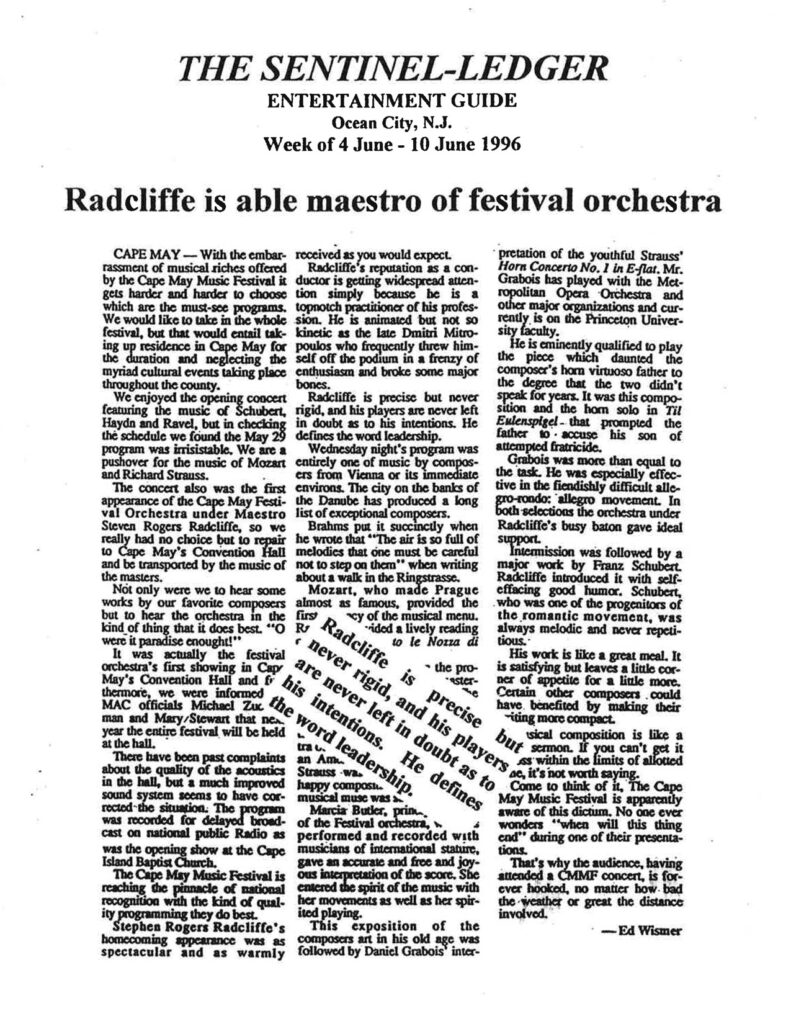
Radcliffe is able Maestro of Festival Orchestra

THE SENTINEL-LEDGER ENTERTAINMENT GUIDE Ocean City, N.J. Week of 4 June – 10 June 1996 Radcliffe is able maestro of festival orchestra CAPE MAY — With the embarrassment of musical riches offered by the Cape May Music Festival it gets harder and harder to choose which are the must-see programs. We would like to take in the whole festival, but that would entail taking up residence in Cape May for the duration and neglecting the myriad cultural events taking place throughout the county. We enjoyed the opening concert featuring the music of Schubert, Haydn and Ravel, but in checking the schedule we found the May 29 program was irresistible. We are a pushover for the music of Mozart and Richard Strauss. The concert also was the first appearance of the Cape May Festival Orchestra under Maestro Stephen Rogers Radcliffe, so we really had no choice but to repair to Cape May’s Convention Hall and be transported by the music of the masters. Not only were we to hear some works by our favorite composers but to hear the orchestra in the kind of thing that it does best — “O were it paradise enough!” It was actually the festival orchestra’s first showing in Cape May’s Convention Hall and, furthermore, we were informed by MAC officials Michael Zuckerman and Mary Stewart that next year the entire festival will be held at the hall. There have been past complaints about the quality of the acoustics in the hall, but a much improved sound system seems to have corrected the situation. The program was recorded for delayed broadcast on National Public Radio as was the opening show at the Cape Island Baptist Church. The Cape May Music Festival is reaching the pinnacle of national recognition with the kind of quality programming they do best. Stephen Rogers Radcliffe’s homecoming appearance was as spectacular and as warmly received as you would expect. Radcliffe’s reputation as a conductor is getting widespread attention simply because he is a topnotch practitioner of his profession. He is animated but not so kinetic as the late Dmitri Mitropoulos who frequently threw himself off the podium in a frenzy of enthusiasm and broke some major bones. Radcliffe is precise but never rigid, and his players are never left in doubt as to his intentions. He defines the word leadership. Wednesday night’s program was entirely one of music by composers from Vienna or its immediate environs. The city on the banks of the Danube has produced a long list of exceptional composers. Brahms put it succinctly when he wrote that “The air is so full of melodies that one must be careful not to step on them” when writing about a walk in the Ringstrasse. Mozart, who made Prague almost as famous, provided the first part of the musical menu. Radcliffe provided a lively reading of the Nozze di Figaro overture. Marcia Butler, principal clarinet of the Festival orchestra, performed and recorded with musicians of international stature, gave an accurate and free and joyous interpretation of the score. She entered the spirit of the music with her movements as well as her spirited playing. This exposition of the composers’ art in his old age was followed by Daniel Grabois’ interpretation of the youthful Strauss’ *Horn Concerto No. 1 in E-flat, Mr. Grabois has played with the Metropolitan Opera Orchestra and other major organizations and currently is on the Princeton University faculty. He is eminently qualified to play the piece which daunted the composer’s horn virtuoso father to the degree that the two didn’t speak for years. It was this composition and the horn solo in Till Eulenspiegel that prompted the father to accuse his son of attempted fratricide. Grabois was more than equal to the task. He was especially effective in the fiendishly difficult allegro con brio movement. In both selections the orchestra under Radcliffe’s busy baton gave ideal support. Intermission was followed by a major work by Franz Schubert. Radcliffe introduced it with self-effacing good humor. Schubert, who was one of the progenitors of the romantic movement, was always melodic and never repetitious. His work is like a great meal. It is satisfying but leaves a little corner of appetite for a little more. Certain other composers could have benefited by making their writing more compact. Musical composition is like a sermon. If you can’t get it across within the limits of allotted time, it’s not worth saying. Come to think of it, The Cape May Music Festival is apparently aware of this dictum. No one ever wonders “when will this thing end” during one of their presentations. That’s why the audience, having attended a CMMF concert, is forever hooked, no matter how bad the weather or great the distance involved. — Ed Wismer

Press | Symphonic Review

Week of June 4-10, 1996

Radcliffe is able Maestro of Festival Orchestra

By Ed Wismer

CAPE MAY — With the embarrassment of musical riches offered by the Cape May Music Festival it gets harder and harder to choose which are the must-see programs. We would like to take in the whole festival, but that would entail taking up residence in Cape May for the duration and neglecting the myriad cultural events taking place throughout the county.

We enjoyed the opening concert featuring the music of Schubert, Haydn and Ravel, but in checking the schedule we found the May 29 program was irresistible. We are a pushover for the music of Mozart and Richard Strauss.

The concert also was the first appearance of the Cape May Festival Orchestra under Maestro Stephen Rogers Radcliffe, so we really had no choice but to repair to Cape May’s Convention Hall and be transported by the music of the masters.

Not only were we to hear some works by our favorite composers but to hear the orchestra in the kind of thing that it does best — “O were it paradise enough!”

It was actually the festival orchestra’s first showing in Cape May’s Convention Hall and, furthermore, we were informed by MAC officials Michael Zuckerman and Mary Stewart that next year the entire festival will be held at the hall.

There have been past complaints about the quality of the acoustics in the hall, but a much improved sound system seems to have corrected the situation. The program was recorded for delayed broadcast on National Public Radio as was the opening show at the Cape Island Baptist Church.

The Cape May Music Festival is reaching the pinnacle of national recognition with the kind of quality programming they do best.

Stephen Rogers Radcliffe’s homecoming appearance was as spectacular and as warmly received as you would expect. Radcliffe’s reputation as a conductor is getting widespread attention simply because he is a topnotch practitioner of his profession. He is animated but not so kinetic as the late Dmitri Mitropoulos who frequently threw himself off the podium in a frenzy of enthusiasm and broke some major bones.

Radcliffe is precise but never rigid, and his players are never left in doubt as to his intentions. He defines the word leadership.

Wednesday night’s program was entirely one of music by composers from Vienna or its immediate environs. The city on the banks of the Danube has produced a long list of exceptional composers.

Brahms put it succinctly when he wrote that “The air is so full of melodies that one must be careful not to step on them” when writing about a walk in the Ringstrasse.

Mozart, who made Prague almost as famous, provided the first part of the musical menu. Radcliffe provided a lively reading of the Nozze di Figaro overture.

Marcia Butler, principal clarinet of the Festival orchestra, performed and recorded with musicians of international stature, gave an accurate and free and joyous interpretation of the score. She entered the spirit of the music with her movements as well as her spirited playing.

This exposition of the composers’ art in his old age was followed by Daniel Grabois’ interpretation of the youthful Strauss’ *Horn Concerto No. 1 in E-flat, Mr. Grabois has played with the Metropolitan Opera Orchestra and other major organizations and currently is on the Princeton University faculty.

He is eminently qualified to play the piece which daunted the composer’s horn virtuoso father to the degree that the two didn’t speak for years. It was this composition and the horn solo in Till Eulenspiegel that prompted the father to accuse his son of attempted fratricide.

Grabois was more than equal to the task. He was especially effective in the fiendishly difficult allegro con brio movement. In both selections the orchestra under Radcliffe’s busy baton gave ideal support.

Intermission was followed by a major work by Franz Schubert. Radcliffe introduced it with self-effacing good humor. Schubert, who was one of the progenitors of the romantic movement, was always melodic and never repetitious.

His work is like a great meal. It is satisfying but leaves a little corner of appetite for a little more. Certain other composers could have benefited by making their writing more compact.

Musical composition is like a sermon. If you can’t get it across within the limits of allotted time, it’s not worth saying. Come to think of it, The Cape May Music Festival is apparently aware of this dictum. No one ever wonders “when will this thing end” during one of their presentations.

That’s why the audience, having attended a CMMF concert, is forever hooked, no matter how bad the weather or great the distance involved.

— Ed Wismer

THE SENTINEL-LEDGER ENTERTAINMENT GUIDE Ocean City, N.J. Week of 4 June – 10 June 1996 Radcliffe is able maestro of festival orchestra CAPE MAY — With the embarrassment of musical riches offered by the Cape May Music Festival it gets harder and harder to choose which are the must-see programs. We would like to take in the whole festival, but that would entail taking up residence in Cape May for the duration and neglecting the myriad cultural events taking place throughout the county. We enjoyed the opening concert featuring the music of Schubert, Haydn and Ravel, but in checking the schedule we found the May 29 program was irresistible. We are a pushover for the music of Mozart and Richard Strauss. The concert also was the first appearance of the Cape May Festival Orchestra under Maestro Stephen Rogers Radcliffe, so we really had no choice but to repair to Cape May’s Convention Hall and be transported by the music of the masters. Not only were we to hear some works by our favorite composers but to hear the orchestra in the kind of thing that it does best — “O were it paradise enough!” It was actually the festival orchestra’s first showing in Cape May’s Convention Hall and, furthermore, we were informed by MAC officials Michael Zuckerman and Mary Stewart that next year the entire festival will be held at the hall. There have been past complaints about the quality of the acoustics in the hall, but a much improved sound system seems to have corrected the situation. The program was recorded for delayed broadcast on National Public Radio as was the opening show at the Cape Island Baptist Church. The Cape May Music Festival is reaching the pinnacle of national recognition with the kind of quality programming they do best. Stephen Rogers Radcliffe’s homecoming appearance was as spectacular and as warmly received as you would expect. Radcliffe’s reputation as a conductor is getting widespread attention simply because he is a topnotch practitioner of his profession. He is animated but not so kinetic as the late Dmitri Mitropoulos who frequently threw himself off the podium in a frenzy of enthusiasm and broke some major bones. Radcliffe is precise but never rigid, and his players are never left in doubt as to his intentions. He defines the word leadership. Wednesday night’s program was entirely one of music by composers from Vienna or its immediate environs. The city on the banks of the Danube has produced a long list of exceptional composers. Brahms put it succinctly when he wrote that “The air is so full of melodies that one must be careful not to step on them” when writing about a walk in the Ringstrasse. Mozart, who made Prague almost as famous, provided the first part of the musical menu. Radcliffe provided a lively reading of the Nozze di Figaro overture. Marcia Butler, principal clarinet of the Festival orchestra, performed and recorded with musicians of international stature, gave an accurate and free and joyous interpretation of the score. She entered the spirit of the music with her movements as well as her spirited playing. This exposition of the composers’ art in his old age was followed by Daniel Grabois’ interpretation of the youthful Strauss’ *Horn Concerto No. 1 in E-flat, Mr. Grabois has played with the Metropolitan Opera Orchestra and other major organizations and currently is on the Princeton University faculty. He is eminently qualified to play the piece which daunted the composer’s horn virtuoso father to the degree that the two didn’t speak for years. It was this composition and the horn solo in Till Eulenspiegel that prompted the father to accuse his son of attempted fratricide. Grabois was more than equal to the task. He was especially effective in the fiendishly difficult allegro con brio movement. In both selections the orchestra under Radcliffe’s busy baton gave ideal support. Intermission was followed by a major work by Franz Schubert. Radcliffe introduced it with self-effacing good humor. Schubert, who was one of the progenitors of the romantic movement, was always melodic and never repetitious. His work is like a great meal. It is satisfying but leaves a little corner of appetite for a little more. Certain other composers could have benefited by making their writing more compact. Musical composition is like a sermon. If you can’t get it across within the limits of allotted time, it’s not worth saying. Come to think of it, The Cape May Music Festival is apparently aware of this dictum. No one ever wonders “when will this thing end” during one of their presentations. That’s why the audience, having attended a CMMF concert, is forever hooked, no matter how bad the weather or great the distance involved. — Ed Wismer

Bachmann, Radcliffe et al provide sparkle to the Cape May Festival

OCEAN CITY SENTINEL LEDGER June 6, 1995 Bachmann, Radcliffe et al provide sparkle to the Cape May Festival CAPE MAY — As with past years, the Cape May Music Festival 1995 edition is a gala celebration of great music, and on Wednesday, May 31 we were fortunate enough to witness a fantastic performance of Piotr Tchaikovsky’s Violin Concerto in D and the Mozart Symphony No. 39 in E flat. The featured soloist in the Tchaikovsky concerto was violin virtuoso Maria Bachmann, with Stephen Rogers Radcliffe and the Cape May Festival Orchestra. Ms. Bachmann is about to hit the big time of concert artists by virtue of a management contract with Columbia Artists and has been recommended by Leonard Slatkin, conductor of the National Symphony in Washington D.C. She has performed with the South Jersey Symphony and the Bridgeton Symphony, but will now enter a new high-profile phase of her career. The Tchaikovsky concerto evokes mental pictures of the majesty of czarist Russia contrasted with the wildly energetic gyrations of peasant dancing. Anyone cognizant of Slavic culture finds the elegance and vigor of the music entrancing; anyone familiar with great violin masterpieces knows that this concerto is no exercise for beginners. The concerto had to run a fierce gauntlet of fault finding when it was introduced in 1881 by the Vienna Philharmonic with Adolf Brodsky as soloist and Hans Richter on the podium. It was butchered by critic Eduard Hanslick and even Tchaikovsky’s patroness Nadezda von Meck was highly critical of the first movement. Some violinists of the day called it unplayable, but even with its minefield of difficult passages, it is only second to the Mendelssohn concerto in popularity with violinists and audiences today. Time has given Tchaikovsky his revenge. The Cape May Festival Orchestra has the discipline, economy and responsiveness to Radcliffe’s excellent conducting to bring off even the uneven tempo of the scherzo movement of the Brahms and later to be equally effective in Tchaikovsky and Mozart. Stephen Rogers Radcliffe’s cohorts did a magnificent job on the Variations complex score. Brahms probably wrote some of his best for woodwinds and that section of the orchestra often provides the identifying Brahms sound. The Cape May Festival Orchestra has the discipline, economy and responsiveness to Radcliffe’s excellent conducting to bring off even the uneven tempo of the scherzo movement of the Brahms and later to be equally effective in Tchaikovsky and Mozart. Maria Bachmann’s association with Columbia Artists began at midnight after her bravura performance of the Tchaikovsky violin concerto was completed with a flair and strength that seemed phenomenal for one so slightly built. She is a powerful performer and her opening statement of the initial theme informed the audience that she was not a lightweight by any measure. There was a perfect amalgam between her and the orchestra; the only disappointment for us was a slight letdown in the second movement of the concerto. In the finale (a wild dance), Bachmann was ready to join the ranks of Szigeti, Morini and other female violinists who give the boys a run for their money. Radcliffe’s reading of the Mozart symphony was right on the money and the final allegro echoed the good-humored portions of the film Amadeus. We believe the 33-piece orchestra of incredibly gifted young musicians is the best the festival has ever assembled. Personnel changes from year to year are inevitable but there seems to be an unending supply of accomplished youngsters forthcoming annually from conservatories. We hope that they continue to find steady employment in the field that they obviously love. — Ed Wismer

Press | Symphonic Review

Tuesday, June 6, 1995

Bachmann, Radcliffe et al provide sparkle to the Cape May Festival

By Ed Wismer

CAPE MAY — As with past years, the Cape May Music Festival 1995 edition is a gala celebration of great music, and on Wednesday, May 31 we were fortunate enough to witness a fantastic performance of Piotr Tchaikovsky’s Violin Concerto in D and the Mozart Symphony No. 39 in E flat.

The featured soloist in the Tchaikovsky concerto was violin virtuoso Maria Bachmann, with Stephen Rogers Radcliffe and the Cape May Festival Orchestra.

Ms. Bachmann is about to hit the big time of concert artists by virtue of a management contract with Columbia Artists and has been recommended by Leonard Slatkin, conductor of the National Symphony in Washington D.C.

She has performed with the South Jersey Symphony and the Bridgeton Symphony, but will now enter a new high-profile phase of her career.

The Tchaikovsky concerto evokes mental pictures of the majesty of czarist Russia contrasted with the wildly energetic gyrations of peasant dancing.

Anyone cognizant of Slavic culture finds the elegance and vigor of the music entrancing; anyone familiar with great violin masterpieces knows that this concerto is no exercise for beginners.

The concerto had to run a fierce gauntlet of fault finding when it was introduced in 1881 by the Vienna Philharmonic with Adolf Brodsky as soloist and Hans Richter on the podium. It was butchered by critic Eduard Hanslick and even Tchaikovsky’s patroness Nadezda von Meck was highly critical of the first movement. Some violinists of the day called it unplayable, but even with its minefield of difficult passages, it is only second to the Mendelssohn concerto in popularity with violinists and audiences today. Time has given Tchaikovsky his revenge.

The Cape May Festival Orchestra has the discipline, economy and responsiveness to Radcliffe’s excellent conducting to bring off even the uneven tempo of the scherzo movement of the Brahms and later to be equally effective in Tchaikovsky and Mozart.

Stephen Rogers Radcliffe’s cohorts did a magnificent job on the Variations complex score. Brahms probably wrote some of his best for woodwinds and that section of the orchestra often provides the identifying Brahms sound.

The Cape May Festival Orchestra has the discipline, economy and responsiveness to Radcliffe’s excellent conducting to bring off even the uneven tempo of the scherzo movement of the Brahms and later to be equally effective in Tchaikovsky and Mozart.

Maria Bachmann’s association with Columbia Artists began at midnight after her bravura performance of the Tchaikovsky violin concerto was completed with a flair and strength that seemed phenomenal for one so slightly built. She is a powerful performer and her opening statement of the initial theme informed the audience that she was not a lightweight by any measure.

There was a perfect amalgam between her and the orchestra; the only disappointment for us was a slight letdown in the second movement of the concerto. In the finale (a wild dance), Bachmann was ready to join the ranks of Szigeti, Morini and other female violinists who give the boys a run for their money.

Radcliffe’s reading of the Mozart symphony was right on the money and the final allegro echoed the good-humored portions of the film Amadeus.

We believe the 33-piece orchestra of incredibly gifted young musicians is the best the festival has ever assembled. Personnel changes from year to year are inevitable but there seems to be an unending supply of accomplished youngsters forthcoming annually from conservatories.

We hope that they continue to find steady employment in the field that they obviously love.

— Ed Wismer

THE SENTINEL-LEDGER Ocean City, N.J. Week of 7-13 June 1994 Festival Orchestra goes pops By ED WISMER Sentinel-Ledger Critic OCEAN CITY — The second Cape May Music Festival event to be held on the Music Pier for 1994 took place June 4 and it was a real "Popper." The Cape May Festival Orchestra played a program of light classics and the best of Broadway. This does seem like carrying coals to Newcastle because of the similarity of programming by our own sensational Ocean City Pops, but good music is sempiternal and it's truly a case of the more, the merrier. It best represents another opportunity to spread culture in this area through cooperation by the Pashley Insurance Agency, The Sentinel-Ledger and the city of Ocean City. All concerned are to be commended for their support of the arts. The Festival Orchestra had the pleasure and privilege of playing in Ocean City's state of the art facility. Festival artistic director Stephen Rogers Radcliffe mounted the podium and started the proceedings off with a flourish. Pops orchestras and programs are proliferating exponentially. Most of us think of Pops orchestras starting with that part-time fireman Arthur Fiedler up in Boston, but pops programing was quite popular at the turn of the 20th century and before. A Sousa program would have consisted of light classics, popular songs and show tunes (many of which Sousa wrote himself a la John Williams). We have heard Radcliffe's orchestra do some very ambitious work in the past and recall an occasion when a 19th century synthesizer was used to intensify the sound. Radcliffe is experimental and innovative in his approach and one can always expect some extra pyrotechnics. He did not disappoint us this time either. The program consisted of works inspired by folk music and dance that was multi-ethnic. Radcliffe led off with a Rossini Overture that was impressively played and followed it with Dvorak's Slavonic Dance Op. 46, No. 8 (one of the more lively numbers in this evocative suite). > Artistic Director Stephen Rogers Radcliffe is fun to watch > Radcliffe is fun to watch. His kinetic gyrations were most evident in the Dvorak but he only enlivens proceedings thusly when it is appropriate. The late Dmitri Mitroupolis was overly physical and often fell right off the podium. Radcliffe's feet enthusiastically left the floor at times but he was always in control. Ralph Vaughan Williams' Fantasia on Greensleeves followed it, and along with Faure's Pavane Op. 50, brought a more solemn and sedate mood to the concert. The wind section was outstanding in these two pieces. An unfamiliar tarantelle by Camille Saint Saens proved to be a lively and lovely example of how versatile the French composer could be. The Bizet Suite from Carmen featured "just right" vigorous tempi and playing that was, at the same time, abandoned and precise. The brass players took full advantage of Bizet's proclivity for writing superbly for their instruments. The final portion of the program consisted of two genuine Broadway classics in the form of selections from Gershwin's folk opera Porgy and Bess and Bernstein's West Side Story highlights. Both came in the form of fresh sounding and unfamiliar arrangements that featured innovative instrumental scoring that gave them new life. These evinced a standing ovation which was rewarded with an encore of Flimsy Korsetoff's (pardon an old musician's pun) Flight of the Bumble Bee which hummed right along. It is a certainty that the audience felt that it had a grand night out, topped off with truly professional musicianship and the sponsors could openly glow with pride. The whole affair added new vistas of cultural excellence that upheld the tradition of fine entertainment values exemplified by both cities. [Sidebar Text] CAPE MAY — The fifth annual Cape May Music Festival began May 15 and continues through June 26, hosting what is described as some of the world's most accomplished soloists and chamber musicians in music from the Renaissance and Vivaldi to the jazz era. The Festival Orchestra is conducted by Stephen Rogers Radcliffe. The festival is sponsored by the Mid-Atlantic Center for the Arts (884-5404), in association with the Cape May Institute.

Festival Orchestra Goes Pops

THE SENTINEL-LEDGER Ocean City, N.J. Week of 7-13 June 1994 Festival Orchestra goes pops By ED WISMER Sentinel-Ledger Critic OCEAN CITY — The second Cape May Music Festival event to be held on the Music Pier for 1994 took place June 4 and it was a real "Popper." The Cape May Festival Orchestra played a program of light classics and the best of Broadway. This does seem like carrying coals to Newcastle because of the similarity of programming by our own sensational Ocean City Pops, but good music is sempiternal and it's truly a case of the more, the merrier. It best represents another opportunity to spread culture in this area through cooperation by the Pashley Insurance Agency, The Sentinel-Ledger and the city of Ocean City. All concerned are to be commended for their support of the arts. The Festival Orchestra had the pleasure and privilege of playing in Ocean City's state of the art facility. Festival artistic director Stephen Rogers Radcliffe mounted the podium and started the proceedings off with a flourish. Pops orchestras and programs are proliferating exponentially. Most of us think of Pops orchestras starting with that part-time fireman Arthur Fiedler up in Boston, but pops programing was quite popular at the turn of the 20th century and before. A Sousa program would have consisted of light classics, popular songs and show tunes (many of which Sousa wrote himself a la John Williams). We have heard Radcliffe's orchestra do some very ambitious work in the past and recall an occasion when a 19th century synthesizer was used to intensify the sound. Radcliffe is experimental and innovative in his approach and one can always expect some extra pyrotechnics. He did not disappoint us this time either. The program consisted of works inspired by folk music and dance that was multi-ethnic. Radcliffe led off with a Rossini Overture that was impressively played and followed it with Dvorak's Slavonic Dance Op. 46, No. 8 (one of the more lively numbers in this evocative suite). > Artistic Director Stephen Rogers Radcliffe is fun to watch > Radcliffe is fun to watch. His kinetic gyrations were most evident in the Dvorak but he only enlivens proceedings thusly when it is appropriate. The late Dmitri Mitroupolis was overly physical and often fell right off the podium. Radcliffe's feet enthusiastically left the floor at times but he was always in control. Ralph Vaughan Williams' Fantasia on Greensleeves followed it, and along with Faure's Pavane Op. 50, brought a more solemn and sedate mood to the concert. The wind section was outstanding in these two pieces. An unfamiliar tarantelle by Camille Saint Saens proved to be a lively and lovely example of how versatile the French composer could be. The Bizet Suite from Carmen featured "just right" vigorous tempi and playing that was, at the same time, abandoned and precise. The brass players took full advantage of Bizet's proclivity for writing superbly for their instruments. The final portion of the program consisted of two genuine Broadway classics in the form of selections from Gershwin's folk opera Porgy and Bess and Bernstein's West Side Story highlights. Both came in the form of fresh sounding and unfamiliar arrangements that featured innovative instrumental scoring that gave them new life. These evinced a standing ovation which was rewarded with an encore of Flimsy Korsetoff's (pardon an old musician's pun) Flight of the Bumble Bee which hummed right along. It is a certainty that the audience felt that it had a grand night out, topped off with truly professional musicianship and the sponsors could openly glow with pride. The whole affair added new vistas of cultural excellence that upheld the tradition of fine entertainment values exemplified by both cities. [Sidebar Text] CAPE MAY — The fifth annual Cape May Music Festival began May 15 and continues through June 26, hosting what is described as some of the world's most accomplished soloists and chamber musicians in music from the Renaissance and Vivaldi to the jazz era. The Festival Orchestra is conducted by Stephen Rogers Radcliffe. The festival is sponsored by the Mid-Atlantic Center for the Arts (884-5404), in association with the Cape May Institute.

Press | Symphonic Review

June 7-13, 1994

Festival Orchestra Goes Pops

By Ed Wismer

OCEAN CITY — The second Cape May Music Festival event to be held on the Music Pier for 1994 took place June 4 and it was a real “Popper.”

The Cape May Festival Orchestra played a program of light classics and the best of Broadway. This does seem like carrying coals to Newcastle because of the similarity of programming by our own sensational Ocean City Pops, but good music is sempiternal and it’s truly a case of the more, the merrier.

It best represents another opportunity to spread culture in this area through cooperation by the Pashley Insurance Agency, The Sentinel-Ledger and the city of Ocean City. All concerned are to be commended for their support of the arts.

The Festival Orchestra had the pleasure and privilege of playing in Ocean City’s state of the art facility.

Festival artistic director Stephen Rogers Radcliffe mounted the podium and started the proceedings off with a flourish. Pops orchestras and programs are proliferating exponentially. Most of us think of Pops orchestras starting with that part-time fireman Arthur Fiedler up in Boston, but pops programing was quite popular at the turn of the 20th century and before.

A Sousa program would have consisted of light classics, popular songs and show tunes (many of which Sousa wrote himself a la John Williams). We have heard Radcliffe’s orchestra do some very ambitious work in the past and recall an occasion when a 19th century synthesizer was used to intensify the sound. Radcliffe is experimental and innovative in his approach and one can always expect some extra pyrotechnics. He did not disappoint us this time either.

The program consisted of works inspired by folk music and dance that was multi-ethnic. Radcliffe led off with a Rossini Overture that was impressively played and followed it with Dvorak’s Slavonic Dance Op. 46, No. 8 (one of the more lively numbers in this evocative suite).

Radcliffe is fun to watch. His kinetic gyrations were most evident in the Dvorak but he only enlivens proceedings thusly when it is appropriate. The late Dmitri Mitroupolis was overly physical and often fell right off the podium. Radcliffe’s feet enthusiastically left the floor at times but he was always in control. Ralph Vaughan Williams’ Fantasia on Greensleeves followed it, and along with Faure’s Pavane Op. 50, brought a more solemn and sedate mood to the concert. The wind section was outstanding in these two pieces. An unfamiliar tarantelle by Camille Saint Saens proved to be a lively and lovely example of how versatile the French composer could be.

The Bizet Suite from Carmen featured “just right” vigorous tempi and playing that was, at the same time, abandoned and precise. The brass players took full advantage of Bizet’s proclivity for writing superbly for their instruments.

The final portion of the program consisted of two genuine Broadway classics in the form of selections from Gershwin’s folk opera Porgy and Bess and Bernstein’s West Side Story highlights. Both came in the form of fresh sounding and unfamiliar arrangements that featured innovative instrumental scoring that gave them new life. These evinced a standing ovation which was rewarded with an encore of Flimsy Korsetoff’s (pardon an old musician’s pun) Flight of the Bumble Bee which hummed right along.

It is a certainty that the audience felt that it had a grand night out, topped off with truly professional musicianship and the sponsors could openly glow with pride.

The whole affair added new vistas of cultural excellence that upheld the tradition of fine entertainment values exemplified by both cities.

CAPE MAY — The fifth annual Cape May Music Festival began May 15 and continues through June 26, hosting what is described as some of the world’s most accomplished soloists and chamber musicians in music from the Renaissance and Vivaldi to the jazz era.

The Festival Orchestra is conducted by Stephen Rogers Radcliffe. The festival is sponsored by the Mid-Atlantic Center for the Arts (884-5404), in association with the Cape May Institute.

THE SENTINEL-LEDGER Ocean City, N.J. Week of 7-13 June 1994 Festival Orchestra goes pops By ED WISMER Sentinel-Ledger Critic OCEAN CITY — The second Cape May Music Festival event to be held on the Music Pier for 1994 took place June 4 and it was a real "Popper." The Cape May Festival Orchestra played a program of light classics and the best of Broadway. This does seem like carrying coals to Newcastle because of the similarity of programming by our own sensational Ocean City Pops, but good music is sempiternal and it's truly a case of the more, the merrier. It best represents another opportunity to spread culture in this area through cooperation by the Pashley Insurance Agency, The Sentinel-Ledger and the city of Ocean City. All concerned are to be commended for their support of the arts. The Festival Orchestra had the pleasure and privilege of playing in Ocean City's state of the art facility. Festival artistic director Stephen Rogers Radcliffe mounted the podium and started the proceedings off with a flourish. Pops orchestras and programs are proliferating exponentially. Most of us think of Pops orchestras starting with that part-time fireman Arthur Fiedler up in Boston, but pops programing was quite popular at the turn of the 20th century and before. A Sousa program would have consisted of light classics, popular songs and show tunes (many of which Sousa wrote himself a la John Williams). We have heard Radcliffe's orchestra do some very ambitious work in the past and recall an occasion when a 19th century synthesizer was used to intensify the sound. Radcliffe is experimental and innovative in his approach and one can always expect some extra pyrotechnics. He did not disappoint us this time either. The program consisted of works inspired by folk music and dance that was multi-ethnic. Radcliffe led off with a Rossini Overture that was impressively played and followed it with Dvorak's Slavonic Dance Op. 46, No. 8 (one of the more lively numbers in this evocative suite). > Artistic Director Stephen Rogers Radcliffe is fun to watch > Radcliffe is fun to watch. His kinetic gyrations were most evident in the Dvorak but he only enlivens proceedings thusly when it is appropriate. The late Dmitri Mitroupolis was overly physical and often fell right off the podium. Radcliffe's feet enthusiastically left the floor at times but he was always in control. Ralph Vaughan Williams' Fantasia on Greensleeves followed it, and along with Faure's Pavane Op. 50, brought a more solemn and sedate mood to the concert. The wind section was outstanding in these two pieces. An unfamiliar tarantelle by Camille Saint Saens proved to be a lively and lovely example of how versatile the French composer could be. The Bizet Suite from Carmen featured "just right" vigorous tempi and playing that was, at the same time, abandoned and precise. The brass players took full advantage of Bizet's proclivity for writing superbly for their instruments. The final portion of the program consisted of two genuine Broadway classics in the form of selections from Gershwin's folk opera Porgy and Bess and Bernstein's West Side Story highlights. Both came in the form of fresh sounding and unfamiliar arrangements that featured innovative instrumental scoring that gave them new life. These evinced a standing ovation which was rewarded with an encore of Flimsy Korsetoff's (pardon an old musician's pun) Flight of the Bumble Bee which hummed right along. It is a certainty that the audience felt that it had a grand night out, topped off with truly professional musicianship and the sponsors could openly glow with pride. The whole affair added new vistas of cultural excellence that upheld the tradition of fine entertainment values exemplified by both cities. [Sidebar Text] CAPE MAY — The fifth annual Cape May Music Festival began May 15 and continues through June 26, hosting what is described as some of the world's most accomplished soloists and chamber musicians in music from the Renaissance and Vivaldi to the jazz era. The Festival Orchestra is conducted by Stephen Rogers Radcliffe. The festival is sponsored by the Mid-Atlantic Center for the Arts (884-5404), in association with the Cape May Institute.

Roundly With the Spirit of the Night

Press | Symphonic Reviews

The New York Times Logo

Monday, December 17, 1990

Roundly With the Spirit of the Night

By James R. Oestreich

As usual, Mozart probably got it right: a little night music is better than a lot. Or perhaps a sense of anticlimax was inevitable after a gripping account of Berlioz’s sublime “Nuits d’Été.” In any event, the full evening of night music on Friday by the New York Chamber Ensemble at Florence Gould Hall tended to drag in its second half. Florent Schmitt’s “Soirs,” in particular, slick and saccharine, made for a weak ending.

Coming from anyone else, such a miscalculation would hardly be news. But Stephen Rogers Radcliffe, the ensemble’s music director, has in recent years proved a masterly programmer, presenting unusual material from past and present in imaginative yet coherent juxtapositions. And on paper, this concert, too, seemed a thing of beauty.

Before the Berlioz came Mozart’s “Eine Kleine Nachtmusik” and Luigi Dallapiccola’s translation and transmogrification of it, “Piccola Musica Notturna.” After intermission came Joseph Schwantner’s “Canticle of the Evening Bells” and the Schmitt. And even the familiar items were given an interesting twist, with Mozart’s “Nachtmusik” played by only five string players, one to a part, and “Nuits d’Été” performed in Philip West’s arrangement for chamber orchestra.

Mr. West arranged Berlioz’s orchestral songs for his wife, the mezzo-soprano Jan DeGaetani, who recorded them shortly before her death. They were performed here, superbly, by Charlotte Hellekant, a young Swedish mezzo-soprano who studied with DeGaetani at the Eastman School of Music in Rochester and who now lives in New York.

Ms. Hellekant showed a commanding presence and sang with full, limpid, even tone and admirable agility in her range. Her half-voice was especially beautiful. Identification with the text was keen, though occasionally generalized.

But Stephen Rogers Radcliffe, the ensemble’s music director, has in recent years proved a masterly programmer, presenting unusual material from past and present in imaginative yet coherent juxtapositions.

The more modern works went well, particularly the quirky little Dallapiccola. And various individuals made strong showings throughout the evening, especially Susan Rotholz, a flutist who played the concerto-like solo part in Schwantner’s “Canticles.” All the players seemed to enter the spirit of this piece, which found some of them doubling on bells, cymbals and others on water glasses. A few fascinating sounds emerged, but not enough to compensate for the pretension of the work’s ritualistic aspects.

Re-creating a Musical Event of 1927

The New York Times NEW YORK, MONDAY, JUNE 4, 1990 Re-creating a Musical Event of 1927 By JOHN ROCKWELL Since 1987, Stephen Rogers Radcliffe and his New York Chamber Ensemble have been presenting some of New York's friskiest programming — and performances, one hastens to add, since intention without follow-through equals mere conceit. Mr. Radcliffe has an interest in the music of the early 20th century, meaning the earliest and best years of modernism. He looks at music with a historian's eye, re-creating important musical events with modern forces. For those forces he unites smaller chamber groups under his "Chamber Ensemble" banner, the current components being the Chester String Quartet and the piano and wind sextet Hexagon, with additional freelance forces added as necessary. Friday night's program at Gould Hall, which enlisted 22 instrumentalists and 7 singers, counted as one of the ensemble's best. In 1927 the prestigious, composer-organized summer festival at Donaueschingen, in what is now West Germany, moved over to Baden-Baden, which had a bigger hall. The central program, on July 17, presented staged performances of four new chamber operas by Ernst Toch, Darius Milhaud, Kurt Weill and Paul Hindemith, ranging in length — the timings are those from Friday — from 11 minutes to 33 minutes. Mr. Radcliffe re-created that program with a few variations. The most important was that in Baden-Baden the operas were staged with proper sets and costumes; in New York, despite some effective hints of characterization, they were given in concert form. The order was juggled, too, ending with the longest piece, the Toch. Musical interludes were omitted, most piquantly Milhaud's jazzy "Création du Monde," which received its first performance in Baden-Baden. Chamber operas of Weill, Milhaud, Hindemith and Ernst Toch. Friday's program was rather grandly entitled "The Birth of Chamber Opera." That does a disservice to more than 300 years of earlier chamber operas. It also suggests that these 1927 scores had a profound impact on music to come. Since some pessimists count 1925 as the year the operatic canon stopped admitting new entries, and since Nazism and World War II disrupted artistic evolution of all kinds, that is hard to sustain. Certainly there were all manner of theatrical "actions" in the 1960's, but they were generally closer to today's performance art than 1927's operatic compressions. That said, the 1927 evening was clearly an event, and given the quality of at least three of the scores and of the performances, Friday was also something of an event. The music sounded urgent, amusing and ingenious, full of a spirit of adventure and even an optimism that was soon to be dashed by larger political events. Far and away the most famous and influential of the four scores was Weill's "Mahagonny Songspiel," a 27-minute song sequence that soon grew into the full-dress "Rise and Fall of the City of Mahagonny," which the Metropolitan Opera has done with success. The "Songspiel" crops up fairly often, but few performances have matched Friday's in the crispness and spunky clarity of the instrumental playing. Hearing the music so performed, one could appreciate anew the brilliance with which Weill synthesized Bertolt Brecht's cabaret obsessions, jazz and modernist formalism. The singing — all night — was by no means bad, either. The program opened with Hindemith's "There and Back," Marion J. Farquhar's English version of "Hin und Zurück." This 11-minute score depicts a jealous husband's murder of his wife, the intercession of an angel and then the filmic rewinding of the events back to the opening marital bliss, the second half being an exact musical reversal of the first half. More a cute joke than evocative music, the opera succeeds because it is a joke and is most definitely cute. The most successful mix of musical economy and invention was Milhaud's "Abduction of Europa," heard in an Eric Smith translation. Here, more than in any of the other three operas, one feels that the composer has made a complete, ingenious and fully satisfying statement within the limits set by the festival's commissioners. Finally, Toch's "Princess and the Pea" (again in a Farquhar translation) emerged as not only the longest but also the most operatically and musically conventional of the lot. Posterity is not as dumb as is sometimes asserted; there's a reason Toch is now less famous than the other three composers on this bill. Singers for the evening were Katherine Johnson, Margaret Bishop, Nancy Ortez, Mark Bleeke, Michael Brown, Richard Holmes and Robert Osborne.

Press | Opera Reviews

The New York Times Logo

Monday, June 4, 1990

Re-creating a Musical Event of 1927

By John Rockwell

Since 1987, Stephen Rogers Radcliffe and his New York Chamber Ensemble have been presenting some of New York’s friskiest programming — and performances, one hastens to add, since intention without follow-through equals mere conceit.

Mr. Radcliffe has an interest in the music of the early 20th century, meaning the earliest and best years of modernism. He looks at music with a historian’s eye, re-creating important musical events with modern forces. For those forces he unites smaller chamber groups under his “Chamber Ensemble” banner, the current components being the Chester String Quartet and the piano and wind sextet Hexagon, with additional freelance forces added as necessary.

Friday night’s program at Gould Hall, which enlisted 22 instrumentalists and 7 singers, counted as one of the ensemble’s best. In 1927 the prestigious, composer-organized summer festival at Donaueschingen, in what is now West Germany, moved over to Baden-Baden, which had a bigger hall. The central program, on July 17, presented staged performances of four new chamber operas by Ernst Toch, Darius Milhaud, Kurt Weill and Paul Hindemith, ranging in length — the timings are those from Friday — from 11 minutes to 33 minutes.

Mr. Radcliffe re-created that program with a few variations. The most important was that in Baden-Baden the operas were staged with proper sets and costumes; in New York, despite some effective hints of characterization, they were given in concert form. The order was juggled, too, ending with the longest piece, the Toch. Musical interludes were omitted, most piquantly Milhaud’s jazzy “Création du Monde,” which received its first performance in Baden-Baden.

Chamber operas of Weill, Milhaud, Hindemith and Ernst Toch.

Friday’s program was rather grandly entitled “The Birth of Chamber Opera.” That does a disservice to more than 300 years of earlier chamber operas. It also suggests that these 1927 scores had a profound impact on music to come. Since some pessimists count 1925 as the year the operatic canon stopped admitting new entries, and since Nazism and World War II disrupted artistic evolution of all kinds, that is hard to sustain. Certainly there were all manner of theatrical “actions” in the 1960’s, but they were generally closer to today’s performance art than 1927’s operatic compressions.

That said, the 1927 evening was clearly an event, and given the quality of at least three of the scores and of the performances, Friday was also something of an event. The music sounded urgent, amusing and ingenious, full of a spirit of adventure and even an optimism that was soon to be dashed by larger political events.

Far and away the most famous and influential of the four scores was Weill’s “Mahagonny Songspiel,” a 27-minute song sequence that soon grew into the full-dress “Rise and Fall of the City of Mahagonny,” which the Metropolitan Opera has done with success.

The “Songspiel” crops up fairly often, but few performances have matched Friday’s in the crispness and spunky clarity of the instrumental playing. Hearing the music so performed, one could appreciate anew the brilliance with which Weill synthesized Bertolt Brecht’s cabaret obsessions, jazz and modernist formalism. The singing — all night — was by no means bad, either.

The program opened with Hindemith’s “There and Back,” Marion J. Farquhar’s English version of “Hin und Zurück.” This 11-minute score depicts a jealous husband’s murder of his wife, the intercession of an angel and then the filmic rewinding of the events back to the opening marital bliss, the second half being an exact musical reversal of the first half. More a cute joke than evocative music, the opera succeeds because it is a joke and is most definitely cute.

The most successful mix of musical economy and invention was Milhaud’s “Abduction of Europa,” heard in an Eric Smith translation. Here, more than in any of the other three operas, one feels that the composer has made a complete, ingenious and fully satisfying statement within the limits set by the festival’s commissioners.

Finally, Toch’s “Princess and the Pea” (again in a Farquhar translation) emerged as not only the longest but also the most operatically and musically conventional of the lot. Posterity is not as dumb as is sometimes asserted; there’s a reason Toch is now less famous than the other three composers on this bill.

Singers for the evening were Katherine Johnson, Margaret Bishop, Nancy Ortez, Mark Bleeke, Michael Brown, Richard Holmes and Robert Osborne.

The New York Times NEW YORK, MONDAY, JUNE 4, 1990 Re-creating a Musical Event of 1927 By JOHN ROCKWELL Since 1987, Stephen Rogers Radcliffe and his New York Chamber Ensemble have been presenting some of New York's friskiest programming — and performances, one hastens to add, since intention without follow-through equals mere conceit. Mr. Radcliffe has an interest in the music of the early 20th century, meaning the earliest and best years of modernism. He looks at music with a historian's eye, re-creating important musical events with modern forces. For those forces he unites smaller chamber groups under his "Chamber Ensemble" banner, the current components being the Chester String Quartet and the piano and wind sextet Hexagon, with additional freelance forces added as necessary. Friday night's program at Gould Hall, which enlisted 22 instrumentalists and 7 singers, counted as one of the ensemble's best. In 1927 the prestigious, composer-organized summer festival at Donaueschingen, in what is now West Germany, moved over to Baden-Baden, which had a bigger hall. The central program, on July 17, presented staged performances of four new chamber operas by Ernst Toch, Darius Milhaud, Kurt Weill and Paul Hindemith, ranging in length — the timings are those from Friday — from 11 minutes to 33 minutes. Mr. Radcliffe re-created that program with a few variations. The most important was that in Baden-Baden the operas were staged with proper sets and costumes; in New York, despite some effective hints of characterization, they were given in concert form. The order was juggled, too, ending with the longest piece, the Toch. Musical interludes were omitted, most piquantly Milhaud's jazzy "Création du Monde," which received its first performance in Baden-Baden. Chamber operas of Weill, Milhaud, Hindemith and Ernst Toch. Friday's program was rather grandly entitled "The Birth of Chamber Opera." That does a disservice to more than 300 years of earlier chamber operas. It also suggests that these 1927 scores had a profound impact on music to come. Since some pessimists count 1925 as the year the operatic canon stopped admitting new entries, and since Nazism and World War II disrupted artistic evolution of all kinds, that is hard to sustain. Certainly there were all manner of theatrical "actions" in the 1960's, but they were generally closer to today's performance art than 1927's operatic compressions. That said, the 1927 evening was clearly an event, and given the quality of at least three of the scores and of the performances, Friday was also something of an event. The music sounded urgent, amusing and ingenious, full of a spirit of adventure and even an optimism that was soon to be dashed by larger political events. Far and away the most famous and influential of the four scores was Weill's "Mahagonny Songspiel," a 27-minute song sequence that soon grew into the full-dress "Rise and Fall of the City of Mahagonny," which the Metropolitan Opera has done with success. The "Songspiel" crops up fairly often, but few performances have matched Friday's in the crispness and spunky clarity of the instrumental playing. Hearing the music so performed, one could appreciate anew the brilliance with which Weill synthesized Bertolt Brecht's cabaret obsessions, jazz and modernist formalism. The singing — all night — was by no means bad, either. The program opened with Hindemith's "There and Back," Marion J. Farquhar's English version of "Hin und Zurück." This 11-minute score depicts a jealous husband's murder of his wife, the intercession of an angel and then the filmic rewinding of the events back to the opening marital bliss, the second half being an exact musical reversal of the first half. More a cute joke than evocative music, the opera succeeds because it is a joke and is most definitely cute. The most successful mix of musical economy and invention was Milhaud's "Abduction of Europa," heard in an Eric Smith translation. Here, more than in any of the other three operas, one feels that the composer has made a complete, ingenious and fully satisfying statement within the limits set by the festival's commissioners. Finally, Toch's "Princess and the Pea" (again in a Farquhar translation) emerged as not only the longest but also the most operatically and musically conventional of the lot. Posterity is not as dumb as is sometimes asserted; there's a reason Toch is now less famous than the other three composers on this bill. Singers for the evening were Katherine Johnson, Margaret Bishop, Nancy Ortez, Mark Bleeke, Michael Brown, Richard Holmes and Robert Osborne.