![Fanfare The Magazine for Serious Record Collectors March/April 1996 • Volume 19, Number 4 MOORE: Gallantry—A Soap Opera¹. HINDEMITH: Hin und Zurück². MENOTTI: The Telephone³. Stephen Rogers Radcliffe conducting; Jeanne Ommerlé, soprano (Helene²; Lucy³); Margaret Bishop, soprano (Lola¹); Julia Parks, mezzo-soprano (Announcer¹); Carl Halvorson, tenor (Donald¹; Robert²); Robert Osborne, tenor (Orderly²); Richard Holmes, baritone (Dr. Gregg¹; A Doctor²; Ben³); Austin Wright Moore, bass (A Sage³); The New York Chamber Ensemble. ALBANY TROY 173 [DDD]; 60:49. Produced by Dan Kincaid. (Distributed by Albany Music.) This group, with some of the same singers, performed these three comic one-acts at a luncheon concert in New York City’s Bryant Park a few summers back. I thought the trio most amusing, and, checking my watch, thought, "What a neat CD they would make!" Wishes do come true, sometimes. Douglas Moore’s 1957 Gallantry is a loving spoof of television soap operas, complete with commercial interruptions. In the commercials, a slinky lady announcer advertises soap and wax; in the drama itself a surgeon is trying to seduce his nurse-anesthetist, but she loves another, who turns out to be the patient on the operating table. . . . Moore wrote charming music for this blend of farce and sentiment, with a variety of arias and duets. To turn the finale into a quartet, the surgeon joins the announcer in endorsing the products while a love duet is still going on. My favorite exchange goes: > Donald (casually): How is Mrs. Gregg, Doctor? > Lola (stunned): Mrs. Gregg? > Donald: Yes! how is your wife, Doctor? > Dr. Gregg (disdainfully): Put the patient to sleep, Miss Markham. > Hindemith’s 1927 "sketch with music" centers on the cinematic trick of reversing the action: husband suspects wife of infidelity; they argue, and the truth comes out; he shoots her; doctor arrives and takes her away; husband leaps out window. A sage appears and decides to turn it all around. Husband leaps back in; wife is carried back in; bullet returns to gun; argument goes backward to a happy ending. This performance is in an English translation (the performance on a Candide LP is sung in German). Accompaniment is by two pianos and six woodwinds; it all takes but eleven minutes. The music is lively fun, and this performance makes the most of it. Menotti’s 1946 The Telephone has been a continuing success for half a century; its wit and elegance are typical of his early operas. The plot situation and the spirit of the piece are exactly the opposite of that other telephone opera, Poulenc’s La Voix humaine. Ben is trying to propose to Lucy, but her telephone keeps interrupting; he leaves and phones in his proposal, which she accepts. I’ve never heard The Telephone done better than on this disc: Jeanne Ommerlé is a breezy delight as the scatterbrained heroine, and she sings the high-lying near-monolog with silken ease. The instrumentalists are all first-rate, with especially lovely oboe playing by Marcia Butler. The recordings are bright and clear; full texts are included. An ugly cartoon cover becomes quite funny once you know Moore’s piece. I can’t imagine any listener not being amused and charmed by this disc. James H. North](https://stephenrogersradcliffe.com/wp-content/uploads/jupiterx/images/Fanfare_Magazine_March_1996-scaled-50545bc.jpg)
Press | Recording Review
March/April 1996 • Volume 19, Number 4
MOORE: Gallantry—A Soap Opera¹
HINDEMITH: Hin und Zurück²
MENOTTI: The Telephone³
Stephen Rogers Radcliffe conducting;
Jeanne Ommerlé, soprano (Helene²; Lucy³);
Margaret Bishop, soprano (Lola¹);
Julia Parks, mezzo-soprano (Announcer¹);
Carl Halvorson, tenor (Donald¹; Robert²);
Robert Osborne, tenor (Orderly²);
Richard Holmes, baritone (Dr. Gregg¹; A Doctor²; Ben³);
Austin Wright Moore, bass (A Sage³);
The New York Chamber Ensemble.
ALBANY TROY 173 [DDD]; 60:49.
Produced by Dan Kincaid. (Distributed by Albany Music.)
By James H. North
This group, with some of the same singers, performed these three comic one-acts at a luncheon concert in New York City’s Bryant Park a few summers back. I thought the trio most amusing, and, checking my watch, thought, “What a neat CD they would make!” Wishes do come true, sometimes.
Douglas Moore’s 1957 Gallantry is a loving spoof of television soap operas, complete with commercial interruptions. In the commercials, a slinky lady announcer advertises soap and wax; in the drama itself a surgeon is trying to seduce his nurse-anesthetist, but she loves another, who turns out to be the patient on the operating table. . . . Moore wrote charming music for this blend of farce and sentiment, with a variety of arias and duets. To turn the finale into a quartet, the surgeon joins the announcer in endorsing the products while a love duet is still going on. My favorite exchange goes:
Donald (casually): How is Mrs. Gregg, Doctor?
Lola (stunned): Mrs. Gregg?
Donald: Yes! how is your wife, Doctor?
Dr. Gregg (disdainfully): Put the patient to sleep, Miss Markham.
Hindemith’s 1927 “sketch with music” centers on the cinematic trick of reversing the action: husband suspects wife of infidelity; they argue, and the truth comes out; he shoots her; doctor arrives and takes her away; husband leaps out window. A sage appears and decides to turn it all around. Husband leaps back in; wife is carried back in; bullet returns to gun; argument goes backward to a happy ending. This performance is in an English translation (the performance on a Candide LP is sung in German). Accompaniment is by two pianos and six woodwinds; it all takes but eleven minutes. The music is lively fun, and this performance makes the most of it.
Menotti’s 1946 The Telephone has been a continuing success for half a century; its wit and elegance are typical of his early operas. The plot situation and the spirit of the piece are exactly the opposite of that other telephone opera, Poulenc’s La Voix humaine. Ben is trying to propose to Lucy, but her telephone keeps interrupting; he leaves and phones in his proposal, which she accepts. I’ve never heard The Telephone done better than on this disc: Jeanne Ommerlé is a breezy delight as the scatterbrained heroine, and she sings the high-lying near-monolog with silken ease. The instrumentalists are all first-rate, with especially lovely oboe playing by Marcia Butler.
The recordings are bright and clear; full texts are included. An ugly cartoon cover becomes quite funny once you know Moore’s piece. I can’t imagine any listener not being amused and charmed by this disc.
James H. North
![Fanfare The Magazine for Serious Record Collectors March/April 1996 • Volume 19, Number 4 MOORE: Gallantry—A Soap Opera¹. HINDEMITH: Hin und Zurück². MENOTTI: The Telephone³. Stephen Rogers Radcliffe conducting; Jeanne Ommerlé, soprano (Helene²; Lucy³); Margaret Bishop, soprano (Lola¹); Julia Parks, mezzo-soprano (Announcer¹); Carl Halvorson, tenor (Donald¹; Robert²); Robert Osborne, tenor (Orderly²); Richard Holmes, baritone (Dr. Gregg¹; A Doctor²; Ben³); Austin Wright Moore, bass (A Sage³); The New York Chamber Ensemble. ALBANY TROY 173 [DDD]; 60:49. Produced by Dan Kincaid. (Distributed by Albany Music.) This group, with some of the same singers, performed these three comic one-acts at a luncheon concert in New York City’s Bryant Park a few summers back. I thought the trio most amusing, and, checking my watch, thought, "What a neat CD they would make!" Wishes do come true, sometimes. Douglas Moore’s 1957 Gallantry is a loving spoof of television soap operas, complete with commercial interruptions. In the commercials, a slinky lady announcer advertises soap and wax; in the drama itself a surgeon is trying to seduce his nurse-anesthetist, but she loves another, who turns out to be the patient on the operating table. . . . Moore wrote charming music for this blend of farce and sentiment, with a variety of arias and duets. To turn the finale into a quartet, the surgeon joins the announcer in endorsing the products while a love duet is still going on. My favorite exchange goes: > Donald (casually): How is Mrs. Gregg, Doctor? > Lola (stunned): Mrs. Gregg? > Donald: Yes! how is your wife, Doctor? > Dr. Gregg (disdainfully): Put the patient to sleep, Miss Markham. > Hindemith’s 1927 "sketch with music" centers on the cinematic trick of reversing the action: husband suspects wife of infidelity; they argue, and the truth comes out; he shoots her; doctor arrives and takes her away; husband leaps out window. A sage appears and decides to turn it all around. Husband leaps back in; wife is carried back in; bullet returns to gun; argument goes backward to a happy ending. This performance is in an English translation (the performance on a Candide LP is sung in German). Accompaniment is by two pianos and six woodwinds; it all takes but eleven minutes. The music is lively fun, and this performance makes the most of it. Menotti’s 1946 The Telephone has been a continuing success for half a century; its wit and elegance are typical of his early operas. The plot situation and the spirit of the piece are exactly the opposite of that other telephone opera, Poulenc’s La Voix humaine. Ben is trying to propose to Lucy, but her telephone keeps interrupting; he leaves and phones in his proposal, which she accepts. I’ve never heard The Telephone done better than on this disc: Jeanne Ommerlé is a breezy delight as the scatterbrained heroine, and she sings the high-lying near-monolog with silken ease. The instrumentalists are all first-rate, with especially lovely oboe playing by Marcia Butler. The recordings are bright and clear; full texts are included. An ugly cartoon cover becomes quite funny once you know Moore’s piece. I can’t imagine any listener not being amused and charmed by this disc. James H. North](https://stephenrogersradcliffe.com/wp-content/uploads/1996/03/Fanfare_Magazine_March_1996-791x1024.jpg)
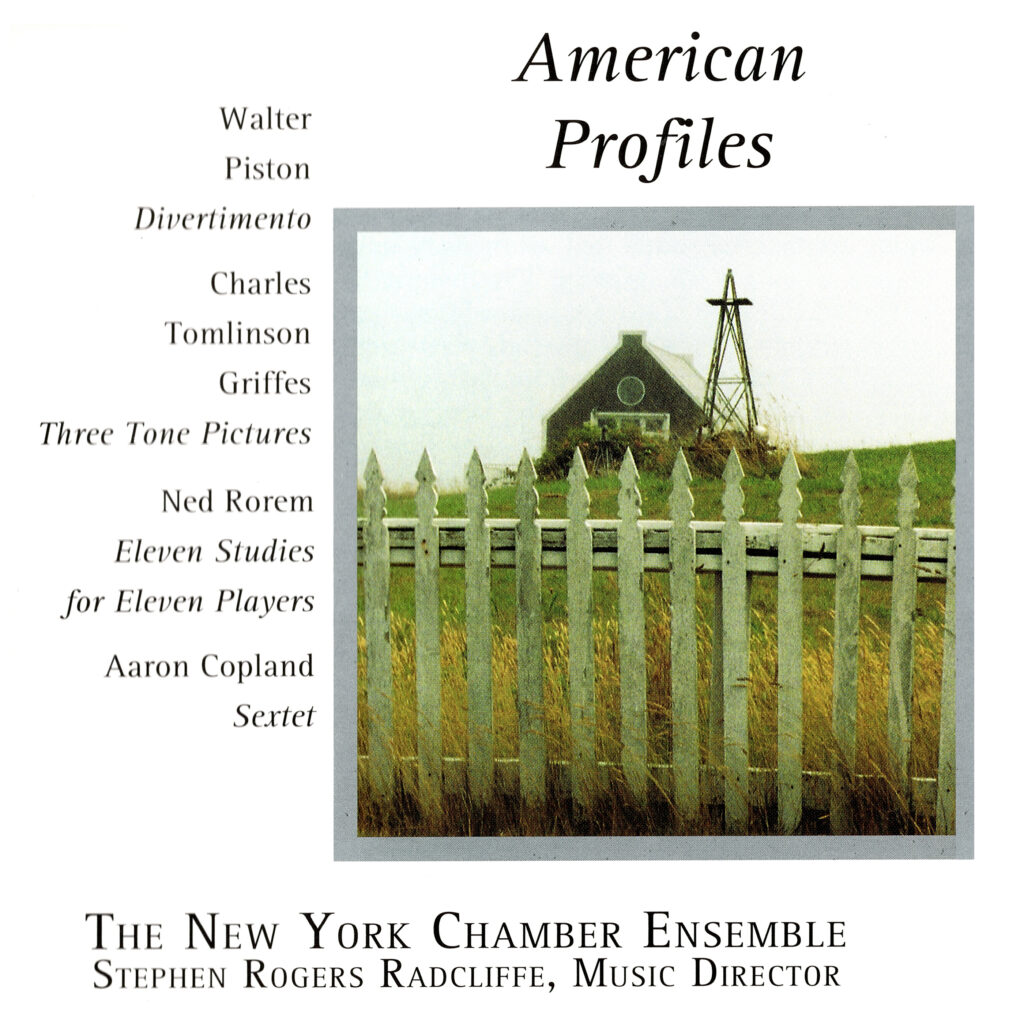
![Fanfare The Magazine for Serious Record Collectors March/April 1996 • Volume 19, Number 4 AMERICAN PROFILES. Stephen Rogers Radcliffe conducting the New York Chamber Ensemble. ALBANY TROY 175 [DDD]; 64:26. PISTON: Divertimento. GRIFFES: Three Tone Pictures. ROREM: Eleven Studies for Eleven Players. COPLAND: Sextet. While each of these pieces has been recorded before—all but the Piston currently have at least one recording in the catalog—it was an excellent idea to bring all four together on a single disc. They work together extremely well because of their differences as much as because of what they have in common. Piston’s three-movement Divertimento is, like all of this composer’s music, a sturdily crafted work in which strong, memorable thematic material is supported by solid, occasionally dissonant counterpoint. The two lively, thoroughly neo-classical outer movements surround a central slow movement based on a wonderful, flowing oboe melody. The Griffes pieces, arranged by the composer from his original version for piano, are attractive little landscapes, featuring the composer’s special brand of impressionism. Rorem’s Studies are a series of miniatures, varying widely in mood as well as instrumentation, that show the composer’s fine sense of detail, wry sense of humor, and irrepressible melodic gift. The final work, Copland’s own arrangement of his Short Symphony, is a masterpiece of American neo-Classicism. Nervous, muscular, and economical, the brief three-movement work is one of Copland’s most rhythmically challenging pieces. The performances are very good. The bouncy vitality of the Copland and Piston works is particularly well captured by Radcliffe and his excellent musicians. The Rorem pieces are played with lots of detail and show off individual members of the ensemble to great advantage. My only reservations concern the Griffes pieces where the beat seems all too heavy and the instrumental blends a bit rough. In addition, the piano, although nicely played by David Korevaar, is overly prominent, suggesting more a concerto than a work for chamber orchestra. The recording is good, quite clean and natural, but a little bit close. These flaws aside, this is a most enjoyable disc that should find a welcome place in every collection of American music. Richard Burke](https://stephenrogersradcliffe.com/wp-content/uploads/jupiterx/images/Fanfare_Magazine_April_1996-scaled-134f5c2.jpg)
![Fanfare The Magazine for Serious Record Collectors March/April 1996 • Volume 19, Number 4 AMERICAN PROFILES. Stephen Rogers Radcliffe conducting the New York Chamber Ensemble. ALBANY TROY 175 [DDD]; 64:26. PISTON: Divertimento. GRIFFES: Three Tone Pictures. ROREM: Eleven Studies for Eleven Players. COPLAND: Sextet. While each of these pieces has been recorded before—all but the Piston currently have at least one recording in the catalog—it was an excellent idea to bring all four together on a single disc. They work together extremely well because of their differences as much as because of what they have in common. Piston’s three-movement Divertimento is, like all of this composer’s music, a sturdily crafted work in which strong, memorable thematic material is supported by solid, occasionally dissonant counterpoint. The two lively, thoroughly neo-classical outer movements surround a central slow movement based on a wonderful, flowing oboe melody. The Griffes pieces, arranged by the composer from his original version for piano, are attractive little landscapes, featuring the composer’s special brand of impressionism. Rorem’s Studies are a series of miniatures, varying widely in mood as well as instrumentation, that show the composer’s fine sense of detail, wry sense of humor, and irrepressible melodic gift. The final work, Copland’s own arrangement of his Short Symphony, is a masterpiece of American neo-Classicism. Nervous, muscular, and economical, the brief three-movement work is one of Copland’s most rhythmically challenging pieces. The performances are very good. The bouncy vitality of the Copland and Piston works is particularly well captured by Radcliffe and his excellent musicians. The Rorem pieces are played with lots of detail and show off individual members of the ensemble to great advantage. My only reservations concern the Griffes pieces where the beat seems all too heavy and the instrumental blends a bit rough. In addition, the piano, although nicely played by David Korevaar, is overly prominent, suggesting more a concerto than a work for chamber orchestra. The recording is good, quite clean and natural, but a little bit close. These flaws aside, this is a most enjoyable disc that should find a welcome place in every collection of American music. Richard Burke](https://stephenrogersradcliffe.com/wp-content/uploads/1996/03/Fanfare_Magazine_April_1996-791x1024.jpg)



![THE SENTINEL-LEDGER Ocean City, N.J. Week of 7-13 June 1994 Festival Orchestra goes pops By ED WISMER Sentinel-Ledger Critic OCEAN CITY — The second Cape May Music Festival event to be held on the Music Pier for 1994 took place June 4 and it was a real "Popper." The Cape May Festival Orchestra played a program of light classics and the best of Broadway. This does seem like carrying coals to Newcastle because of the similarity of programming by our own sensational Ocean City Pops, but good music is sempiternal and it's truly a case of the more, the merrier. It best represents another opportunity to spread culture in this area through cooperation by the Pashley Insurance Agency, The Sentinel-Ledger and the city of Ocean City. All concerned are to be commended for their support of the arts. The Festival Orchestra had the pleasure and privilege of playing in Ocean City's state of the art facility. Festival artistic director Stephen Rogers Radcliffe mounted the podium and started the proceedings off with a flourish. Pops orchestras and programs are proliferating exponentially. Most of us think of Pops orchestras starting with that part-time fireman Arthur Fiedler up in Boston, but pops programing was quite popular at the turn of the 20th century and before. A Sousa program would have consisted of light classics, popular songs and show tunes (many of which Sousa wrote himself a la John Williams). We have heard Radcliffe's orchestra do some very ambitious work in the past and recall an occasion when a 19th century synthesizer was used to intensify the sound. Radcliffe is experimental and innovative in his approach and one can always expect some extra pyrotechnics. He did not disappoint us this time either. The program consisted of works inspired by folk music and dance that was multi-ethnic. Radcliffe led off with a Rossini Overture that was impressively played and followed it with Dvorak's Slavonic Dance Op. 46, No. 8 (one of the more lively numbers in this evocative suite). > Artistic Director Stephen Rogers Radcliffe is fun to watch > Radcliffe is fun to watch. His kinetic gyrations were most evident in the Dvorak but he only enlivens proceedings thusly when it is appropriate. The late Dmitri Mitroupolis was overly physical and often fell right off the podium. Radcliffe's feet enthusiastically left the floor at times but he was always in control. Ralph Vaughan Williams' Fantasia on Greensleeves followed it, and along with Faure's Pavane Op. 50, brought a more solemn and sedate mood to the concert. The wind section was outstanding in these two pieces. An unfamiliar tarantelle by Camille Saint Saens proved to be a lively and lovely example of how versatile the French composer could be. The Bizet Suite from Carmen featured "just right" vigorous tempi and playing that was, at the same time, abandoned and precise. The brass players took full advantage of Bizet's proclivity for writing superbly for their instruments. The final portion of the program consisted of two genuine Broadway classics in the form of selections from Gershwin's folk opera Porgy and Bess and Bernstein's West Side Story highlights. Both came in the form of fresh sounding and unfamiliar arrangements that featured innovative instrumental scoring that gave them new life. These evinced a standing ovation which was rewarded with an encore of Flimsy Korsetoff's (pardon an old musician's pun) Flight of the Bumble Bee which hummed right along. It is a certainty that the audience felt that it had a grand night out, topped off with truly professional musicianship and the sponsors could openly glow with pride. The whole affair added new vistas of cultural excellence that upheld the tradition of fine entertainment values exemplified by both cities. [Sidebar Text] CAPE MAY — The fifth annual Cape May Music Festival began May 15 and continues through June 26, hosting what is described as some of the world's most accomplished soloists and chamber musicians in music from the Renaissance and Vivaldi to the jazz era. The Festival Orchestra is conducted by Stephen Rogers Radcliffe. The festival is sponsored by the Mid-Atlantic Center for the Arts (884-5404), in association with the Cape May Institute.](https://stephenrogersradcliffe.com/wp-content/uploads/1994/06/1994_06_07_Sentinel_Ledger_June_7_1994-791x1024.jpg)
![Fanfare The Magazine for Serious Record Collectors January/February 1995 • Volume 18, Number 3 ROCHBERG: Music for the Magic Theater. Octet; A Grand Fantasia. Stephen Rogers Radcliffe conducting the New York Chamber Ensemble. NEW WORLD 80462-2 [DDD]; 48:39. Produced by Daniel Kincaid. Our esteemed editor continues to send me discs of George Rochberg's music, even though I have expressed a general distaste for it. It makes sense that each of Fanfare's reviewers gets mostly music that he or she appreciates; we are more likely to be knowledgeable about the music and informed about competing recordings that way, but it also accounts for the so-often-favorable reviews which have bothered some of our correspondents. An occasional counterview may be bracing, and I welcome another chance to understand any composer. Rochberg, of course, has been many things at many times; his compositional life was long an evolving struggle to find his own style, at a time (ca. 1945–75) when style was strictly dictated by a few academics (if you don't write my way, you don't pass my course, so you won't get the degree, so you can't succeed in the academic world of music, so you give up composing as a career). Music for the Magic Theater (1965) found Rochberg at a turning point; he had previously followed the required atonal serialism, and had experimented with music of chance, only to find unexpected, depressing similarities between the two systems. Here Rochberg tries to merge music past with music present and future by using collage, which was not yet fashionable, although Ives's music was beginning to be known. Collage brings much variety to these twenty-seven minutes, but it also exemplifies the problem I have with Rochberg's music: it seems so internally disconnected, with one minute's Mozart likely to be followed by another's Mahler or Miles Davis. The three "Acts" of this magic theater go from confusion of past and present, to wallowing in the past, and finally trying and dissolving the present "into what?" This seems to me more like sophisticated navel-gazing than making music. The booklet points out that B. A. Zimmermann was exactly Rochberg's age, forcing me to ask why I accept the German composer's collages more than the American's. It is because Zimmermann does so much more with his inherited material; he works it over thoroughly, transforming it into something all his own. For the record, the fifteen instrumentalists here (yes, yes: Schoenberg and Berg) make many beautiful and intriguing sounds, and they are expertly recorded. Octet; A Grand Fantasia (1980) consists of twelve brief pieces scored for two to eight players (flute, clarinet, horn, violin, viola, cello, bass, and piano). References to the past are now more subtle, more a matter of style than of substance. The variety of tempos and moods (listing them all would take nearly as long as hearing them) is somehow more acceptable as a suite of short pieces than as chunks within larger movements. It also enables me to pinpoint a preference for Rochberg in slow tempos to Rochberg at speed. I give him much credit for leading the assault on an intolerable musical establishment, but I still don't like Rochberg's own solutions much. I hope this review is useful to someone; if you disagree with each thought I have expressed, you better go out and buy this record. James H. North • • • It's easy to speak of a kinship of Rochberg to Ives. Ives was the first to play about with polystylistics, emulsions in the main of highbrow with low. In the listening, however, the Ives-Rochberg connection plays as tenuous. We make better use of space contemplating Rochberg's entirely self-conscious move in the early 60s from serial atonality to (what has been called by the less than enthralled) pastiche. This bouncing about from musical style to style is today much in vogue, thanks in large measure to several of George Rochberg's pivotal works. The more appropriate comparison is to Lucas Foss, a Rochberg contemporary whose esthetic flexibility measures as relatively opportunistic. His obvious qualities notwithstanding, is Rochberg's a baleful influence on impressionable minds? In an environment where Steve Martland is packaged—in semi-beefcake, heaven help us!—as a hot property, the question is silly. Rather, let us see an unusually good and honest composer having hung an existential right on the road to what seemed to him, if not to everyone, a dead end. With regard to the discomfort Rochberg's suspiciously entertaining alternatives inflict on those for whom Theodore Adorno wields papal authority (to name but one arbiter), I offer this useless opinion. Perhaps—just perhaps—it is Rochberg's nature to entertain, his sojourn in Second Vienna's long shadow an aspect of development toward what he has become—a fulfillment that has helped shape today's postmodern terrain, moreover. (Escapes from serialism's constraints have led in startlingly disparate directions: Stefan Wolpe's for one, Giacinto Scelsi's for another.) Schwann Opus show Rochberg's cassettes, mostly CRI, outnumbering CDs. It's gratifying to see a skimpy CDiscography graced by these well-played and -recorded additions. Mike Silverton](https://stephenrogersradcliffe.com/wp-content/uploads/jupiterx/images/Fanfare_January_1995-scaled-54d33f5.jpg)
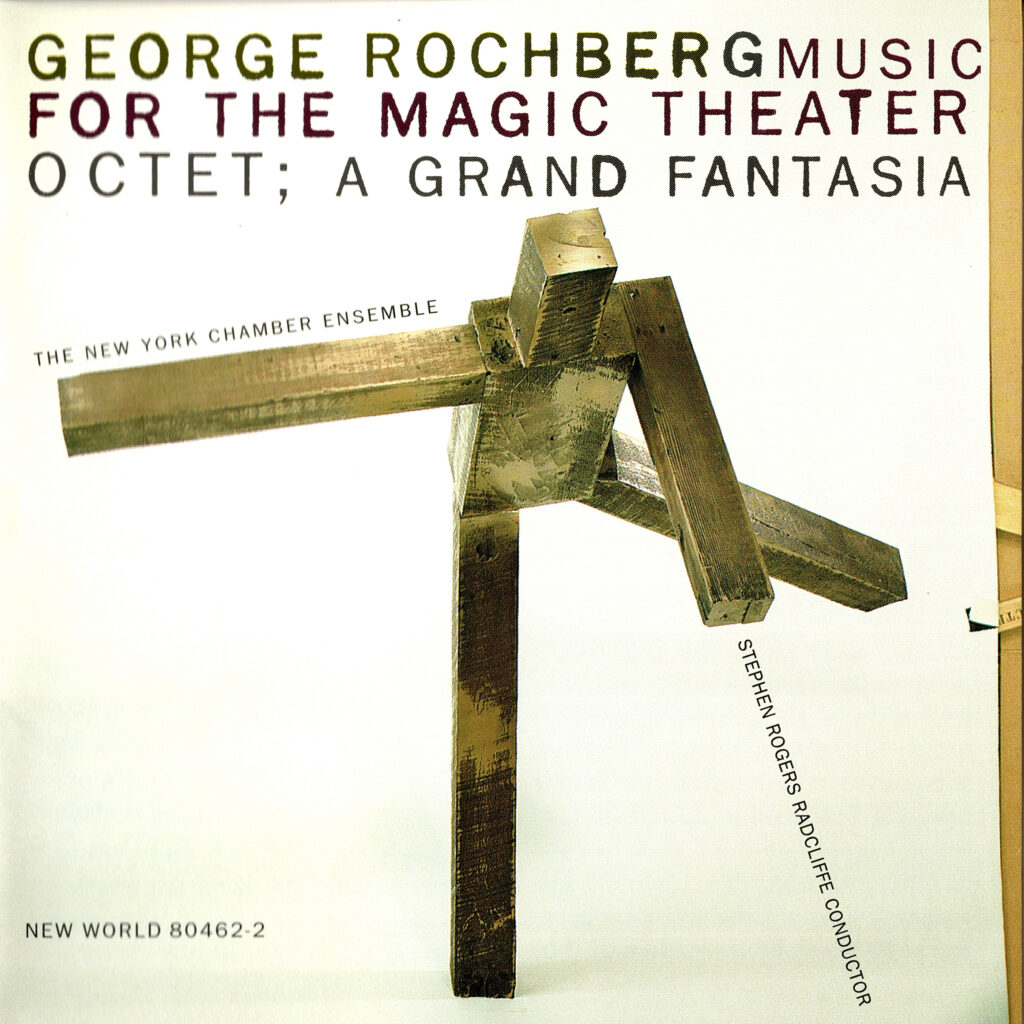
![Fanfare The Magazine for Serious Record Collectors January/February 1995 • Volume 18, Number 3 ROCHBERG: Music for the Magic Theater. Octet; A Grand Fantasia. Stephen Rogers Radcliffe conducting the New York Chamber Ensemble. NEW WORLD 80462-2 [DDD]; 48:39. Produced by Daniel Kincaid. Our esteemed editor continues to send me discs of George Rochberg's music, even though I have expressed a general distaste for it. It makes sense that each of Fanfare's reviewers gets mostly music that he or she appreciates; we are more likely to be knowledgeable about the music and informed about competing recordings that way, but it also accounts for the so-often-favorable reviews which have bothered some of our correspondents. An occasional counterview may be bracing, and I welcome another chance to understand any composer. Rochberg, of course, has been many things at many times; his compositional life was long an evolving struggle to find his own style, at a time (ca. 1945–75) when style was strictly dictated by a few academics (if you don't write my way, you don't pass my course, so you won't get the degree, so you can't succeed in the academic world of music, so you give up composing as a career). Music for the Magic Theater (1965) found Rochberg at a turning point; he had previously followed the required atonal serialism, and had experimented with music of chance, only to find unexpected, depressing similarities between the two systems. Here Rochberg tries to merge music past with music present and future by using collage, which was not yet fashionable, although Ives's music was beginning to be known. Collage brings much variety to these twenty-seven minutes, but it also exemplifies the problem I have with Rochberg's music: it seems so internally disconnected, with one minute's Mozart likely to be followed by another's Mahler or Miles Davis. The three "Acts" of this magic theater go from confusion of past and present, to wallowing in the past, and finally trying and dissolving the present "into what?" This seems to me more like sophisticated navel-gazing than making music. The booklet points out that B. A. Zimmermann was exactly Rochberg's age, forcing me to ask why I accept the German composer's collages more than the American's. It is because Zimmermann does so much more with his inherited material; he works it over thoroughly, transforming it into something all his own. For the record, the fifteen instrumentalists here (yes, yes: Schoenberg and Berg) make many beautiful and intriguing sounds, and they are expertly recorded. Octet; A Grand Fantasia (1980) consists of twelve brief pieces scored for two to eight players (flute, clarinet, horn, violin, viola, cello, bass, and piano). References to the past are now more subtle, more a matter of style than of substance. The variety of tempos and moods (listing them all would take nearly as long as hearing them) is somehow more acceptable as a suite of short pieces than as chunks within larger movements. It also enables me to pinpoint a preference for Rochberg in slow tempos to Rochberg at speed. I give him much credit for leading the assault on an intolerable musical establishment, but I still don't like Rochberg's own solutions much. I hope this review is useful to someone; if you disagree with each thought I have expressed, you better go out and buy this record. James H. North • • • It's easy to speak of a kinship of Rochberg to Ives. Ives was the first to play about with polystylistics, emulsions in the main of highbrow with low. In the listening, however, the Ives-Rochberg connection plays as tenuous. We make better use of space contemplating Rochberg's entirely self-conscious move in the early 60s from serial atonality to (what has been called by the less than enthralled) pastiche. This bouncing about from musical style to style is today much in vogue, thanks in large measure to several of George Rochberg's pivotal works. The more appropriate comparison is to Lucas Foss, a Rochberg contemporary whose esthetic flexibility measures as relatively opportunistic. His obvious qualities notwithstanding, is Rochberg's a baleful influence on impressionable minds? In an environment where Steve Martland is packaged—in semi-beefcake, heaven help us!—as a hot property, the question is silly. Rather, let us see an unusually good and honest composer having hung an existential right on the road to what seemed to him, if not to everyone, a dead end. With regard to the discomfort Rochberg's suspiciously entertaining alternatives inflict on those for whom Theodore Adorno wields papal authority (to name but one arbiter), I offer this useless opinion. Perhaps—just perhaps—it is Rochberg's nature to entertain, his sojourn in Second Vienna's long shadow an aspect of development toward what he has become—a fulfillment that has helped shape today's postmodern terrain, moreover. (Escapes from serialism's constraints have led in startlingly disparate directions: Stefan Wolpe's for one, Giacinto Scelsi's for another.) Schwann Opus show Rochberg's cassettes, mostly CRI, outnumbering CDs. It's gratifying to see a skimpy CDiscography graced by these well-played and -recorded additions. Mike Silverton](https://stephenrogersradcliffe.com/wp-content/uploads/1995/01/Fanfare_January_1995-791x1024.jpg)


![THE SENTINEL-LEDGER Ocean City, N.J. Week of 7-13 June 1994 Festival Orchestra goes pops By ED WISMER Sentinel-Ledger Critic OCEAN CITY — The second Cape May Music Festival event to be held on the Music Pier for 1994 took place June 4 and it was a real "Popper." The Cape May Festival Orchestra played a program of light classics and the best of Broadway. This does seem like carrying coals to Newcastle because of the similarity of programming by our own sensational Ocean City Pops, but good music is sempiternal and it's truly a case of the more, the merrier. It best represents another opportunity to spread culture in this area through cooperation by the Pashley Insurance Agency, The Sentinel-Ledger and the city of Ocean City. All concerned are to be commended for their support of the arts. The Festival Orchestra had the pleasure and privilege of playing in Ocean City's state of the art facility. Festival artistic director Stephen Rogers Radcliffe mounted the podium and started the proceedings off with a flourish. Pops orchestras and programs are proliferating exponentially. Most of us think of Pops orchestras starting with that part-time fireman Arthur Fiedler up in Boston, but pops programing was quite popular at the turn of the 20th century and before. A Sousa program would have consisted of light classics, popular songs and show tunes (many of which Sousa wrote himself a la John Williams). We have heard Radcliffe's orchestra do some very ambitious work in the past and recall an occasion when a 19th century synthesizer was used to intensify the sound. Radcliffe is experimental and innovative in his approach and one can always expect some extra pyrotechnics. He did not disappoint us this time either. The program consisted of works inspired by folk music and dance that was multi-ethnic. Radcliffe led off with a Rossini Overture that was impressively played and followed it with Dvorak's Slavonic Dance Op. 46, No. 8 (one of the more lively numbers in this evocative suite). > Artistic Director Stephen Rogers Radcliffe is fun to watch > Radcliffe is fun to watch. His kinetic gyrations were most evident in the Dvorak but he only enlivens proceedings thusly when it is appropriate. The late Dmitri Mitroupolis was overly physical and often fell right off the podium. Radcliffe's feet enthusiastically left the floor at times but he was always in control. Ralph Vaughan Williams' Fantasia on Greensleeves followed it, and along with Faure's Pavane Op. 50, brought a more solemn and sedate mood to the concert. The wind section was outstanding in these two pieces. An unfamiliar tarantelle by Camille Saint Saens proved to be a lively and lovely example of how versatile the French composer could be. The Bizet Suite from Carmen featured "just right" vigorous tempi and playing that was, at the same time, abandoned and precise. The brass players took full advantage of Bizet's proclivity for writing superbly for their instruments. The final portion of the program consisted of two genuine Broadway classics in the form of selections from Gershwin's folk opera Porgy and Bess and Bernstein's West Side Story highlights. Both came in the form of fresh sounding and unfamiliar arrangements that featured innovative instrumental scoring that gave them new life. These evinced a standing ovation which was rewarded with an encore of Flimsy Korsetoff's (pardon an old musician's pun) Flight of the Bumble Bee which hummed right along. It is a certainty that the audience felt that it had a grand night out, topped off with truly professional musicianship and the sponsors could openly glow with pride. The whole affair added new vistas of cultural excellence that upheld the tradition of fine entertainment values exemplified by both cities. [Sidebar Text] CAPE MAY — The fifth annual Cape May Music Festival began May 15 and continues through June 26, hosting what is described as some of the world's most accomplished soloists and chamber musicians in music from the Renaissance and Vivaldi to the jazz era. The Festival Orchestra is conducted by Stephen Rogers Radcliffe. The festival is sponsored by the Mid-Atlantic Center for the Arts (884-5404), in association with the Cape May Institute.](https://stephenrogersradcliffe.com/wp-content/uploads/jupiterx/images/1994_06_07_Sentinel_Ledger_June_7_1994-scaled-e616d06.jpg)



![New York Newsday Monday, April 9, 1990 Stephen Rogers Radcliffe, Conductor MUSIC REVIEW An Homage to a Teacher AMERICANS IN PARIS: STUDENTS OF NADIA BOULANGER. Music by Aaron Copland, Roy Harris, David Diamond, Ned Rorem. New York Chamber Ensemble (Chester String Quartet, Hexagon), Stephen Rogers Radcliffe, conductor. Friday night. Florence Gould Hall, Alliance Francaise, 55 E. 59 St., Manhattan. By Peter Goodman THE MARK OF the great teacher is her ability to help the pupil be himself, not merely an image of the mentor. Nadia Boulanger was that sort of teacher. Renowned in the American musical world as the French pedagogue around whom gathered generations of aspiring composers from Virgil Thomson to Philip Glass, it is clear that whatever she taught them, she did not force them into her own mold. On Friday night, the New York Chamber Ensemble, an ambitious young group that includes a string quartet, a wind ensemble and other musicians, presented an attractive program devoted to the work of four of Boulanger's students. It was an evening of prima facie evidence that whatever Nadia Boulanger did, she didn't distort the voices of Aaron Copland, Roy Harris, David Diamond or Ned Rorem. Indeed, only Rorem, the youngest of the four composers, could be said to speak in French. The program opened with two works for clarinet, piano and string quartet: Copland's Sextet, a reworking of his "Short Symphony," and Harris' Concerto for Clarinet, Piano and Strings. Their only similarity was the instrumentation. Copland created the Sextet in 1937 after failing to gain performances of the "Short Symphony," completed in 1933. Although written in his artistic rather than populist style, the similarities between the composer's two voices are plain: harmonies of seconds and ninths, electric rhythms, lovely writing for clarinet, bursts of lyricism squeezed between dense blocks of sound. It's the work of a master, and the Chester String Quartet (part of the ensemble) played with an ease that belied all the difficulty musicians found with the work 45 years ago. Harris' concerto is immediately more lyrical and elegiac, with its slow, deep introduction on clarinet and piano, and its long, singing lines. If Copland was a tough city kid, Harris was a singer from the country. The concerto is full of richness, both harmonic and contrapuntal, and a sense of ease not found in Copland. Ultimately, the concerto is too relaxed and doesn't keep the listener involved. The second half included David Diamond's Concerto for Chamber Orchestra, written in 1940, and Ned Rorem's Eleven Studies for Eleven Players. The Diamond was the most awkward piece on the program, straightforward, with square rhythms and steady pulse and a sense of self-conscious seriousness that kept it from coming alive. Only during the two sprightly, dancing fugues did one hear what seemed to be the composer's natural voice. Rorem, of course, has never hidden his natural voice, witty, epigrammatic, cool and lyrical — French. In the Eleven Studies, various combinations of strings, winds, brass and percussion sing, dance, joke or whisper mysteriously, an exquisite platter of aural hors d'oeuvres. The performances were fine, crisp and lively, particularly the playing of trumpeter Stephen Burns, oboist Matthew Dine and pianist David Korevaar. Steven Rogers Radcliffe conducted. The concert, by the way, was part of a series in Florence Gould Hall, an excellent chamber two stories below ground level at the Alliance Francaise on East 59th Street. It's a hall that deserves more activity. / II [Caption under photo: Stephen Rogers Radcliffe conducted the works composed by Nadia Boulanger's students.]](https://stephenrogersradcliffe.com/wp-content/uploads/jupiterx/images/1990_09_04_NY_Newsday_April_9_1990-scaled-553bd9b.jpg)

![New York Newsday Monday, April 9, 1990 Stephen Rogers Radcliffe, Conductor MUSIC REVIEW An Homage to a Teacher AMERICANS IN PARIS: STUDENTS OF NADIA BOULANGER. Music by Aaron Copland, Roy Harris, David Diamond, Ned Rorem. New York Chamber Ensemble (Chester String Quartet, Hexagon), Stephen Rogers Radcliffe, conductor. Friday night. Florence Gould Hall, Alliance Francaise, 55 E. 59 St., Manhattan. By Peter Goodman THE MARK OF the great teacher is her ability to help the pupil be himself, not merely an image of the mentor. Nadia Boulanger was that sort of teacher. Renowned in the American musical world as the French pedagogue around whom gathered generations of aspiring composers from Virgil Thomson to Philip Glass, it is clear that whatever she taught them, she did not force them into her own mold. On Friday night, the New York Chamber Ensemble, an ambitious young group that includes a string quartet, a wind ensemble and other musicians, presented an attractive program devoted to the work of four of Boulanger's students. It was an evening of prima facie evidence that whatever Nadia Boulanger did, she didn't distort the voices of Aaron Copland, Roy Harris, David Diamond or Ned Rorem. Indeed, only Rorem, the youngest of the four composers, could be said to speak in French. The program opened with two works for clarinet, piano and string quartet: Copland's Sextet, a reworking of his "Short Symphony," and Harris' Concerto for Clarinet, Piano and Strings. Their only similarity was the instrumentation. Copland created the Sextet in 1937 after failing to gain performances of the "Short Symphony," completed in 1933. Although written in his artistic rather than populist style, the similarities between the composer's two voices are plain: harmonies of seconds and ninths, electric rhythms, lovely writing for clarinet, bursts of lyricism squeezed between dense blocks of sound. It's the work of a master, and the Chester String Quartet (part of the ensemble) played with an ease that belied all the difficulty musicians found with the work 45 years ago. Harris' concerto is immediately more lyrical and elegiac, with its slow, deep introduction on clarinet and piano, and its long, singing lines. If Copland was a tough city kid, Harris was a singer from the country. The concerto is full of richness, both harmonic and contrapuntal, and a sense of ease not found in Copland. Ultimately, the concerto is too relaxed and doesn't keep the listener involved. The second half included David Diamond's Concerto for Chamber Orchestra, written in 1940, and Ned Rorem's Eleven Studies for Eleven Players. The Diamond was the most awkward piece on the program, straightforward, with square rhythms and steady pulse and a sense of self-conscious seriousness that kept it from coming alive. Only during the two sprightly, dancing fugues did one hear what seemed to be the composer's natural voice. Rorem, of course, has never hidden his natural voice, witty, epigrammatic, cool and lyrical — French. In the Eleven Studies, various combinations of strings, winds, brass and percussion sing, dance, joke or whisper mysteriously, an exquisite platter of aural hors d'oeuvres. The performances were fine, crisp and lively, particularly the playing of trumpeter Stephen Burns, oboist Matthew Dine and pianist David Korevaar. Steven Rogers Radcliffe conducted. The concert, by the way, was part of a series in Florence Gould Hall, an excellent chamber two stories below ground level at the Alliance Francaise on East 59th Street. It's a hall that deserves more activity. / II [Caption under photo: Stephen Rogers Radcliffe conducted the works composed by Nadia Boulanger's students.]](https://stephenrogersradcliffe.com/wp-content/uploads/1990/04/1990_09_04_NY_Newsday_April_9_1990-791x1024.jpg)