Skip to content

Press

Between conductor and pianist Symbiosis creates an astounding experience at May 31 Cape May Music Festival concert By ED WISMER Cape May Star and Wave Critic CAPE MAY — The large audience attending the Cape May Music Festival concert on Thursday, May 31 got more than their money's worth. The lengthy list of goodies the music lovers received includes the Cape May Festival Orchestra in all its glory, under the lively baton of Music Director Stephen Rogers Radcliffe. Then there was the outstanding program the orchestra played and the dazzling piano soloist Fabio Bidini. The musical cornucopia was literally overflowing. Gioacchino Rossini had a knack for writing frothy and frivolous overtures even for his allegedly tragic operas. In the midst of the crashing about in the orchestra's percussion section is always a flute sounding like a demented magpie. Thursday night's opening of the composer's "Semiramide Overture" was vintage Rossini. Radcliffe gave it a reading worthy of Toscanini or Muti. It was a tooth rattling and percussive tour de force. The French horn quartet early in the piece was played lushly, as was the work of all sections of the orchestra. Contrasted with Rossini's bombastic boomer, the Schubert "Symphony No. 8," or "Unfinished Symphony," could only be described as tranquil and poetic. Mendelssohn is often described as a composer who never wrote an ugly note, and Schubert could be in the same category. The amount of music he turned out in 31 years, cut short by typhoid fever, is prodigious. His oeuvre amounted to 1,500 pieces. Schubert started to write the Symphony No. 8 when he was 25. He never returned to the project, but he more than earned the right to abandon it considering all the other music he wrote. Radcliffe and the orchestra gave the symphony its due in a haunting rendition that displayed the sonority of the strings and marvelous harmony in the winds. Bidini's advance billing called him a passionate pianist, thus qualifying for the understatement of the year. The Prokofiev concerto is probably one of the most difficult to play in musical literature. It is a deft mixture of melody and dissonance reminiscent of "Rocky IV." Bidini's interpretation was a display of manual dexterity that inspired me to depict him with as many hands as a Hindu idol. His dynamic digits were a mere blur. Artists of Bidini's caliber are what have made the festival grow in stature and reputation. Although essentially hidden behind the concert grand, Radcliffe was a strong presence. His collaboration with the pianist was exquisite. The symbiotic relationship between the two artists was quite evident. Numerous standing ovations were well earned. Cape May Star and Wave June 7, 2001

Energetic Youth Symphony Packs a Punch

MILWAUKEE JOURNAL SENTINEL - October 22, 2004 Bass clarinet shines in smart concerto Under guest conductor’s baton, Chamber Orchestra debuts commissioned piece By TOM STRINI Journal Sentinel music critic Stephen Rogers Radcliffe, guest conductor and certain candidate for the open Milwaukee Chamber Orchestra podium job, presided over an exceptionally engaging MCO program Thursday evening at Wisconsin Lutheran College. The centerpiece was the premiere of James Grant's Concerto for Bass Clarinet and Strings, commissioned and performed by William Helmers of the MCO. Grant exploits all of Helmers' great skill and the virtuosic potential of this instrument, which appears so rarely in the solo spotlight. But this concerto is more than a showcase for Helmers and the bass clarinet. Grant here has made music that is structurally smart, emotionally probing, rhythmically clever and harmonically subtle. The clarinet darts about the strings like a bird in a forest in the first movement, "Levity." In the second, Grant casts the soloist as a lonely wanderer speaking a soliloquy in a landscape of Impressionist chords. Any one of those harmonies is gentle and beautiful, but they slowly gather surprising climactic force. The wrenching climax justifies Grant's long, melancholy denouement. Strings and woodwind scamper and chase through the lively, ever-unfolding melodies of the finale, "Emphasis," which is more than a mindless romp. The momentum builds to some hair-raising hyena howls that had the audience howling back in approval when the 15-minute concerto ended. Helmers wasn't the only soloist to succeed in a big way Thursday. Harpist Danis Kelly played Debussy's "Danses sacrée et profane" with sensitivity and panache. Her finely shaded touch and dynamics gave each chord vivid, distinct presence in the Schwan Concert Hall, the perfect venue for Debussy's shimmering sonorities. Radcliffe and the orchestra framed both soloists beautifully. Balanced, well-tuned string playing lit up Debussy's chords, and Radcliffe and the orchestra showed an easy command of Grant's tricky rhythms. They framed the program with Serenades for Strings by Dvorak (Opus 22 in E) and one of his prize students, Josef Suk (Opus 6 in E-flat). The Dvorak was a little bland under Radcliffe's baton. And I wish he'd at least lifted a finger to try to sort out the all-too-predictable messiness that cropped up in the more intricate passages for the violins in both Serenades. But Radcliffe did well overall and showed particular sympathy for Suk's restless, chromatic harmonies and searching, sprawling melodies. He heard the drama and made it gripping.

Bass Clarinet Shines in Smart Concerto

Sunday, Feb. 2, 2003 Sioux City Journal Vol. 139 No. 150 • Sioux City, Iowa • METRO EDITION Beethoven performed in seemless fashion during symphony concert By Bruce R. Miller Journal staff writer [REVIEW] At Saturday's Sioux City Symphony concert, pianist Ursula Oppens did what so many guest artists don't. She listened. Throughout Beethoven's Piano Concerto in E-Flat Major, Opus 73, Oppens complemented what the resident musicians did; she didn't just expect them to keep up with her. The result was a seamless performance that must have been as exciting for the orchestra as it was for the audience. Ironically, the piece was one Beethoven wrote after he had lost his hearing. Filled with rapid runs, it could have been a "look at me" turn for the two-time Grammy winner. Instead, Oppens played as if she had been a member of the orchestra for years. Slipping into the stormy duel between the cellos and the violins, she gave the work the understated surprise it needed. In the second movement, she created the piano equivalent of Frank Lloyd Wright's Fallingwater, a fluid aria that got Oppens to embrace the piano and dig into the music's very definite structure. She even nodded her head in ways that suggested the fire of the work's creator. Because the orchestra and the guest artist were so well matched, heat seemed to rise from the stage. In truth, the building's thermostat was set a bit high. But the musicians could have melted ice with their performance. Unfortunately, the first ("Overture to Fidelio") and last (Symphony No. 7 in A Major, Opus 92) offerings didn't have as much heat as the centerpiece. The timpanist was challenged on both, but overwhelmed in the former, impressed in the latter. The oboes got a chance to solo in the symphony as well. But this was really a night for strings. In all three selections, the pace was intense. The workout was a good one. While the overture wasn't as memorable as it could have been, it made the concerto all the more special. The symphony, as a result, was a bit of a let-down, even though it asked more of its players and reeked of the familiar. There were sections that have been lifted for film scores, movements that have served as inspiration for others (including Schubert). The play "Amadeus" made much of Mozart's excess ("too many notes, the royal said). But Beethoven insisted every one he put on paper was important. When the symphony was performed in 1813, Mozart's old nemesis Antonio Salieri led the percussion section. It's easy to see the necessity of every melody, counter-melody and beat. The stuff works because it's so intricate. One look at conductor Stephen Rogers Radcliffe revealed as much. He got the best exercise of all. And he enjoyed the perks of a guest performer who wasn't around for the glory. She was there for the workout, too.

Beethoven Performed in Seemless Fashion During Symphony Concert

The Philadelphia Inquirer 174th Year, No. 4 • South Jersey C • TUESDAY, JUNE 4, 2002 • www.philly.com • 50 C Review Music Cape May orchestra: Solidity by the sea By David Patrick Stearns INQUIRER MUSIC CRITIC CAPE MAY — Gamboling beachgoers in this Victorian-styled resort have an opportunity to cool their sunburns with late-afternoon symphonic music performed literally on the beach. The 18-concert Cape May Music Festival (through June 23) imports ensembles from jazz to early music (including Philadelphia’s Piffaro), the core of it all being the Cape May Festival Orchestra. The group is made up of current and recently graduated conservatory students on what must be hugely enjoyable three-year fellowships, playing alongside principal players drawn from the New York Chamber Ensemble. Sunday’s venue was the 800-seat Convention Hall. The 5 p.m. concert was late enough to leave time for body surfing but early enough to watch dolphins surface not far offshore during intermission. With the stiff ocean winds whistling atmospherically around the Convention Hall, does it matter if the music-making is any good? It always matters, and here, though there’s nothing particularly original in philosophy or concept, solidity is everywhere. With a 44-piece orchestra (half the usual size) in an acoustically dry hall, that’s no small accomplishment. Where weighty sonorities are customarily heard in the slow movement of Beethoven’s Symphony No. 7, music director Stephen Rogers Radcliff went for something intense and penetrating, since weight just wasn’t available to him. The intoxicated high spirits of the symphony’s final movement are often conveyed by the sheer breathlessness of so many players with so much velocity; Radcliffe pushed the accelerator to the floor even higher, while maintaining elegant fleetness. His rhythm has a sense of gravitational movement, shaping as well as measuring the notes. And there were surprises, mostly from the presence of Beethoven’s rarely heard "Leonore Overture No. 1," which was written for the opera Fidelio, minus the majesty that’s such a key factor in later, more appropriate overtures. With any festival, there’s a luck-of-the-draw element. I had the bad luck to miss the Dvorak Cello Concerto with the fascinating Matt Haimovitz on Thursday and the worse luck to hear Beethoven’s Piano Concerto No. 5 ("Emperor") with Ursula Oppens. Hers is a magic name in contemporary music circles, thanks to her fearless and resourceful championing of great, modern musical explorers, such as Elliott Carter and Conlon Nancarrow. However, the special pleading that works on the cutting edge led to horrifying results with Beethoven. Oppens was relentlessly loud, graceless and ham-fisted. How could such a performance receive a standing ovation? Trickery: She jumped ahead of the orchestra with greater frequency and with broader leaps as the performance went on, generating artificial though highly unmusical tension. Contact David Patrick Stearns at 215-854-4907 or dstearns@phillynews.com. The next Cape May Festival Orchestra event features pianist Horacio Gutierrez at 8 p.m. Thursday at Convention Hall, Beach Drive at Stockton Place. Information: 609-884-5404 or www.capemaymac.org.

Cape May orchestra: Solidity by the sea

Gramophone September 2001 Brahms • Franck [N] Brahms Serenade in D, Op 11 (nonet version, reconstr Boustead) Franck Pièces brèves (arr Büsser) The New York Chamber Ensemble / Stephen Rodgers Radcliffe Roméo Records 7209 (55 minutes: DDD) A fresh, lyrical account of Brahms’s Serenade in its near-to-original chamber version Brahms’s Serenade No 1 in D major, Op 11, is known largely in the orchestral guise the composer devised in 1859. But he conceived the piece first as a chamber work for flute, two clarinets, horn, bassoon, violin, viola, cello and bass. The original 1858 version, in a reconstruction by Alan Boustead, is the chief fascination on this disc from the New York Chamber Ensemble under Stephen Rodgers Radcliffe. As Clara Schumann suggested to Brahms, the score claimed a symphonic character that seemed to cry out for more instruments. Even so, the chamber version places the music in intimate relief, pointing out the long-breathed lyricism and lilting personality of the pastoral material. Brahms even provided a hint in the orchestral version that he was fond of the smaller incarnation: the Menuetto I and II in the former are scored for flute, two clarinets, bassoon, first violins, violas and cellos. Boustead’s reconstruction may be speculative, but it honours Brahms’s sound world even as it embraces the music’s charm, poetry and moments when the sun slips behind the clouds. The disc’s other novelties are three of Franck’s Pièces brèves, organ miniatures from the last year of the composer’s life orchestrated by Henri Büsser. They are delightful trifles beautifully cast for winds, brasses, strings and percussion. The New York Chamber Ensemble, which made this recording in November 1992, brings ample polish and expressive depth to both scores. The Brahms, from a studio performance, is rendered fresh as motivated by Radcliffe’s judicious tempos and attention to detail and his players’ vibrant interweaving of lines. Donald Rosenberg

Brahms • Franck

Between conductor and pianist Symbiosis creates an astounding experience at May 31 Cape May Music Festival concert By ED WISMER Cape May Star and Wave Critic CAPE MAY — The large audience attending the Cape May Music Festival concert on Thursday, May 31 got more than their money's worth. The lengthy list of goodies the music lovers received includes the Cape May Festival Orchestra in all its glory, under the lively baton of Music Director Stephen Rogers Radcliffe. Then there was the outstanding program the orchestra played and the dazzling piano soloist Fabio Bidini. The musical cornucopia was literally overflowing. Gioacchino Rossini had a knack for writing frothy and frivolous overtures even for his allegedly tragic operas. In the midst of the crashing about in the orchestra's percussion section is always a flute sounding like a demented magpie. Thursday night's opening of the composer's "Semiramide Overture" was vintage Rossini. Radcliffe gave it a reading worthy of Toscanini or Muti. It was a tooth rattling and percussive tour de force. The French horn quartet early in the piece was played lushly, as was the work of all sections of the orchestra. Contrasted with Rossini's bombastic boomer, the Schubert "Symphony No. 8," or "Unfinished Symphony," could only be described as tranquil and poetic. Mendelssohn is often described as a composer who never wrote an ugly note, and Schubert could be in the same category. The amount of music he turned out in 31 years, cut short by typhoid fever, is prodigious. His oeuvre amounted to 1,500 pieces. Schubert started to write the Symphony No. 8 when he was 25. He never returned to the project, but he more than earned the right to abandon it considering all the other music he wrote. Radcliffe and the orchestra gave the symphony its due in a haunting rendition that displayed the sonority of the strings and marvelous harmony in the winds. Bidini's advance billing called him a passionate pianist, thus qualifying for the understatement of the year. The Prokofiev concerto is probably one of the most difficult to play in musical literature. It is a deft mixture of melody and dissonance reminiscent of "Rocky IV." Bidini's interpretation was a display of manual dexterity that inspired me to depict him with as many hands as a Hindu idol. His dynamic digits were a mere blur. Artists of Bidini's caliber are what have made the festival grow in stature and reputation. Although essentially hidden behind the concert grand, Radcliffe was a strong presence. His collaboration with the pianist was exquisite. The symbiotic relationship between the two artists was quite evident. Numerous standing ovations were well earned. Cape May Star and Wave June 7, 2001

Between Conductor and Pianist

Your Online Guide to Classical Music ClassicsToday.com JUNE, 2001 ANTONÍN DVOŘÁK Serenade for Strings JOSEPH SUK Serenade in E-flat JOHANN STRAUSS JR. Pizzicato Polka JOHANNES BRAHMS Hungarian Dance No. 5 Hungarian Virtuosi Chamber Orchestra Stephen Rogers Radcliffe Romeo - 7206 (CD) Reference Recording - Dvořák: Wolff/Teldec; Suk: Belohlávek Artistic Quality 10 / 10 Sound Quality This is an exceptionally fine string orchestra disc. Although Dvořák's Serenade for Strings certainly does not want for excellent interpretations—Karajan with the Berlin Philharmonic and Hugh Wolff with the St. Paul Chamber Orchestra, for example—but Stephen Rogers Radcliffe's approach is so fresh, his rubato so natural and sensitive, and his instinct for the music's Czech essence so true that you come away not wanting to hear anybody else's. When is the last time you heard the Waltz movement start with a slight hesitation in the tempo, and then organically pick up speed as the phrase continues? How often do you hear the beautiful Larghetto so lovingly caressed, or the finale's note values so scrupulously observed that they give the music an added zing? Rogers Radcliffe is exceptionally attentive to the music's vertical dimension, drawing a remarkably sonorous yet clearly detailed sound from the Hungarian Virtuosi Chamber Orchestra. Listen to the burnished tone of those sustained double bass notes in the first movement. Delicious! These same qualities are found in Josef Suk's delightful Serenade in E-flat, where Rogers Radcliffe's lightness and sensitivity to nuance provides a marked contrast to Belohlávek's comparatively more measured performance with the much richer sounding Czech Philharmonic strings—nowhere more so than in the slow movement, where the added intimacy of the smaller Hungarian band creates an atmosphere of such intense beauty you wish it would never end. The remaining items, fetching renditions of Strauss' Pizzicato Polka and Brahms' Hungarian Dance No. 5, give these marvelous musicians yet another opportunity to strut their stuff. Czech music and string orchestra fans shouldn't even think of not buying this one, and the richly resonant recording fully supports the beauty of the playing. —Victor Carr Jr.

ANTONÍN DVOŘÁK Serenade for Strings

Conductor, Cellist Create Romantic, Phenomenal Performance

Sioux City Journal April 12, 1998 Orchestra presents monumental symphony in ‘The Resurrection’ By Judi Hazlett Journal staff writer [Review] There may be bigger orchestras performing Mahler in bigger cities, but you’ll have to look long and hard to find any that will beat what happened right here in Sioux City Saturday night. It was a monumental musical event as the Sioux City Symphony Orchestra played a monumental symphony. Gustav Mahler’s Symphony No. 2, "The Resurrection," is a work of gigantic imagination and creativity in itself, but performing it takes on superhuman proportions. For the orchestra, its length and challenges loom large. Logistically, to get a huge orchestra on the stage at Eppley Auditorium, plus a huge chorus, two soloists and the conductor takes more than just a bit of doing. But the SCSO did it — with lots of style, class and panache, thanks to music director and conductor Stephen Rogers Radcliffe. He kept everything together in a performance that was sustained and deliberate, through the revealing slow and soft parts as well as the Mahler "tornadoes" that whirl everything up and around, then just as quickly suspend you in the storm’s peaceful center before whirling you around some more. Radcliffe never rushed it, but kept it unfolding and growing right into the magnificent finale of the fifth movement. That’s when the meaning of the word resurrection hits home. Out of Mahler’s beginning first movement — a funeral march — themes move through four more movements with moments depicting earthly bliss, turmoil, despair, mourning and the ever-present specter of death. Finally, Mahler realizes death can be transcendent, which, as Radcliffe pointed out, makes this symphony an appropriate one for the resurrection of Christ celebrated by Christians at Easter. The fourth movement introduces a solo voice but the fifth movement pulls out all the stops. It featured knockout performances by mezzo soprano Lucille Beer and soprano Sara Seglem as soloists. Their voices were added to the smooth, full vocalizations of the combined voices of the Siouxland Master Chorale, directed by Gregory Fuller; the Northwestern College Choir, directed by Kimberly Utke; the Wayne State College Choir, directed by David Lawrence; and the Siouxland Community Chorus, directed by Shirley Neugebauer-Luebke. As good as this all was, the evening really belonged to the orchestra, which underwent a resurrection of its own with Saturday’s performance. The musicians play almost every minute of the two and a half hour work, and work it is. Kudos to the brass and horns, which were brilliant, and the strings for providing the glue. Clearly there are the resources here for big works like this.

Orchestra presents monumental symphony in ‘The Resurrection’

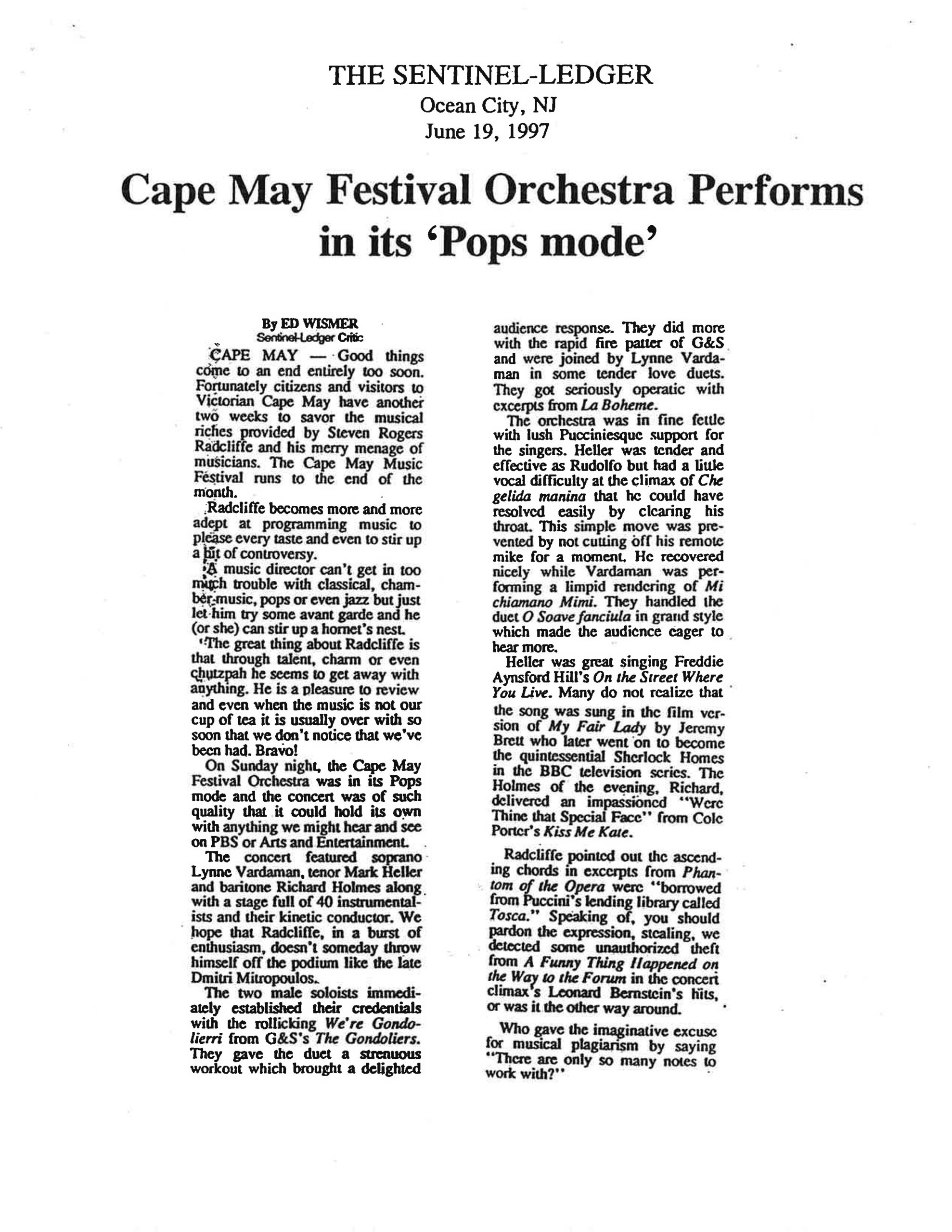
THE SENTINEL-LEDGER Ocean City, NJ June 19, 1997 Cape May Festival Orchestra Performs in its ‘Pops mode’ By ED WISMER Sentinel-Ledger Critic CAPE MAY — Good things come to an end entirely too soon. Fortunately citizens and visitors to Victorian Cape May have another two weeks to savor the musical riches provided by Stephen Rogers Radcliffe and his merry menage of musicians. The Cape May Music Festival runs to the end of the month. Radcliffe becomes more and more adept at programming music to please every taste and even to stir up a bit of controversy. A music director can't get in too much trouble with classical, chamber music, pops or even jazz but just let him try some avant garde and he (or she) can stir up a hornet's nest. The great thing about Radcliffe is that through talent, charm or even chutzpah he seems to get away with anything. He is a pleasure to review and even when the music is not our cup of tea it is usually over with so soon that we don't notice that we've been had. Bravo! On Sunday night, the Cape May Festival Orchestra was in its Pops mode and the concert was of such quality that it could hold its own with anything we might hear and see on PBS or Arts and Entertainment. The concert featured soprano Lynne Vardaman, tenor Mark Heller and baritone Richard Holmes along with a stage full of 40 instrumentalists and their kinetic conductor. We hope that Radcliffe, in a burst of enthusiasm, doesn't someday throw himself off the podium like the late Dmitri Mitropoulos. The two male soloists immediately established their credentials with the rollicking We're Gondolieri from G&S's The Gondoliers. They gave the duet a strenuous workout which brought a delighted audience response. They did more with the rapid fire patter of G&S and were joined by Lynne Vardaman in some tender love duets. They got seriously operatic with excerpts from La Boheme. The orchestra was in fine fettle with lush Pucciniesque support for the singers. Heller was tender and effective as Rudolfo but had a little vocal difficulty at the climax of Che gelida manina that he could have resolved easily by clearing his throat. This simple move was prevented by not cutting off his remote mike for a moment. He recovered nicely while Vardaman was performing a limpid rendering of Mi chiamano Mimi. They handled the duet O Soave fanciula in grand style which made the audience eager to hear more. Heller was great singing Freddie Aynsford Hill's On the Street Where You Live. Many do not realize that the song was sung in the film version of My Fair Lady by Jeremy Brett who later went on to become the quintessential Sherlock Holmes in the BBC television series. The Holmes of the evening, Richard, delivered an impassioned "Were Thine that Special Face" from Cole Porter's Kiss Me Kate. Radcliffe pointed out the ascending chords in excerpts from Phantom of the Opera were "borrowed from Puccini's lending library called Tosca." Speaking of, you should pardon the expression, stealing, we detected some unauthorized theft from A Funny Thing Happened on the Way to the Forum in the concert climax's Leonard Bernstein's hits, or was it the other way around. Who gave the imaginative excuse for musical plagiarism by saying "There are only so many notes to work with?"

Cape May Festival Orchestra Performs in its ‘Pops mode’

The Philadelphia Inquirer Saturday, June 14, 1997 Review: Music Cape May Festival adds music to the Shore mix By Daniel Webster INQUIRER MUSIC CRITIC Climate, culture, commerce: That was the formula laid out Thursday by New Jersey state arts council spokesman David Miller in his preface to the concert by the Cape May Festival Orchestra. Miller called the festival a model of what can happen when a resort community adds the arts to its traditional mix of sun and beachfront games. The concert, coming midway in a season that begins in late May and runs through June 29, brought around 250 vacationers into Cape May's Convention Hall to sit on folding chairs to hear music by Stravinsky, Beethoven and Mendelssohn. Artistic director Stephen Rogers Radcliffe noted that the eight-year-old festival was designed as a boost to the "shoulder season," the early beach weeks before sun and water temperature guarantee full hotels. Radcliffe's musical forces are built around his New York Chamber Ensemble, which performs as an entity and whose players function as principals amid the young professionals who fill out the festival orchestra. In the course of the festival's history, a stage shell has been installed and some reflecting panels placed in the ceiling in an effort to focus the acoustics. More panels would help, but the hall was not designed as a musical setting, and Radcliffe sees adapting to the hall as one of the experiences helpful to his young players. His program balanced popular favorites — Beethoven's Symphony No. 5 and Mendelssohn's Violin Concerto — with Stravinsky's tangy Dances Concertantes. He guided the orchestra through Stravinsky's laconic metric scheme with admirable poise. The performance preserved the irony of this gloss on conventional ballet writing while solo players injected dots of sound and theatrical melodic fragments. The winds and brass have an advantage in this hall, but in Stravinsky, their prominence was both welcome and vital. Violinist Corey Cerovsek was soloist in Mendelssohn's concerto. Steering clear of the staginess that has become a kind of norm with this piece, Cerovsek put his considerable virtuosity to musical ends. He shaded phrases, touched lightly some of the sweeps — like those opening the final movement — and found delicacy in writing that often sounds like shouting. The inner colors in his playing of the middle movement drew similar playing from the orchestra in this fresh reading. Audience response led Cerovsek to play a Kreisler nugget in which virtuosity again was bent to the task of mining the musical depth of the piece. After all that, the Beethoven symphony, played by an ensemble similar in size to those of Beethoven's time, sounded young, alert and a little brash. [Photo Caption] Stephen Rogers Radcliffe is the festival's artistic director. [Boxed Text] Cape May Music Festival Stephen Rogers Radcliffe conducts various programs in the festival, at Convention Hall, Cape May, through June 29. Information: 609-884-5404.

Cape May Festival adds music to the Shore mix

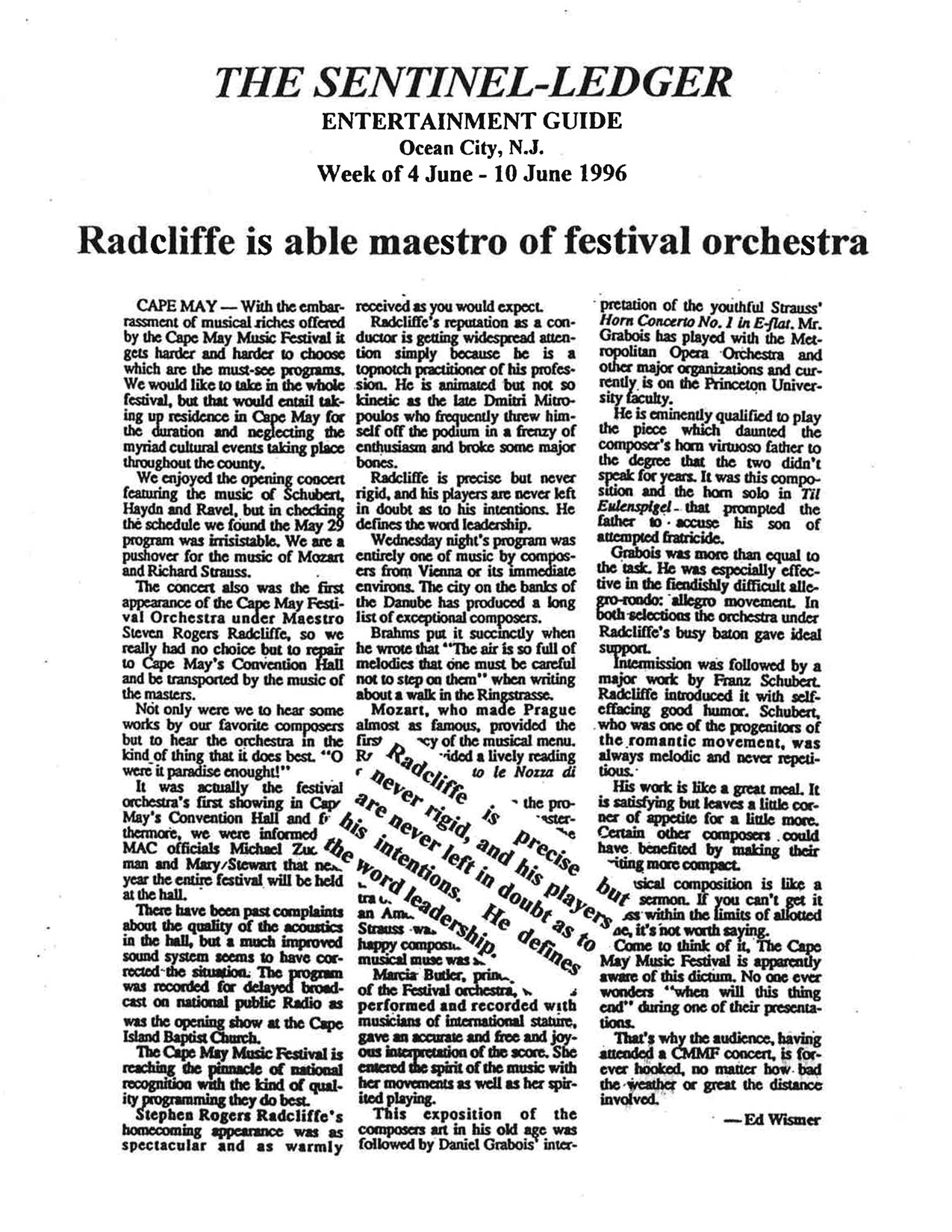
THE SENTINEL-LEDGER ENTERTAINMENT GUIDE Ocean City, N.J. Week of 4 June – 10 June 1996 Radcliffe is able maestro of festival orchestra CAPE MAY — With the embarrassment of musical riches offered by the Cape May Music Festival it gets harder and harder to choose which are the must-see programs. We would like to take in the whole festival, but that would entail taking up residence in Cape May for the duration and neglecting the myriad cultural events taking place throughout the county. We enjoyed the opening concert featuring the music of Schubert, Haydn and Ravel, but in checking the schedule we found the May 29 program was irresistible. We are a pushover for the music of Mozart and Richard Strauss. The concert also was the first appearance of the Cape May Festival Orchestra under Maestro Stephen Rogers Radcliffe, so we really had no choice but to repair to Cape May’s Convention Hall and be transported by the music of the masters. Not only were we to hear some works by our favorite composers but to hear the orchestra in the kind of thing that it does best — “O were it paradise enough!” It was actually the festival orchestra’s first showing in Cape May’s Convention Hall and, furthermore, we were informed by MAC officials Michael Zuckerman and Mary Stewart that next year the entire festival will be held at the hall. There have been past complaints about the quality of the acoustics in the hall, but a much improved sound system seems to have corrected the situation. The program was recorded for delayed broadcast on National Public Radio as was the opening show at the Cape Island Baptist Church. The Cape May Music Festival is reaching the pinnacle of national recognition with the kind of quality programming they do best. Stephen Rogers Radcliffe’s homecoming appearance was as spectacular and as warmly received as you would expect. Radcliffe’s reputation as a conductor is getting widespread attention simply because he is a topnotch practitioner of his profession. He is animated but not so kinetic as the late Dmitri Mitropoulos who frequently threw himself off the podium in a frenzy of enthusiasm and broke some major bones. Radcliffe is precise but never rigid, and his players are never left in doubt as to his intentions. He defines the word leadership. Wednesday night’s program was entirely one of music by composers from Vienna or its immediate environs. The city on the banks of the Danube has produced a long list of exceptional composers. Brahms put it succinctly when he wrote that “The air is so full of melodies that one must be careful not to step on them” when writing about a walk in the Ringstrasse. Mozart, who made Prague almost as famous, provided the first part of the musical menu. Radcliffe provided a lively reading of the Nozze di Figaro overture. Marcia Butler, principal clarinet of the Festival orchestra, performed and recorded with musicians of international stature, gave an accurate and free and joyous interpretation of the score. She entered the spirit of the music with her movements as well as her spirited playing. This exposition of the composers’ art in his old age was followed by Daniel Grabois’ interpretation of the youthful Strauss’ *Horn Concerto No. 1 in E-flat, Mr. Grabois has played with the Metropolitan Opera Orchestra and other major organizations and currently is on the Princeton University faculty. He is eminently qualified to play the piece which daunted the composer’s horn virtuoso father to the degree that the two didn’t speak for years. It was this composition and the horn solo in Till Eulenspiegel that prompted the father to accuse his son of attempted fratricide. Grabois was more than equal to the task. He was especially effective in the fiendishly difficult allegro con brio movement. In both selections the orchestra under Radcliffe’s busy baton gave ideal support. Intermission was followed by a major work by Franz Schubert. Radcliffe introduced it with self-effacing good humor. Schubert, who was one of the progenitors of the romantic movement, was always melodic and never repetitious. His work is like a great meal. It is satisfying but leaves a little corner of appetite for a little more. Certain other composers could have benefited by making their writing more compact. Musical composition is like a sermon. If you can’t get it across within the limits of allotted time, it’s not worth saying. Come to think of it, The Cape May Music Festival is apparently aware of this dictum. No one ever wonders “when will this thing end” during one of their presentations. That’s why the audience, having attended a CMMF concert, is forever hooked, no matter how bad the weather or great the distance involved. — Ed Wismer

Radcliffe is able Maestro of Festival Orchestra

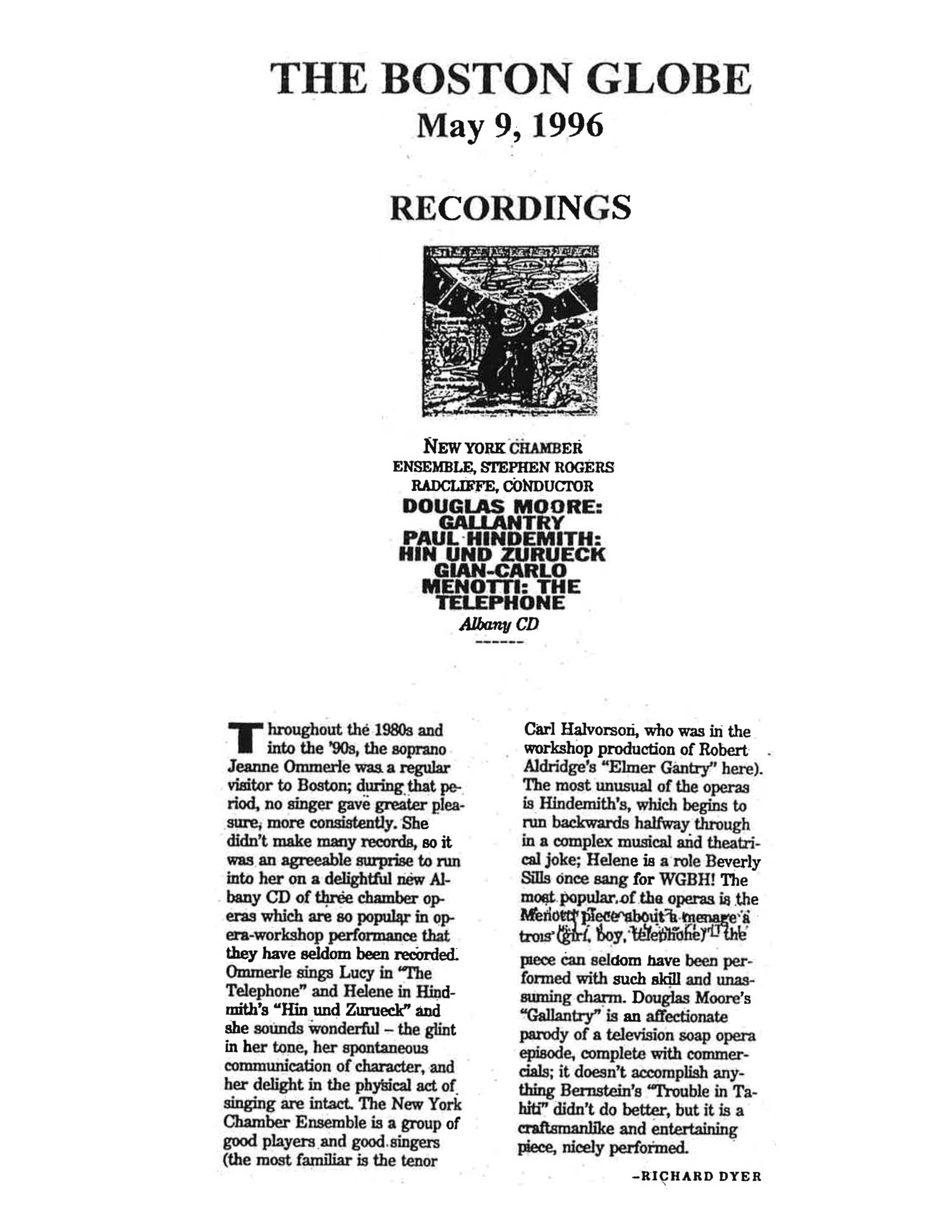
THE BOSTON GLOBE May 9, 1996 RECORDINGS NEW YORK CHAMBER ENSEMBLE, STEPHEN ROGERS RADCLIFFE, CONDUCTOR DOUGLAS MOORE: GALLANTRY PAUL HINDEMITH: HIN UND ZURUECK GIAN-CARLO MENOTTI: THE TELEPHONE Albany CD Throughout the 1980s and into the ’90s, the soprano Jeanne Ommerle was a regular visitor to Boston; during that period, no singer gave greater pleasure, more consistently. She didn’t make many records, so it was an agreeable surprise to run into her on a delightful new Albany CD of three chamber operas which are so popular in opera-workshop performance that they have seldom been recorded. Ommerle sings Lucy in “The Telephone” and Helene in Hindemith’s “Hin und Zurueck,” and she sounds wonderful — the glint in her tone, her spontaneous communication of character, and her delight in the physical act of singing are intact. The New York Chamber Ensemble is a group of good players and good singers (the most familiar is the tenor Carl Halvorson, who was in the workshop production of Robert Aldridge’s “Elmer Gantry” here). The most unusual of the operas is Hindemith’s, which begins to run backwards halfway through in a complex musical and theatrical joke; Helene is a role Beverly Sills once sang for WGBH! The most popular of the operas is the Menotti piece about a ménage à trois of girl, boy, telephone! The piece can seldom have been performed with such skill and unassuming charm. Douglas Moore’s “Gallantry” is an affectionate parody of a television soap opera episode, complete with commercials; it doesn’t accomplish anything Bernstein’s “Trouble in Tahiti” didn’t do better, but it is a craftsmanlike and entertaining piece, nicely performed. — RICHARD DYER ⸻ If you’d like, I can also standardize all of these clippings into a consistent press-archive format for Stephen’s website (publication, date, reviewer, repertoire, label, performers).

The Boston Globe Recording Review

Fanfare The Magazine for Serious Record Collectors March/April 1996 • Volume 19, Number 4 MOORE: Gallantry—A Soap Opera¹. HINDEMITH: Hin und Zurück². MENOTTI: The Telephone³. Stephen Rogers Radcliffe conducting; Jeanne Ommerlé, soprano (Helene²; Lucy³); Margaret Bishop, soprano (Lola¹); Julia Parks, mezzo-soprano (Announcer¹); Carl Halvorson, tenor (Donald¹; Robert²); Robert Osborne, tenor (Orderly²); Richard Holmes, baritone (Dr. Gregg¹; A Doctor²; Ben³); Austin Wright Moore, bass (A Sage³); The New York Chamber Ensemble. ALBANY TROY 173 [DDD]; 60:49. Produced by Dan Kincaid. (Distributed by Albany Music.) This group, with some of the same singers, performed these three comic one-acts at a luncheon concert in New York City’s Bryant Park a few summers back. I thought the trio most amusing, and, checking my watch, thought, "What a neat CD they would make!" Wishes do come true, sometimes. Douglas Moore’s 1957 Gallantry is a loving spoof of television soap operas, complete with commercial interruptions. In the commercials, a slinky lady announcer advertises soap and wax; in the drama itself a surgeon is trying to seduce his nurse-anesthetist, but she loves another, who turns out to be the patient on the operating table. . . . Moore wrote charming music for this blend of farce and sentiment, with a variety of arias and duets. To turn the finale into a quartet, the surgeon joins the announcer in endorsing the products while a love duet is still going on. My favorite exchange goes: > Donald (casually): How is Mrs. Gregg, Doctor? > Lola (stunned): Mrs. Gregg? > Donald: Yes! how is your wife, Doctor? > Dr. Gregg (disdainfully): Put the patient to sleep, Miss Markham. > Hindemith’s 1927 "sketch with music" centers on the cinematic trick of reversing the action: husband suspects wife of infidelity; they argue, and the truth comes out; he shoots her; doctor arrives and takes her away; husband leaps out window. A sage appears and decides to turn it all around. Husband leaps back in; wife is carried back in; bullet returns to gun; argument goes backward to a happy ending. This performance is in an English translation (the performance on a Candide LP is sung in German). Accompaniment is by two pianos and six woodwinds; it all takes but eleven minutes. The music is lively fun, and this performance makes the most of it. Menotti’s 1946 The Telephone has been a continuing success for half a century; its wit and elegance are typical of his early operas. The plot situation and the spirit of the piece are exactly the opposite of that other telephone opera, Poulenc’s La Voix humaine. Ben is trying to propose to Lucy, but her telephone keeps interrupting; he leaves and phones in his proposal, which she accepts. I’ve never heard The Telephone done better than on this disc: Jeanne Ommerlé is a breezy delight as the scatterbrained heroine, and she sings the high-lying near-monolog with silken ease. The instrumentalists are all first-rate, with especially lovely oboe playing by Marcia Butler. The recordings are bright and clear; full texts are included. An ugly cartoon cover becomes quite funny once you know Moore’s piece. I can’t imagine any listener not being amused and charmed by this disc. James H. North

MOORE: Gallantry—A Soap Opera HINDEMITH: Hin und Zurück MENOTTI: The Telephone

Fanfare The Magazine for Serious Record Collectors March/April 1996 • Volume 19, Number 4 AMERICAN PROFILES. Stephen Rogers Radcliffe conducting the New York Chamber Ensemble. ALBANY TROY 175 [DDD]; 64:26. PISTON: Divertimento. GRIFFES: Three Tone Pictures. ROREM: Eleven Studies for Eleven Players. COPLAND: Sextet. While each of these pieces has been recorded before—all but the Piston currently have at least one recording in the catalog—it was an excellent idea to bring all four together on a single disc. They work together extremely well because of their differences as much as because of what they have in common. Piston’s three-movement Divertimento is, like all of this composer’s music, a sturdily crafted work in which strong, memorable thematic material is supported by solid, occasionally dissonant counterpoint. The two lively, thoroughly neo-classical outer movements surround a central slow movement based on a wonderful, flowing oboe melody. The Griffes pieces, arranged by the composer from his original version for piano, are attractive little landscapes, featuring the composer’s special brand of impressionism. Rorem’s Studies are a series of miniatures, varying widely in mood as well as instrumentation, that show the composer’s fine sense of detail, wry sense of humor, and irrepressible melodic gift. The final work, Copland’s own arrangement of his Short Symphony, is a masterpiece of American neo-Classicism. Nervous, muscular, and economical, the brief three-movement work is one of Copland’s most rhythmically challenging pieces. The performances are very good. The bouncy vitality of the Copland and Piston works is particularly well captured by Radcliffe and his excellent musicians. The Rorem pieces are played with lots of detail and show off individual members of the ensemble to great advantage. My only reservations concern the Griffes pieces where the beat seems all too heavy and the instrumental blends a bit rough. In addition, the piano, although nicely played by David Korevaar, is overly prominent, suggesting more a concerto than a work for chamber orchestra. The recording is good, quite clean and natural, but a little bit close. These flaws aside, this is a most enjoyable disc that should find a welcome place in every collection of American music. Richard Burke

AMERICAN PROFILES. Stephen Rogers Radcliffe conducting the New York Chamber Ensemble

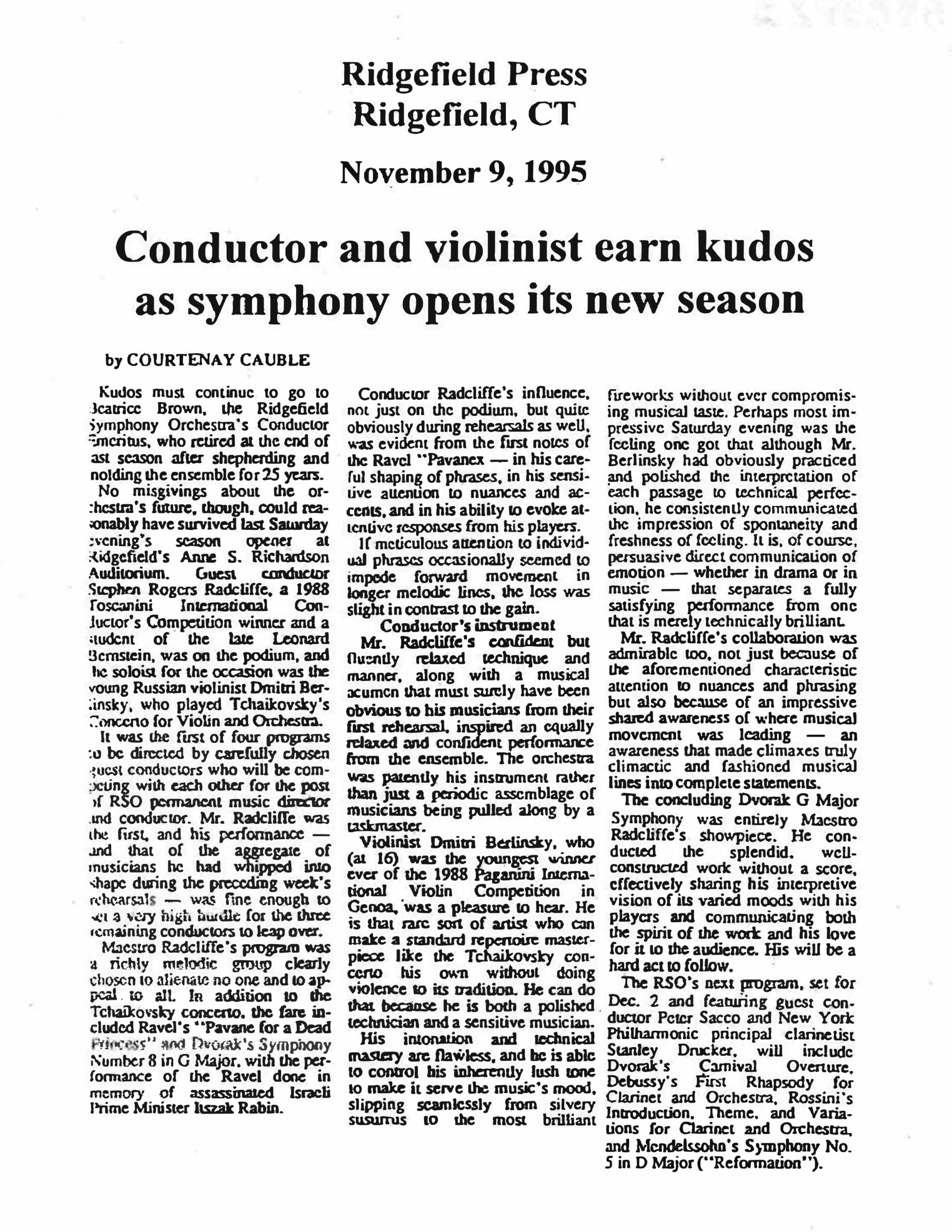
Ridgefield Press Ridgefield, CT November 9, 1995 Conductor and violinist earn kudos as symphony opens its new season by COURTENAY CAUBLE Kudos must continue to go to Beatrice Brown, the Ridgefield Symphony Orchestra's Conductor Emeritus, who retired at the end of last season after shepherding and molding the ensemble for 25 years. No misgivings about the orchestra's future, though, could reasonably have survived last Saturday evening's season opener at Ridgefield's Anne S. Richardson Auditorium. Guest conductor Stephen Rogers Radcliffe, a 1988 Toscanini International Conductor's Competition winner and a student of the late Leonard Bernstein, was on the podium, and the soloist for the occasion was the young Russian violinist Dmitri Berlinsky, who played Tchaikovsky's Concerto for Violin and Orchestra. It was the first of four programs to be directed by carefully chosen guest conductors who will be competing with each other for the post of RSO permanent music director and conductor. Mr. Radcliffe was the first, and his performance — and that of the aggregate of musicians he had whipped into shape during the preceding week's rehearsals — was fine enough to set a very high hurdle for the three remaining conductors to leap over. Maestro Radcliffe's program was a richly melodic group clearly chosen to alienate no one and to appeal to all. In addition to the Tchaikovsky concerto, the fare included Ravel's "Pavane for a Dead Princess" and Dvorak's Symphony Number 8 in G Major, with the performance of the Ravel done in memory of assassinated Israeli Prime Minister Itszak Rabin. Conductor Radcliffe's influence, not just on the podium, but quite obviously during rehearsals as well, was evident from the first notes of the Ravel "Pavane" — in his careful shaping of phrases, in his sensitive attention to nuances and accents, and in his ability to evoke attentive responses from his players. If meticulous attention to individual phrases occasionally seemed to impede forward movement in longer melodic lines, the loss was slight in contrast to the gain. Conductor's instrument Mr. Radcliffe's confident but fluently relaxed technique and manner, along with a musical acumen that must surely have been obvious to his musicians from their first rehearsal, inspired an equally relaxed and confident performance from the ensemble. The orchestra was patently his instrument rather than just a periodic assemblage of musicians being pulled along by a taskmaster. Violinist Dmitri Berlinsky, who (at 16) was the youngest winner ever of the 1988 Paganini International Violin Competition in Genoa, was a pleasure to hear. He is that rare sort of artist who can make a standard repertoire masterpiece like the Tchaikovsky concerto his own without doing violence to its tradition. He can do that because he is both a polished technician and a sensitive musician. His intonation and technical mastery are flawless, and he is able to control his inherently lush tone to make it serve the music's mood, slipping seamlessly from silvery sussurus to the most brilliant fireworks without ever compromising musical taste. Perhaps most impressive Saturday evening was the feeling one got that although Mr. Berlinsky had obviously practiced and polished the interpretation of each passage to technical perfection, he consistently communicated the impression of spontaneity and freshness of feeling. It is, of course, emotion — whether in drama or in music — that separates a fully satisfying performance from one that is merely technically brilliant. Mr. Radcliffe's collaboration was admirable too, not just because of the aforementioned characteristic attention to nuances and phrasing but also because of an impressive shared awareness of where musical movement was leading — an awareness that made climaxes truly climactic and fashioned musical lines into complete statements. The concluding Dvorak G Major Symphony was entirely Maestro Radcliffe's showpiece. He conducted the splendid, well-constructed work without a score, effectively sharing his interpretive vision of its varied moods with his players and communicating both the spirit of the work and his love for it to the audience. His will be a hard act to follow. The RSO's next program, set for Dec. 2 and featuring guest conductor Peter Sacco and New York Philharmonic principal clarinetist Stanley Drucker, will include Dvorak's Carnival Overture, Debussy's First Rhapsody for Clarinet and Orchestra, Rossini's Introduction, Theme, and Variations for Clarinet and Orchestra, and Mendelssohn's Symphony No. 5 in D Major ("Reformation").

Conductor and Violinist Earn Kudos as Symphony Opens Its New Season

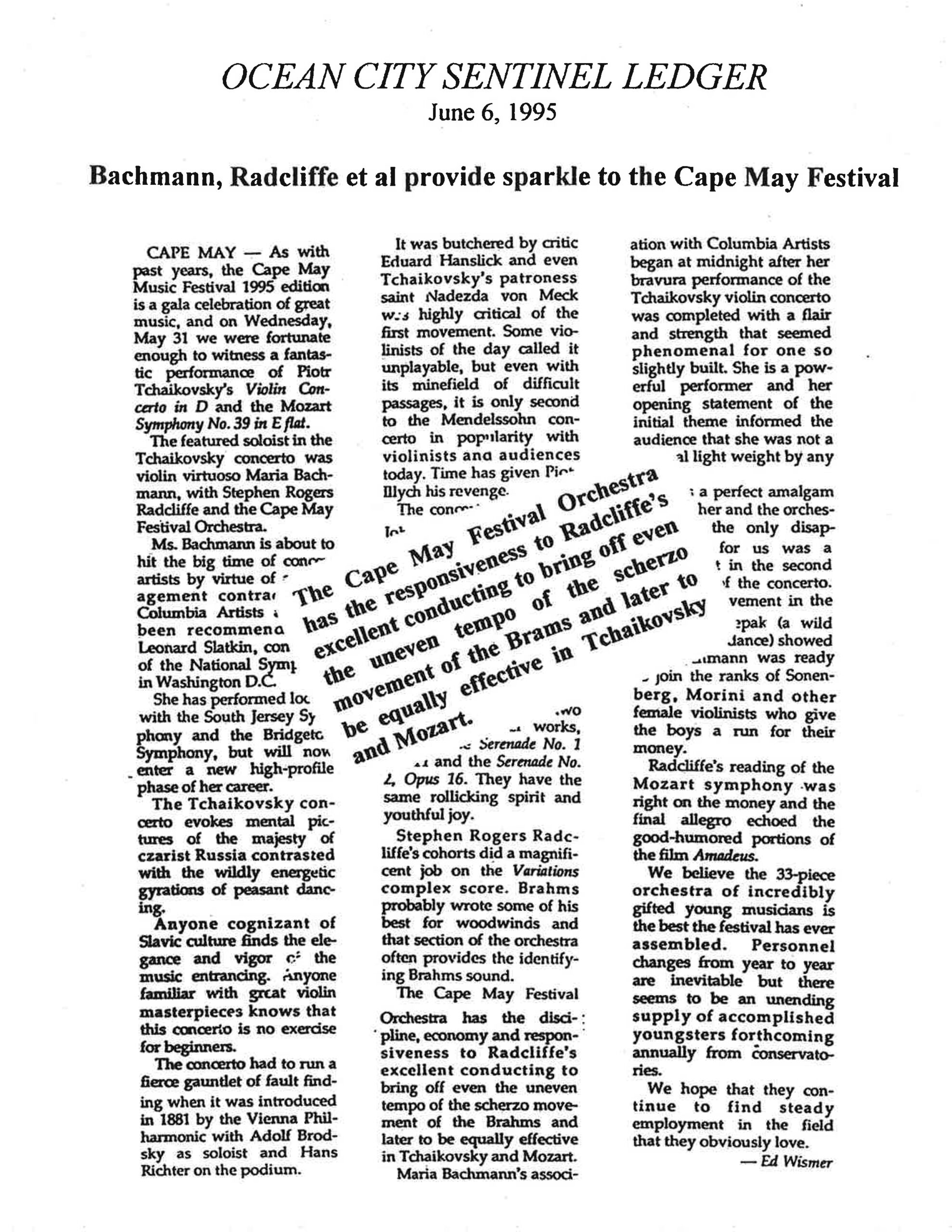
OCEAN CITY SENTINEL LEDGER June 6, 1995 Bachmann, Radcliffe et al provide sparkle to the Cape May Festival CAPE MAY — As with past years, the Cape May Music Festival 1995 edition is a gala celebration of great music, and on Wednesday, May 31 we were fortunate enough to witness a fantastic performance of Piotr Tchaikovsky’s Violin Concerto in D and the Mozart Symphony No. 39 in E flat. The featured soloist in the Tchaikovsky concerto was violin virtuoso Maria Bachmann, with Stephen Rogers Radcliffe and the Cape May Festival Orchestra. Ms. Bachmann is about to hit the big time of concert artists by virtue of a management contract with Columbia Artists and has been recommended by Leonard Slatkin, conductor of the National Symphony in Washington D.C. She has performed with the South Jersey Symphony and the Bridgeton Symphony, but will now enter a new high-profile phase of her career. The Tchaikovsky concerto evokes mental pictures of the majesty of czarist Russia contrasted with the wildly energetic gyrations of peasant dancing. Anyone cognizant of Slavic culture finds the elegance and vigor of the music entrancing; anyone familiar with great violin masterpieces knows that this concerto is no exercise for beginners. The concerto had to run a fierce gauntlet of fault finding when it was introduced in 1881 by the Vienna Philharmonic with Adolf Brodsky as soloist and Hans Richter on the podium. It was butchered by critic Eduard Hanslick and even Tchaikovsky’s patroness Nadezda von Meck was highly critical of the first movement. Some violinists of the day called it unplayable, but even with its minefield of difficult passages, it is only second to the Mendelssohn concerto in popularity with violinists and audiences today. Time has given Tchaikovsky his revenge. The Cape May Festival Orchestra has the discipline, economy and responsiveness to Radcliffe’s excellent conducting to bring off even the uneven tempo of the scherzo movement of the Brahms and later to be equally effective in Tchaikovsky and Mozart. Stephen Rogers Radcliffe’s cohorts did a magnificent job on the Variations complex score. Brahms probably wrote some of his best for woodwinds and that section of the orchestra often provides the identifying Brahms sound. The Cape May Festival Orchestra has the discipline, economy and responsiveness to Radcliffe’s excellent conducting to bring off even the uneven tempo of the scherzo movement of the Brahms and later to be equally effective in Tchaikovsky and Mozart. Maria Bachmann’s association with Columbia Artists began at midnight after her bravura performance of the Tchaikovsky violin concerto was completed with a flair and strength that seemed phenomenal for one so slightly built. She is a powerful performer and her opening statement of the initial theme informed the audience that she was not a lightweight by any measure. There was a perfect amalgam between her and the orchestra; the only disappointment for us was a slight letdown in the second movement of the concerto. In the finale (a wild dance), Bachmann was ready to join the ranks of Szigeti, Morini and other female violinists who give the boys a run for their money. Radcliffe’s reading of the Mozart symphony was right on the money and the final allegro echoed the good-humored portions of the film Amadeus. We believe the 33-piece orchestra of incredibly gifted young musicians is the best the festival has ever assembled. Personnel changes from year to year are inevitable but there seems to be an unending supply of accomplished youngsters forthcoming annually from conservatories. We hope that they continue to find steady employment in the field that they obviously love. — Ed Wismer

Bachmann, Radcliffe et al provide sparkle to the Cape May Festival

Fanfare The Magazine for Serious Record Collectors January/February 1995 • Volume 18, Number 3 ROCHBERG: Music for the Magic Theater. Octet; A Grand Fantasia. Stephen Rogers Radcliffe conducting the New York Chamber Ensemble. NEW WORLD 80462-2 [DDD]; 48:39. Produced by Daniel Kincaid. Our esteemed editor continues to send me discs of George Rochberg's music, even though I have expressed a general distaste for it. It makes sense that each of Fanfare's reviewers gets mostly music that he or she appreciates; we are more likely to be knowledgeable about the music and informed about competing recordings that way, but it also accounts for the so-often-favorable reviews which have bothered some of our correspondents. An occasional counterview may be bracing, and I welcome another chance to understand any composer. Rochberg, of course, has been many things at many times; his compositional life was long an evolving struggle to find his own style, at a time (ca. 1945–75) when style was strictly dictated by a few academics (if you don't write my way, you don't pass my course, so you won't get the degree, so you can't succeed in the academic world of music, so you give up composing as a career). Music for the Magic Theater (1965) found Rochberg at a turning point; he had previously followed the required atonal serialism, and had experimented with music of chance, only to find unexpected, depressing similarities between the two systems. Here Rochberg tries to merge music past with music present and future by using collage, which was not yet fashionable, although Ives's music was beginning to be known. Collage brings much variety to these twenty-seven minutes, but it also exemplifies the problem I have with Rochberg's music: it seems so internally disconnected, with one minute's Mozart likely to be followed by another's Mahler or Miles Davis. The three "Acts" of this magic theater go from confusion of past and present, to wallowing in the past, and finally trying and dissolving the present "into what?" This seems to me more like sophisticated navel-gazing than making music. The booklet points out that B. A. Zimmermann was exactly Rochberg's age, forcing me to ask why I accept the German composer's collages more than the American's. It is because Zimmermann does so much more with his inherited material; he works it over thoroughly, transforming it into something all his own. For the record, the fifteen instrumentalists here (yes, yes: Schoenberg and Berg) make many beautiful and intriguing sounds, and they are expertly recorded. Octet; A Grand Fantasia (1980) consists of twelve brief pieces scored for two to eight players (flute, clarinet, horn, violin, viola, cello, bass, and piano). References to the past are now more subtle, more a matter of style than of substance. The variety of tempos and moods (listing them all would take nearly as long as hearing them) is somehow more acceptable as a suite of short pieces than as chunks within larger movements. It also enables me to pinpoint a preference for Rochberg in slow tempos to Rochberg at speed. I give him much credit for leading the assault on an intolerable musical establishment, but I still don't like Rochberg's own solutions much. I hope this review is useful to someone; if you disagree with each thought I have expressed, you better go out and buy this record. James H. North • • • It's easy to speak of a kinship of Rochberg to Ives. Ives was the first to play about with polystylistics, emulsions in the main of highbrow with low. In the listening, however, the Ives-Rochberg connection plays as tenuous. We make better use of space contemplating Rochberg's entirely self-conscious move in the early 60s from serial atonality to (what has been called by the less than enthralled) pastiche. This bouncing about from musical style to style is today much in vogue, thanks in large measure to several of George Rochberg's pivotal works. The more appropriate comparison is to Lucas Foss, a Rochberg contemporary whose esthetic flexibility measures as relatively opportunistic. His obvious qualities notwithstanding, is Rochberg's a baleful influence on impressionable minds? In an environment where Steve Martland is packaged—in semi-beefcake, heaven help us!—as a hot property, the question is silly. Rather, let us see an unusually good and honest composer having hung an existential right on the road to what seemed to him, if not to everyone, a dead end. With regard to the discomfort Rochberg's suspiciously entertaining alternatives inflict on those for whom Theodore Adorno wields papal authority (to name but one arbiter), I offer this useless opinion. Perhaps—just perhaps—it is Rochberg's nature to entertain, his sojourn in Second Vienna's long shadow an aspect of development toward what he has become—a fulfillment that has helped shape today's postmodern terrain, moreover. (Escapes from serialism's constraints have led in startlingly disparate directions: Stefan Wolpe's for one, Giacinto Scelsi's for another.) Schwann Opus show Rochberg's cassettes, mostly CRI, outnumbering CDs. It's gratifying to see a skimpy CDiscography graced by these well-played and -recorded additions. Mike Silverton

ROCHBERG: Music for the Magic Theater – Review

ATHENS DAILY NEWS/ATHENS BANNER-HERALD, Sunday, October 23, 1994 – Page 15A By Ernie Torres Weekend News Editor George Rochberg Rochberg: "Music for the Magic Theater." New World Records. (48:41) ★★★★ The two chamber works on this New World recording by Stephen Rogers Radcliffe and the New York Chamber Ensemble offer an interesting look at George Rochberg's singular brand of modernism. It's not music for the unadventurous, but it's by no means inaccessible. Taking its name from the Magic Theater in "Steppenwolf," the Hermann Hesse novel, "Music for the Magic Theater" is a sound collage of sorts from 1965 in which Rochberg reexamines the music of the past and the present. Over the course of three "acts" there are musical quotations from Mozart's K. 287 Divertimento; Beethoven's Op. 130 String Quartet; Mahler's Ninth Symphony; Webern; Varese; Stockhausen; Miles Davis' "Stella by Starlight"; and Rochberg's own Second String Quartet. Act 1 juxtaposes Mozart with austere and dissonant modernism; Act 2 is mostly Mozart, Miles and melodic; Act 3 is a return to our century's tonal austerity, with a searching, ambiguous and quiet ending. "Music for the Magic Theater" is scored for a 15-piece chamber ensemble. Also on this disc is Rochberg's Octet: A Grand Fantasia from 1980, which is scored for flute, clarinet, horn, violin, viola, cello, bass and piano. Consisting of 12 short sections, the Octet gets off to a fast and gruff beginning but gives way to mostly slow and medium-slow tem- [text cuts off] [Photo Caption] ROCHBERG

Rochberg: “Music for the Magic Theater.” New World Records

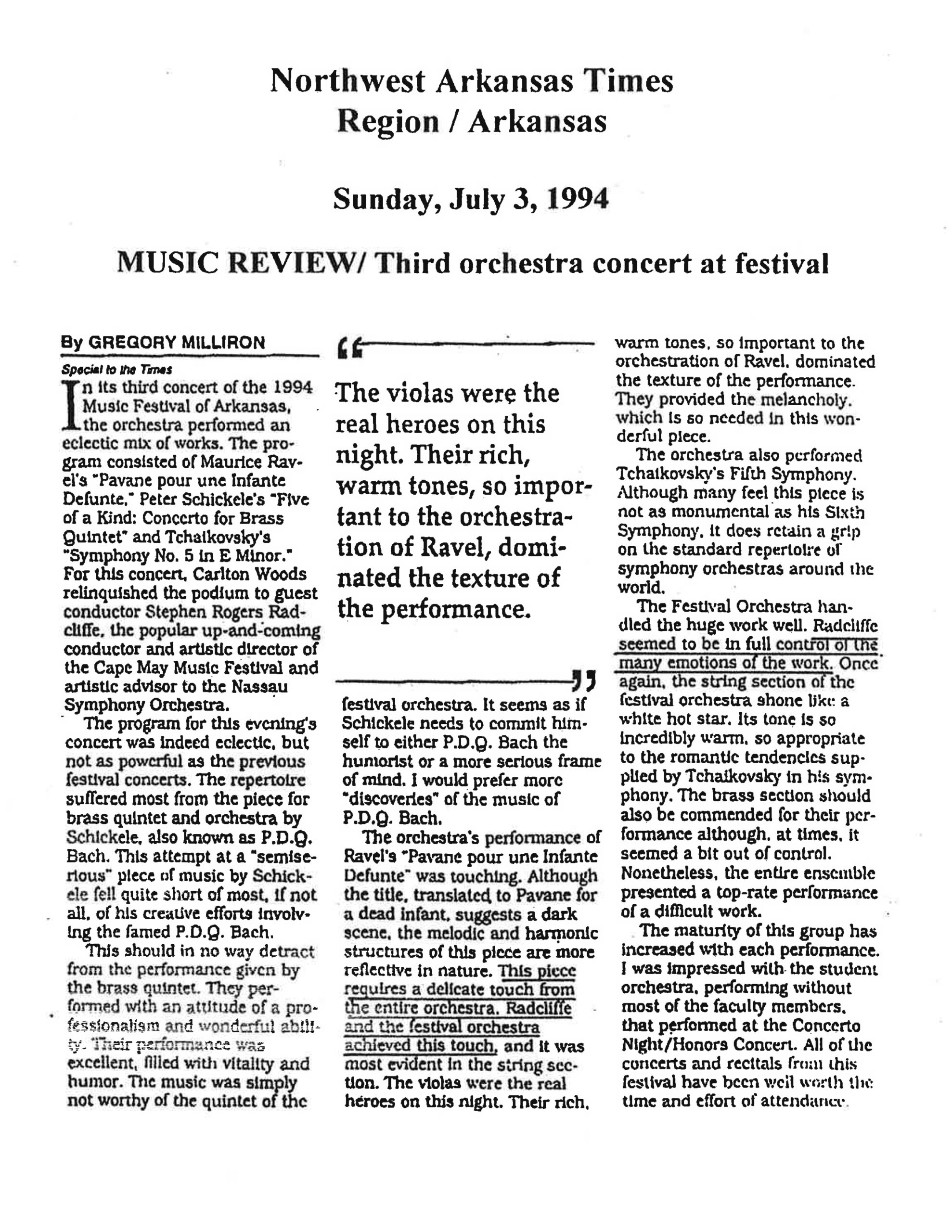
Northwest Arkansas Times Region / Arkansas Sunday, July 3, 1994 MUSIC REVIEW/ Third orchestra concert at festival By GREGORY MILLIRON Special to the Times In its third concert of the 1994 Music Festival of Arkansas, the orchestra performed an eclectic mix of works. The program consisted of Maurice Ravel's "Pavane pour une Infante Defunte," Peter Schickele's "Five of a Kind: Concerto for Brass Quintet" and Tchaikovsky's "Symphony No. 5 in E Minor." For this concert, Carlton Woods relinquished the podium to guest conductor Stephen Rogers Radcliffe, the popular up-and-coming conductor and artistic director of the Cape May Music Festival and artistic advisor to the Nassau Symphony Orchestra. The program for this evening's concert was indeed eclectic, but not as powerful as the previous festival concerts. The repertoire suffered most from the piece for brass quintet and orchestra by Schickele, also known as P.D.Q. Bach. This attempt at a "semiserious" piece of music by Schickele fell quite short of most, if not all, of his creative efforts involving the famed P.D.Q. Bach. This should in no way detract from the performance given by the brass quintet. They performed with an attitude of professionalism and wonderful ability. Their performance was excellent, filled with vitality and humor. The music was simply not worthy of the quintet of the festival orchestra. It seems as if Schickele needs to commit himself to either P.D.Q. Bach the humorist or a more serious frame of mind. I would prefer more "discoveries" of the music of P.D.Q. Bach. The orchestra's performance of Ravel's "Pavane pour une Infante Defunte" was touching. Although the title, translated to Pavane for a dead infant, suggests a dark scene, the melodic and harmonic structures of this piece are more reflective in nature. This piece requires a delicate touch from the entire orchestra. Radcliffe and the festival orchestra achieved this touch, and it was most evident in the string section. The violas were the real heroes on this night. Their rich, warm tones, so important to the orchestration of Ravel, dominated the texture of the performance. They provided the melancholy which is so needed in this wonderful piece. > The violas were the real heroes on this night. Their rich, warm tones, so important to the orchestration of Ravel, dominated the texture of the performance. > The orchestra also performed Tchaikovsky's Fifth Symphony. Although many feel this piece is not as monumental as his Sixth Symphony, it does retain a grip on the standard repertoire of symphony orchestras around the world. The Festival Orchestra handled the huge work well. Radcliffe seemed to be in full control of the many emotions of the work. Once again, the string section of the festival orchestra shone like a white hot star. Its tone is so incredibly warm, so appropriate to the romantic tendencies supplied by Tchaikovsky in his symphony. The brass section should also be commended for their performance although, at times, it seemed a bit out of control. Nonetheless, the entire ensemble presented a top-rate performance of a difficult work. The maturity of this group has increased with each performance. I was impressed with the student orchestra, performing without most of the faculty members, that performed at the Concerto Night/Honors Concert. All of the concerts and recitals from this festival have been well worth the time and effort of attendance.

Third Orchestra Concert at Festival

THE SENTINEL-LEDGER Ocean City, N.J. Week of 7-13 June 1994 Festival Orchestra goes pops By ED WISMER Sentinel-Ledger Critic OCEAN CITY — The second Cape May Music Festival event to be held on the Music Pier for 1994 took place June 4 and it was a real "Popper." The Cape May Festival Orchestra played a program of light classics and the best of Broadway. This does seem like carrying coals to Newcastle because of the similarity of programming by our own sensational Ocean City Pops, but good music is sempiternal and it's truly a case of the more, the merrier. It best represents another opportunity to spread culture in this area through cooperation by the Pashley Insurance Agency, The Sentinel-Ledger and the city of Ocean City. All concerned are to be commended for their support of the arts. The Festival Orchestra had the pleasure and privilege of playing in Ocean City's state of the art facility. Festival artistic director Stephen Rogers Radcliffe mounted the podium and started the proceedings off with a flourish. Pops orchestras and programs are proliferating exponentially. Most of us think of Pops orchestras starting with that part-time fireman Arthur Fiedler up in Boston, but pops programing was quite popular at the turn of the 20th century and before. A Sousa program would have consisted of light classics, popular songs and show tunes (many of which Sousa wrote himself a la John Williams). We have heard Radcliffe's orchestra do some very ambitious work in the past and recall an occasion when a 19th century synthesizer was used to intensify the sound. Radcliffe is experimental and innovative in his approach and one can always expect some extra pyrotechnics. He did not disappoint us this time either. The program consisted of works inspired by folk music and dance that was multi-ethnic. Radcliffe led off with a Rossini Overture that was impressively played and followed it with Dvorak's Slavonic Dance Op. 46, No. 8 (one of the more lively numbers in this evocative suite). > Artistic Director Stephen Rogers Radcliffe is fun to watch > Radcliffe is fun to watch. His kinetic gyrations were most evident in the Dvorak but he only enlivens proceedings thusly when it is appropriate. The late Dmitri Mitroupolis was overly physical and often fell right off the podium. Radcliffe's feet enthusiastically left the floor at times but he was always in control. Ralph Vaughan Williams' Fantasia on Greensleeves followed it, and along with Faure's Pavane Op. 50, brought a more solemn and sedate mood to the concert. The wind section was outstanding in these two pieces. An unfamiliar tarantelle by Camille Saint Saens proved to be a lively and lovely example of how versatile the French composer could be. The Bizet Suite from Carmen featured "just right" vigorous tempi and playing that was, at the same time, abandoned and precise. The brass players took full advantage of Bizet's proclivity for writing superbly for their instruments. The final portion of the program consisted of two genuine Broadway classics in the form of selections from Gershwin's folk opera Porgy and Bess and Bernstein's West Side Story highlights. Both came in the form of fresh sounding and unfamiliar arrangements that featured innovative instrumental scoring that gave them new life. These evinced a standing ovation which was rewarded with an encore of Flimsy Korsetoff's (pardon an old musician's pun) Flight of the Bumble Bee which hummed right along. It is a certainty that the audience felt that it had a grand night out, topped off with truly professional musicianship and the sponsors could openly glow with pride. The whole affair added new vistas of cultural excellence that upheld the tradition of fine entertainment values exemplified by both cities. [Sidebar Text] CAPE MAY — The fifth annual Cape May Music Festival began May 15 and continues through June 26, hosting what is described as some of the world's most accomplished soloists and chamber musicians in music from the Renaissance and Vivaldi to the jazz era. The Festival Orchestra is conducted by Stephen Rogers Radcliffe. The festival is sponsored by the Mid-Atlantic Center for the Arts (884-5404), in association with the Cape May Institute.

Festival Orchestra Goes Pops

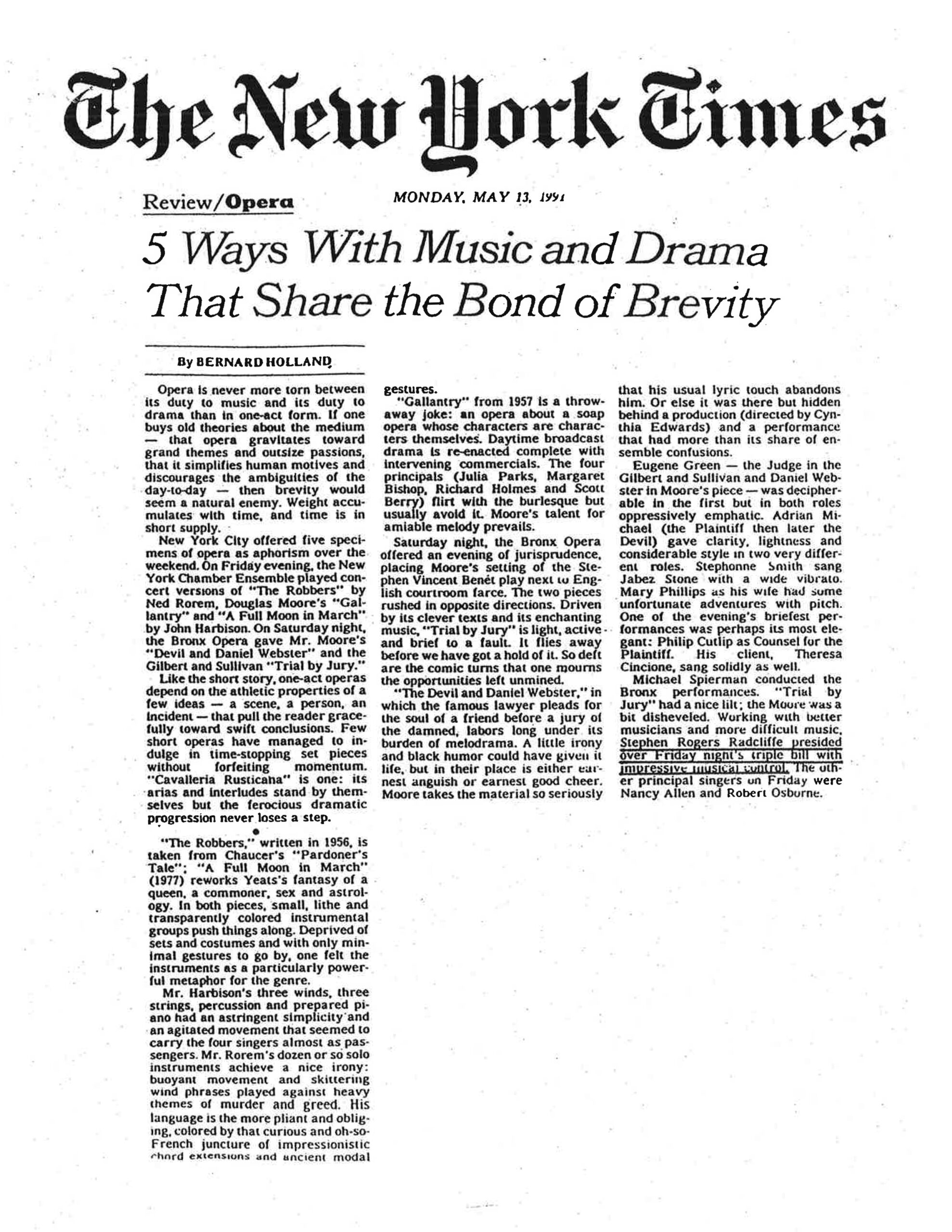
Based on the image provided, here is the retyped article: The New York Times Review/Opera MONDAY, MAY 13, 1991 5 Ways With Music and Drama That Share the Bond of Brevity By BERNARD HOLLAND Opera is never more torn between its duty to music and its duty to drama than in one-act form. If one buys old theories about the medium — that opera gravitates toward grand themes and outsize passions, that it simplifies human motives and discourages the ambiguities of the day-to-day — then brevity would seem a natural enemy. Weight accumulates with time, and time is in short supply. New York City offered five specimens of opera as aphorism over the weekend. On Friday evening, the New York Chamber Ensemble played concert versions of "The Robbers" by Ned Rorem, Douglas Moore's "Gallantry" and "A Full Moon in March" by John Harbison. On Saturday night, the Bronx Opera gave Mr. Moore's "Devil and Daniel Webster" and the Gilbert and Sullivan "Trial by Jury." Like the short story, one-act operas depend on the athletic properties of a few ideas — a scene, a person, an incident — that pull the reader gracefully toward swift conclusions. Few short operas have managed to indulge in time-stopping set pieces without forfeiting momentum. "Cavalleria Rusticana" is one: its arias and interludes stand by themselves but the ferocious dramatic progression never loses a step. • "The Robbers," written in 1956, is taken from Chaucer's "Pardoner's Tale": "A Full Moon in March" (1977) reworks Yeats's fantasy of a queen, a commoner, sex and astrology. In both pieces, small, lithe and transparently colored instrumental groups push things along. Deprived of sets and costumes and with only minimal gestures to go by, one felt the instruments as a particularly powerful metaphor for the genre. Mr. Harbison's three winds, three strings, percussion and prepared piano had an astringent simplicity and an agitated movement that seemed to carry the four singers almost as passengers. Mr. Rorem's dozen or so solo instruments achieve a nice irony: buoyant movement and skittering wind phrases played against heavy themes of murder and greed. His language is the more pliant and obliging, colored by that curious and oh-so-French juncture of impressionistic chord extensions and ancient modal gestures. "Gallantry" from 1957 is a throwaway joke: an opera about a soap opera whose characters are characters themselves. Daytime broadcast drama is re-enacted complete with intervening commercials. The four principals (Julia Parks, Margaret Bishop, Richard Holmes and Scott Berry) flirt with the burlesque but usually avoid it. Moore's talent for amiable melody prevails. Saturday night, the Bronx Opera offered an evening of jurisprudence, placing Moore's setting of the Stephen Vincent Benét play next to English courtroom farce. The two pieces rushed in opposite directions. Driven by its clever texts and its enchanting music, "Trial by Jury" is light, active and brief to a fault. It flies away before we have got a hold of it. So deft are the comic turns that one mourns the opportunities left unmined. "The Devil and Daniel Webster," in which the famous lawyer pleads for the soul of a friend before a jury of the damned, labors long under its burden of melodrama. A little irony and black humor could have given it life, but in their place is either earnest anguish or earnest good cheer. Moore takes the material so seriously that his usual lyric touch abandons him. Or else it was there but hidden behind a production (directed by Cynthia Edwards) and a performance that had more than its share of ensemble confusions. Eugene Green — the Judge in the Gilbert and Sullivan and Daniel Webster in Moore's piece — was decipherable in the first but in both roles oppressively emphatic. Adrian Michael (the Plaintiff then later the Devil) gave clarity, lightness and considerable style in two very different roles. Stephonne Smith sang Jabez Stone with a wide vibrato. Mary Phillips as his wife had some unfortunate adventures with pitch. One of the evening's briefest performances was perhaps its most elegant: Philip Cutlip as Counsel for the Plaintiff. His client, Theresa Cincione, sang solidly as well. Michael Spierman conducted the Bronx performances. "Trial by Jury" had a nice lilt; the Moore was a bit disheveled. Working with better musicians and more difficult music, Stephen Rogers Radcliffe presided over Friday night's triple bill with impressive musical control. The other principal singers on Friday were Nancy Allen and Robert Osborne.

5 Ways With Music and Drama That Share the Bond of Brevity

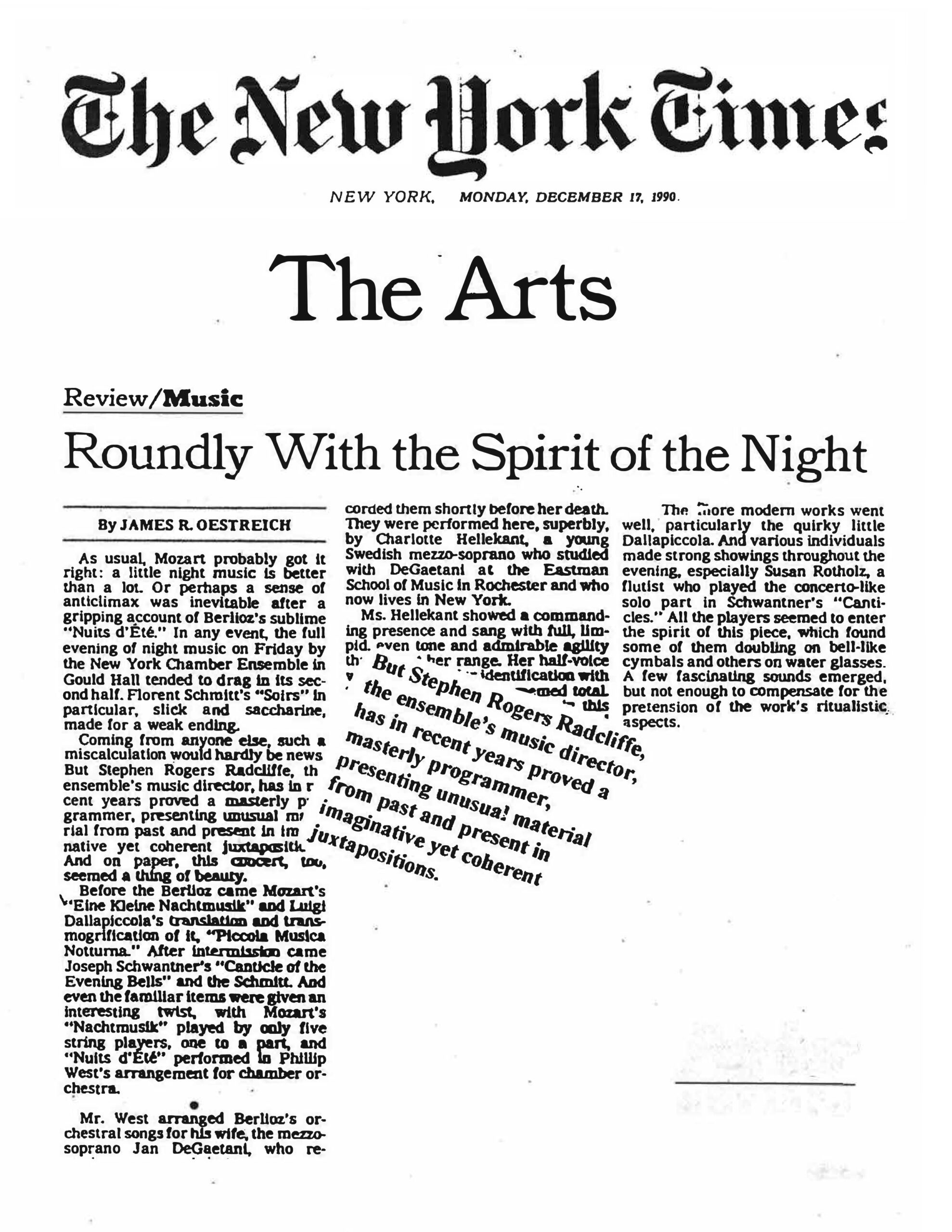
Roundly With the Spirit of the Night

NEW YORK POST TUESDAY, JUNE 5, 1990 Mini-operas make comeback By DALE HARRIS CLASSICAL review FRIDAY evening's concert by the New York Chamber Ensemble at Florence Gould Hall was at once enjoyable and enlightening. Led by Stephen Rogers Radcliffe, the group resuscitated one of the most interesting events in the history of 20th-century music: the program of four miniature operas given at the Baden-Baden Festival of 1927. The year 1927 was a time of crisis for music in general and for opera in particular. In their very different ways, Hindemith's "Hin und Zurueck," Kurt Weill's "Mahagonny Songspiel," Ernst Toch's "Princess and the Pea" and Milhaud's "Rape of Europa" were all modernist manifestoes, provocative attempts to reanimate the corpse of post-Wagnerian opera. The operas, naturally enough, caused a great deal of friction in conservative German musical circles. It's no accident that within a few years every one of these composers was a refugee from the Nazis. The Hindemith mocks the conventions of tragedy, the Milhaud of classical myth, the Toch of fairy-tale romance. Historical importance is one thing, agelessness another. It was edifying to hear these three. It was exciting to hear the Weill, the only one that looks as though it will last another 50 years.

Mini-Operas Make Comeback

The New York Times NEW YORK, MONDAY, JUNE 4, 1990 Re-creating a Musical Event of 1927 By JOHN ROCKWELL Since 1987, Stephen Rogers Radcliffe and his New York Chamber Ensemble have been presenting some of New York's friskiest programming — and performances, one hastens to add, since intention without follow-through equals mere conceit. Mr. Radcliffe has an interest in the music of the early 20th century, meaning the earliest and best years of modernism. He looks at music with a historian's eye, re-creating important musical events with modern forces. For those forces he unites smaller chamber groups under his "Chamber Ensemble" banner, the current components being the Chester String Quartet and the piano and wind sextet Hexagon, with additional freelance forces added as necessary. Friday night's program at Gould Hall, which enlisted 22 instrumentalists and 7 singers, counted as one of the ensemble's best. In 1927 the prestigious, composer-organized summer festival at Donaueschingen, in what is now West Germany, moved over to Baden-Baden, which had a bigger hall. The central program, on July 17, presented staged performances of four new chamber operas by Ernst Toch, Darius Milhaud, Kurt Weill and Paul Hindemith, ranging in length — the timings are those from Friday — from 11 minutes to 33 minutes. Mr. Radcliffe re-created that program with a few variations. The most important was that in Baden-Baden the operas were staged with proper sets and costumes; in New York, despite some effective hints of characterization, they were given in concert form. The order was juggled, too, ending with the longest piece, the Toch. Musical interludes were omitted, most piquantly Milhaud's jazzy "Création du Monde," which received its first performance in Baden-Baden. Chamber operas of Weill, Milhaud, Hindemith and Ernst Toch. Friday's program was rather grandly entitled "The Birth of Chamber Opera." That does a disservice to more than 300 years of earlier chamber operas. It also suggests that these 1927 scores had a profound impact on music to come. Since some pessimists count 1925 as the year the operatic canon stopped admitting new entries, and since Nazism and World War II disrupted artistic evolution of all kinds, that is hard to sustain. Certainly there were all manner of theatrical "actions" in the 1960's, but they were generally closer to today's performance art than 1927's operatic compressions. That said, the 1927 evening was clearly an event, and given the quality of at least three of the scores and of the performances, Friday was also something of an event. The music sounded urgent, amusing and ingenious, full of a spirit of adventure and even an optimism that was soon to be dashed by larger political events. Far and away the most famous and influential of the four scores was Weill's "Mahagonny Songspiel," a 27-minute song sequence that soon grew into the full-dress "Rise and Fall of the City of Mahagonny," which the Metropolitan Opera has done with success. The "Songspiel" crops up fairly often, but few performances have matched Friday's in the crispness and spunky clarity of the instrumental playing. Hearing the music so performed, one could appreciate anew the brilliance with which Weill synthesized Bertolt Brecht's cabaret obsessions, jazz and modernist formalism. The singing — all night — was by no means bad, either. The program opened with Hindemith's "There and Back," Marion J. Farquhar's English version of "Hin und Zurück." This 11-minute score depicts a jealous husband's murder of his wife, the intercession of an angel and then the filmic rewinding of the events back to the opening marital bliss, the second half being an exact musical reversal of the first half. More a cute joke than evocative music, the opera succeeds because it is a joke and is most definitely cute. The most successful mix of musical economy and invention was Milhaud's "Abduction of Europa," heard in an Eric Smith translation. Here, more than in any of the other three operas, one feels that the composer has made a complete, ingenious and fully satisfying statement within the limits set by the festival's commissioners. Finally, Toch's "Princess and the Pea" (again in a Farquhar translation) emerged as not only the longest but also the most operatically and musically conventional of the lot. Posterity is not as dumb as is sometimes asserted; there's a reason Toch is now less famous than the other three composers on this bill. Singers for the evening were Katherine Johnson, Margaret Bishop, Nancy Ortez, Mark Bleeke, Michael Brown, Richard Holmes and Robert Osborne.

Re-creating a Musical Event of 1927

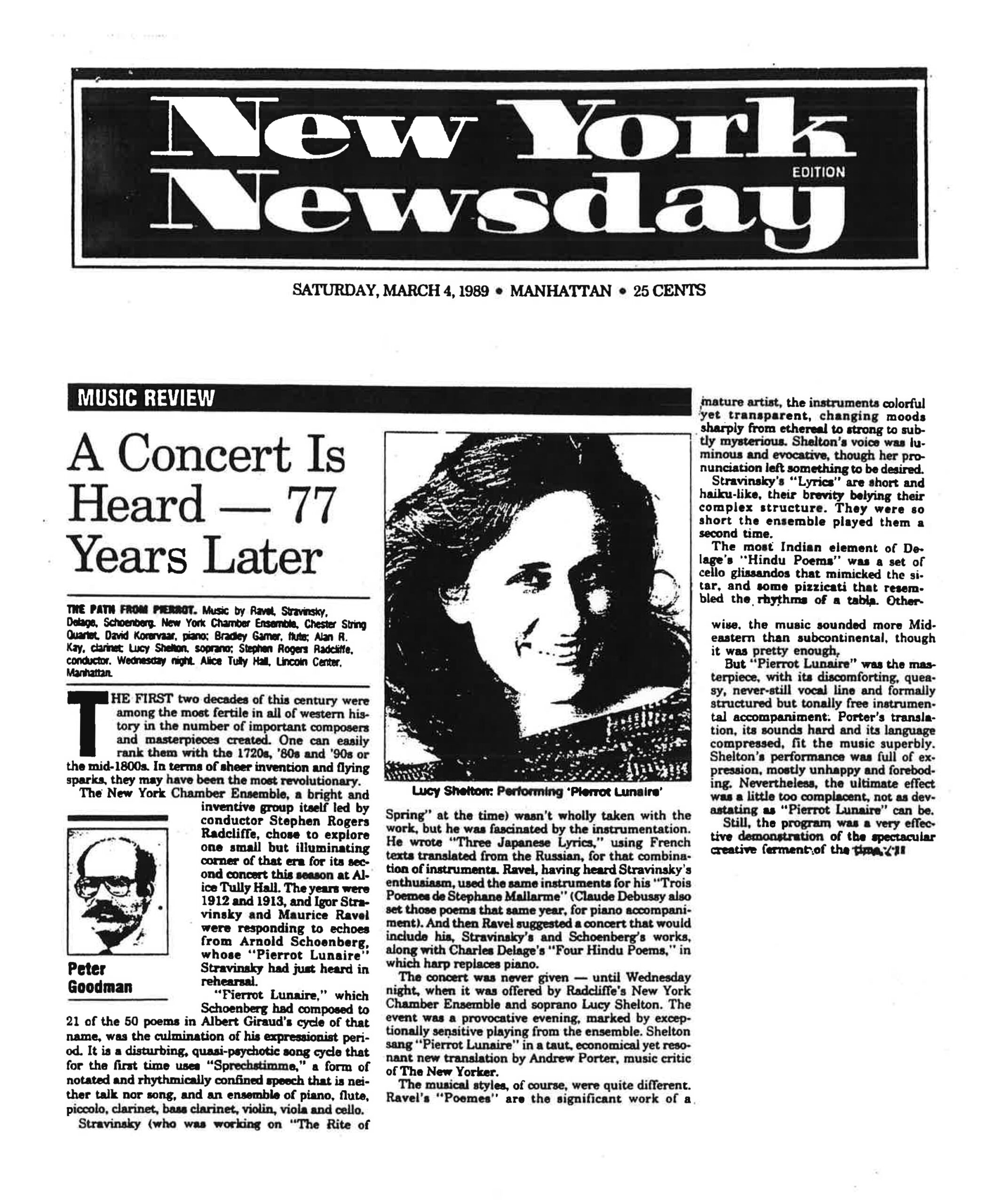
York Newsday: New York Newsday New York EDITION MONDAY, JUNE 4, 1990 • MANHATTAN • 25 CENTS MUSIC REVIEW History As Engaging Theater THE NEW YORK CHAMBER ENSEMBLE. Stephen Rogers Radcliffe, music director. Hindemith: "Hin und Zurück" ("There and Back"); Weill: Mahagonny Songspiel; Milhaud: "The Abduction of Europe"; Ernst Toch: "The Princess and the Pea." Starring: Katherine Johnson, Margaret Bishop, Mark Bleeke, Richard Holmes, Robert Osborne, Nancy Ortez, Michael Brown. Florence Gould Hall, Friday night. By Tim Page THE NEW YORK Chamber Ensemble's Friday night re-creation of a particularly important concert from the 1927 Baden-Baden Festival was not only good, vital history but an engaging evening of music theater as well. Some background information: In the summer of 1927, four young composers — Paul Hindemith, Kurt Weill, Darius Milhaud and Ernst Toch — were invited to write short operas for performance in a small theater, with a limited number of soloists and a chamber ensemble instead of a full orchestra. On July 17 of that year, the four works received their world premiere performances at a festival of music in the German spa town of Baden-Baden; three of these were greeted enthusiastically, while the Weill work provoked wildly mixed reactions and even, if contemporary reports can be believed, some fisticuffs. Still, Weill's "Mahagonny Songspiel," to a text by Bertholt Brecht, was the only one of the four to enter the standard repertory and the central "Alabama Song" may be numbered among the composer's best-known creations. I have little patience for Brecht's shrill, debased representation of humanity but the music in this half-hour is wonderful — lean, tuneful, citric and altogether original. No wonder it caused a fuss. Hindemith's "Hin and Zuruck" — "There and Back" — owes a clear debt to the cinema. It might be described as an operatic palindrome that reaches a certain point in its action and is then run backwards. A husband enters to wish his wife a happy birthday, finds an incriminating love note, shoots her, then jumps out a window. The sequence of events is then reversed: the husband falls back through the window, the wife is restored to life, they quarrel about the love note, he wishes her a happy birthday and departs. Hindemith's score mirrors this chain of events: It is vigorous, virtuosic, richly contrapuntal and — no slight intended — sounds just as good backwards as forwards. In general, the music of Darius Milhaud has not worn the years very well (the same may be said of the other composers in the aggregate of French composers known as "Les Six," but Milhaud, with the most inflated reputation, had the farthest to fall). He now is remembered almost exclusively for his little jazz-age masterpiece, "La Creation du Monde," but the sweet pocket opera (nine minutes) he wrote for Baden-Baden, "The Abduction of Europe," deserves an occasional performance. It is exquisitely made, often very funny (including a chorus of mooing cows), imbued throughout with a sort of pastoral elegance that leads to a vaporous and beautiful finale. Unfortunately, the final opera, Ernst Toch's "The Princess and the Pea," is trite throughout, a succession of melodic, harmonic and theatrical predictabilities. Doubly unfortunately, it was by far the longest opera on the program — some 45 minutes. Still, for the sake of history, it had to be included: The New York Chamber Ensemble gave it a lively reading, and Margaret Bishop made a delightfully pouty princess. Indeed, there was little to fault in the evening's performances. The ensemble playing was synchronous and energetic, and Stephen Rogers Radcliffe's leadership was never less than authoritative. The singers — Mark Bleeke, Richard Holmes, Michael Brown, Robert Osborne, Nancy Ortez and Katherine Johnson — were equally fine; I particularly admired the Lotte Lenya-like mix of sweet and sour that Johnson brought to the Weill work. / II [Caption under photo: Conductor Stephen Rogers Radcliffe]

History As Engaging Theater

New York Newsday Monday, April 9, 1990 Stephen Rogers Radcliffe, Conductor MUSIC REVIEW An Homage to a Teacher AMERICANS IN PARIS: STUDENTS OF NADIA BOULANGER. Music by Aaron Copland, Roy Harris, David Diamond, Ned Rorem. New York Chamber Ensemble (Chester String Quartet, Hexagon), Stephen Rogers Radcliffe, conductor. Friday night. Florence Gould Hall, Alliance Francaise, 55 E. 59 St., Manhattan. By Peter Goodman THE MARK OF the great teacher is her ability to help the pupil be himself, not merely an image of the mentor. Nadia Boulanger was that sort of teacher. Renowned in the American musical world as the French pedagogue around whom gathered generations of aspiring composers from Virgil Thomson to Philip Glass, it is clear that whatever she taught them, she did not force them into her own mold. On Friday night, the New York Chamber Ensemble, an ambitious young group that includes a string quartet, a wind ensemble and other musicians, presented an attractive program devoted to the work of four of Boulanger's students. It was an evening of prima facie evidence that whatever Nadia Boulanger did, she didn't distort the voices of Aaron Copland, Roy Harris, David Diamond or Ned Rorem. Indeed, only Rorem, the youngest of the four composers, could be said to speak in French. The program opened with two works for clarinet, piano and string quartet: Copland's Sextet, a reworking of his "Short Symphony," and Harris' Concerto for Clarinet, Piano and Strings. Their only similarity was the instrumentation. Copland created the Sextet in 1937 after failing to gain performances of the "Short Symphony," completed in 1933. Although written in his artistic rather than populist style, the similarities between the composer's two voices are plain: harmonies of seconds and ninths, electric rhythms, lovely writing for clarinet, bursts of lyricism squeezed between dense blocks of sound. It's the work of a master, and the Chester String Quartet (part of the ensemble) played with an ease that belied all the difficulty musicians found with the work 45 years ago. Harris' concerto is immediately more lyrical and elegiac, with its slow, deep introduction on clarinet and piano, and its long, singing lines. If Copland was a tough city kid, Harris was a singer from the country. The concerto is full of richness, both harmonic and contrapuntal, and a sense of ease not found in Copland. Ultimately, the concerto is too relaxed and doesn't keep the listener involved. The second half included David Diamond's Concerto for Chamber Orchestra, written in 1940, and Ned Rorem's Eleven Studies for Eleven Players. The Diamond was the most awkward piece on the program, straightforward, with square rhythms and steady pulse and a sense of self-conscious seriousness that kept it from coming alive. Only during the two sprightly, dancing fugues did one hear what seemed to be the composer's natural voice. Rorem, of course, has never hidden his natural voice, witty, epigrammatic, cool and lyrical — French. In the Eleven Studies, various combinations of strings, winds, brass and percussion sing, dance, joke or whisper mysteriously, an exquisite platter of aural hors d'oeuvres. The performances were fine, crisp and lively, particularly the playing of trumpeter Stephen Burns, oboist Matthew Dine and pianist David Korevaar. Steven Rogers Radcliffe conducted. The concert, by the way, was part of a series in Florence Gould Hall, an excellent chamber two stories below ground level at the Alliance Francaise on East 59th Street. It's a hall that deserves more activity. / II [Caption under photo: Stephen Rogers Radcliffe conducted the works composed by Nadia Boulanger's students.]

An Homage to a Teacher

The ADVOCATE SERVING THE COMMUNITY SINCE 1829 • STAMFORD, CONNECTICUT • TUESDAY, MARCH 20, 1990 Radcliffe leads young virtuosos By John S. Sweeney Music Critic What is happening to the musical training of today's young people? Truly astonishing things, the Rondo Chamber Orchestra demonstrated Sunday afternoon at the Norwalk Concert Hall. Four virtuosos, none over 15 years of age, conducted by Stephen Radcliffe, already a veteran at 29, made remarkable music together. Radcliffe, who already has made his mark as a youthful conductor to watch, is a native of Greenwich and received his early musical training in the Greenwich public schools. What impressed most on Sunday was not the technical skills of the players, although they were of the highest order, but the real understanding of the music they performed. One would not expect musicians so young to grasp the subtleties of Bach, Haydn or Mozart as fully as did these performers. The youthful artists all played a full-length concerto, thus giving them a complete performing experience and their audience the opportunity to become fully acquainted with their musicianship. A sterling performance of Bach's D minor Concerto for two violins by two pupils of Alfred Markov, founder of Rondo, opened the program. Both 15 years old, Leonard Primak was born in Kiev and Gregory Kalinovsky in Leningrad. Their schooling was of the most solid discipline, with intonation, bowing, and dynamics all first rate. Radcliffe focused his ensemble with knowing craft, conducting with an easy, flowing style that brought rhythmic vitality and dynamic balances into place. Things got even better with Taiwan-born Kenneth Kuo, also 15, in Haydn's C major cello concerto. Kuo played with admirable security, executing the treacherous passages in thumb position with excellent intonation and control of bowing with a focused, well-rounded tone. His understanding of the slow movement, his sense of phrasing, his splendid balance with the orchestra, and the elan of his finale, making no concessions to difficulties, all belied his youth. Radcliffe drew from his orchestra a refined and stylistically impeccable accompaniment. His discerning sense of balance allowed his soloist to play his virtuoso passages without forcing the tone, yet provided solid support when required. Janacek's early work for strings, "Idyll," made an excellent foil on an otherwise baroque and classical program. Radcliffe extracted three contrasting movements from the work, each with an individual Slavic charm. His conducting was simple, technically skillful and idiomatically expressive without any trace of exaggeration or distortion. Alisa Kaplan, an engaging and self-possessed 12-year-old, stole the show with her surprisingly mature performance of Mozart's A major Piano Concerto, K. 414. Struggling with a less-than-perfect Steinway grand, her technical skills were superior and her style absolutely correct. She played her cadenzas with a remarkable understanding of their improvisational nature. Her rhythm never faltered even when, here and there, no doubt because of the jitters, a memory lapse occured. The accompaniment by the orchestra was commendable in its grace and dynamic control. Radcliffe followed his soloist's stylistic intentions with perfect faithfulness. [Photo Caption: STEPHEN R. RADCLIFFE]

Radcliffe leads young virtuosos

Here is the full text from the image: ⸻ The New York Times TUESDAY, DECEMBER 12, 1989 Making Connections of Sight and Sound By BERNARD HOLLAND Friday night’s concert at Florence Gould Hall invited the audience to hear pictures and see sounds. Here the New York Chamber Ensemble offered a series of pieces inspired by paintings, or at least the idea of painting. It asked an interesting question. Is there a single sense of beauty common to all art forms, one that transforms itself to fit the various senses? Or do the ears, the eyes and the nose represent esthetic kingdoms of their own, each with its own language and values, and each with its insuperable walls? On Friday, Morton Feldman’s quintet called “De Kooning” offered homage to one particular artist. Tomlinson Griffes, himself a painter, had “Tone Pictures,” and a cut-and-paste art of Georges Braque and his companions was mirrored by the music of Harry Somers and Ottorino Respighi in “Seven Pollock Paintings,” “Picasso Suite” and “Trittico Botticelliano,” respectively — provided either “sonic analogues” (as the program notes described them) or simply metaphors in sound. Less one might argue that this was an appropriate approach, the composers’ task was to articulate Picasso’s cubism with angular blue period with doleful lyricism, one gaunt dual portrait with dissonant counterpoint. Mr. Bourland’s Jackson Pollock pieces were filled with independent instrumental voices, each wiggling on its own course. “Collage” pieced together different metric fragments. Set against these aural puns were the Griffes pieces, with their gentle, pastoral impressions, and the Feldman, whose tiny murmurs seemed at quite a distance from the busy Willem de Kooning paintings being projected simultaneously. Indeed, sight and sound did not so much meet at this concert as simply stand in amicable proximity to each other. It took a third party to bring them together — a composition’s title or an explanatory program note. Music exists only with help from the outside. Claude Debussy understood this when he gave his piano Preludes evocative pictorial names but then put them at the end of the printed score, not the beginning. The New York Chamber Ensemble consists of the Chester String Quartet and about a dozen other musicians (one group of which calls itself Hexagon). They are deftly directed by Stephen Rogers Radcliffe, who is presumably responsible for this kind of unusual and interesting programming idea. That its premise was untenable made the evening no less interesting. ⸻ They are deftly directed by Stephen Rogers Radcliffe, who is presumably responsible for this kind of unusual and interesting programming idea.

Making Connections of Sight and Sound

Here is the full text as it appears in the image: ⸻ The New York Times NEW YORK, SUNDAY, MARCH 5, 1989 Reviews/Music A Program Built on ‘Pierrot Lunaire’ By MICHAEL KIMMELMAN It is not hard to imagine what so impressed Stravinsky when he heard Schoenberg’s “Pierrot Lunaire” for the first time in the winter of 1912. Three-quarters of a century later, a listener can still be made to feel unsettled by the music’s urgency and strangeness. The group of 21 “songs” (to be rendered in sprechstimme, or a kind of notated speech) is typically described as Expressionistic. But it will not necessarily strike a modern listener that way, at least not if the term is meant to imply a connection with paintings by Nolde or Kandinsky. Certainly in a performance like the one offered by the New York Chamber Ensemble and Lucy Shelton, the soprano, at Alice Tully Hall on Wednesday evening, it was another sense of “Pierrot” that obtained — one conforming more to Schoenberg’s injunction that the musicians sustain a “light, ironical, satirical tone.” The Chester String Quartet and its guests — David Korevaar, pianist, and Bradley Garner and Alan R. Kay performing on several wind instruments — were under the baton of Stephen Rogers Radcliffe. The group placed itself at one side of the stage while Ms. Shelton sang on a platform at the other, giving to both soloist and ensemble an appropriately equal weight. There is something pristine and almost precious about this music, with its distilled and compact episodes. Mr. Radcliffe made his players pay close attention to the composer’s directions for detached notes, exactness of attack and a clarity of instrumental textures, all of which emphasized what a bizarre accompaniment Schoenberg has provided for Albert Giraud’s eerie and ruthless poems. This was a fine, contained performance, even if Ms. Shelton, despite her easy tone and precision at conveying the mood of each piece, failed to project clearly more than a few words of Andrew Porter’s English translation from the German text. “Pierrot” was the evening’s principal offering and its inspiration. The event re-created a program, conceived by Ravel 76 years ago but never realized. Having heard Schoenberg’s piece, Stravinsky composed a haiku-like set of “Three Japanese Lyrics,” utilizing the same configuration of instrumentalists. He spoke about “Pierrot” to Ravel, with whom he was then collaborating on the orchestration of Mussorgsky’s “Kovantchina,” and the Frenchman decided he would also try his hand at writing for a chamber group. “Trois Poèmes de Stéphane Mallarmé” was completed in 1913 and Ravel put forward the idea that it be performed alongside the pieces by Stravinsky and Schoenberg, with the evening rounded out by “Quatre Poèmes Hindous,” a set of songs by Maurice Delage, one of Ravel’s pupils and a friend of Stravinsky. All the works are small, on the scale of Schoenberg’s songs for “Pierrot.” Stravinsky’s are the tiniest gems and they received on Wednesday evening two gentle run-throughs, the second even more playful and full of color than the first. One might have wished for overt sensuousness from Ms. Shelton in the Ravel and, in the Delage, some wonderment when delivering lines describing the birth of Buddha. There may not be quite the same swings of mood in these splendid miniatures as there are in “Pierrot,” but only a performer deploying a wide expressive range can do them full justice.

A Program Built on ‘Pierrot Lunaire’

New York Newsday SATURDAY, MARCH 4, 1989 • MANHATTAN • 25 CENTS MUSIC REVIEW A Concert Is Heard — 77 Years Later THE PATH FROM PIERROT. Music by Ravel, Stravinsky, Delage, Schoenberg. New York Chamber Ensemble, Chester String Quartet, David Korevaar, piano; Bradley Garner, flute; Alan R. Kay, clarinet; Lucy Shelton, soprano; Stephen Rogers Radcliffe, conductor. Wednesday night. Alice Tully Hall, Lincoln Center, Manhattan. By Peter Goodman THE FIRST two decades of this century were among the most fertile in all of western history in the number of important composers and masterpieces created. One can easily rank them with the 1720s, '80s and '90s or the mid-1800s. In terms of sheer invention and flying sparks, they may have been the most revolutionary. The New York Chamber Ensemble, a bright and inventive group itself led by conductor Stephen Rogers Radcliffe, chose to explore one small but illuminating corner of that era for its second concert this season at Alice Tully Hall. The years were 1912 and 1913, and Igor Stravinsky and Maurice Ravel were responding to echoes from Arnold Schoenberg, whose "Pierrot Lunaire" Stravinsky had just heard in rehearsal. "Pierrot Lunaire," which Schoenberg had composed to 21 of the 50 poems in Albert Giraud's cycle of that name, was the culmination of his expressionist period. It is a disturbing, quasi-psychotic song cycle that for the first time uses "Sprechstimme," a form of notated and rhythmically confined speech that is neither talk nor song, and an ensemble of piano, flute, piccolo, clarinet, bass clarinet, violin, viola and cello. Stravinsky (who was working on "The Rite of Spring" at the time) wasn't wholly taken with the work, but he was fascinated by the instrumentation. He wrote "Three Japanese Lyrics," using French texts translated from the Russian, for that combination of instruments. Ravel, having heard Stravinsky's enthusiasm, used the same instruments for his "Trois Poèmes de Stephane Mallarmé" (Claude Debussy also set those poems that same year, for piano accompaniment). And then Ravel suggested a concert that would include his, Stravinsky's and Schoenberg's works, along with Charles Delage's "Four Hindu Poems," in which harp replaces piano. The concert was never given — until Wednesday night, when it was offered by Radcliffe's New York Chamber Ensemble and soprano Lucy Shelton. The event was a provocative evening, marked by exceptionally sensitive playing from the ensemble. Shelton sang "Pierrot Lunaire" in a taut, economical yet resonant new translation by Andrew Porter, music critic of The New Yorker. The musical styles, of course, were quite different. Ravel's "Poèmes" are the significant work of a mature artist, the instruments colorful yet transparent, changing moods sharply from ethereal to strong to subtly mysterious. Shelton's voice was luminous and evocative, though her pronunciation left something to be desired. Stravinsky's "Lyrics" are short and haiku-like, their brevity belying their complex structure. They were so short the ensemble played them a second time. The most Indian element of Delage's "Hindu Poems" was a set of cello glissandos that mimicked the sitar, and some pizzicati that resembled the rhythms of a tabla. Otherwise, the music sounded more Mideastern than subcontinental, though it was pretty enough. But "Pierrot Lunaire" was the masterpiece, with its discomforting, queasy, never-still vocal line and formally structured but tonally free instrumental accompaniment. Porter's translation, its sounds hard and its language compressed, fit the music superbly. Shelton's performance was full of expression, mostly unhappy and foreboding. Nevertheless, the ultimate effect was a little too complacent, not as devastating as "Pierrot Lunaire" can be. Still, the program was a very effective demonstration of the spectacular creative ferment of the time.

A Concert Is Heard — 77 Years Later

Based on the second image provided, here is the retyped article: The New York Times NEW YORK, SUNDAY, JANUARY 17, 1988 Music: ‘Verein Revisited,’ By Chamber Ensemble By JOHN ROCKWELL The New York Chamber Ensemble has undertaken an appealing four-concert series this season at Alice Tully Hall. Entitled "Music of the Verein Revisited," it offers music once heard on the programs of Arnold Schoenberg's Society for Private Musical Performances in Vienna between 1917 and 1921. Schoenberg's society played its part in Modernism's turning inward, away from audiences and, ultimately, from accessibility. Embittered by hostile receptions from the public and the press, Schoenberg offered instead "private" performances designed for connoisseurs, which meant people disposed to like them. Whatever the negative implications of this idea, there can be no doubt that a lot of interesting music was heard, in sympathetic, presumably authoritative performances. But another curious aspect of this chamber society was its refusal to confine itself to chamber music. A regular feature of its programs was chamber reductions of orchestral works, and they provided some of the most interesting moments of Friday's concert. The second half of the program consisted of Hanns Eisler's version for 10 players of Schoenberg's Six Orchestral Songs (Op. 8), of which three were performed. Then came Erwin Stein's reduction of Mahler's Fourth Symphony (billed as complete on the season flyer, but only the fourth movement was played), and finally Eisler's account of the 20-minute first movement of Bruckner's massive Seventh Symphony, no less. One might think, in this age of readily available recordings, that the time for such compressions had passed. But perhaps out of a jaded search for novelty, and perhaps for the light they shed on structure, there has been a lively market in concert and on disk for this sort of transcription, along with Liszt's piano versions of the Beethoven symphonies and similar forms of orchestral "Hausmusik." On Friday, the Mahler, which responded well in Stein's sensitive re-scoring for 12 instrumentalists to the inherently chamber quality of the original, went best of all — in part because the reduced orchestration allowed Dawn Upshaw's positively angelic statement of the vocal part to shine through all the more clearly. The Eisler Bruckner was of considerable interest, as well. It was done at a time when the bowdlerized "revisions" of Bruckner's scores were very much in vogue. Eisler remained faithful to the composer's intentions, neatly translating his music for string quartet, string bass, clarinet, horn, piano and harmonium. This scoring captured a surprising amount of Bruckner's slowly tightening tension, although naturally the sheer sonorous weight of his climaxes could only be hinted at. In compensation, the ingenious shifts from one harmonic realm to another have rarely been heard so translucently. • The Eisler version of the three Schoenberg songs, on the other hand, seemed less persuasive. Miss Upshaw again sang gloriously, but the accompaniment was like toy music. Before the intermission came more delights from Miss Upshaw, with Stravinsky's set of four Russian songs called "Pribaoutki." This was followed by the New York Woodwind Quintet's intense, virtuosic statement of the 35-minute Schoenberg Quintet (Op. 26). Other performers were the Chester String Quartet; Ursula Oppens (piano), Alan Feinberg (harmonium), Alvin Brehm (string bass), Alan R. Kay (clarinet) and Stephen Rogers Radcliffe (conductor). The final two concerts in this series will be on Feb. 6 and April 8, when yet another movement of the Bruckner-Eisler Seventh Symphony — the Scherzo, this time — will be heard.

Music: ‘Verein Revisited,’ By Chamber Ensemble

New York Newsday TUESDAY, SEPT. 15, 1987 Schoenberg’s Thorny Power Demystified MUSIC REVIEW > THE NEW YORK CHAMBER ENSEMBLE Stephen Rogers Radcliffe music director. The New York Woodwind Quintet. The Fine Arts Quartet. Ursula Oppens piano Gwendolyn Mok harmonium Alvin Brehm bass Debussy Hanns Eisler Prelude to the Afternoon of a Faun. Schoenberg Felix Greissle: Four Songs. Schoenberg. "Lied der Waldtaube" from "Gurrelieder." Mahler Philip West Ruckert Lieder. Schoenberg. Kammersymphonie (Op. 9). Alice Tully Hall Saturday night. > By Tim Page "IS THIS WHAT they call new music?" asked the woman in front of me Saturday night at Alice Tully Hall, immediately after a performance of Arnold Schoenberg's "Vier Lieder" (Opus 22), written in 1915. When I replied that it was actually fairly old music by now, she was silent for a moment, then turned again. "And do you really like it?" she asked, a look of befuddlement on her face. Well, yes, I do; very much indeed. But many do not, and Schoenberg's later works are no more popular today than they were 25 years ago. A poll conducted by the Schwann record catalog named Schoenberg the least popular composer in the repertory, and one of the few who inspired genuine antipathy from an audience. The fabled day when the masses would accept and love his music as their own — long promised by Schoenberg's apostles — never came. Yet the music itself shows no sign of losing its thorny, uncompromising power, and I suspect that it will always command a small audience and a great deal of respect. After more than half a century, it still challenges, still sounds "modern," still refuses to soften into easy listening. In 1921, Schoenberg asserted that he had "ensured the supremacy of German music for the next 100 years." It never happened (although who can say what might have come to pass had there never been a war?) and it is entirely possible that Schoenberg will ultimately be regarded as a brilliant eccentric — one of those composers, such as Gesualdo, Berlioz, Sibelius and Varese, who will always stand outside the musical mainstream. Oddly enough, it is now easier to like Schoenberg than it ever was before — not merely because he is no longer endlessly extolled as a stern prophet of sounds to come, but because we have learned to play him. Stephen Rogers Radcliffe, the young American conductor who led the New York Chamber Ensemble Saturday night, understands Schoenberg with rare acuity. Throughout the program, he emphasized the composer's ties to the past: One heard the influence of Brahms, Mahler, even Johann Strauss in his music, and the dissonances were incorporated into a continuum, rather than pounced upon savagely. Jan DeGaetani, the mezzo-soprano in the "Vier Lieder" (adapted for chamber ensemble by Felix Greissle) and the early "Lied der Waldtraube" from "Gurrelieder" is not so secure in the upper register as she once was, but she remains a warm, dignified, emotive and intelligent interpreter. The program — which was based on the Viennese evenings Schoenberg presided over between 1917 and 1921, under the auspices of the Society for Private Musical Performances — also included a new arrangement of Mahler's "Ruckert Lieder" by Philip West. Expertly and idiomatically fashioned, it sounded like an extraction from a quieter portion of one of Mahler's symphonies. The evening began with Hanns Eisler's reduction of Debussy's "Prelude to the Afternoon of a Faun" for a remarkably full-sounding ensemble of 11 instruments. / II

Schoenberg’s Thorny Power Demystified

The New York Times NEW YORK, MONDAY, SEPTEMBER 14, 1987 Music: Verein Revisited, With Jan DeGaetani By MICHAEL KIMMELMAN In 1918, Schoenberg founded the Verein für Musikalisch Privataufführungen, a society devoted to the presentation of contemporary music from Mahler and Strauss onward. Admission to the society’s concerts was by subscription only; critics were not invited, and rehearsal time was ample. Berg, Webern and other composers active after the First World War belonged to the society, which became one of Austria’s most distinguished cultural institutions until its demise in 1923. The society employed pianists and then chamber ensembles for its concerts, so among the central occupations of members became the transcription of orchestral scores for smaller forces. Dozens of works were rearranged, sometimes by the composers themselves. Saturday evening’s engaging program at Alice Tully Hall by the New York Chamber Ensemble was the first in a series of concerts entitled “Music of the Verein Revisited.” The performing ensemble, which incorporated the Fine Arts Quartet, the New York Woodwind Quintet and a handful of others, played works by Debussy, Schoenberg and Mahler. Stephen Rogers Radcliffe conducted, and the mezzo-soprano Jan DeGaetani was soloist. Debussy’s “Prelude to the Afternoon of a Faun,” transcribed by Hanns Eisler, opened the program. Performed by 11 players, including the pianist Ursula Oppens, the work sounded less plush and colorful than usual, with the winds gaining even more prominence and the strings receding into the background. Still, the benefits of hearing a piece such as this stripped to the bone became apparent: textures were clear and there was no blanket of sound covering up the musical machinery. Miss DeGaetani next rendered three sets of songs: Schoenberg’s “Vier Lieder” (Op. 22), arranged by Felix Greissle; Schoenberg’s “Gurre-Lieder,” arranged by the composer; and Mahler’s “Rückert Lieder,” transcribed by Philip West. Again, the music was on a scale that drew the listener to it and allowed small details to gain prominence. It also suited the temperament of the evening’s soloist, who did not have to battle large numbers of instrumentalists to make herself heard. Throughout, Miss DeGaetani offered performances of exactitude, purity and elegance. Words meant something to Ms. DeGaetani; tones were struck clearly and precisely. She created an atmosphere of rapt concentration, and she sang in beautifully constructed, carefully measured phrases. In particular, the final lines of Mahler’s “Ich Bin der Welt Abhanden Gekommen” were spun out in silken tones. Mr. Radcliffe served ably as partner without drawing from his players quite the same level of refinement. His best work of the evening came during an unusually spirited and thoughtful version of Schoenberg’s “Kammersymphonie” (Op. 9), which closed the program. Future performances in the four-concert Verein series by the New York Chamber Ensemble are scheduled for Jan. 15, Feb. 6 and April 8 at Alice Tully Hall.

Music: Verein Revisited, With Jan DeGaetani

Importance Of The Custom Company Logo Design

Lorem ipsum dolor sit amet, consectetur adipisicing elit, sed eiusmod tempor incididunt ut labore et dolore magna aliqua.
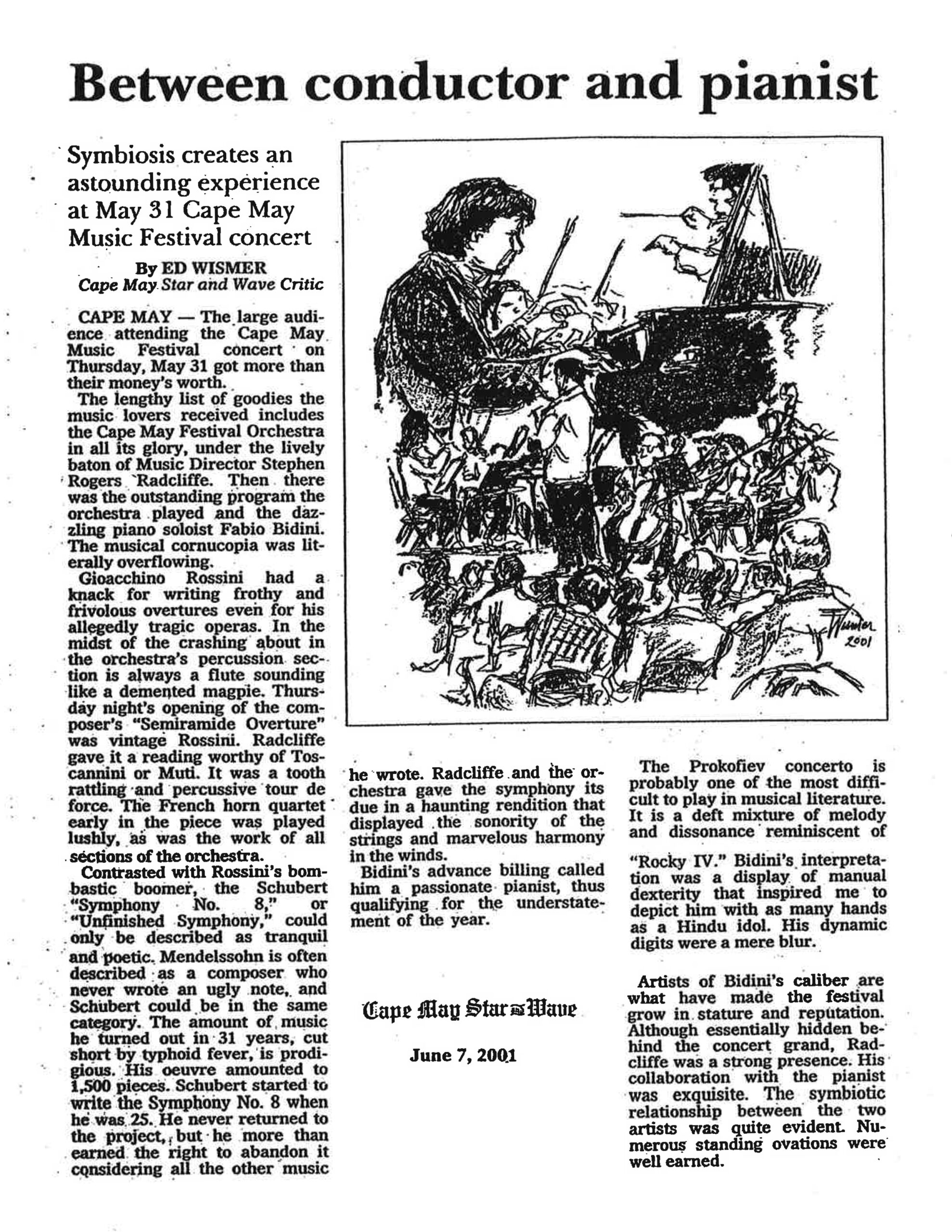

×